





























Herbaceous Clematis with purple and mauve flowers: our top 5
Shrubs covered in flowers
Contents
Clematis, graceful and varied, are highly appreciated by gardeners. Among them, the herbaceous Clematis species commonly form shrubs, as perennials, and sometimes only short climbers. The cultivars with purple and mauve flowers offer rich colours and unfold into a floral display from spring to autumn. We present a selection of herbaceous Clematis whose shades range from deep violet to delicate mauve. These plants, ideal for gardens of all sizes, balconies and terraces, are renowned for their abundant flowering and create a visual impact with relatively little maintenance.

Clematis - Clematis Saphyra 'Estrella'
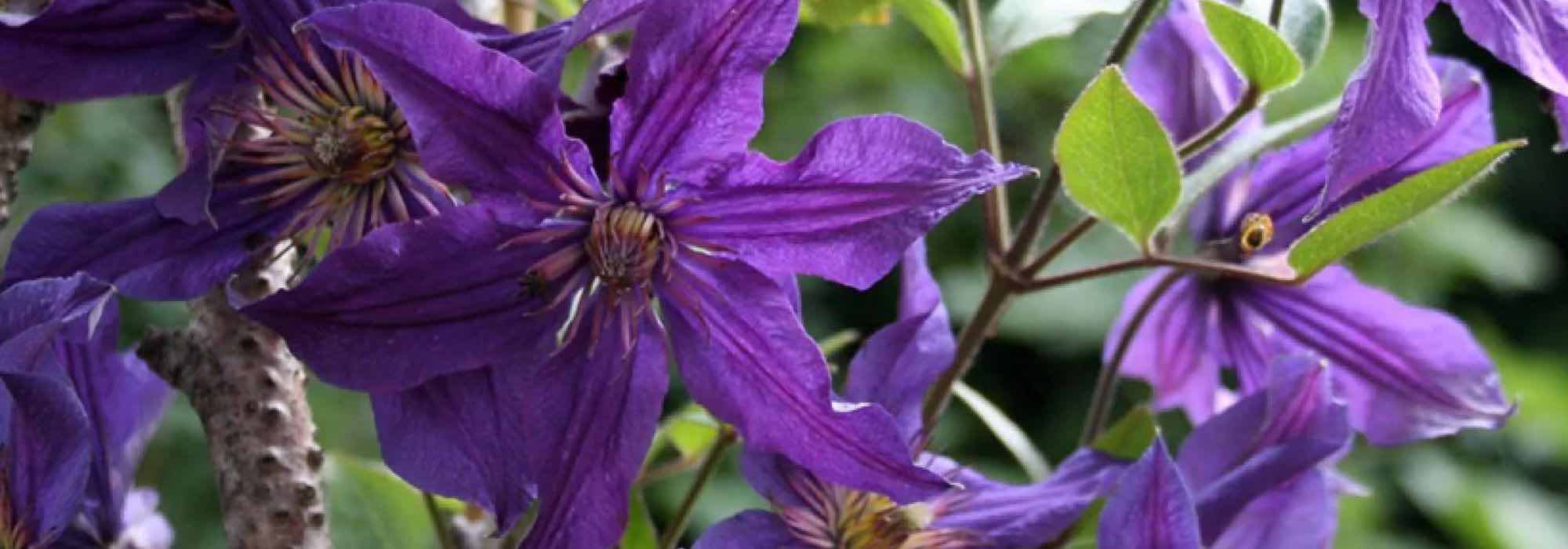
The clematis Saphyra ‘Estrella’ is the fruit of INRA’s work. It adds a compact and robust variety to the Saphyra series known for its hardiness and disease resistance. Small in size with a shrub-like habit rather than climbing, this clematis is perfect for small gardens as well as to ornament terraces and patios. Its abundant flowering extends from spring to summer, purple flowers with narrow sepals that evoke large stars. These then give way to silky decorative fruits persisting long into the season.
Saphyra ‘Estrella’ originates from the species Clematis integrifolia and belongs to varieties that flower on new growth of the current year. With a semi-woody growth, it reaches about one metre in height and spreads over a square metre. In spring, numerous stems emerge from the base, bearing flowers 8 cm in diameter, in a vibrant purple with a yellow-centred heart of stamens that gradually turn to white. Its deciduous leaves are dark green, three-palmate leaves with irregularly cut margins.
Herbaceous clematis offer a wide range of colours, shapes and sizes, and add a romantic and bohemian touch to any garden. Saphyra ‘Estrella’ brightens walls all summer and can be used as groundcover in a shrub border, accompanied by landscape roses and other shrubs such as the escallonias, deutzias or spiraeas. Of modest size, it is also suitable for container growing, whether on a balcony or near an entrance.
Read also
Clematis: planting, pruning and careClematis - Clematis integrifolia 'Miranda'
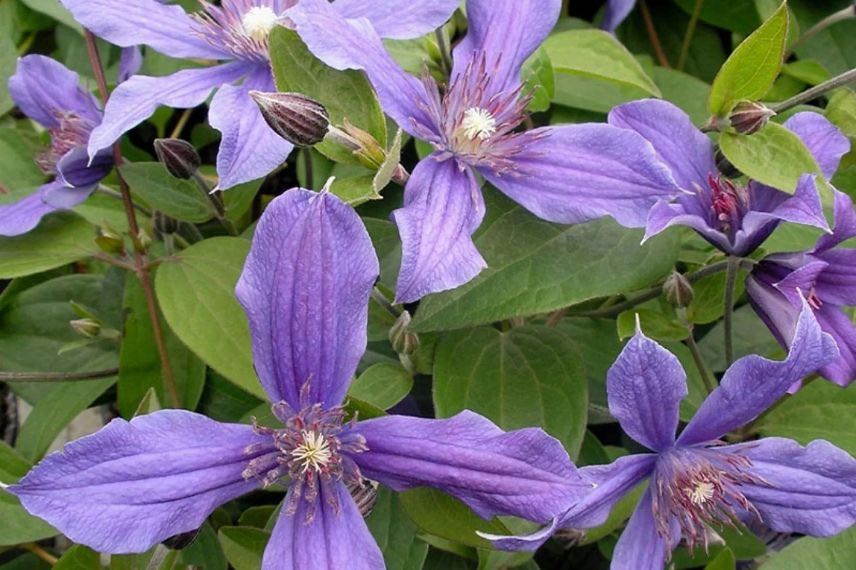
The Clematis integrifolia ‘Miranda’ is a vigorous climbing perennial bearing an abundant, colourful flowering throughout the summer. Its large star-shaped flowers, in a deep blue-violet, feature a heart of stamens that are almost white. This plant is perfect for dressing a wall or a trellis, blending into the greenery of a shrub, or for decorating a terrace in pots.
This clematis is a British hybrid raised from seed sown in 1994. With its long, leafy stems, ‘Miranda’ can reach two metres in height and cover a square metre. From spring, new shoots emerge from its base, bearing glossy green leaves that are oval to elliptical. The flowering, which lasts from June to September, requires cool, moist soil to optimise flowering. These measure 10 cm across and consist of 4 to 6 leaf-shaped petals and very pale stamens. After flowering, feathery, silvery fruits add decorative interest late in the season.
Pair Clematis integrifolia ‘Miranda’ with rambling roses to conceal their often bare feet and extend the flowering period. It also lends itself very well to container cultivation on a balcony or in the ground to brighten a bank, accompanied by perennial sweet pea seeds, variegated ivy, small-flowered periwinkles, creating a most enchanting plant display.
Clematis - Clematis Saphyra 'Violetta'
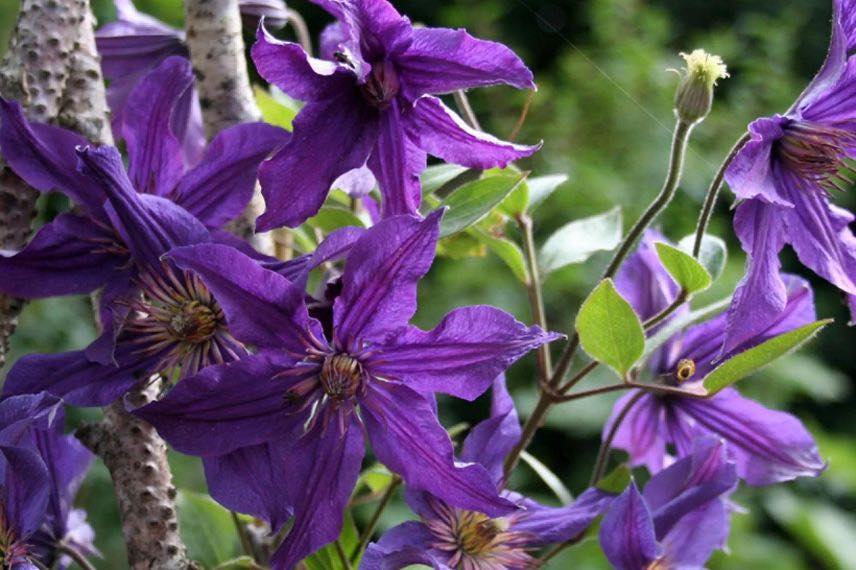
Another Clematis from the excellent Saphyra® series, ‘Violetta’ is a remarkable cultivar, with an upright, compact habit and large flowers of an intense velvety violet, darker than those of the Saphyra® varieties ‘Estrella’ or ‘Indigo’. Flowering generously throughout the summer, it loses all its foliage in winter, then re-emerges in spring with an abundance of leafy stems arising from the stump. Its compact growth and accommodating character make it an ideal choice for pot culture and small gardens, but also as a companion for perennials and low shrubs.
Also originating from the robust herbaceous Clematis integrifolia, native to southern Europe, ‘Violetta’ is a herbaceous perennial, only slightly climbing, forming a bushy tuft that does not exceed one metre in height with a spread of 70 cm. It establishes deeply, ensuring vigorous growth in the years ahead. In spring, it produces numerous stems bearing leaves ovate to elliptical in olive-green. From June to September, it offers abundant flowering with star-shaped flowers 10–12 cm in diameter, with deep velvety purple petals, marked by similar veins and surrounding pink stamens.
‘Violetta’ adapts well to diverse soils and climates, and is drought-tolerant once established, without being susceptible to disease. It is perfectly suited for a pot on a balcony or integrated into garden displays with abelias and dwarf lilacs, for example.
Clematis jouiniana 'Robert Brydon'
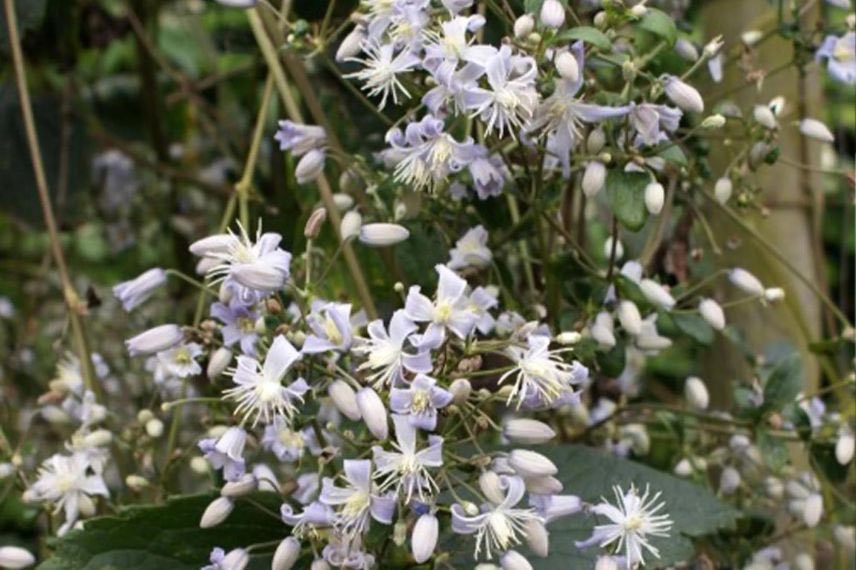
The Clematis jouiniana ‘Robert Brydon’ forms a perennial plant with non-climbing growth, perfectly suited for use as a groundcover. This variety boasts small pale mauve and white flowers that cover the foliage from July to September. With a height of 1.5 m, it develops a dense carpet of flowers with reflexed and tubular petals, measuring around 4 cm in diameter. The deciduous leaves of this clematis are glossy and dark green, divided into three leaflets 3–8 cm long, borne on sturdy stems. After flowering, it produces seedheads adorned with a feathery, silver-grey style, adding notable decorative appeal.
This clematis thrives in a clay-siliceous soil, deep and well-aerated, requiring a sunny position with the base shaded from direct light. It is notable for its ability to cover the base on its own, which helps to maintain the moisture required for its development. It is important to watch for aphid infestations that can affect the plant.
It can be paired with other clematis species or with climbing roses to provide base shade. It also makes a striking display in perennial and annual borders, with love-in-a-mist seeds and euphorbias, for example.
Clematis - Clematis integrifolia 'Blue River'
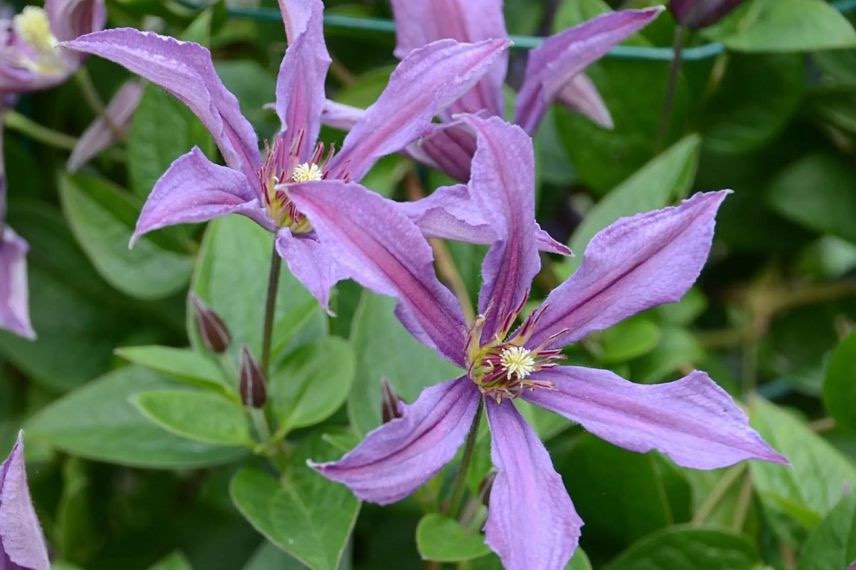
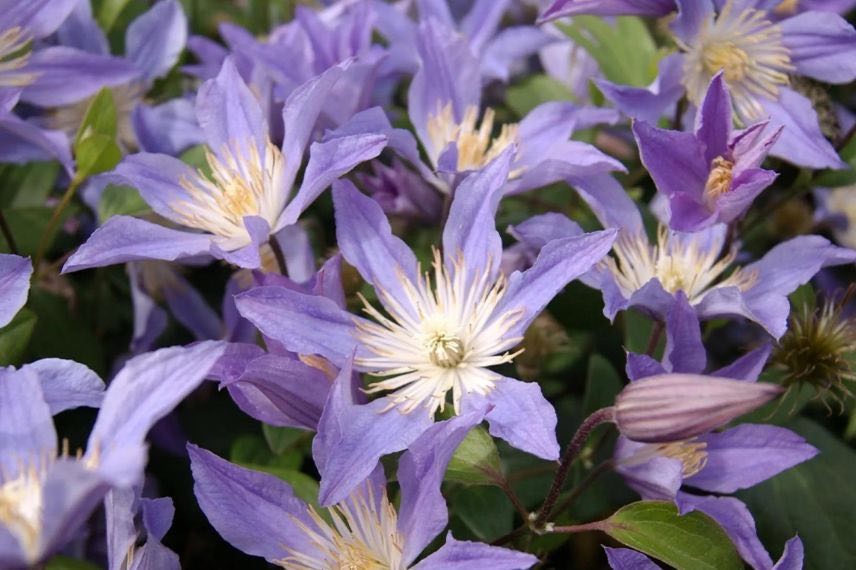
More mauve than blue, the clematis ‘Blue River’, with modest growth, produces a profusion of bell-shaped flowers in the form of bells, which open into stars of a blue-purple or fairly deep mauve shade, adorned with an elegant bouquet of cream stamens. This variety forms a lush clump and flowers throughout the summer season, but remains relatively little-known and underutilised in our gardens. In winter, like many perennials, it loses all above-ground vegetation, but remains a hardy and perennial plant that thrives for years, in pots as well as in the ground.
This clematis, not a strong climber, can reach 1 to 1.5 m in height and width when grown in the ground. It can be trained against a support or left to sprawl. Although slow to establish, once rooted it shows vigorous growth and may become moderately suckering with time. In spring, the leafy shoots bear leaves that are oval to elliptical, mid-green and slightly glossy. From June to September, campanulate flowers emerge abundantly along the stems, and they open almost flat to reach 6 cm in diameter.
Clematis ‘Blue River’ prefers sunny locations without exposure to intense heat. Its herbaceous habit makes it particularly suitable for pot culture on a balcony or terrace, or as part of a border with gauras and campanulas, for example. Its flowering stems are also perfect for creating romantic or country-style bouquets.
For further reading
It isn’t always easy to classify herbaceous clematis into a mauve colour category rather than blue, or the other way around, especially since depending on the light and the time of day these hues can appear differently. We’re flirting with nuances. Do also take a look at our selection of herbaceous clematis with blue flowers, notably the following species and varieties:
- Subscribe!
- Contents
Comments