


How to calculate the volume of plant pot?
Our practical tips for working out how many bags of potting compost to buy
Contents
When you decide to pot a houseplant, a green plant, or outdoor plants on your terrace, it is essential to determine precisely how much potting compost is required. Adequate supply of potting compost ensures the health and optimal growth of your plants. This article guides you through the steps to calculate precisely the amount of potting compost needed, taking into account the different shapes and sizes of pots.
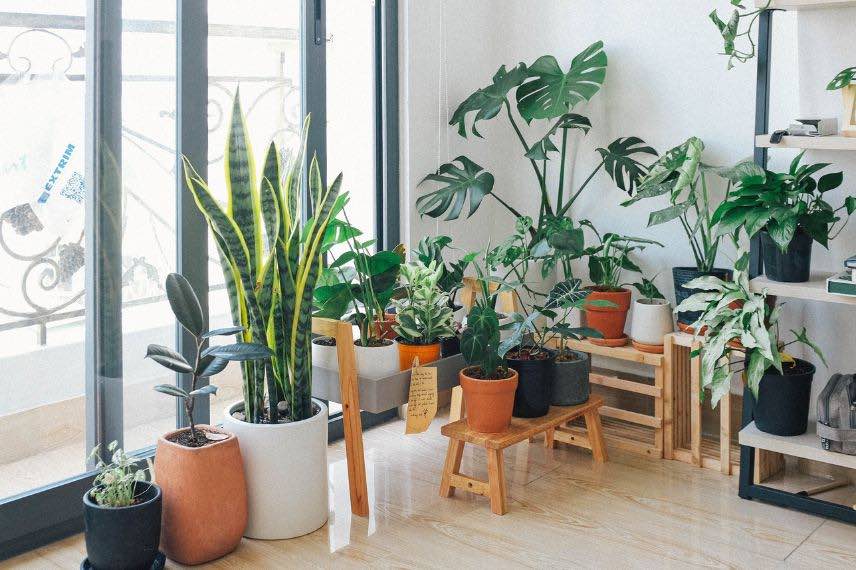
Calculate the different pot volumes for your indoor plants, so you don’t end up with bags of potting compost you won’t use
Why calculate how much potting mix you need?
The potting compost provides an essential nutrient-rich medium for plants, promoting their growth and flowering. Determining the exact amount of potting compost needed for each pot is important in order to know how many bags of potting compost to buy, especially when undertaking several plantings at once or to avoid unnecessarily storing bags of potting compost. A bag of potting compost that is opened dries out, pests can harbour in it, and it does not have an unlimited shelf life. It can be difficult to know how much potting compost is needed to fill a pot, so calculating the volume is therefore important.
Understanding volume measurements
Before calculating the amount of potting compost required, it is important to understand the different volume measures used, such as litres, cubic centimetres and cubic dimensions.
Potting compost bags available on the market often indicate their volume in litres. However, pots are generally measured in centimetres for their diameter and height. To reconcile these measures, it is useful to remember that one litre is equal to one cubic decimetre (dm³). Consequently, 1 litre is equivalent to 1 dm³ and 1 dm³ equals 1000 cubic centimetres.
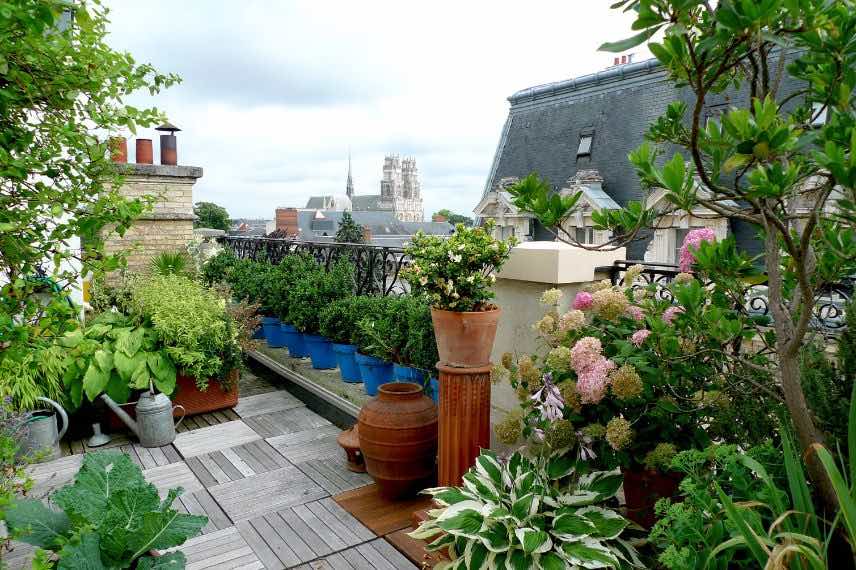
Calculate the volumes of all your pots on the terrace
Pot volume calculation
There are different pot shapes. To measure a pot’s dimensions accurately, use a flexible measuring tape for the diameter and a ruler for the height. Take measurements from the pot’s widest point if the shape is not uniform. Make sure you measure from edge to edge to obtain reliable results.
- Cylindrical pot
Volume of a cylindrical pot can be calculated using the formula: V = π × r² × h, where π (pi) is about 3.14, r is the pot’s radius and h is the pot’s height.
Par exemple, if you have a cylindrical pot with a diameter of 20 cm, which corresponds to a radius of 10 cm (the radius is equal to the diameter divided by 2) and a height of 30 cm: V = 3.14 × (10 cm)² × 30 cm = 9,420 cm³ = 9.42 litres. You will need 10 L of potting compost.
- Square or rectangular pots
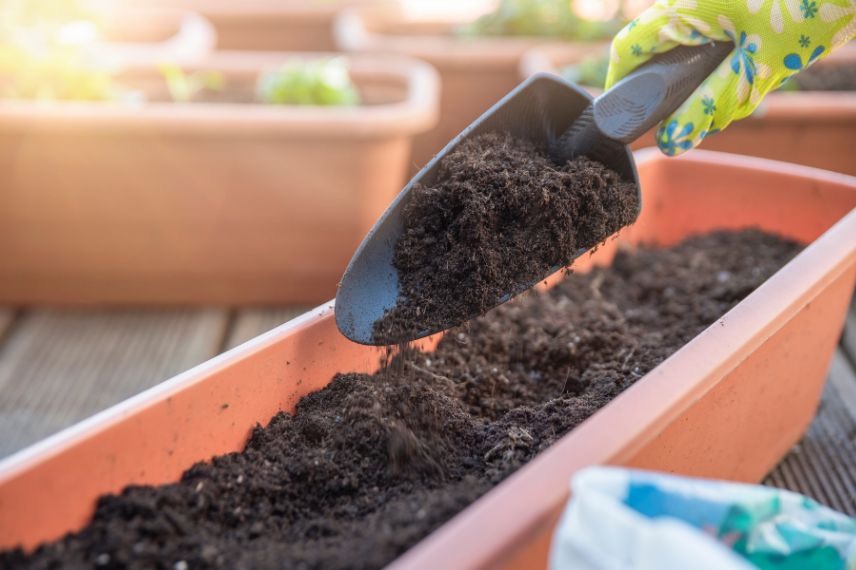
For square or rectangular pots, volume is simply calculated by multiplying the length, width and height of the pot: V = length × width × height.
For example, a square pot with a 25 cm side and a height of 25 cm: V = 25 cm × 25 cm × 25 cm = 15,625 cm³ = 15.625 litres. You will need 16 L of potting compost to fill this pot.
- Conical or pyramidal pots
Conical or pyramidal pots present extra complexity due to their shape. A simplified method is to calculate the average of the upper and lower diameters, then use this value to calculate the volume as for a cylindrical pot. This provides a reasonably close approximation of the volume.
Here’s how to proceed with a concrete example: suppose you have a conical pot with a height of 40 cm, an upper diameter of 30 cm and a lower diameter of 20 cm.
- Calculating the mean of the diameters: Calculate the mean of the pot’s upper and lower diameters. Mean diameter = (Upper diameter + Lower diameter) divided by 2. Mean diameter = (30 cm + 20 cm) / 2 = 25 cm.
- Calculating approximate volume: Now you have the mean diameter, you can use the cylindrical pot volume formula to obtain an approximation of the conical pot’s volume. Use the formula seen above. V = π × r² × h, where r is the radius (half of the mean diameter) and h is the pot’s height.
- Approximate volume = π × (radius)² × height. Approximate volume = 3.14 × (12.5 cm)² × 40 cm = 19,625 cm³.
Rounded to two decimals, the conical pot’s volume is approximately 19,625 cm³. This equates to about 19.63 litres. You will need 20 L of potting compost to fill this pot. Although this simplified method does not give the exact volume of the conical pot, it provides a close estimate that can be used to determine the amount of potting compost required.
Practical tips
Once the exact volume has been calculated, here are some extra tips to optimise your calculations:
- Allow for a little extra potting compost : Always add a small excess of potting compost to the calculated amount to account for settling around the roots.
- Optimising potting compost use : To improve drainage of the substrate, add gravel or expanded clay pellets to the bottom of the pot. This promotes better air circulation and prevents excessive water buildup, which is particularly important for potted plants.
Determining the precise amount of potting compost needed for your potted plants is essential to ensure their health and optimal growth. By understanding the volume measurements, using the appropriate formulas for different pot types, and following tips for precise measurement, you will be able to provide your plants with the ideal environment to thrive. Keep in mind that careful preparation, allowing for a little extra potting compost and optimising drainage, greatly contributes to the success of your indoor plants, your houseplants and your potted plants on the patio.
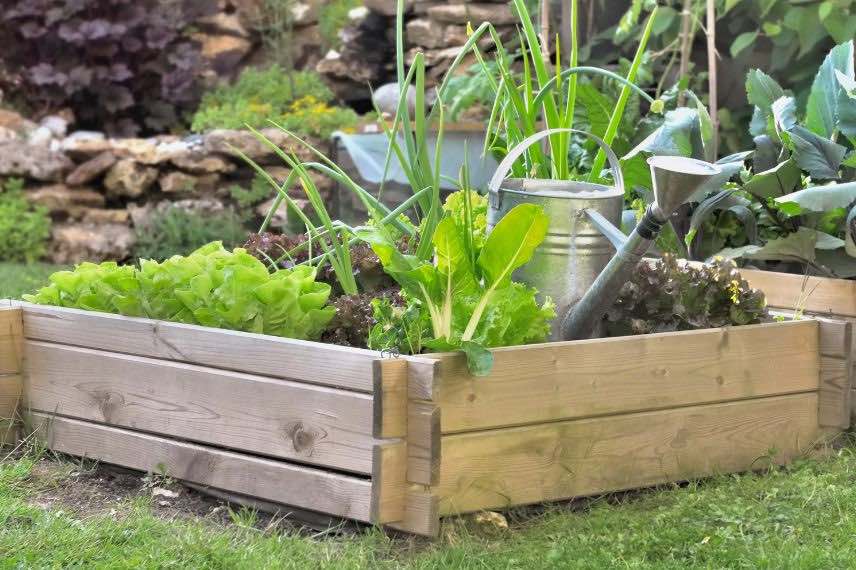
This also allows you to calculate the volume of your square vegetable beds
- Subscribe!
- Contents

Comments