






























How do you create a living wall on a balcony?
A comprehensive guide to vertical gardening
Contents
Do you live in the city and only have a balcony as outdoor space? Yet the call of nature tugs at you. Could the vertical garden be the solution for enjoying a small patch of greenery where you can recharge? This compact vertical garden can easily dress the wall of your balcony, beautifying it by concealing the concrete, while contributing, on a small scale, to biodiversity returning to urban areas. The vertical garden, indeed, offers numerous benefits for your well-being, as well as for the aesthetics of your home and for the environment. Let’s explore together the various techniques for creating a vertical wall on a balcony, from the simplest to the most elaborate, the plants to be planted, and its maintenance

Are you allowed to create a living wall on your balcony?
Of course, if you live in a detached house, you’re free to do what you like on your balcony, as it is private space attached to your home. That said, it may be prudent to consult your commune’s Local Urban Plan (PLU) to check that a particular clause does not prohibit the creation of a living wall, even on a balcony. I grant you, it’s rare, as towns would generally tend to encourage this kind of installation for ecological reasons.
By contrast, if you live in a co-ownership property, you must consult the co-ownership rules that set out your rights and duties. These rules may legitimately stipulate that vegetation on a façade, even on a balcony, is not authorised. Indeed, the fitting out and decoration of a balcony are governed by these rules. Primarily for aesthetic and safety reasons. And you must comply with them.

The installation of a living wall on a balcony must be carried out in accordance with the co-ownership regulations.
Let us now consider the final scenario: you are a tenant and you wish to vegetate the wall of your balcony. It is advisable to obtain authorisation from your landlord or letting agent before embarking on any alterations. And do not hesitate to put any agreement reached with the owner or landlord in writing.
Finally, you must absolutely consider the weight of this living wall. Keep to modest dimensions for suspended or cantilevered balconies. For a recessed balcony, weight is not an issue.
The benefits of a living wall on a balcony
Greening a balcony is, above all, about the desire to beautify an outdoor space where everyone enjoys reading, sipping a drink or simply relaxing. Nevertheless, beyond pure aesthetics, a living wall offers many other benefits:
- It’s a private little patch of greenery that contributes to mental and physical wellbeing. Indeed, greenery is soothing and relaxing, and a living wall helps recreate that important connection with nature, often hard to find in urban environments.
- A living wall will contribute, admittedly on a small scale, to reducing atmospheric pollution in your small space. Indeed, the plants planted on this vertical garden will absorb CO2 and release oxygen, thereby purifying the surrounding air. It’s a way of paying back the carbon debt of cities.
- This vertical garden on your balcony will help create a micro-ecosystem where beneficial insects can settle, butterflies that could in turn attract birds… The living wall is therefore useful for maintaining biodiversity in the city.
- A living wall can be an excellent thermal and acoustic insulator. Plants reduce temperature fluctuations inside the home and dampen noise.
- This green space on your balcony creates a cooling microclimate. Indeed, the living wall naturally increases ambient humidity and thus reduces the sensation of heat in summer.
- It can also help you hide an overly intrusive view by screening external sightlines.
- Compared with installing pots and planters, the living wall represents a real space saver.
How to create a living wall on a balcony?
To turn your balcony into a little green paradise, there are several ways to create a living wall, from the simplest to the most elaborate, and inevitably more difficult to install and maintain.
The easiest to install is the modular living wall kit, made up of modules ready to position and to combine on a suitable support. Practical, but relatively expensive. There are also vertically stacked planter systems that allow a more modular and economical living wall. Finally, it is fairly simple to create a vertical garden thanks to trellises on which climbing plants will grow. To get your balcony vegetated more quickly, it is always feasible to install this trellis on a synthetic lawn laid on the wall.
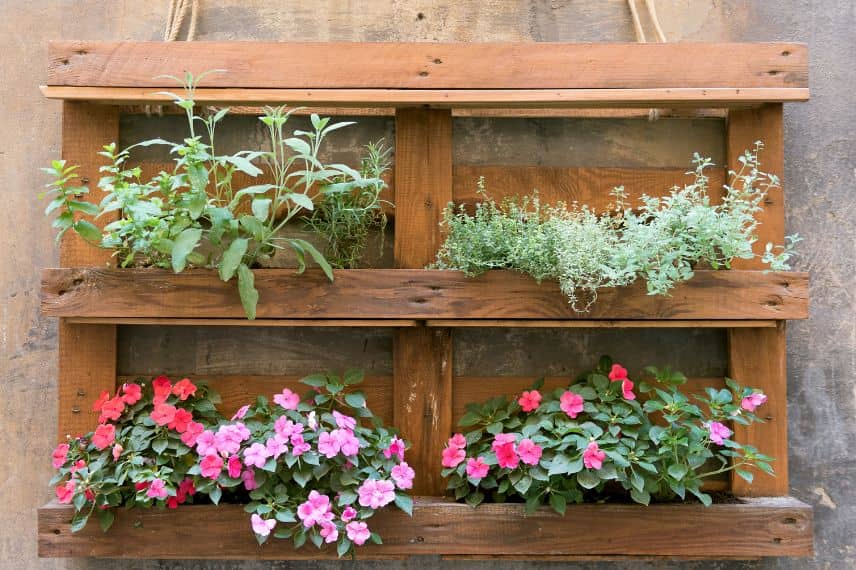
A palette can become a lovely vertical support for plants
If you prefer DIY, the pallet solution is ideal. It is enough to obtain a European pallet and to procure a plastic sheeting (or a sheet of plywood) for the back and a geotextile fabric to dress the pallet. A little potting compost and the job is done:
To obtain a truly aesthetic and natural living wall, simply procure wooden battens, boards and horticultural felt. And Patricia explains how to create this living wall at a low cost and without being a professional handyman. For everything you need to know, I invite you to read her article: How to create an outdoor living wall?
If you have welding know‑how, it may be wise to build the frame of the living wall from galvanised steel, for example with reinforcing bars.
That said, it is essential to leave at least a 1–2 cm gap between the balcony wall and your structure to ensure good ventilation of the backing and to prevent damp.
How to green your balcony?
Plant choice obviously depends on several factors: exposure (full sun, partial shade, or shade?), the climate in your region and the time you have for maintenance. But it is always wiser to select evergreen perennials with evergreen foliage and not frost-hardy. Then you can treat yourself by mixing flowering plants, aromatic herbs, and melliferous plants… These plants should also be easy to grow in a small amount of substrate and heat-tolerant if your balcony faces south.
Discover our selection of a few plants easy to integrate into a living wall on a balcony:
-
- Perennial plants with green or coloured foliage: Heucheras, Hostas, ferns…
- Very heat-tolerant succulent plants: Houseleeks, Saxifrages, Sedums, Echeverias…
- Flowering perennials: Ajuga reptans, Wall bells (Campanula poscharskyana), Rome’s Ruin, Delosperma, Phlox, l‘Aubrieta…
- Groundcover plants: Dichondra reptans, the turquette…
- Aromatic herbs: Thyme, the Indian mint…
- Small grasses: some varieties of Carex or fescue.
 An idea of a living wall composition with Heuchera, Hosta, Indian mint and for the flowers Aubrieta and wall bells</caption]
How to maintain this living wall?
Maintaining a living wall on a balcony involves several essential steps that help plants develop in good conditions. Without disturbing neighbours!
Watering the living wall
Depending on the plants, watering must be more or less regular. Thus, succulent plants will need little water, perennial plants a little more. Therefore, the watering system may vary depending on the plantings. Several options are possible:
- Manual watering with a long-spouted watering can from the top of the living wall
- Watering via misting with a spray bottle
- Installing a micro-perforated hose or a drip irrigation system, connected to a pump that draws water from a reservoir. This device can be easily hidden behind a bush with dense foliage. The ollas can also be a very interesting solution for a living wall, both aesthetically pleasing and practical. It is enough to choose small ollas suitable for the size of the living wall
It is essential that all of these watering systems respect neighbours’ peace by not flooding their own balcony.
Plant care
The various plants growing in a living wall installed on a balcony should benefit from a few basic care measures. To begin with, regular removal of faded flowers or dry or damaged leaves. Some may require a light pruning to limit their growth. Likewise, a few adventive weeds can creep in between the plants; they should be removed regularly.
Fertilisation
The plants you have planted grow in a limited growing medium and in a constrained environment. That’s why it is essential to provide them with liquid fertilisers, tailored to the plants’ needs, at least once a month to nourish them. Only succulent plants can do without them. This fertiliser will simply be added to the watering water.
After a few years, the plants will become exhausted and die. So about 10% of the plants should be replaced each year.
Monitoring
Your living wall must be monitored with the utmost care, as a disease or pest can quickly take hold. The slightest yellowing or leaf drop should not be taken lightly. Similarly, aphids and mealybugs can quickly become very troublesome.
- Subscribe!
- Contents
Comments