






























Contemporary garden design: our ideas and tips
Our planting tips and design ideas
Contents
Simplicity, clean lines, high-quality materials, a pared-back design and vegetation carefully selected for its shapes and colours: the contemporary garden is an economical design that relies on stylistic effects and is distinguished by its generously open spaces.
Discover all the codes of the modern garden, with our tips and ideas to create a garden that is at once very modern, elegant and harmonious.

The fundamentals of contemporary gardening
The spirit
A contemporary garden is defined by restricted plantings, tending toward minimalism with a focus on purity. This garden style rests on sobriety and simplicity, or even stripped-back austerity in the plantings and materials. It has undergone several influences, from Japanese gardens to American gardens. Colour unity also takes precedence, and these spaces often feature monochrome gardens, with foliage taking pride of place. We also prioritise the repetition of motifs and often spectacular visuals which give coherence and a very elegant approach, with often one or two strong ideas in sight: an included tree on a terrace, a “graphic landmark” plant, a raised planting bed, a sculpture or XXL objects, a stylised water feature. Finally, this is a garden where the lawn is either prominently featured and clearly defined, or almost absent. We actually aim to intimately connect the interior spaces of the house to the outdoor spaces, true extensions of the home, designed as a new living space. The contemporary garden even sometimes leans toward a conceptual or eclectic gardens.
Lines and shapes
They are straight, horizontal, and often asymmetrical. Whether in the shape of the beds, in hedge planting, of a terrace, or the laying of pavings, we rely on parallel and oblique lines, generally straight, even if a circle or a large curve may appear. The horizontal surfaces provide movement through their interlockings with one another or with the plantings. The various spaces are defined by these geometric shapes, and the zones are separated, for example, by raised beds or rectilinear screens of vegetation that punctuate the stone pathways. The perspective will always be bolder than that of the traditional garden. Finally, the contemporary garden likes to bring together and contrast low-lying and tall plant forms to create spectacular effects.
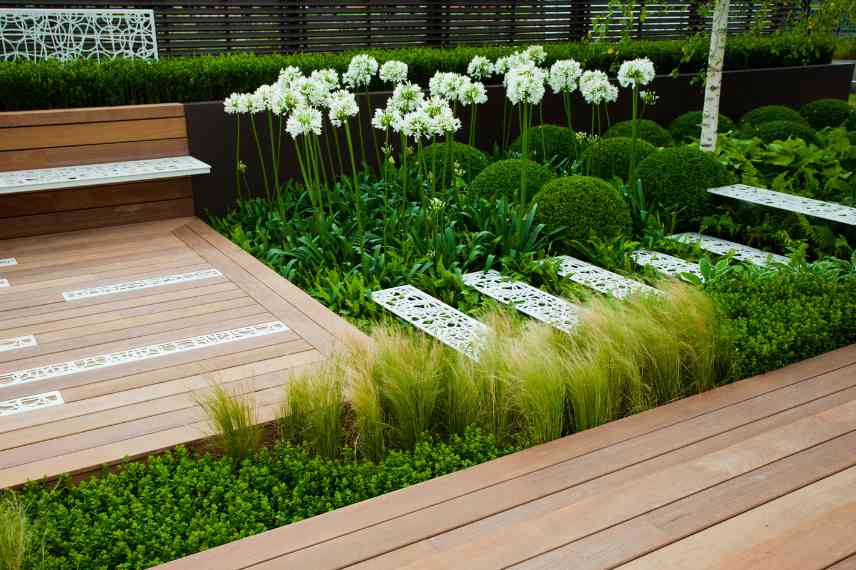
Purity is expressed in the plantings, in the materials and in the lines
Colours
In the contemporary garden, colour tends to be used on foliage and structures. If colours are introduced, it is usually in monochrome mode. The white garden is thus often used for a contemporary garden, as it responds softly to the darker colours of materials often used for this type of garden. But one can also create a two-colour garden (white and blue, mauve and purple, white and yellow), provided one sticks to one or two main colours.
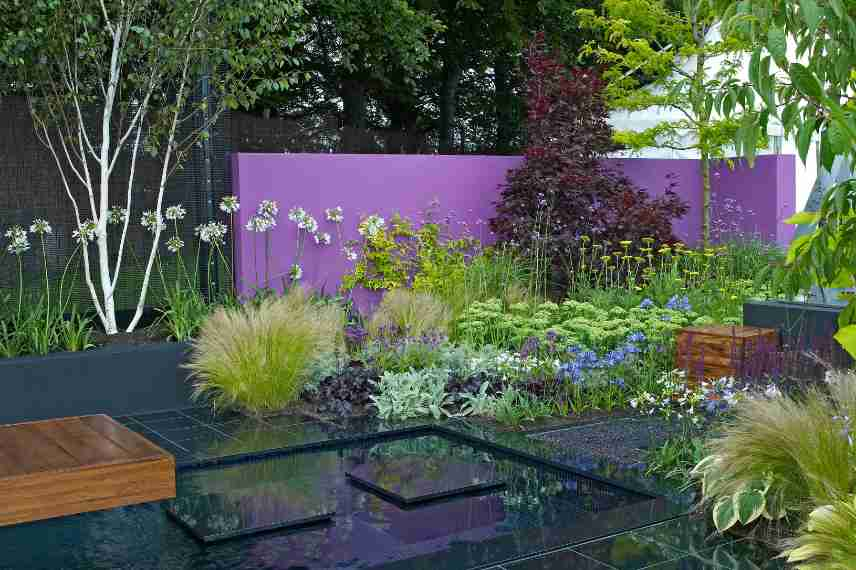
The modern garden uses few colours, but, as here, can be applied to a wall for a striking effect
The planting approach
It often follows a principle of planting in mass, and is arranged geometrically or linearly to create very visual effects. The idea of repeating a motif is a landscaping trick to punctuate and pace the different spaces. Sculptural specimens, few in number, will usually be planted in isolation.
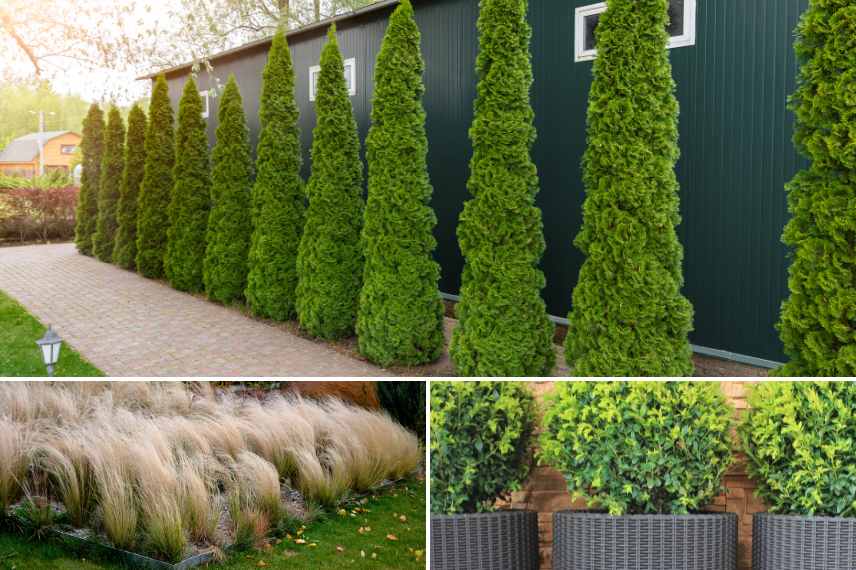
Aligned, in mass, or in threes in planters: motif effects are to be prioritised, with pathways to the terrace
Read also
Designing a city gardenThe ideal garden for contemporary design
Many gardens can opt for a design-led, contemporary style! It could be a rectangular garden, a square garden, an small garden or an urban garden, easier to treat as a whole in this distinctive style. A long garden can certainly accommodate this constraint (space shortage, layout challenges…) to become an asset in the unconventional architecture of the modernist garden. A patio or enclosed garden also lends itself readily to the play of contemporary styling.
Very large gardens, by contrast, are not necessarily suited to this garden style, which retains its character in smaller spaces. Note that roof terrace can also adopt this style, with suitable plants. One can choose a style with an exotic tilt or a more classic look; the important thing is to base it on lines and ground-plan shapes that stay broadly straight. Shade garden or full-sun garden, there are plants for all sun exposures.
Contemporary gardens are sometimes found on a coastal garden design where they benefit from the easy planting of graphic and evergreen plants, but they can also be realised as a dry garden where the emphasis is placed on grasses and succulent plants.
Obviously, a contemporary garden enhances an architect-designed house or a modernist building, harmonising with the purity of their lines.
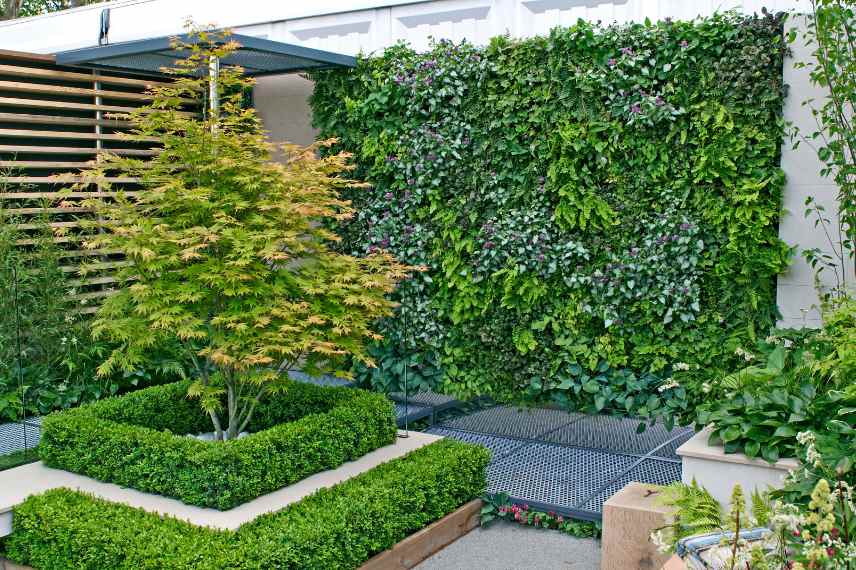
Here is a small urban garden, transformed by the highlighting of a Japanese maple, outlined by boxwood borders, and horizontal lines echoing the verticals of the green wall and a latticed screen in exotic wood
Plant palette for the contemporary garden
We prefer to use predominantly evergreen plants in a modern garden for the structure and lasting presence they provide, which we aim to establish year-round here. They will be mixed with other types of plants and lighter flowering displays. As explained above, it is important to select only a few plants and repeat them throughout the garden. We list in this article a number of ideal plants, but this list is far from exhaustive. Although hard landscaping plays a privileged role in contemporary designs, greenery should not be a poor relation, and it undergoes rigorous selection.
Several options are available, and it is worth drawing on the various assets of the plants below:
Graphic impact
Graphic plants are indispensable to the contemporary garden for their visual impact: elongated leaves of a very extended form or sword-shaped, or leaves with texture or original shapes. Among them are several evergreen plants, with an exotic look and sometimes frost-prone, but not only, alongside the rich range of conifers!
Here you will find Yucca, non-prickly Mahonias with fern-like leaves, Cordyline and Phormium, Astelias, Dianella, bamboos, horsetails, great Melianthus, Cycas, Muehlenbeckia, Agaves, tree ferns, Ginkgo, as well as original varieties in each genus such as Fatsia, the Fatsia polycarpa…
Among the suitable conifers are all the pines, including the original Pinus sylvestris ‘Fastigiata’ or the dwarf pines, the Chamaecyparis, the Juniperus, some of these conifers are readily grown on a trunk. And why not take advantage of the verticality of the cypress or the yew? Discover our ideas in How to integrate cypresses into a contemporary garden?
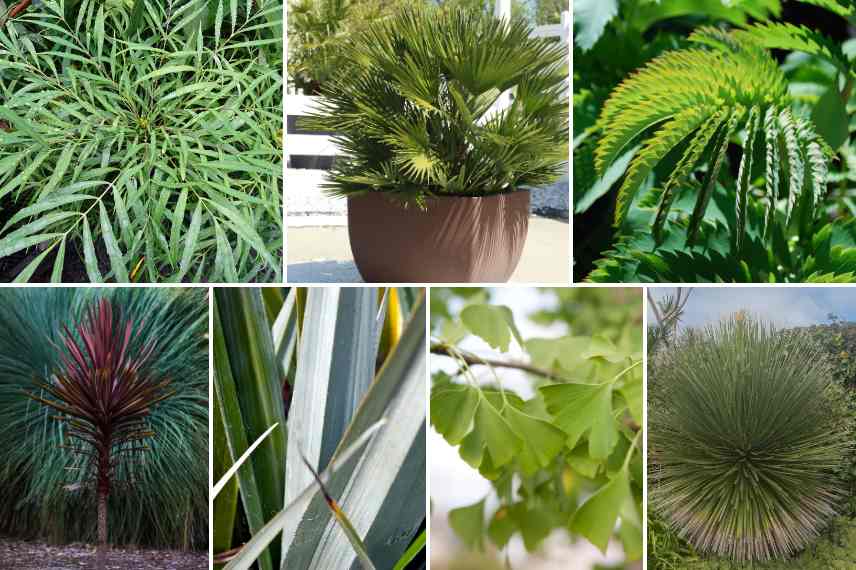
Mahonia ‘Soft Caress’, Chamaerops humilis in a pot, Melianthus major, Cordyline purple, Astelia, Ginkgo and Dasylirion acrotichum
Originality
Also think about weeping forms or twisted shapes for a single garden subject that can take the role of focal plant: Morus alba ‘Pendulum’, Cercidiphyllum japonicum ‘Pendulum’, Robinia pseudoacacia ‘Twisty Baby’, Japanese maples with a trailing silhouette for semi-shaded gardens (notably species from the genus ‘Dissectum’): they are very well suited to small and medium gardens treated as contemporary gardens. An olive tree is always an interesting choice for the décor it provides on its own. Do not forget also shrubs whose winterly branching reveals a strong graphic presence: birches, Poncirus trifoliata, snake-bark maples, as well as the unusual barks of eucalypts whose bluish foliage suits contemporary gardens beautifully.
Dark colours in some perennials or shrubs bring a real asset to the contemporary garden, and allow contrast: Panicum virgatum ‘Blue Darkness’, Ophiopogon, Pittosporum purpureum, Cordylines, among others.
Verticality
Upright plants bring a strong verticality in line with the contemporary spirit. These are either trees and shrubs with a straight or columnar habit, or shrubs trained on a stem (privet, laurustinus or bay laurel, Euonymus), or flexible plants such as grasses chosen for their regal habit, or finally tall flowering displays atop their stems. Not to forget climbers, which, with minimal pruning, provide a unique drawing on walls or fences, and contrast with the horizontality of the terrace areas.
♥ Our favourites: the Cypress genus, notably the Italian Cypress, the very original Euonymus spindle-tree ‘Benkomasaki’, a few Pseudopanax, horsetails and bamboos. In flowering plants: the impressive Canary Islands viper’s bugloss in mild climates, foxgloves, Eremurus, some alliums such as the Allium giganteum, Allium giganteum, ‘Red Mohican’ or ‘Gladiator’, and the large Eucomis (Eucomis pole-evansii), the fritillaries of Persia, not forgetting the Aconites (A. napellus or A. pubiceps), which one would be mistaken to confine to an English garden. Among climbers: the rigidity of star jasmine makes a marvellous show, the originality of an Aristolochia, or the broad foliage of a kiwifruit on which to climb, for instance.
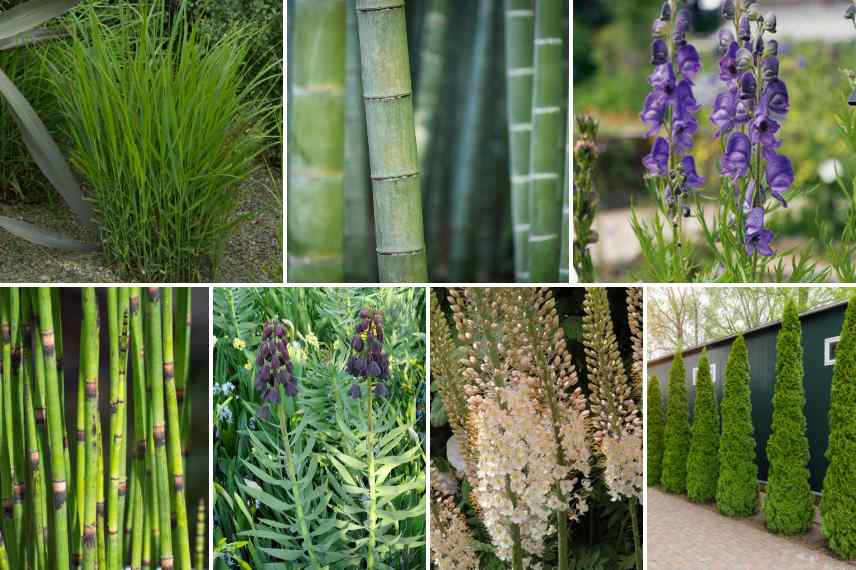
Panicum virgatum ‘Hanse Herms’, bamboos, Aconite, horsetail (Equisetum hyemale), Persian fritillary, Eremurus robustus and Cupressus macrocarpa ‘Goldcrest’
Topiary or pruning forms
Topiary or pruning shapes: evergreen plants pruned into spheres or cubes, or even spirals; shrubs pruned into curtains or trained against a screen often seen in classical gardens, the topiary, the niwaki, this cloud-pruning art native to Japanese gardens, can also be used in a contemporary style : they bring a strong modernity and originality, which is exactly what we aim to create. Evergreen shrubs, holm oak (Ilex sp.), boxwood (and its alternatives), and bay laurel lend themselves well, but also pyracantha, Lonicera shrubs, and in the deciduous or marcescent category the hornbeams, or of course pears and apples!
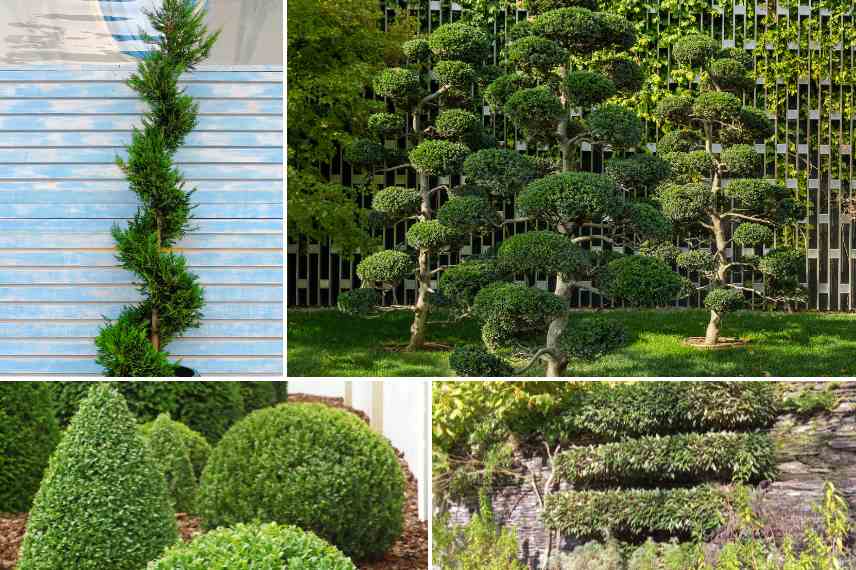
Ilex crenata, Cupressus macrocarpa ‘Goldcrest’, boxwood and Laurus nobilis (bay laurel) trained as a screen (photo Gwenaëlle Authier)
Grasses
Grasses have been essential in landscape art for several years, grasses bring lightness and movement to the contemporary garden, indispensable for softening lines and spaces. Positive point: they can also be grown in pots, with the taller ones on the terrace, and they come in almost all shades of green, up to coppery tones.
Structural plants par excellence, tall grasses emphasise the graphic quality of a space. Others, with a more pliant habit, give a very natural, wilder look depending on the species used, while others, such as low fescues, rhythmically define plant strata. Their combination or not with perennials, ferns, shrubs makes a real hit in the modern garden.
♥ Our favourites: all the Miscanthus and Pennisetums, the Chasmanthium for the originality of their seedheads, the Muhlenbergia and the Panicums erect, or cushion-forming grasses such as Hakonechloa (Japanese grasses), and Carex for shadier zones.
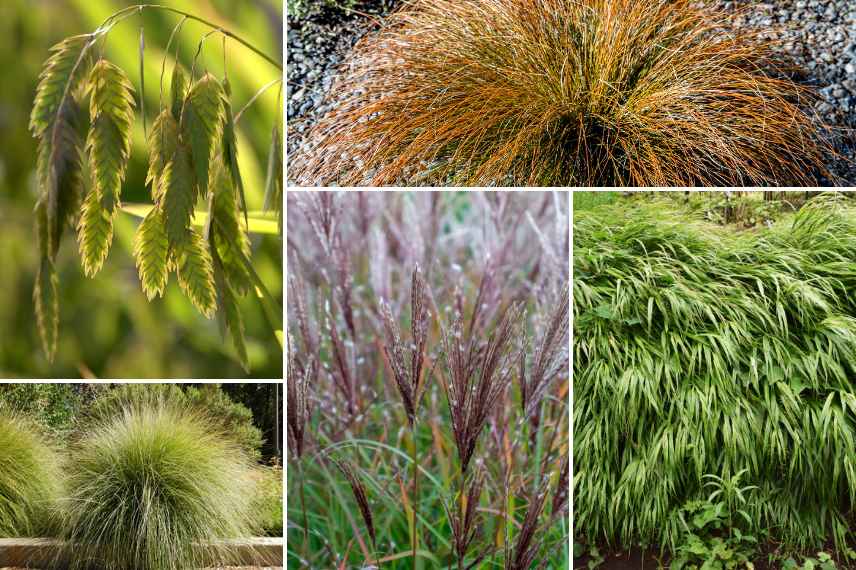
Chasmanthium latifolium, Carex testacea, Muhlenbergia rigens, Miscanthus sinensis et Hakonechloa macra
Plants that naturally form a cushion habit are also to be exploited, as they ensure forms that are spontaneously structured in the garden: Hebe (shrubby veronicas), some dwarf Pittosporums, heathers or white Azaleas, etc.
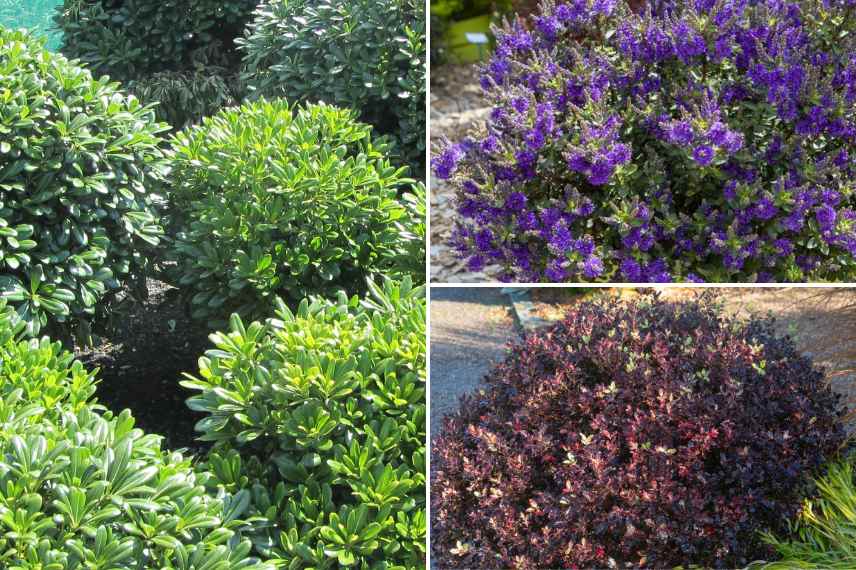
Pittosporum tobira ‘Nanum’, Hebe ‘Claret Crush’ et Pittosporum tenuifolium ‘Tom Thumb’
→ Also read 10 graphic plants, perfect for modern gardens, 7 trees with striking foliage and form, shrubs with graphic foliage and habit, Perennials that tolerate drought and heat for a contemporary garden, Which plants for a contemporary balcony? and feathery inflorescences.
Design tips: harmonies, materials, furniture and décor
For décor, we again favour restraint, avoid the superfluous, but not fall into austerity, aiming above all for an overall coherence of style.
Balance and harmony of plant life in the contemporary garden
- Lawn: The advantage of a contemporary garden is that mowing is facilitated by its pure, linear design. It is sometimes absent, but it generally carries more or less importance in large swathes depending on the garden. It should be planned in advance for a substantial area, or even prioritised according to usage.
- Flowering: they provide support, but the garden is essentially structured by shrubs and foliage. Vary the types of inflorescences rather than overload with colours by choosing appropriate perennial plants. For example Eremurus, Allium, Arum, Eryngium and white hydrangeas, which may include a few blue or mauve varieties.
- Choose only a few plants, unique and architectural, to create subtle green tones or contrasts of form (airy and austere).
- Prefer plants with grey or silvery foliage, perfect for a contemporary ambience due to their refinement.
- Treat the whole garden in this style: restraint will be reinforced. Only in a large garden, a Japanese-inspired area can be integrated as a sub-section to create surprise.
Hard elements
- The terrace is particularly refined and considered in a contemporary layout: it is often large and can even extend onto the ground if one desires minimal maintenance and prefers oversized pots. Wooden decking is possible, sometimes only forming sleek, design-led pergolas.
- Landscape masonry: it plays a significant role in creating the contemporary garden by adding modernity to its shapes. Its importance is evident in terrace creation, walls or screens, benches, blocks to accommodate the massifs, for example, up to the borders that strongly shape the garden’s design. The plan should therefore be considered early for this type of garden.
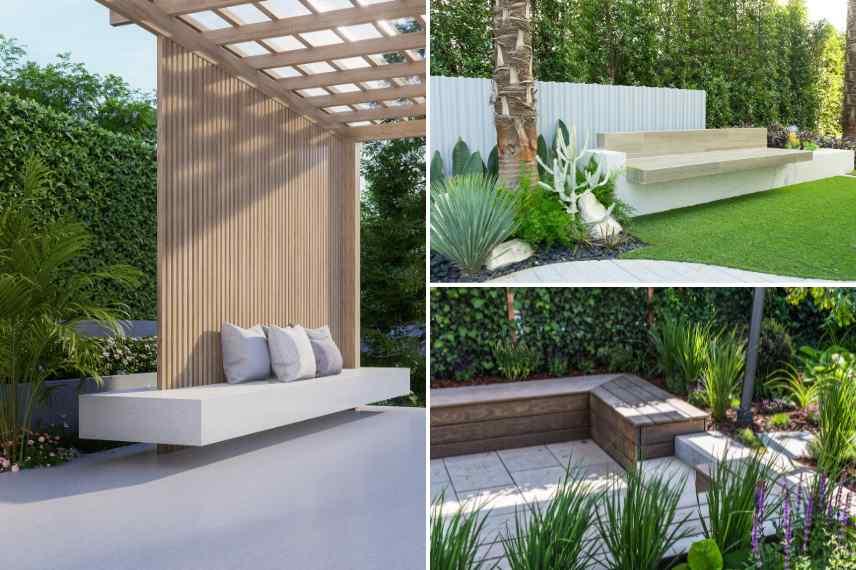
Benches, made of concrete or wood, are one of the defining features of the contemporary garden
- Hard landscaping: it plays an important role in a design garden, but the key is not to overdo it. Beware of landscapers who push gravel for the front entrance… seen too often and not particularly ornamental. Also beware of decorative black-and-white pebbles, often recommended by the same landscapers, which do not look their best in a pared-back garden and often come at the expense of creativity in plant selection and garden planning.
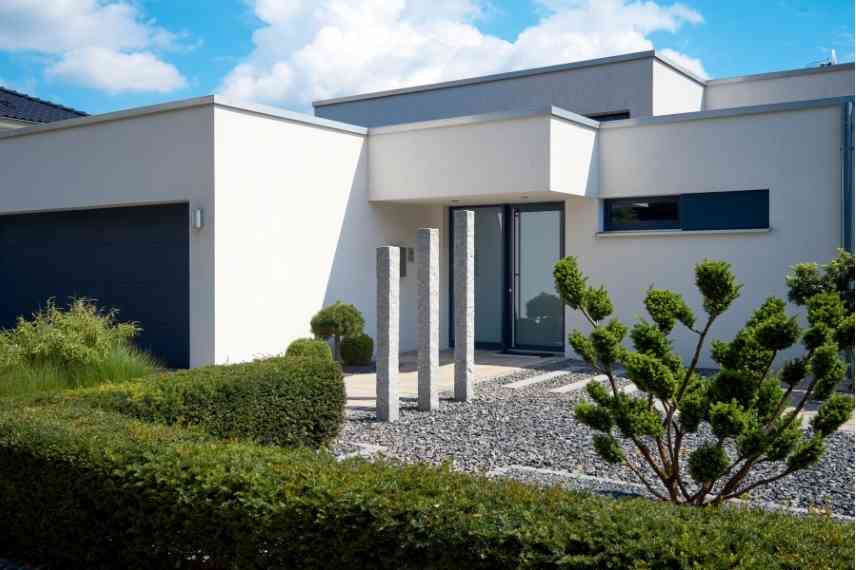
Gravel being very present here isn’t everyone’s cup of tea, but it fits the sober architecture of the built form here
- Use of colour: black and its variants (anthracite) are often sought in contemporary layouts. As with modern building window openings, it strengthens and unites the different built elements of the garden. The black colour should be echoed throughout the garden or coordinated with the concrete, a neutral material. Conversely, one can employ a vivid hue in blocks of colour on walls or screens, ideally in harmony with the main colour chosen for the flowering displays (most often blue, mauve, terracotta or red), as in the example below.
Materials and furniture
- Materials: metal, zinc, corten steel, slate are noble materials that pair perfectly with the contemporary garden. Concrete, porcelain stoneware, wood, if used on a terrace or as a pergola, are common. Groundworks favour the use of large slabs.
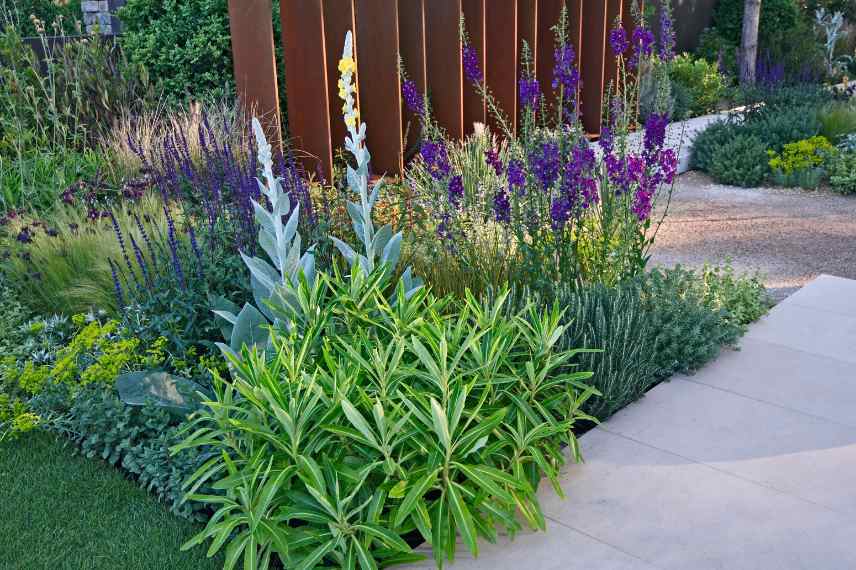 Subtle and very elegant alliance of Corten steel and a light-coloured paving
-
- Garden furniture: design; seating is also chosen in neutral or muted tones: black to anthracite, taupe or pearl grey, greige or white, and in weather-resistant materials: fibreglass seats, polypropylene, composite materials such as resin-woven. Wood can also be considered, provided it stays in very contemporary shapes as shown below. Pergolas are chosen for their design appeal, cube-shaped, in wood or metal. Benches are built to be fully integrated into the project, either raised or merging with the planting.
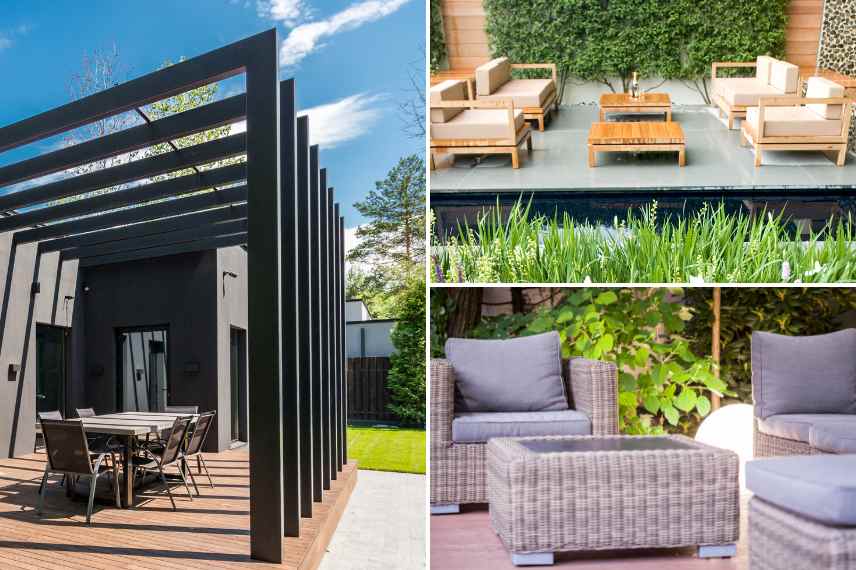
The furniture further enhances the garden’s style.
Decorative elements
- Pots, planters and troughs: often tall or oversized, they allow room for impressive flora or a fine shrub. Lightweight synthetic materials such as resin, earth fibre or fibre cement come in well-suited colours. Large square or oval tubs make a striking impression, always planned to create repetitions (x2 or x4 to frame an entrance or a path, or isolated as x3, x5).
- Objects and sculptures: without overdoing it and depending on the garden size, one, two or three quirky objects can enter this contemporary setting: large granite spheres, giant corten steel oculus, sculptures, gabions… They provide the finishing touch. Organic or abstract shapes can be integrated in polished stone, metal or wood.
- Lighting: it enhances the spaces after dark. It should be discreet, highlighting surfaces and a striking specimen in isolation. Lanterns are possible, but again chosen in a pared-back way or spotlights integrated into the pathways. Read also Solar energy in the garden.
- Water may feature via a pool, a reflecting pool or a basin. In modern villas, an overflow pool and water features that emerge at the surface contribute fully to the contemporary décor.
[caption id="attachment_282753" align="aligncenter" width="856"]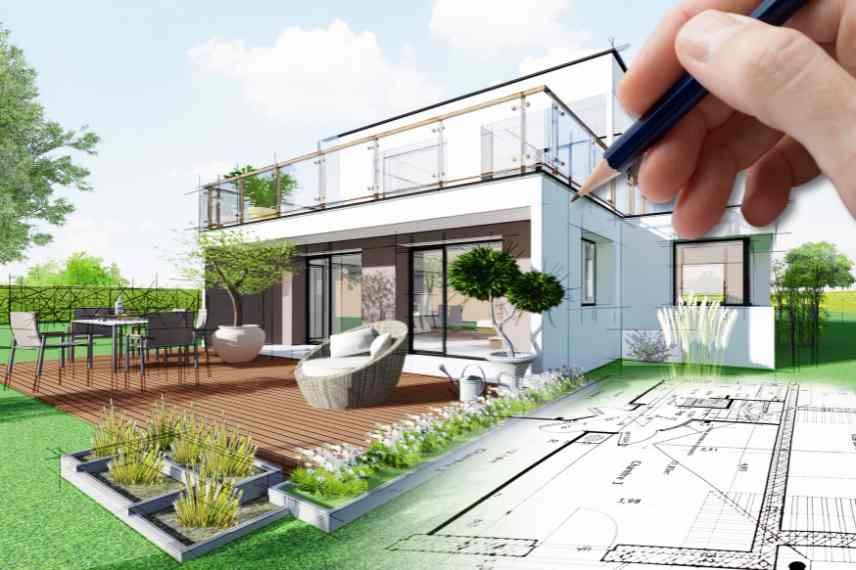 The plan will be essential to delimiting spaces
→ Read also 5 planting tips for a graphic and modern garden and How to design a graphic and modern garden?
- Subscribe!
- Contents
Comments