





























How to design a naturalistic garden?
Our tips and ideas for creating a wild and natural garden
Contents
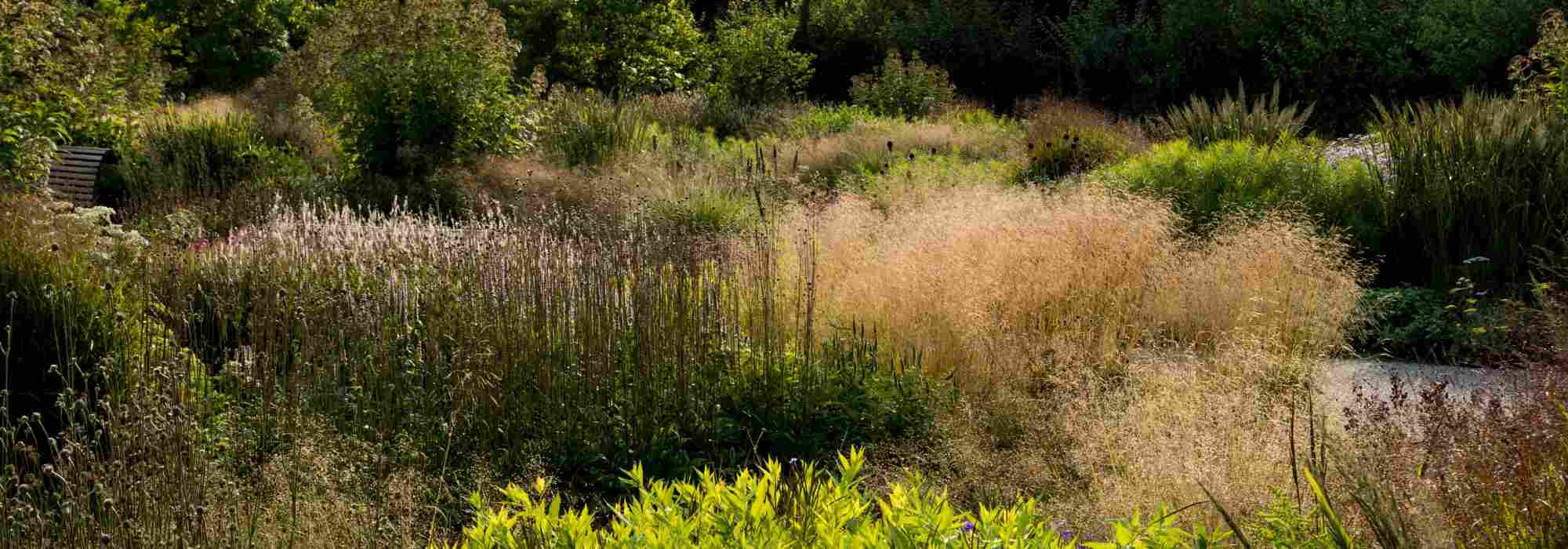
A strong trend in landscape design in recent years, the naturalistic garden is attracting more and more followers. This garden, rooted in a wild and natural design, has profoundly changed our view of gardens. Drawing inspiration from great American meadows, the naturalistic garden demands absolute respect for the environment and relies on the harmony of nature. How to create this garden paradise at home? Follow our tips!
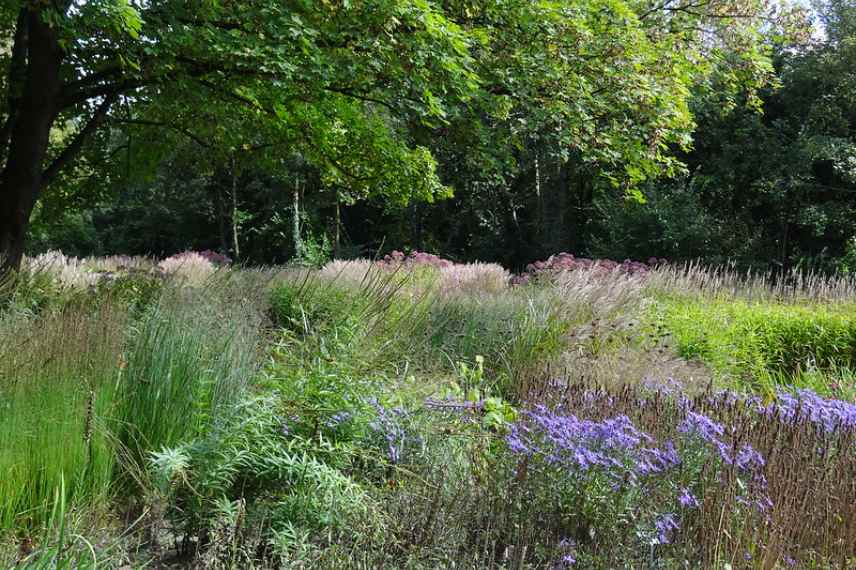
Garden at Maximilianpark in Germany (photo by Ester Westerveld)

What is a naturalistic garden?
If the name Gertrude Jekyll evokes the renewal of the English-style garden, that of Piet Oudolf is associated with the naturalistic garden. Why? Because he has revolutionised a certain vision of the garden since the 1990s. Yet, well before the “Dutch Wave” and Gilles Clément’s Moving Garden, others imagined a new free and wild garden. Jens Jensen in the United States was a pioneer in the field in the 19th century, just as William Robinson across the Channel. The naturalistic garden is therefore a new approach to gardening that is not as old as one might think, but which has been making its way for a few decades, notably in Europe. Over the years, the naturalistic garden has gained in popularity, all the more with the rise of ecological movements and the growing awareness of biodiversity.
The naturalistic garden stands out for certain characteristic features:
The movement and open spaces
Plants are chosen for their ability to move at the slightest breeze. So there are many perennials and grasses that are found in the naturalistic garden. Spaces are deliberately arranged to maximise the horizon. Nothing disturbs the axis of sight. In this dream-like nature where the ambience aims to be as natural as possible, with an alternation of clearings and planted meadows, the lawn has no place, or it takes the form of a steppe lawn. These are rather large mown avenues that punctuate and meander through the garden. The design of the garden must be, contrary to expectation, well thought out in advance: the apparent lack of order and the “tangle” is not achieved by chance: for here, as for another more classical garden, designing an overall plan of the spaces will be essential.
Mass plantings of perennials and the use of grasses
The mass planting style in the naturalistic garden blurs its own boundaries: you normally can’t tell where the garden begins and ends. One tries to reproduce a spontaneous effect in the plantings. A lot of emphasis is placed on combining colours and textures. The effect of long flowering is highly sought after in perennials to extend each season. Grasses come, in their turn, to bring movement, and they also act as a delicate palette, softening the brightness of certain perennial blooms.
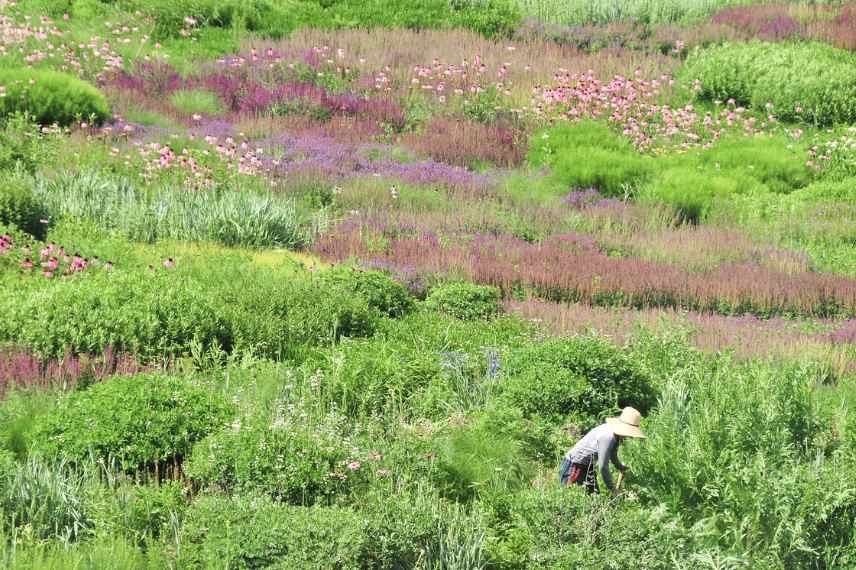
The Lorie Garden at Millennium Park, Chicago (Photo: John Leszczynski)
The recreation of a biotope
In the naturalistic garden, one finds several specific zones, thus somewhat imitating nature: an alternation between a dry meadow and damp spaces, a wild shaded corner and ideally a water feature as refugium for dragonflies and frogs. One therefore draws inspiration from natural ecosystems to create a refugium for biodiversity, while paying attention to aesthetics and functionality.
Limited maintenance
Native plants, adapted to the soil and climate of the region, allow for no irrigation, with systematic mulching in planted areas preserving moisture (and limiting adventives). The garden becomes self-sufficient very quickly. If this garden is evolving over the years, it is now often regarded as the garden of the future, because it addresses current environmental challenges by reducing the use of pesticidal products and requiring less water and maintenance.
A late mowing twice a year is sufficient to maintain a balanced meadow, and differentiated mowing is practised. We let the garden live its life, leaving the seeds on the plants in winter. They will feed the birds and add a decorative touch.
For which garden?
You can experiment with a naturalistic style in several types of gardens, some being nevertheless more suited to these large-scale plantings. Gardeners wishing to design a garden without watering will find in the naturalistic garden a range of plants that are fully suited. This garden, with its palette of flora that is resilient to both cold and high heat, can, moreover, be planted anywhere on the territory.
The large garden
The wide open spaces reveal all their beauty and potential with a naturalistic garden. They typically offer large, sun-drenched expanses that can shelter the flora typical of a meadow.
Multi-hectare gardens are very suitable, as they can play with the wide range of flora available (see below). An extension of the garden, for example by acquiring a new plot, can thus be imagined within the naturalistic concept to more easily make the most of the new spaces. A large garden can also more easily incorporate a water garden or a wetland area into its layout.
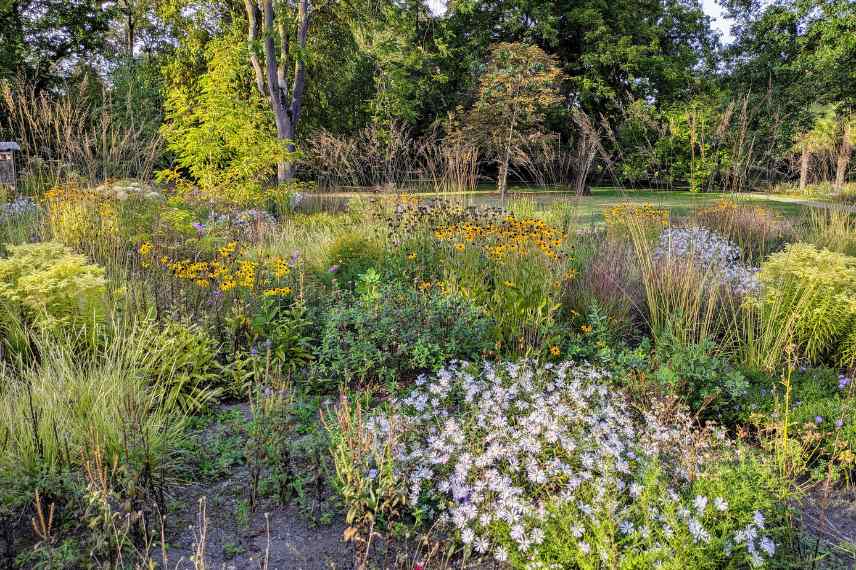
The flat garden
The flat garden benefits greatly from being planned in a naturalistic style: it will gain volume, the planting approach bringing a lot of movement and height to this space that is often deemed dull. If the garden is medium-sized, the broadly open naturalistic plantings will even make it appear larger by guiding the eye to the distance.
The country garden
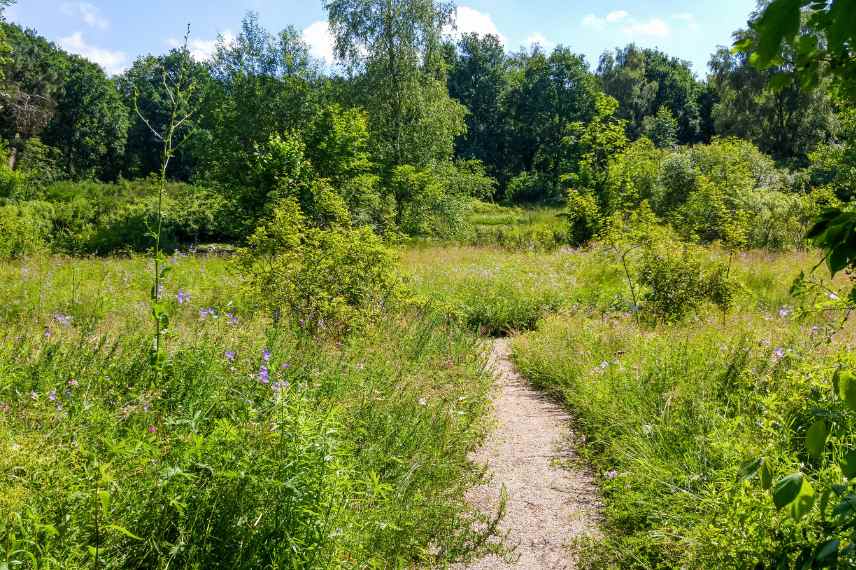
It is another garden entirely in harmony with the naturalistic style. The country garden follows the rules of a naturalistic garden in the type of plants to adopt, in the soft, unfussy style that also characterises the natural garden, and in its limited maintenance.
The English garden
The naturalistic garden can also be envisaged in a second, more natural part of an English garden on which the beds are based on mixed-borders. The abundance of perennials and grasses then appears as a simple and spontaneous link.
Plant palette
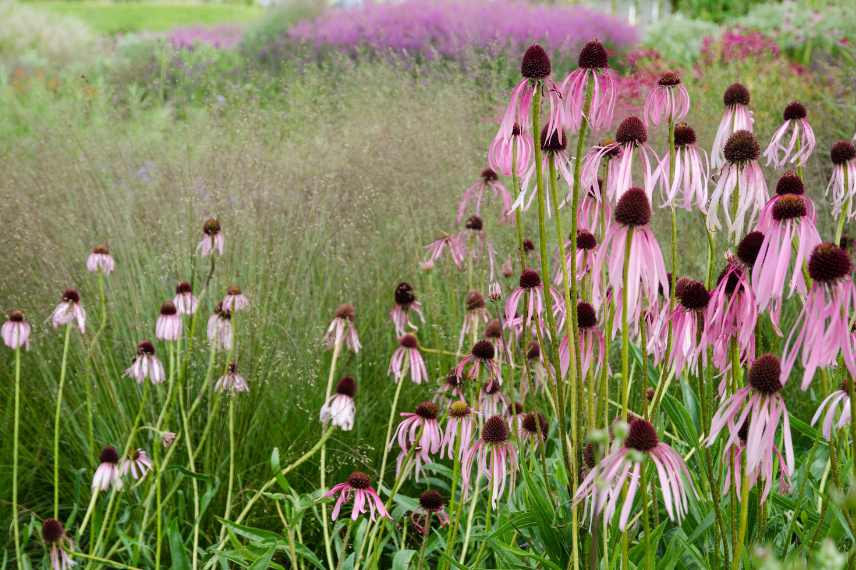
The core of the naturalist garden palette features a herbaceous visual made up of perennial plants and grasses. We aim to achieve ornamental displays for most of the year and create seasonal effects, favouring long flowering periods.
Hardy plants
Straight from the American Great Plains, the plants of the naturalist garden are perennial, hardy, melliferous plants that thrive in dry or damp soils. We can add other native European plants, provided they retain a wild character. We prioritise all species beneficial to biodiversity. Here are some essentials to plant:
- The Echinaceas and the Rudbeckias, notably Rudbeckia hirta and Rudbeckia fulgida
- The yarrows
- The Monardas
- The Liatris
- The scabious and knautia
- The Gauras
- The perennial verbenas (V. bonariensis, V. hastata, etc.)
- The linarias
- The sun-loving flowers: Heleniums, Inulas, Helianthus, Heliopsis, Silphium, Buphthalmum…
- The asters (Aster laevis, Aster novae-angliae…)
- The thistles, Cirsium and Eryngiums
- The Sanguisorba
→ Read also: 10 iconic perennial plants for naturalist gardens
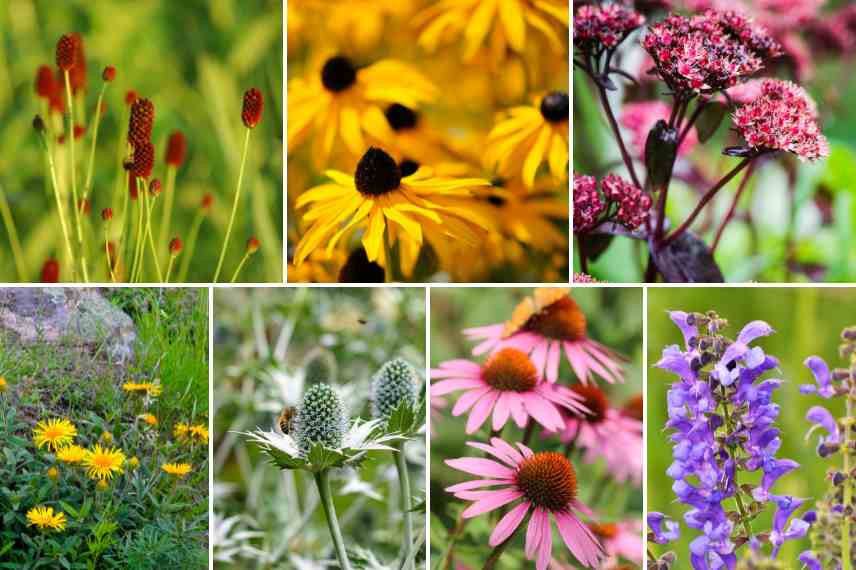
Sanguisorba officinalis, Rudbeckia hirta, Sedum spectabile, Buphthalmum, Eryngium, Echinacea purpurea and Salvia pratensis
Tall perennials
A sense of gigantism also features in this large-scale garden, with tall, stately plants, even oversized, while remaining wild in appearance.
Here you’ll find for example Cephalaria, the Selinum wallichianum, many yellow-flowering plants of the sunflower family such as Silphium, the Veronicastrum, wild fennel, the Lychnis chalcedonica, the ligularias, the salicaries, the pimpinellas, the amorpha, etc.
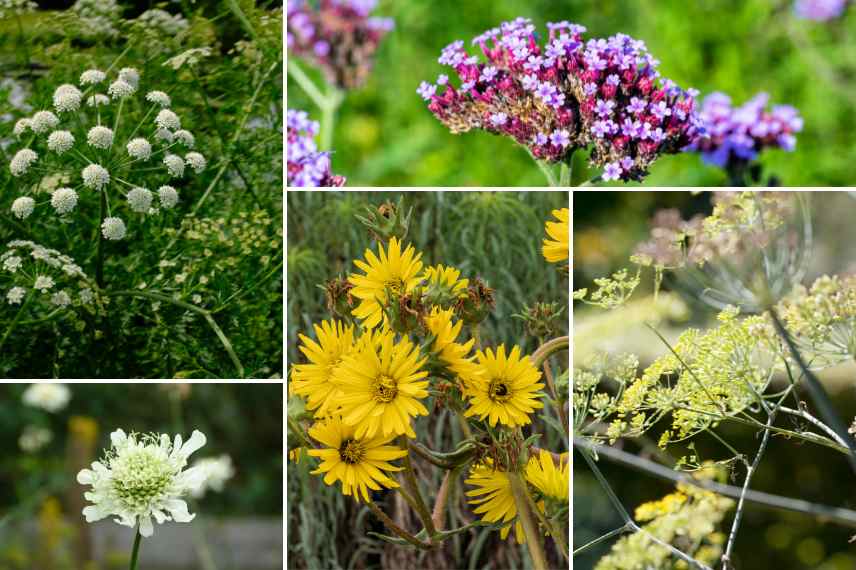
Selinum wallichianum, Verbena bonariensis, Cephalaria gigantea, Silphium laciniatum and Foeniculum vulgare
Grasses
They are simply indispensable to the naturalist garden! Not only do they catch light beautifully and stay attractive for a long time, but they’re also structural, dance in the wind and shelter small wildlife in winter. The straightest among them will provide natural support for the more sprawling perennials.
Adopt Andropogon, Calamagrostis, Melica, Molinia, Sporobolus, Schizachyrium, Chasmanthium, Sesleria, Stipa, Miscanthus and Pennisetum… among other ornamental grasses of interest.
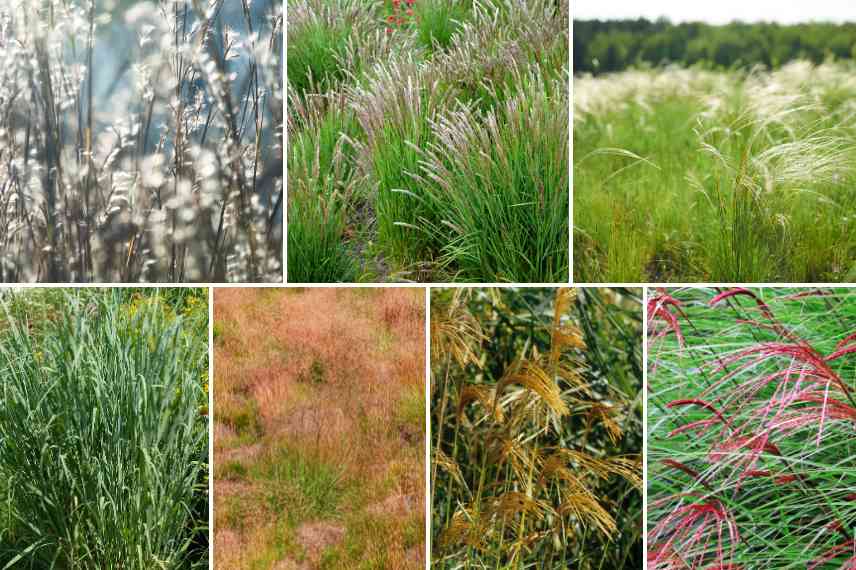
Schizachyrium scoparium, Melica ciliata, Stipa pennata, Panicum virgatum ‘Dallas Blues’, Molinia caeruela, Miscanthus nepalensis et Miscanthus sinensis
→ Read also: jardin naturel, 5 plantes sauvages remarquables.
Trees, shrubs and bulbs
Beyond the base of grasses and perennials, introduce taller native plants to create shrub steppes that will colour beautifully in autumn, bulbs that will naturalise and a few very light annuals:
Betula pendula, Virginia sumac,Sorbus aucuparia, Sambucus nigra, red dogwoods, bluebells, snake’s-head fritillary, Nigella, cornflowers, etc.
For the damp zones of the naturalist garden
Gather the best plants that attract pollinators and offer a colourful display year-round: meadowsweet, loosestrifes, Persicarias, Rodgersia, marsh iris (Iris pseudacorus) and Siberian iris, rushes (Juncus effusus), etc.
Maintenance made easy
Once established, a naturalistic garden evolves harmoniously with minimal intervention. It’s a sustainable garden, and its different habitats (meadow, marsh, and shadier areas) will regulate themselves. But, like any planting, the first year, or even the second, requires minimal care and watering. Water features will require slightly more regular maintenance to stay healthy and attractive. Don’t hesitate to plant densely: this will limit the proliferation of weeds and quickly give your garden a lush, full appearance.
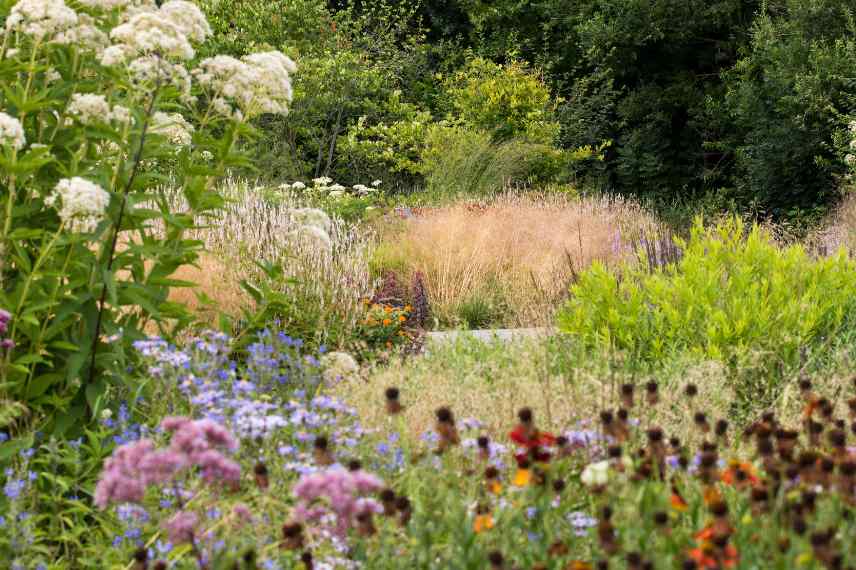
Massed, dense plantings greatly simplify maintenance
Design tips: colour harmonies, materials, furniture and décor
Decorative elements
In a naturalist garden, there’s no need to buy expensive items. Elements are sourced directly from nature to create eco-friendly and natural furnishings. Gather large tree stumps, create insect hotels by alternating pine cones, straw and bricks, establish dry hedges to delineate spaces or the plot, and leave piles of wood stacked to shelter insects.
Wooden barriers should look very natural, ranch-style fencing for horses, ideally using branches and trunks from the garden. Bird boxes and feeders will also be useful, to be dotted around the garden.
→ Also read: What should you do with old trees in the garden?; How to make an insect hotel; How to create a dead hedge? and A pile of branches or dead wood for garden wildlife.
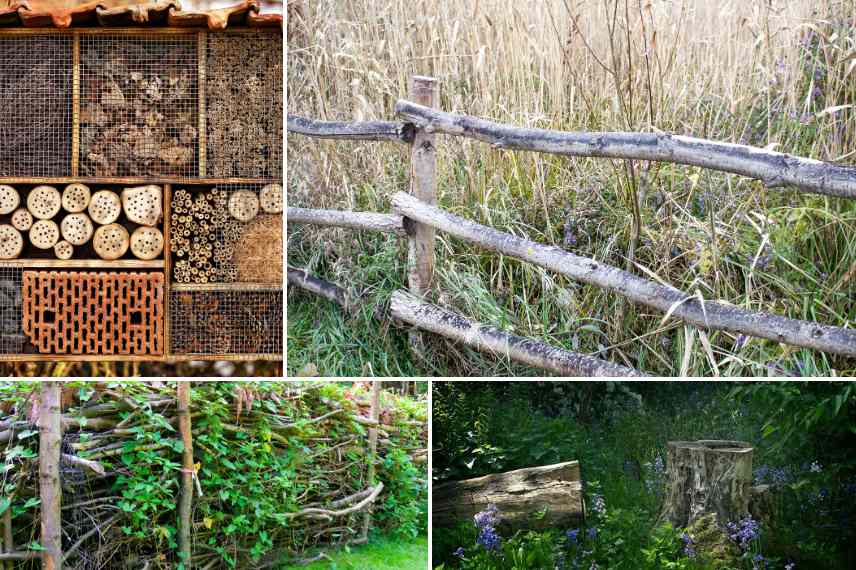
Furniture
The furniture blends seamlessly into the wide open spaces : improvised benches made from old trees, seats made from stumps left in place… We can also add a few seats in their natural state, such as old, rusting garden lounges, and acquire handsome Adirondack chairs, these seats of American origin feeling completely at home in this type of garden. Here, wood and metal also have their place, provided the furniture is arranged thoughtfully to enjoy the different viewpoints on the planting or on a water feature.
→ Discover design ideas for wood in the garden: ideas and inspirations.
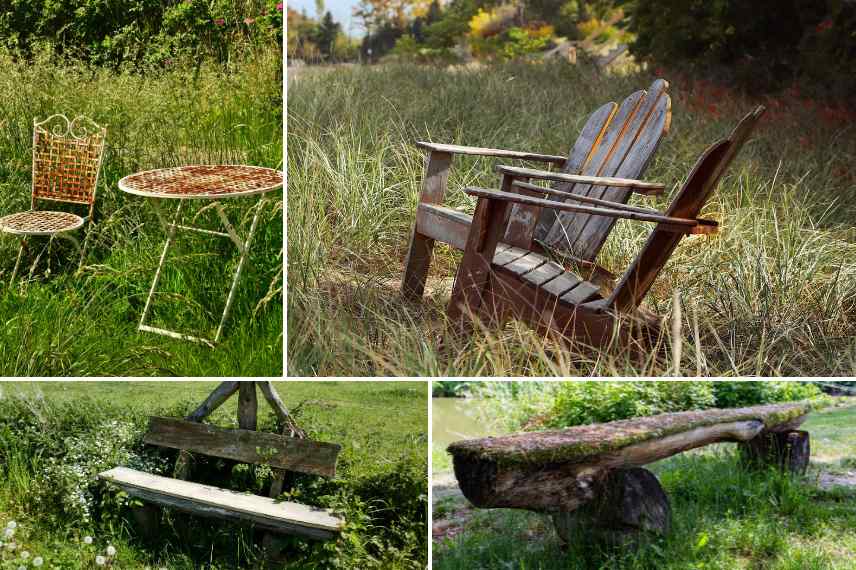
Grand-scale decor
In these wide, open spaces, you can even indulge in a few unique creations made from twigs, wicker sculptures, or even the insertion of animal figures. They will be few in number—one or two are enough to perfect a composition intended to be as symbiotic as possible.
→ Also read: Animal-themed decor in the garden ; Living willow weaving hedge hut and basketry: the art of weaving plants.
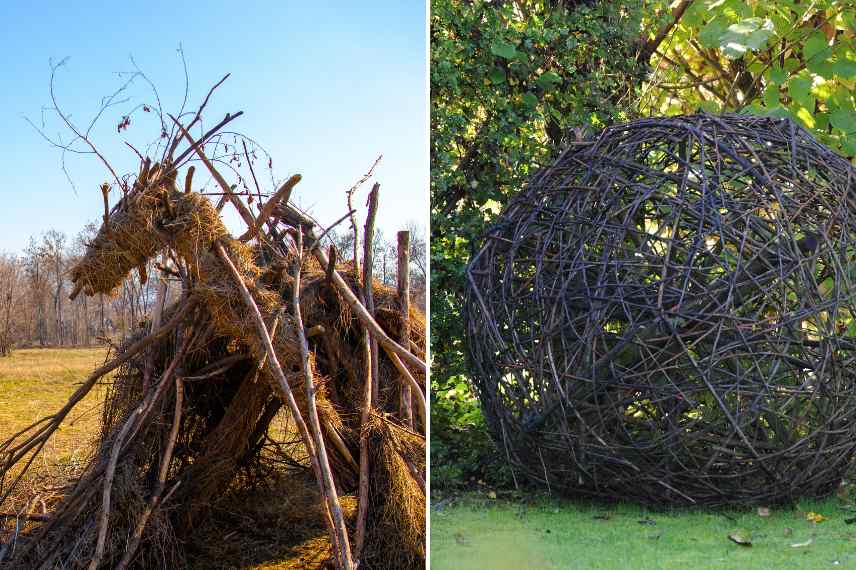
Giant organic sculptures seem to emerge from nature…
Paths
The naturalist garden loves broad, freshly cut avenues to showcase the sizeable planting beds. Also favour gentle paths: wood chips from your own mulch in the wildest or woodland areas, and raw materials, such as local stone slabs to create winding paths.
Naturalistic gardens for inspiration
Ideal when starting out in this kind of project is to draw inspiration from very beautiful gardens designed in a naturalistic style. There are more and more of them around the world, as the trend dictates. Here are some of the most remarkable in France and abroad:
- The Jardin Plume garden, in Normandy, one of the most emblematic and well-known in France. Alexandra visited there for us!
- The Mesnil-Gaillard Garden in Normandy as well, which Jean-Christophe visited in autumn;
- The Jardin de Berchigranges (Vosges) created by Thierry and Monique Dronet; this garden is a true sanctuary for biodiversity with its ponds and natural meadows;
- The Hermannshof Garden, in Weinheim, Germany: it’s Pierre who takes you on a tour in the Hermannshof Garden in April
- The Hummelo Garden, Piet Oudolf’s private garden in the eastern Netherlands, a genuine source of inspiration. Pierre has visited it again for us here!
- In England: the Millennium Garden at Pensthorpe Natural Park, designed by Piet Oudolf as well as Bury Court, in Surrey.
- Cambo Estate near St Andrews, widely inspired by Piet Oudolf and regarded as one of Scotland’s finest gardens.
- The garden of Fernando Martos, in southern Spain.
- Subscribe!
- Contents
Comments