I had the opportunity to learn basketry a few years ago while volunteering with a basketmaker who grows willow. This technique, which consists of weaving plants, is an art accessible to everyone and requires little in the way of resources (and few tools)... Especially as plants suitable for weaving are easy to find in the wild! There is something quite fascinating about assembling the rods, passing them over and under one another, and watching an object gradually take shape. Basketry is a task of patience. It is a craft that is disappearing, and basketmakers have become quite rare in France, because the craft is time-consuming and therefore costly... However, for personal use it is still possible to have fun weaving willow!
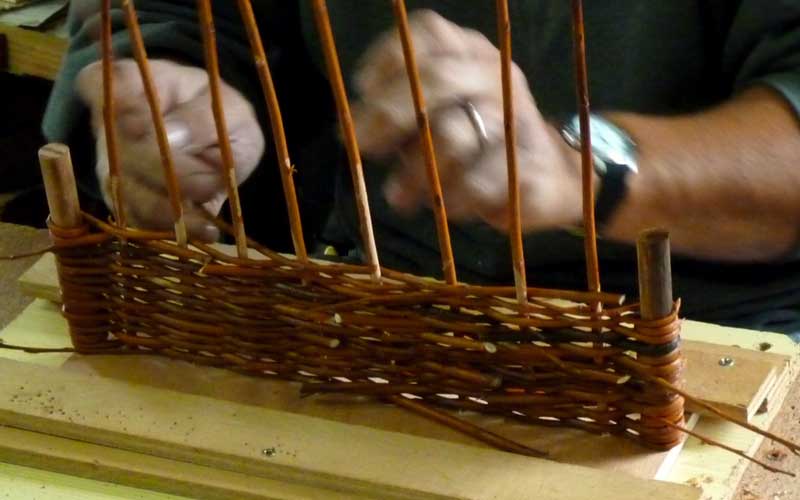
Basketry consists of weaving rods by passing them from one side to the other around fixed vertical rods that serve as uprights (photo Marthe Lelievre)
Various uses in the garden
Basketry is often used to make willow baskets, but you can also create many items for the garden: a nest box for birds, supports for climbing plants, partitions to separate different parts of the garden, small edging for flowerbeds... Hedges, screens, arbors, pergolas, tipis, playhouses for children... Just let your imagination run free! Basketry makes it possible to create genuine works of art and plant sculptures. Possibilities are endless, and woven objects fit easily into garden furniture.
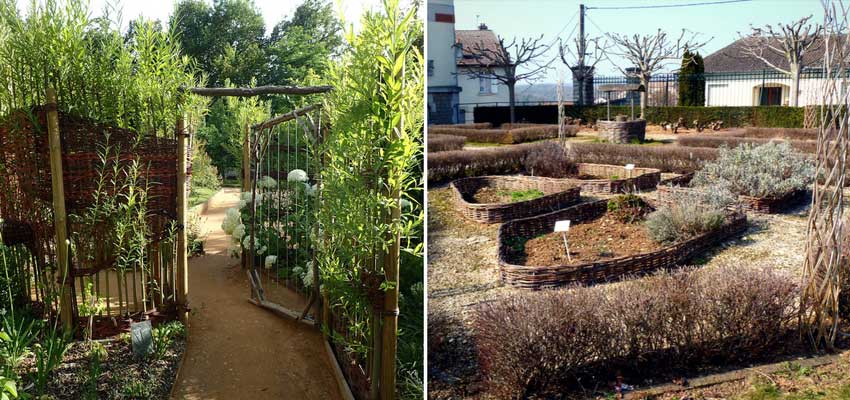
Willow fits easily into garden settings! Left, in the garden "A la recherche du lupin blanc", at Chaumont-sur-Loire Garden Festival (2017). Right, in front of Ecole Nationale de vannerie de Fayl-Billot (photo Ji-Elle).
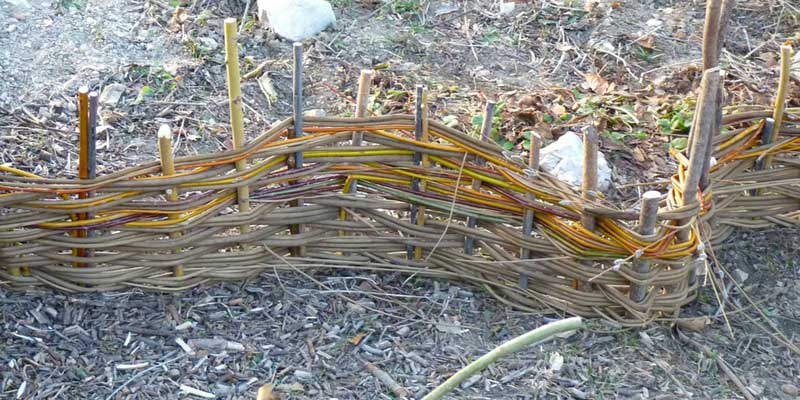
A small willow edging can be integrated into a garden to define flowerbeds, for example (photo: Hugues-Mircea Paillet)
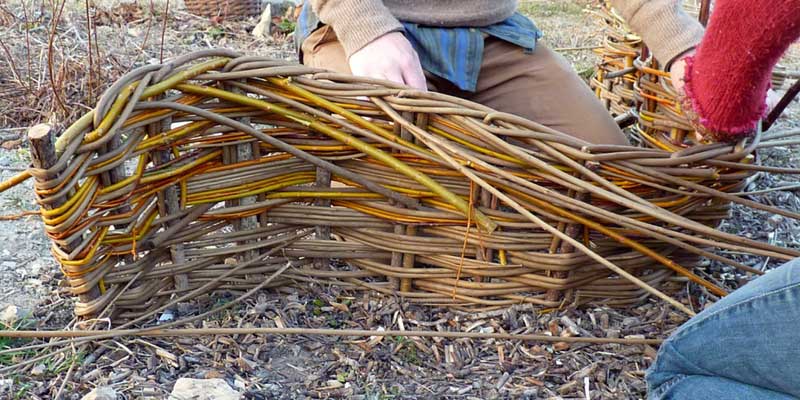
Weaving a willow edging (photo: Hugues-Mircea Paillet)
Grow your own willow?
The willow rods used for basketry are actually branches of willow intended for weaving. It is perfectly possible to grow willow for this purpose. Many varieties exist, which allows you to obtain different colours! Species commonly used are Salix triandra, Salix purpurea, Salix alba and Salix viminalis, and one of the best varieties for basketry is Salix triandra 'Noir de Villaines'. Willow multiplies very easily by propagation by cuttings, and many willow growers and basketmakers sell cuttings. Feel free to grow willow: besides providing material for weaving, it can be used for medicinal purposes (its bark contains salicylic acid, close to aspirin), for RCW (mulch) or as a rooting stimulant to help your cuttings take root (willow water can replace rooting hormone). Plant preferably at the end of winter, around March, in deep soil that stays relatively cool in summer. You can also buy willow rods ready for weaving directly from basketmakers! You can find raw, natural willow rods and rods from which the bark has been removed to obtain a white-coloured rod.
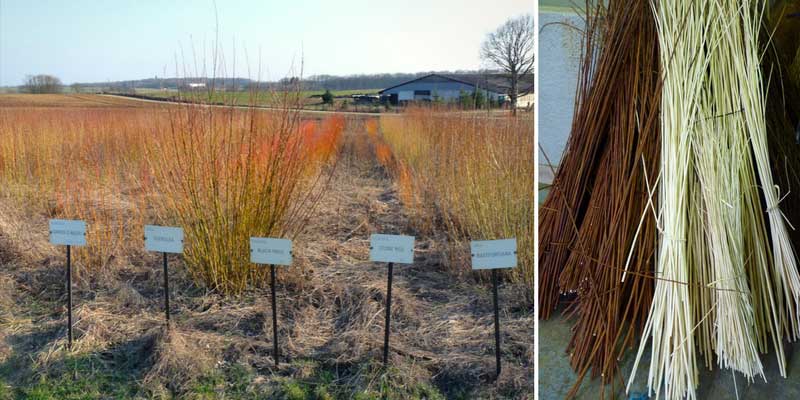
A willow bed: willow cultivation intended for basketry (photo Ji-Elle) / Bundles of willow rods ready for weaving (photo Marthe Lelievre). White rods are peeled willow, from which bark has been removed.
... or harvest it in the wild?
You can easily find wild willow suitable for weaving. Species used for basketry (Salix alba, S. purpurea, S. viminalis and S. triandra) grow wild in France, mainly along watercourses. You can look for and harvest them. Choose the longest, straightest, relatively thin branches. And although willow is by far the most used species in basketry, many other plants can be used! These include hedge clematis, dogwood (Cornus sanguinea), hazel, honeysuckle, hops and rush, to name a few. You can even mix several species to obtain different colours, for example by using some dogwood branches within a willow structure.
Harvesting is done from late November–early December through to February, when the plant is dormant (leaves have fallen and sap has not yet risen).
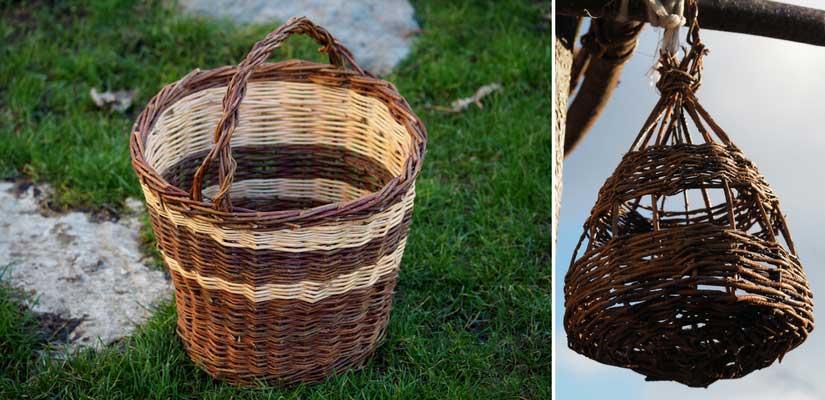
A basket I made / a nest box for birds
Further reading...
Basketry is a somewhat technical art... If you are interested, many basketmakers offer workshops or training! Also discover books written on the subject.
- La Vannerie Sauvage, by Bernard Bertrand, published by Editions de Terran. A superb book in two volumes that explains how to weave wild plants. Each volume comes with a DVD.
- Ecole Nationale d'Osiériculture et de Vannerie in Fayl-Billot, unique of its kind, offers courses that prepare students for the profession of basketmaker.
- Website of Tresselavie, which offers workshops and training
- Website of L’Oseraie du possible, a basketmakers' collective





























Comments