



How to get rid of invasive Provencal canes?
Our tips for eliminating or containing them naturally
Contents
The Provençal cane, or Arundo donax is a giant reed, with vigorous growth and that grows rapidly. It forms a dense clump composed of rigid, robust canes, which can reach up to 4–5 m in height, and bears long green leaves, sometimes variegated. It has rootstock roots, which allow it to spread easily. It brings a very natural look to the garden, and is particularly useful for forming windbreak or screening hedges. When it thrives there, it can be particularly invasive, which is why it is advisable to install a anti-rootstock barrier at planting, to limit its spread. Discover all our tips for getting rid of Provençal canes that are a little too invasive!

How do you recognise the Provençal cane?
Giant reed is a rhizomatous plant that can become invasive in many ecosystems. It grows naturally in damp areas along watercourses and ditches. To identify it, it is important to familiarise yourself with its distinctive characteristics. Giant reed resembles a reed, and forms thick, robust stems, standing upright, reaching up to 4 metres in height. It bears long leaves (40–60 cm long), drooping at the tips, glaucous green, and with rough margins. There are also variegated varieties, with leaves striped with silvery white or cream-yellow (for example Arundo donax ‘Variegata Versicolor’ or ‘Aureovariegata’). They are valued for the brightness they bring to the garden. In late summer – early autumn (usually September–October), giant reed displays large plume-like panicles at the tops of its stems, over 50 cm long, initially greenish and turning brown at maturity. The plant’s ability to spread rapidly is due to its underground rhizome system. Giant reed can thus become a problem in gardens and natural habitats, as its rhizomes allow the plant to spread quickly and to dominate other plant species. Once well established, it is difficult to eradicate. It is also listed among invasive species in certain regions of the world, such as New Caledonia, and it has begun naturalising in the southwest of France.
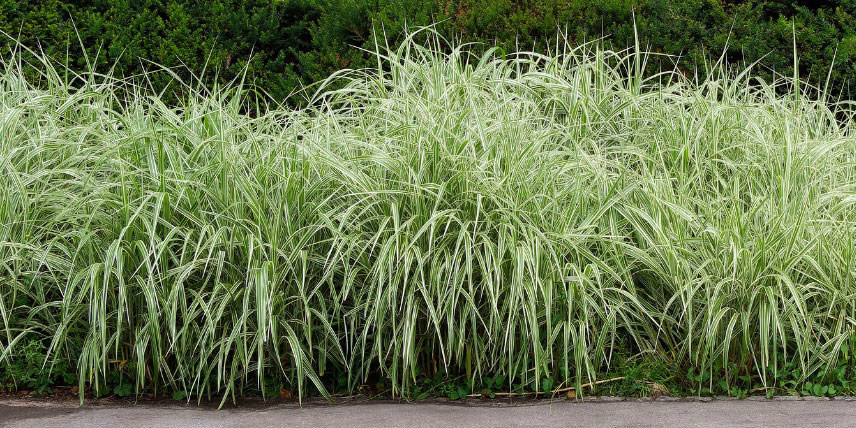
Giant reed with variegated leaves, Arundo donax ‘Variegata’
How to contain it?
It is far better to anticipate and contain Provence cane early on, at planting time, rather than remove it once established. This will take you far more time and energy.
The best way to contain Provence cane is to install a rhizome barrier at planting, in the same way as for bamboo. If you did not think of installing one at that moment and Provence cane has begun to spread, it is also possible to add it later, after removing shoots and rootstocks that extend beyond the defined area.
- Dig a planting hole about 50 to 60 cm deep. If the plant is already in place, dig a trench all around it to the same depth.
- Plant Provence cane in the centre of the planting hole.
- Then place the rhizome barrier all around, with a 15° angle. It should protrude 5–10 cm above soil level.
- Securely join the two ends of the rhizome barrier together.
- Backfill the hole with soil, covering the part that emerges from the soil, then firm gently.
Another solution is to grow Provence cane in large pots or containers, which can be installed, for example, on your terrace or beside a pool. Thus you can enjoy its ornamental qualities without taking the risk that it colonises your garden!
In open ground, it is preferable to grow variegated varieties, which are less invasive than the species, while being very decorative.
How to get rid of it naturally?
Natural eradication of Provence canes requires patience and perseverance. We recommend tackling it in early autumn or in spring. The aim is to destroy the rootstocks and remove as many as possible, as the plant can restart from a section of rootstock left in the soil.
- Choose whether you want to remove all Provençal canes or just a portion that extends beyond their original planting area.
- Dig up the plants using a spade. We recommend digging to a depth of at least 30 cm. The rootstocks are typically located about 20 cm below the soil surface.
- Remove as many rootstock fragments as possible, where possible.
- Then cover the soil with a large, sturdy, waterproof black sheet.
- As soon as you see new growth, remove it immediately. This will exhaust the rootstocks and they will eventually die.
- Regularly cut the canes at soil level. This action, repeated several times over a growing season, will gradually weaken the plant by depleting its energy reserves stored in the rootstocks.
- If you choose to keep plants in part of the garden, be sure to install a rhizome barrier to prevent the plants from spreading again.
It is important to monitor the area regularly for any regrowth and to remove new shoots immediately.
If the area to be cleared is large, it may be more effective to use a mini digger to excavate the ground rather than digging up and removing the rootstocks manually.
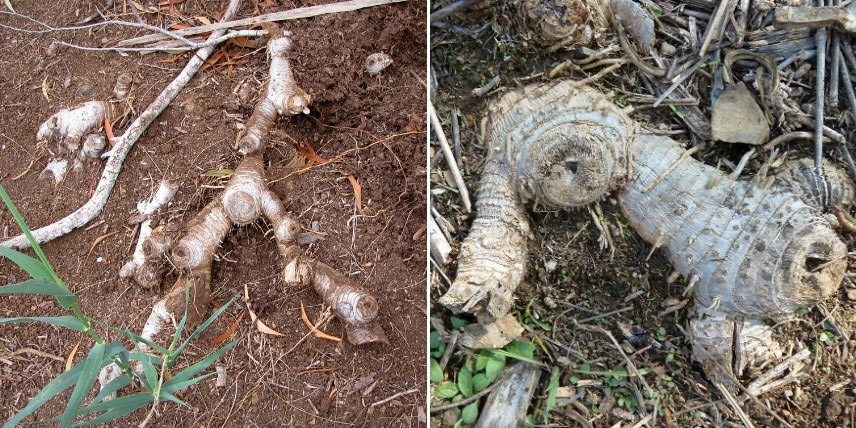
To remove Provençal cane and prevent it from regrowing, all rootstocks must be removed (photos: Forest and Kim Starr / JMK)
- Subscribe!
- Contents
Comments