






























How to grow Miscanthus in pots?
Tips for planting and care
Contents
Striking and elegant, Miscanthus is a grass that is gaining in popularity. This plant, also known as Chinese reed or elephant grass, is used in gardens of varied styles: contemporary, natural, exotic or English. It forms clumps of slender leaves that rustle in the wind and grows to a height of between 60 cm and 3 metres. In summer or autumn, depending on the varieties, the foliage is adorned with soft, fluffy plumes with golden, silver, bronze or pink hues, creating an airy, luminous display. The flowering plumes form fans. The foliage is marcescent; it dries on the plant and remains decorative year-round. Easy to grow, Miscanthus withstands cold, wind and salt spray. It can be grown in all regions in open ground, but also in pots for compact varieties.
Discover our tips for growing Miscanthus in pots on your balcony or terrace.
→ To learn more, discover our full page on planting and care of Miscanthus as well as on Growing potted plants.

Which varieties to grow in pots?
For pot culture, choose medium-sized varieties such as:
- the Miscanthus sinensis ‘Cute One’ – Dwarf Chinese silver grass: this variety reaches a mature height of 50 cm. It is the smallest of the Chinese silver grasses, which makes it a good plant for pot culture. It forms a dense clump of slender leaves, which in late summer is topped with plume-like inflorescences in cream-purple colour. Requiring little water, it is easy to grow in a pot, in full sun. It is hardy to -29°C.
- the Miscanthus sinensis ‘Little Miss’ – Chinese silver grass. It grows up to 80 cm tall at maturity and is perfectly suited to pot culture thanks to its small size. It is distinguished by its original colours. The clump of foliage is two-tone: green at the centre, it is red to purplish on the edges. In late summer, this festival of colours is enhanced by the flowering of slim plume-like inflorescences almost red. It is hardy to -29°C.
- the Miscanthus sinensis ‘Gold Bar’ – Chinese silver grass also grows to a height of 80 cm. Its leaves are bright and variegated, green with cream-yellow stripes across. Between September and October, it becomes adorned with plume-like inflorescences coloured beige-rose, purple and burgundy. It prefers sun and is also hardy to -29°C.
- the Miscanthus sinensis ‘Adagio’ – Chinese silver grass. It grows up to 1.10 metres tall and is well suited to pot culture. This Chinese silver grass forms a dense clump of silvery-grey foliage and is particularly floriferous. Between August and November, it yields slender pinkish inflorescences that fade to pale cream with time. It prefers sun and is hardy to -29°C.
- the Miscanthus sinensis ‘Boucle’ – Chinese silver grass. This new variety of Chinese silver grass offers strikingly graphic and original flowering. Of medium height, it grows to about 1.10 metres tall and its foliage green through summer becomes orange as autumn progresses. From September to November, crumpled, compressed and plump inflorescences appear. They open as dense panicles, transitioning from purplish-brown to purple, then to pink-purple, finishing in silvery tones. This Miscanthus can be planted in large pots, in full sun and in well-prepared soil, not too dry.
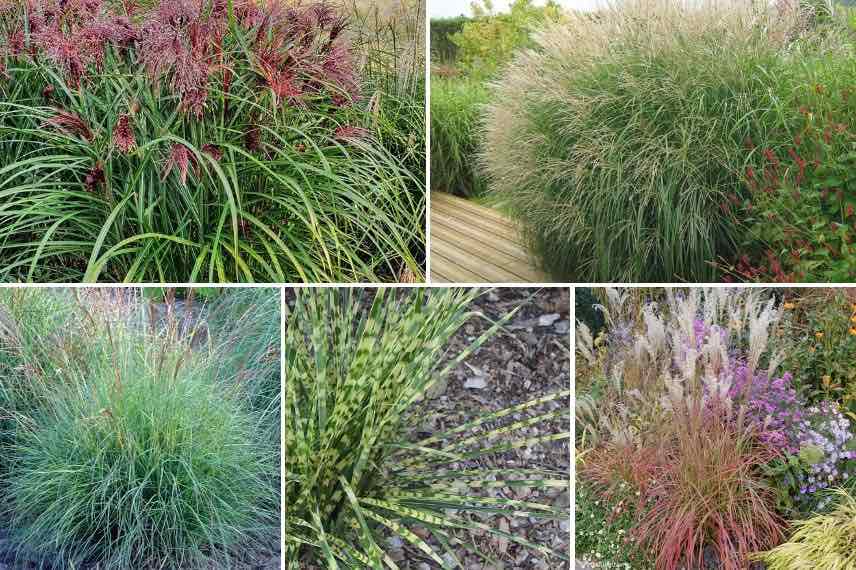
Clockwise: Miscanthus sinensis ‘Boucle’, ‘Adagio’, ‘Little Miss’, ‘Gold Bar’ and ‘Cute One’.
Read also
How to choose a Miscanthus?When should you pot Miscanthus into a container, and what light exposure should it have?
The best time to plant Miscanthus in a pot is in spring, after the last frosts. This gives it plenty of time to establish itself and develop its roots before winter. You can also plant it in early autumn, but make sure it still has a few weeks before the first frosts to establish well.
Miscanthus prefers full sun, which allows it to develop dense foliage and attractive inflorescences. It needs at least 6 hours of direct sun per day to thrive. It can tolerate partial shade, but it will be less floriferous and more sparse.

Plant Miscanthus in full sun.
How to grow Miscanthus in a pot?
What type of pot?
You can use any pot type to plant Miscanthus. Terracotta pots provide better root aeration. However, they can dry out more quickly, so watering will need to be monitored closely.
A plastic pot is another good option. It retains moisture better and is light, which makes it convenient to move the plant. Just ensure there are enough drainage holes.
Choose a pot at least 40 to 50 cm deep to allow the roots to spread. Miscanthus has a tufted habit, so a wide pot (at least 40 cm in diameter) is ideal to give it enough space to grow.
What substrate?
Miscanthus prefers well-drained soil to avoid excess moisture, which could lead to root rot. A mix of universal potting compost enriched with coarse sand or the perlite is ideal. Mix about 2/3 potting compost with 1/3 sand or perlite. This mix provides good drainage while retaining enough moisture for the plant’s needs.
Miscanthus appreciates a substrate rich in organic matter. You can add a little compost or leaf mould to enrich the mix. This will help provide the nutrients needed while keeping the substrate light.
The planting
- Choose a container large enough to accommodate Miscanthus.
- Take a pot with a perforated bottom and a volume at least twice as large as the plant’s root ball.
- Water the root ball thoroughly.
- Add a layer of gravel or clay balls at the bottom of the pot to improve drainage and prevent roots from sitting in water.
- Pour the substrate into the bottom of the pot
- Then place the Miscanthus at the centre of the pot and fill with the rest of the substrate.
- Firmly press the substrate to remove any air pockets and ensure good contact between the soil and the roots.
- Water well Miscanthus immediately after planting to thoroughly moisten the substrate and help the plant establish roots.
Watering Miscanthus in pots
Miscanthus likes soil that is slightly moist, especially during its active growth period, in spring and summer. Generally, water once or twice a week, depending on weather conditions. Before watering, check the moisture of the substrate by inserting your finger into the soil. If the soil is dry to about 2–3 cm depth, it’s time to water.
When you water, make sure to water deeply so that the water reaches all the roots. Avoid frequent shallow watering, which can lead to shallow rooting. Miscanthus does not like its roots in standing water. Ensure excess water drains well through the pot’s drainage holes.
Reduce the watering as growth slows in autumn. In winter, Miscanthus goes into dormancy, and its water needs are very low. Water only when the soil is completely dry.
Fertilising Miscanthus in pots
Enrich the substrate each spring with a little compost or fertiliser to support annual growth.
Pruning
- In late winter, prune the tuft back to the rim of the pot using pruning shears or a heavy-duty shear. New shoots will reappear in May.
- During summer and autumn, optionally remove damaged or broken stems.
Dividing Miscanthus in pots
After a few years of cultivation, the centre of Miscanthus may become bare. It is then time to divide the clump.
- Start by cutting back dried stems to the base.
- Lift the root ball from the soil.
- Divide the root stock into several parts using a toothed saw. The root stock pieces should be at least 20 cm long.
- Replant each part in a different pot or in the open ground.
- Water generously.
Diseases
Miscanthus is free from diseases and not prone to pests.

- Subscribe!
- Contents
Comments