


How to grow passion fruit successfully?
Our key steps to grow and harvest passion fruits in France
Contents
A sudden craving for exotica in the garden? No need to move to live under the tropics! Some fruits with distant, sun-drenched origins grow very well under our latitudes. Also known as grenadilla or maracudja, passion fruit has a flavour that is both sweet and tangy, utterly unique. The simple tasting of its juicy, fragrant pulp transports you to distant lands.
To harvest and enjoy your own passion fruits, you will need to plant a passionflower, and more specifically Passiflora edulis, the only species that produces fruit with an interesting flavour. This climbing, semi-woody and voluble plant, native to Brazil, naturally requires warmth. Very frost-sensitive, it can only be grown in the ground in regions with a mild climate. Otherwise, pot-grown plants and cultivation in a warm greenhouse are mandatory if you hope to taste its passion fruits.
Discover all our tips on planting, growing and care for passion fruit.
Further reading: Passionflower, passion flower: planting, growing, pruning.

What exactly is passion fruit?
Obviously, everyone has already savoured a creamy passion-fruit ice cream or dessert. With its distinctive flavour, synonymous with sun, exoticism and the tropics, the passion fruit invites you on a journey. And that makes sense since it originates from the tropical and subtropical regions of South America, namely Brazil, Argentina, Bolivia, Peru… In other words, this passion fruit, otherwise known as grenadilla, maracuja or maracudja, requires sun, warmth and a certain degree of humidity.
A tropical-origin climbing plant
This famous grenadilla is the fruit of a climbing, semi-woody and fairly vigorous plant in the Passifloraceae family. The genus Passiflora comprises around 500 species, cultivated for their ornamental value or their fruiting which ranges from tasty to less so. But if you really want to grow passion fruits, you’ll need to plant the species Passiflora edulis. This climbing, lush vine with a very spreading habit can reach 10 to 12 m in its natural habitat, approximately 4 m tall with a maximum span of 10 m in our latitudes. Equipped with tendrils at the leaf axils, it clings to any support you care to provide, from a wall trellis to fencing, via arches, a gazebo, or a pergola…
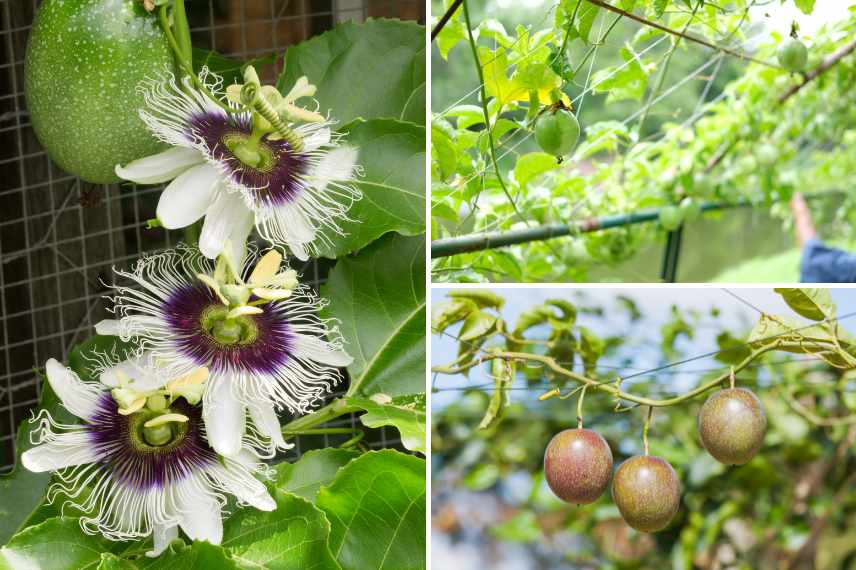
Flowers and fruits at different stages of ripeness of Passiflora edulis
A flowering and fruiting of great beauty
With rapid growth, Passiflora edulis benefits from evergreen, glossy and bright foliage and a fairly vivid green. The leaves are alternate, trilobed, slightly undulate, with ovate and dentate lobes. Flowering occurs in summer, between June and July. In very mild climates, it can continue throughout the summer. Passionflower blooms are stunning, somewhat mysterious in their complexity. This uniqueness is also the origin of the plant’s name, since the term “passiflora” (passion flower) derives from Latin “passio” for passion, and “floris” meaning “flower.” It was the Spanish Jesuits who gave this name to the flower whose morphology recalled the Passion of Christ. The corona and the filaments evoke the crown of thorns, the stamens the wounds of Christ, the pistil the cross, the stigmas the three nails and the bracts the Trinity. In short, passion flower blooms have all the attributes to charm gardeners.
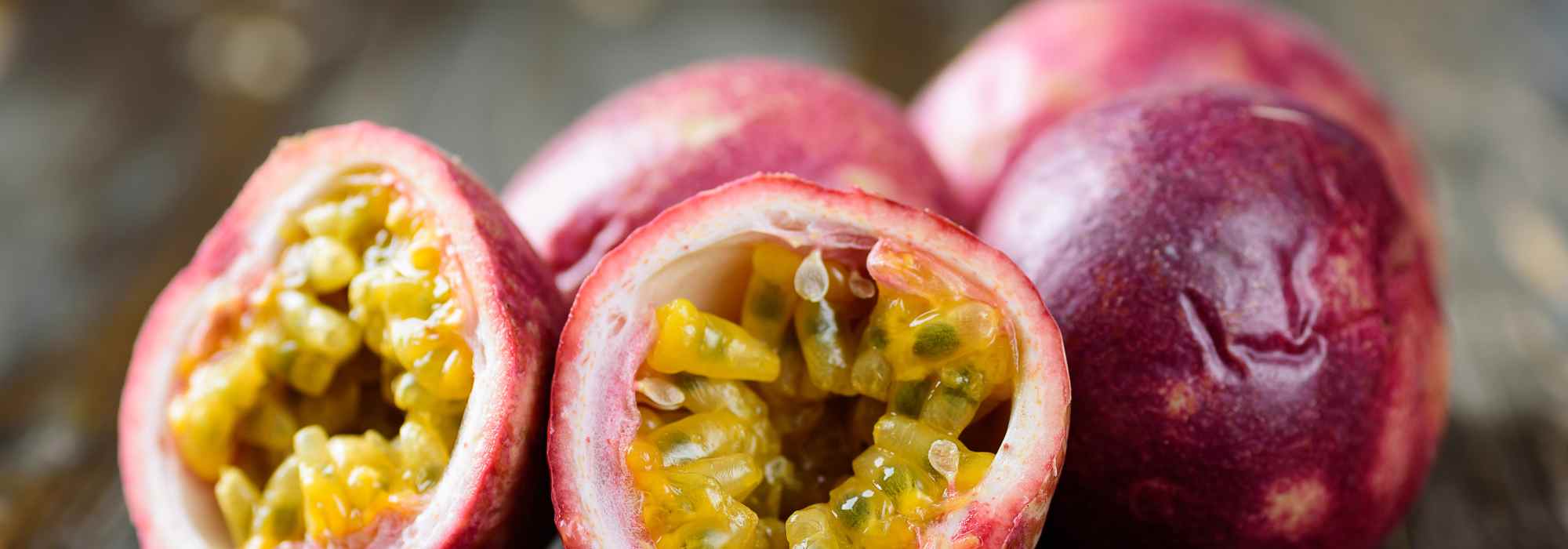
Moreover, they bear delicious fruits. Ovoid in shape, 4 to 6 cm long, these grenadillas hide beneath their smooth skin, purple-violet in colour, a yellow, gelatinous pulp called aril. Very juicy, both sweet and tart, this pulp contains many black seeds. Harvesting of these fruits occurs in August and can continue until October if the weather permits.
Besides the standard plant that bears passion fruits with purple skin, there exists the variety Passiflora edulis f. flavicarpa which produces passion fruits with yellow skin. Unlike the standard species, this passionflower is self-sterile. It is therefore necessary to plant another passionflower nearby to ensure cross-pollination.
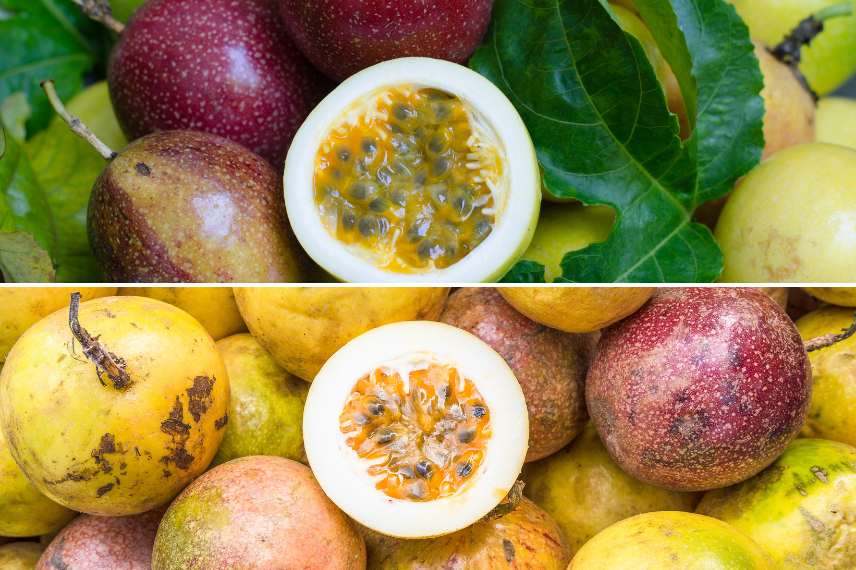
The standard variety of Passiflora edulis yields fruits with purple skin; other varieties produce yellow passion fruits
How to grow a passion fruit vine?
Passion fruit is therefore a climbing plant of tropical origin. It will therefore require plenty of warmth if you hope to harvest passion fruit. Similarly, it is extremely frost-sensitive. As soon as the thermometer shows 5°C, it suffers from the cold. That is why planting it in the ground is only feasible in regions with a mild climate, such as the Mediterranean rim, and more particularly the Côte d’Azur. And even there, it will require a very sunny position.
Where to plant passion fruit?
As we never tire of saying: Passiflora edulis loves warmth. That is why you must install it in a very sunny spot and well sheltered from winds and cold air drafts. A trellis against a south-facing wall is ideal. Or a pergola on a south-facing terrace.
It will need a fertile, fairly light, humus-bearing and cool soil in summer, that is well-drained.
In regions with a less clement climate, passion fruit can be grown in a large pot at least 50 cm in width and depth. The pot should be placed in full sun in summer and brought into a conservatory or a heated greenhouse in winter. However, fruiting is not guaranteed…
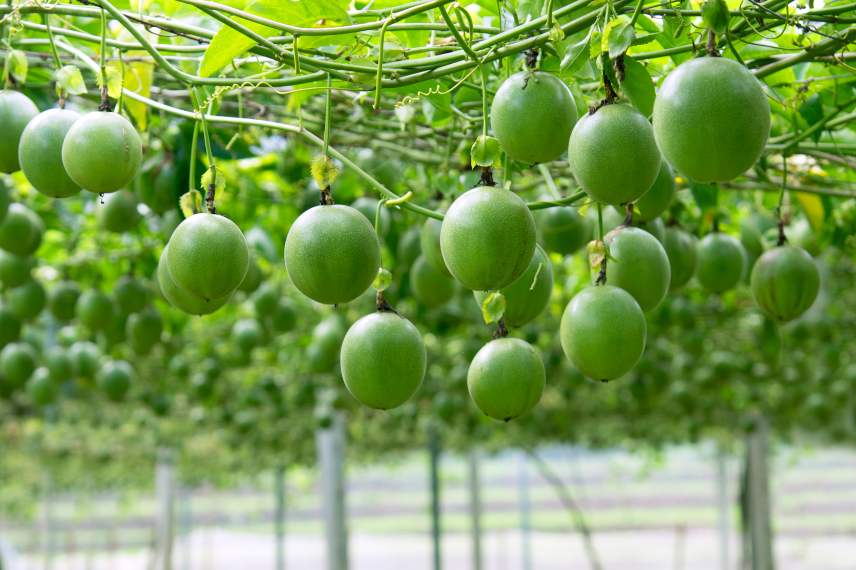
The passion fruit is a climbing plant that needs to be trellised
When to plant passion fruit?
The passion fruit being very frost-tender, it is recommended to plant it in spring to ease establishment.
How to plant Passiflora edulis?
In the ground
- Soak the passionflower root ball in a basin of water
- Dig a hole two to three times the size of the root ball
- Mix the excavated soil with potting compost and with compost (if the soil is heavy, don’t hesitate to add some sand to aid drainage)
- Place the root ball and fill the hole with the excavated soil
- Firm the soil and water generously.
In a pot
- Lay a 4–5 cm layer of clay balls or gravel at the bottom of the pot
- Fill the pot with a mixture of garden soil, potting compost and compost (again, you can add a little sand for drainage)
- Place the root ball and finish filling the pot
- Firm the soil and water generously
How to care for a passion fruit vine?
Whether your passionflower is planted in the ground or in a pot, it needs careful care to grow and, above all, to fruit:
- Water very regularly to keep the soil sufficiently moist, especially in summer during heatwaves or prolonged drought. Waterings will be even more abundant during the growth, flowering and fruiting period. The soil or substrate should remain constantly moist. Then, as autumn approaches and throughout winter, watering should be spaced out.
- Mulch the soil or substrate, on the one hand to retain some moisture and limit watering, and, on the other hand, in winter, to protect the crown from cold if your passion fruit is grown in the ground.
- Overwinter the passion fruit from October, before the onset of the first frosts. A veranda or a heated greenhouse is recommended.
- Prune the climbing shoots of the passion fruit vine in late winter, between March and April, to balance its habit, remove dead or damaged branches and limit its spread. However, this pruning should not be carried out every year, as it delays flowering and, consequently, fruiting.
- Apply a potassium-rich fertiliser for exotic fruit trees as growth resumes to promote flowering and fruiting.
Diseases and pests to monitor
Relatively hardy, Passiflora edulis may be susceptible to anthracnose or mosaic. Discover how to combat it biologically in this article on anthracnose.
Similarly, passion fruits are often attacked by aphids, the mealybugs and the whiteflies.
Read also
How to design a tropical garden?How to propagate passion fruit?
Your neighbour eyes up your passion fruit with envy. And what if you offered them an identical plant to satisfy their passion for gardening—and their sweet tooth? Passion fruit propagates reasonably well by cuttings, or, with a little patience, by sowing seeds.
Humidity-assisted cuttings from August-growth and woody stems are taken in August–September. Simply cut branches 15–20 cm long and remove the lower leaves. The cuttings can be dipped in a rooting activator before being planted in a seed compost. Then cover these cuttings with a plastic film or a cloche and place them in a bright spot, away from direct sunlight. The seed compost should be watered regularly to keep it consistently moist. Ventilation is carried out every three days by removing the plastic or the cloche. Having spent the winter in warmth, the cuttings can be planted in the ground in spring.
Passion fruit seed sowing is more unpredictable, but with a good chance of success if you follow the steps carefully. It is carried out in August:
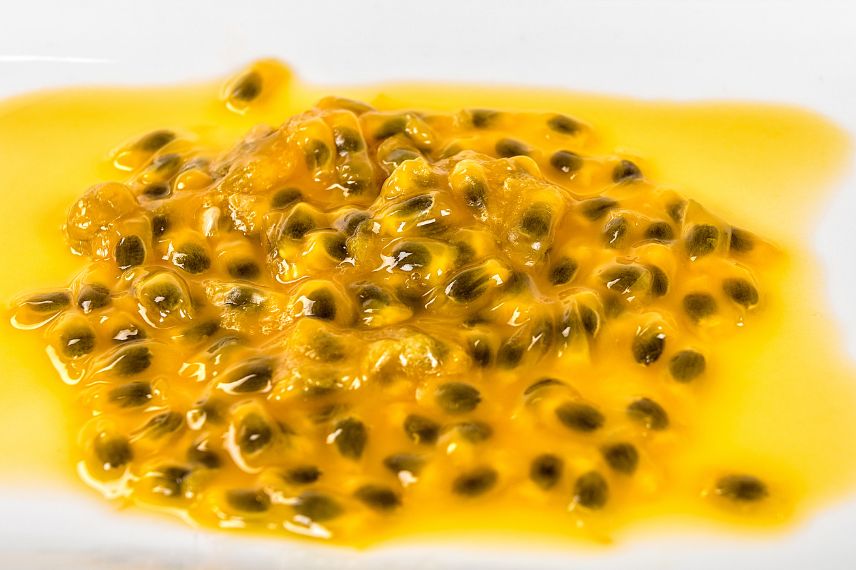
Passion fruit propagates by cuttings or seed sowing
- Harvest passion fruits and extract a few fresh seeds
- Fill seed pots with seed compost
- Plant one to two seeds per pot
- Gently firm the soil and water by misting
- Place a sheet of glass over the pots, lifting it from time to time to aerate
- Store your pots in a warm and bright place, with daytime temperatures around 25°C, slightly cooler at night.
Germination can take several days, weeks or even months. Planting of young passion fruit plants should be done in spring.
When and how to harvest passion fruit?
Harvest generally takes place from August to October. When the fruits are well coloured and their skins begin to wilt and wrinkle, they are ready to be picked. They keep for little more than a week. Rich in dietary fibre, vitamins, antioxidants and iron, and low in calories, they can be enjoyed fresh, provided you don’t mind their gelatinous texture and the presence of seeds. Otherwise, granadillas work very well in fruit salads, or can be used to make sorbets, juices or jams.
- Subscribe!
- Contents
Comments