





























How to lay mulch properly?
Our practical tips for effective mulching of your plants and vegetables
Contents
Mulching your beds is something you hear about all the time, because this layer of leaves, shredded branches, grass clippings, straw or mineral elements has many benefits, acting on both the soil and the plants. But this action, which should be almost automatic and seems simple, is it really done correctly? In a word, is mulching applied correctly? Too much or too little? At the right time?
We answer your most common questions or doubts about applying mulch correctly, once and for all, so that it lives up to all its promises!
→ Michaël explains all the benefits of mulching in Mulching: why, how?

Weeding before mulching?
The question may seem naive, but neglecting to anticipate it guarantees failure. Like a painter who must carefully prepare a wall before applying plaster, your soil must be free of unwanted weeds. When planting a tree or a hedge, and also when finishing a bed, plan to manually remove the weeds with their roots, which, besides being unsightly, could compete with the plant(s) just planted. You can also, just after this weeding work, spread a surface layer of compost on large borders containing heavy-feeding plants, or in the vegetable garden.
N.B.: We remind you, never mulch over a plastic sheet or tarpaulin, as this negates the effects of mulching!
→ Also read: The best mulches for banishing weeds.
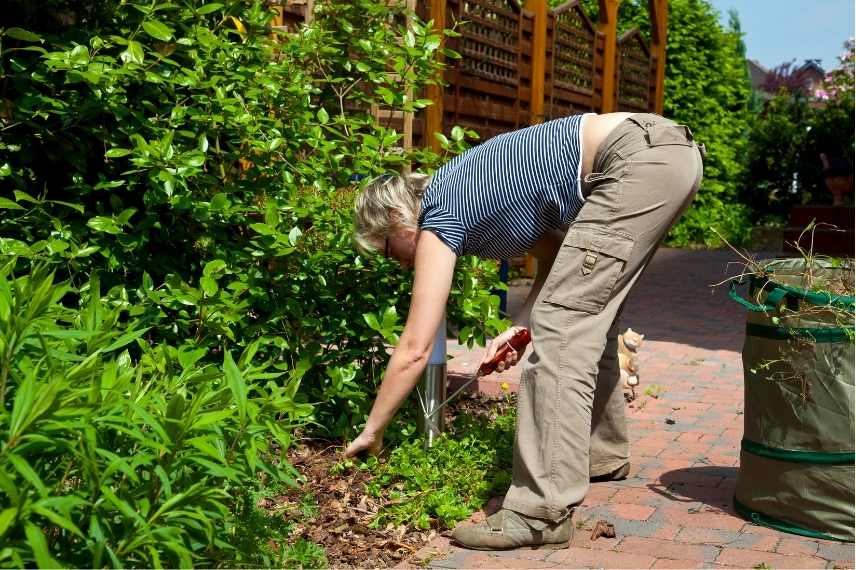
Step 1: weeding!
What depth should the mulch be?
That’s the question most gardeners ask. And it’s often there that the problem lies. We are, in fact, usually not generous enough.It all depends in reality on the nature or material of the mulch, because some will have a greater degree of bulking than others. That is, after a few rains and several weeks, they will settle more than others, but also decompose faster.
We must also take into account the age of the plant: you don’t mulch a tree or a very young plant in a pot with the same amount of mulch.
But, on average, a mulch depth of 5 to 8 cm is regarded as a minimum to reap all the benefits of organic mulching (and 4 to 5 cm for mineral mulching). It is straw and the RCW that should be applied in the thickest layer (between 8 and 10 cm).
This mulch depth increases somewhat when mulching plants that are not very hardy. In that case, be fairly heavy-handed in autumn, before the first frosts, on frost-tender plants such as Dicksonia stumps or Cannas, which can be completely covered with about fifteen centimetres of mulch.
In the vegetable garden, it’s another story: mulching will balance the high temperature rises in summer, but some vegetables don’t appreciate it much (as with alliums). Avoid, in regions where humidity is high, placing it around radishes, carrots and beetroot, as this can speed up rotting. Some vegetables will need more mulching than others, such as all summer vegetables (tomatoes, courgettes, etc.) to help them retain some coolness. Strawberries, delicate and growing close to the ground, deserve a good straw mulch to protect them from rain that damages the fruit. It is also important to take the weather into account! In very wet springs or summers, you may need to wait a while before mulching the vegetable garden, and sometimes even remove an old mulch to prevent a proliferation of snails or small rodents.
My tip: beware mulch made solely from grass clippings, very rich in nitrogen: apply it using dried grass clippings, ideally in the vegetable patch, otherwise they ferment and can scorch the vegetables.
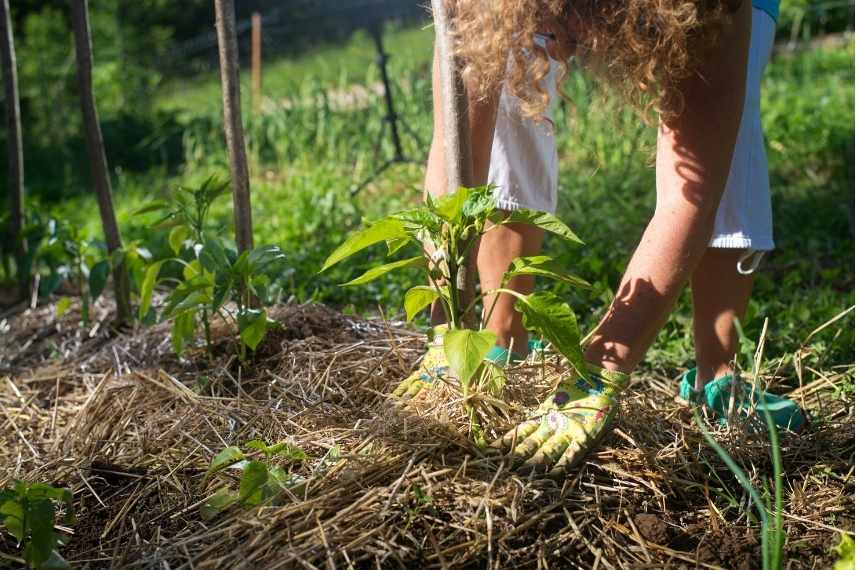
Mulching of pepper plants in the vegetable garden.
How and over what area should the mulch be spread?
Mulching should be laid at the base of a plant. At the base, yes, but with a small caveat: mulch should spread around a perennial, a bush or a tree, no matter what, but always leaving a margin around the plant’s collar (the collar is the transition between the stem and the root system). Otherwise, you risk causing rot, especially to the bark of woody plants.
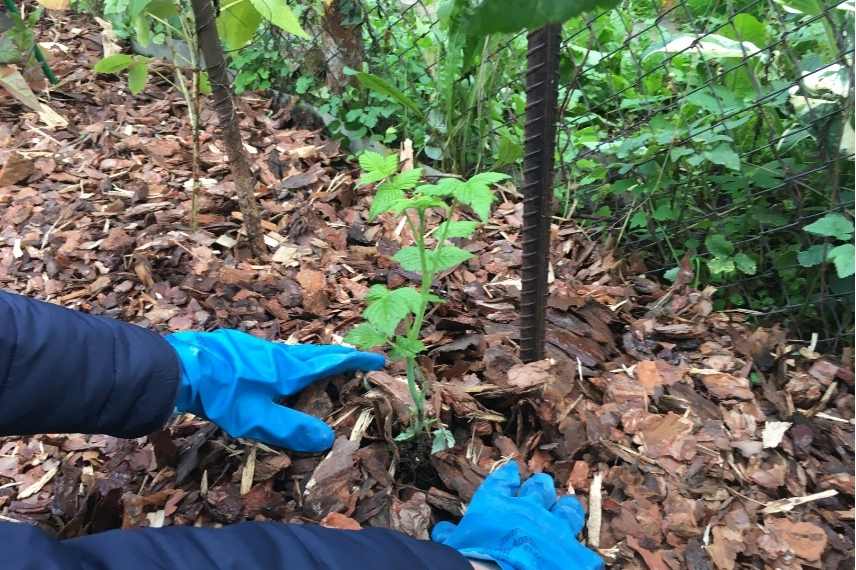
Always clear the plant’s collar
In a large area or on an empty bed layout, don’t hesitate to cover the soil with mulch. You should aim for a uniform spread on a large bed rather than small piles of mulch around each plant. You will limit weeds, and this will also help nourish the soil and, in time, alter its structure with mulches that decompose quickly (for heavy clay soils, for example). In the vegetable garden, you can be selective: limit it to water-hungry vegetables.
Another recommendation: the younger your plant (for example a perennial in a pot planted in autumn or a very young tree), the more you will avoid burying it under mulch. Instead, shape a basin that will help collect rainwater and your irrigation. Conversely, a plant that is already well developed or purchased in spring or at the very start of summer will benefit from generous mulching, even under its leaves, in order to minimise the appearance of adventive weeds.
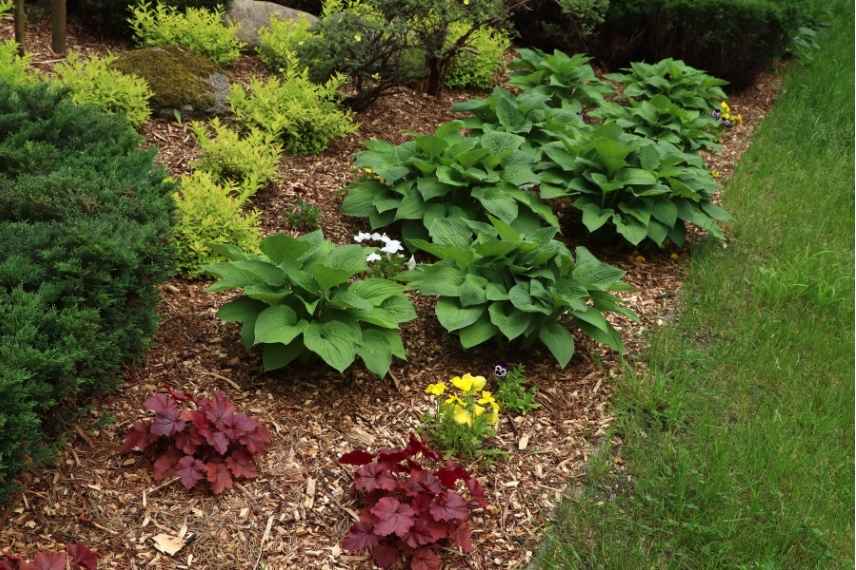
The beds visually benefit from being fully mulched.
Read also
The different organic mulchesWhen to water: before or after laying mulch?
Water thoroughly after applying it, especially if your mulch is fine, like flax flakes or miscanthus. This will prevent that type of mulch from blowing away at the slightest breeze, by tamping it down and fixing it to the soil.
Water, above all, before spreading your mulch: you’ll maintain the moisture the plants need (especially if applied in spring or summer).
In the vegetable garden or on large, drip-irrigated beds, place the mulch over the irrigation system.
When is mulch best applied?
Mulching is generally done when planting, usually in spring or autumn. It is useful to do so at planting time. The important thing is not to place mulch on cold soil. In hot, dry summer, if the vegetable garden had remained naked, mulch, moistening the soil first.
In the vegetable garden, avoid mulching too early to allow the soil to warm up at least beforehand! Between late March and early May, depending on the region.
The specific case of mineral mulches
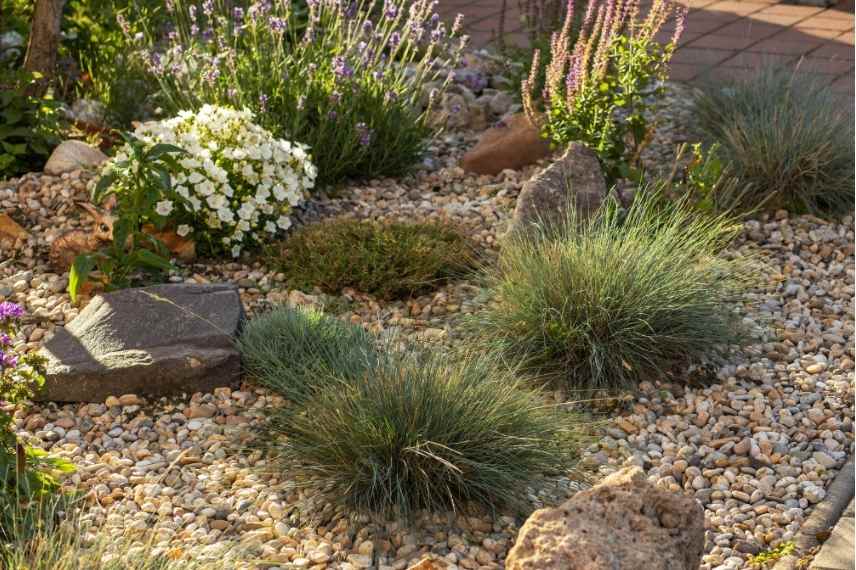
To prevent gravel, pebbles, pozzolana, crushed tiles or slate chippings from mixing with the soil too quickly, ideally lay a geotextile fabric on the soil that has been well prepared before applying your mineral mulch. We are, of course, talking here about dry-border plantings and the layouts of gravel gardens or rock gardens.
How to refresh mulch?
If you have already mulched a border with organic mulch, you will notice that the soil is taking some of it in. This is normal, and even desirable. Therefore, you should re-mulch the border every two or three years, or annually depending on the type of mulch, removing again the adventives that may have developed, and increasing the mulch depth.
In the vegetable garden, you should completely renew the mulch each season, burying it. In case of disease, particularly if the downy mildew has spread to vegetables, the mulch goes straight to the compost. But in general, by the start of a new season, in spring, it has completely decomposed.
- Subscribe!
- Contents
Comments