





























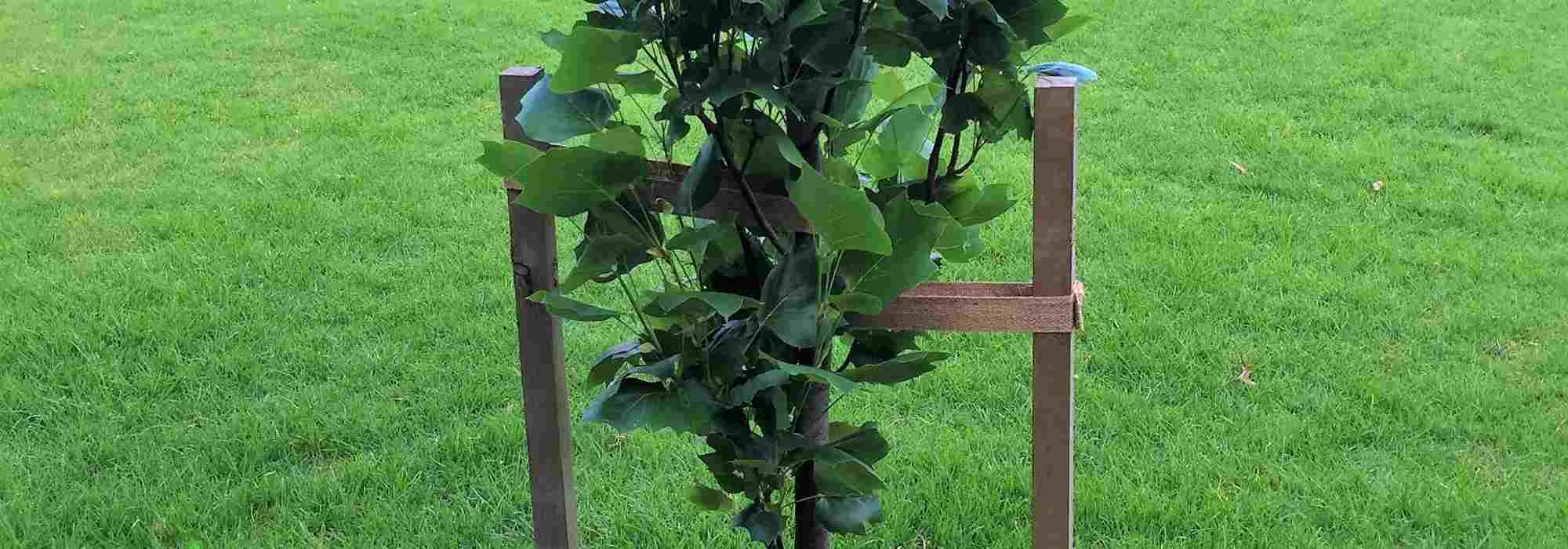
How to straighten a tree after a storm?
the right techniques
Contents
Storms and strong gusts have, unfortunately, become commonplace in our time. And each time, there is damage in the garden. Perennials flattened, broken branches, and sometimes even young trees uprooted. Is it really all over for these last ones? Can we attempt to straighten them up? And if so, how can we do it?
Find in this guide all our tips for straightening a tree after a storm.

A tree needs time to develop a good root system.
It is considered that it takes at least two years after planting for a tree to develop a root system strong enough to withstand strong winds. This is just a minimum, and often, one will count on 4 or 5 years of growth for the tree to remain upright during a storm.
Note: wind is not always the sole cause of a tree leaning. Young fruit trees that produce too much and too quickly can also lean. It is advisable to remove as many fruits as possible during the early years of your fruit tree. This occurs with apple trees, pear trees, and even plum trees.
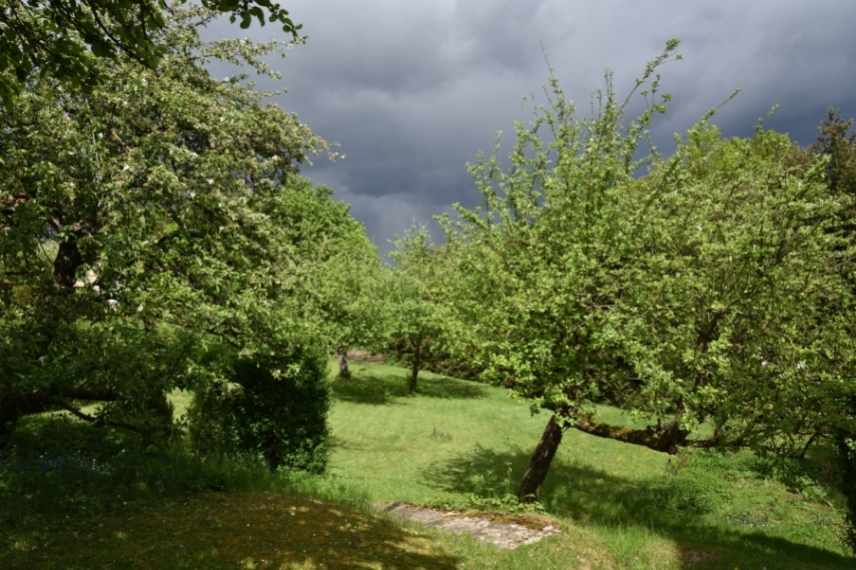 An apple tree in an orchard that has not been straightened or poorly staked during its growth…
Upright a young tree
Initially, we will wait before intervening, unless the tree is at risk of falling completely. The best time to straighten a leaning tree is late autumn or early winter, outside of frost periods. At this time, the soil is well moist. However, if you believe immediate action is necessary: provide at least 20 litres of water at the base of the tree to moisten the soil around the roots.
- Opposite to the lean, plant a stake about 2 m from the tree. The stake should be sturdy and driven deep into the soil (at least 1 metre) using a mallet. A digging bar or a metal stake is a good solution;
- At the point where you will attach the tie to straighten the tree, wrap the trunk with rubber (an old inner tube, for example), fabric (an old T-shirt), or burlap… to protect the bark during the straightening;
- A ratchet strap should preferably be used for the tie between the tree and the stake. This will make the straightening much gentler than simply pulling with your hands. The strap will be wrapped around the tree and the stake, with the ratchet positioned between the two;
- Operate the ratchet of the strap very gently, in small increments, ensuring that the tree straightens properly in line with the stake;
- If, unfortunately, the tree deviates from its trajectory: use a second stake and a second ratchet strap about 2 metres from the tree to put it back “on the straight path”;
- Subsequently, and once the tree is straightened, it will be necessary to prevent it from falling again in the next storm: place an angled stake on the side where the tree leaned before straightening. This angled stake helps to keep the tree in position without damaging the roots. Secure it firmly to the tree using an inner tube, natural jute straps or PVC staking ties designed for this purpose. You will leave this stake for at least 2 years, allowing the tree to develop a solid root system;
- You can now remove the strap and check that the tree remains upright.
In the case of fruit trees, the leaning tree may produce more fruit than usual during the season following its troubles. Remove, in this case, a good portion of the fruit to prevent it from falling again, this time without a storm.
- Subscribe!
- Contents
![[title]How to Straighten a Tree After a Storm
[subtitle]Tips for Gardeners
After a storm, it's common to find trees leaning or bent out of shape. Here are some tips to help you straighten them up:
[bulletlist]
- [param1]Assess the Damage[/param1]: Check the tree for any broken branches or splits in the trunk.
- [param1]Straighten Carefully[/param1]: Gently push the tree back into an upright position, avoiding sudden movements.
- [param1]Support with Stakes[/param1]: Use stakes to support the tree and keep it in place while it recovers.
- [param1]Prune if Necessary[/param1]: Trim any damaged branches to help the tree heal and regain its strength.
- [param1]Monitor Progress[/param1]: Keep an eye on the tree's progress and make adjustments as needed.
By following these tips, you can help your tree recover from the storm and regain its natural beauty in no time.](https://en.promessedefleurs.eu/blogwp/wp-content/uploads/2022/05/redresser-un-arbre-apres-une-tempete-1.jpg "[plantes nom=\"Arbre\"]Redresser un arbre après une tempête peut être crucial pour sa survie et sa santé à long terme. Voici quelques étapes à suivre pour aider l'arbre à se rétablir :
1. **Évaluation des dégâts** : Tout d'abord, évaluez les dommages subis par l'arbre pour déterminer s'il est possible de le redresser en toute sécurité.
2. **Sécurisation de la zone** : Assurez-vous que la zone autour de l'arbre est sécurisée avant de commencer toute opération de redressement.
3. **Redressement progressif** : Utilisez des sangles ou des cordes pour redresser doucement l'arbre. Évitez les mouvements brusques qui pourraient causer davantage de dommages.
4. **Support supplémentaire** : Une fois l'arbre redressé, envisagez de lui fournir un support supplémentaire, comme des tuteurs, pour l'aider à se maintenir en position verticale.
5. **Surveillance continue** : Surveillez régulièrement l'arbre au fil du temps pour vous assurer qu'il se rétablit correctement et ajustez si nécessaire le support fourni.
En suivant ces étapes avec soin, vous augmentez les chances de succès du redressement de l'arbre et contribuez à sa santé future. Si les dommages sont importants ou si vous avez des doutes, n'hésitez pas à faire appel à un professionnel arboricole pour obtenir de l'aide. [/plantes]")
Comments