





























How to successfully grow black radish?
Sowing, growing and care
Contents
The black radish (Raphanus sativus var. niger) is one of those highly appreciated winter vegetables. The large, taprooted, black and rough-skinned roots of this herbaceous plant from the Brassicaceae family are harvested in autumn, before the first heavy frosts. Provided you enjoy its white flesh with a distinctly spicy flavour! Black radish is delicious raw and grated, but it can also be enjoyed cooked, like turnips. To have black radishes in the garden to harvest in autumn, you must anticipate its sowing in summer… I will explain how to sow, care for, and harvest black radish.

What is black radish?
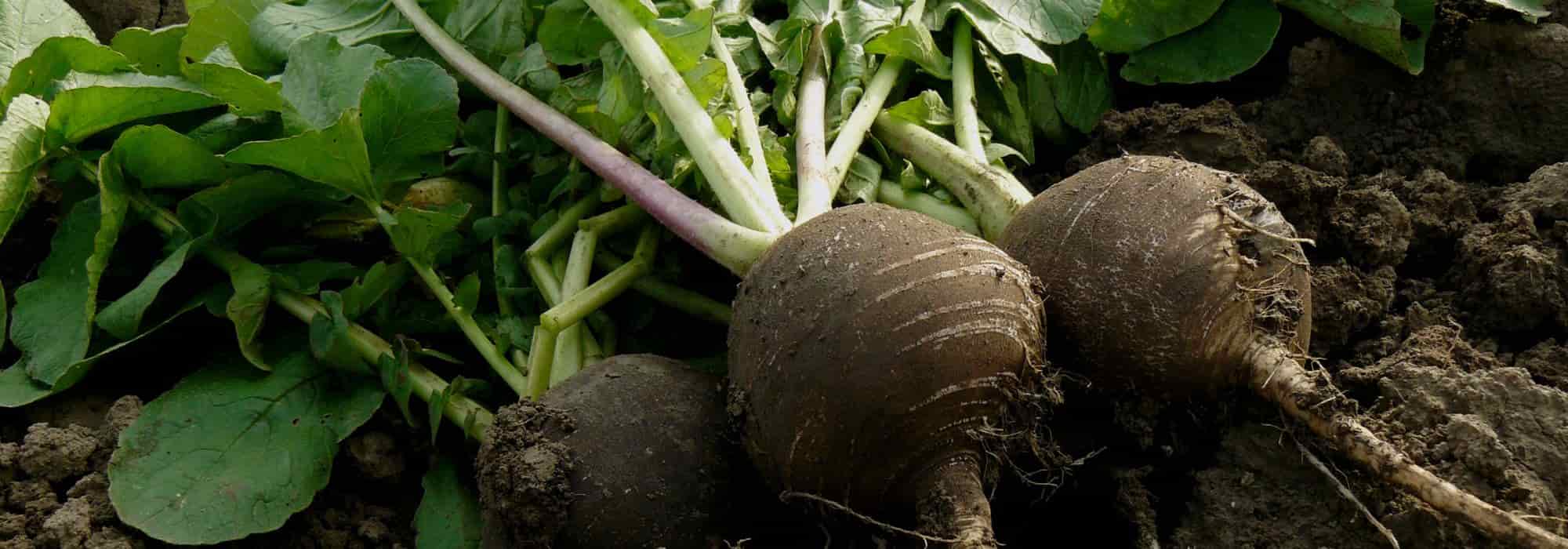
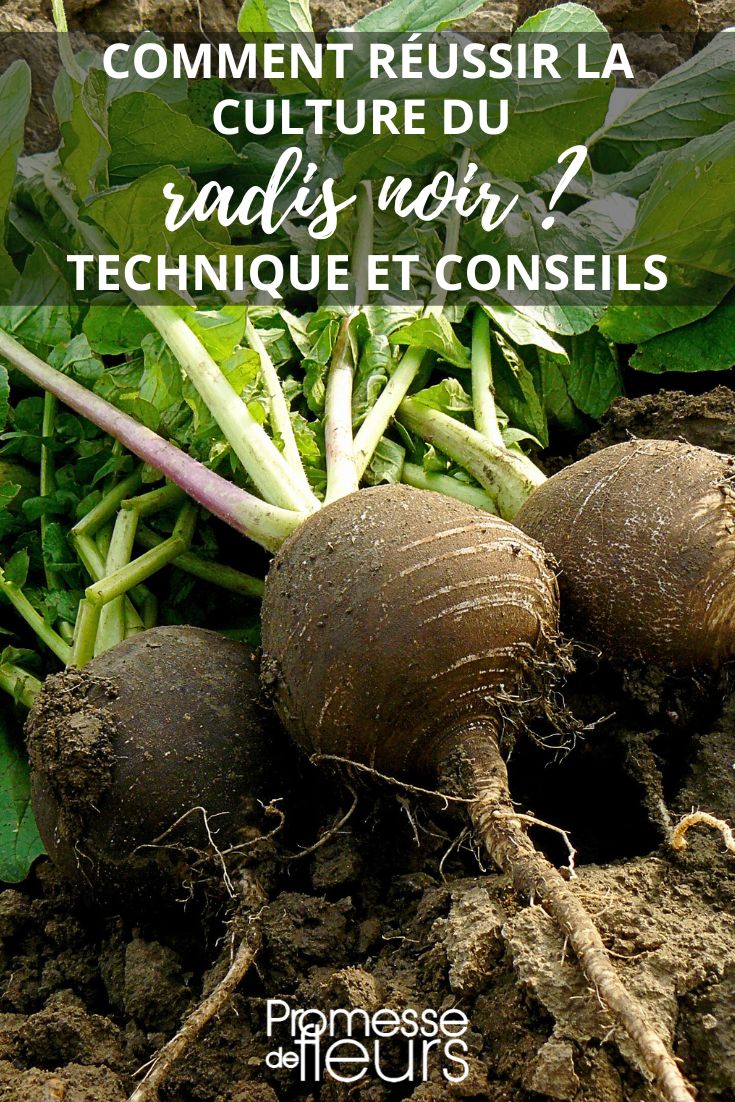
Raphanus sativus var. niger… Obviously, black radish is a very close cousin of the small red and white radish that is enjoyed “raw with salt” from spring to autumn. However, it is quite different in size and especially in its growing and harvesting period. Indeed, black radish is a winter vegetable plant. Its long taproots, usually 15 to 20 cm long and 5 to 7 cm in diameter (although round roots do exist!), have a rough skin, black or purplish, and offer pure white, crunchy flesh with a delightfully spicy flavour.
The foliage of black radish forms a compact tuft of deeply lobed, fairly villous leaves, arranged in a basal rosette. The leaves are borne on tender petioles. As a biennial plant, black radish produces white and purple flowers in the second year after planting. 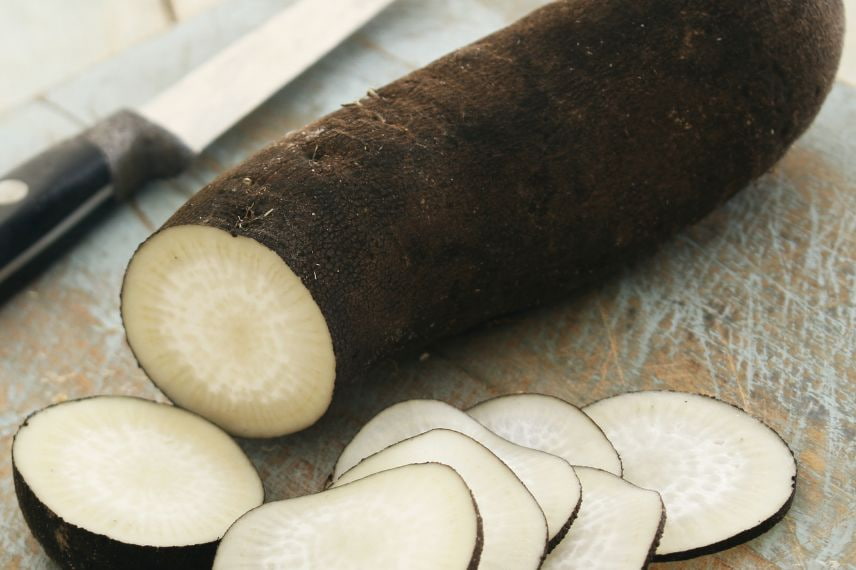
Black radish is notable for its richness in vitamin C, but also in sulphur, a property that allows it to benefit the beauty and quality of skin, hair, and nails. It is also worth highlighting that it has a significant content of vitamin B, phosphorus, magnesium, calcium, copper, iodine, iron… It is also a recognised diuretic and anti-scurvy agent, recommended for diabetics and those with bladder or gallbladder issues. Furthermore, it is low in calories (25 kcal/100 g) and high in fibre.
Read also
Radish: sowing, growing, harvestingSowing black radish: when? where? how?
Sowing black radish is not particularly complicated; you just need to plan ahead to harvest its beautiful fleshy roots with black skin.
When to sow?
Black radish is sown in summer, from mid-June to August, or even September in regions with a mild climate. However, unlike its rapidly growing cousin, you should expect at least 3 to 4 months between sowing and harvest. Additionally, the taproots of black radish freeze at temperatures below -3 °C, which often leads to rotting.
Where to sow?
Black radish is somewhat particular about its location: it must be planted in a sunny spot. While it enjoys warmth, black radish prefers regions with a temperate climate.
On the other hand, it is more accommodating regarding soil type, although it prefers rich, cool, deep, and rather light soils. Thus, a well-worked, loose, humus-bearing sandy soil will make it happy.
The autumn before sowing, it is wise to incorporate well-decomposed manure or compost into the soil.
Sowing should preferably be done during the waning moon.
How to sow?
- Soak the seeds in warm water for 24 hours to speed up germination. The seeds are ready to sow when they have swollen and the germ is slightly visible.
- Draw furrows spaced 20 to 30 cm apart and 2 to 3 cm deep.
- Sow sparsely, ideally one seed every 10 cm.
- Cover with a thin layer of crumbly soil.
- Firm down with the back of a rake.
- Water generously with a fine spray.
To achieve staggered harvests, it is beneficial to sow in intervals until the end of August. When the seedlings have at least 2 to 3 leaves, thin them to 10 cm apart, keeping the strongest ones.
Black radish can be sown in pots, provided you choose a container that is deeper than it is wide.
Care
Knowing that black radish will have to endure the intense summer heat, it is essential to ensure regular watering to keep the soil continuously moist. Watering will therefore be very frequent to facilitate root growth and avoid an overly pungent flavour. And, in case of extreme heat, watering should be generous.
To retain soil moisture, it is highly recommended to mulch black radishes. This mulching will also serve to protect the radish roots from early frost episodes in regions with the harshest climate. 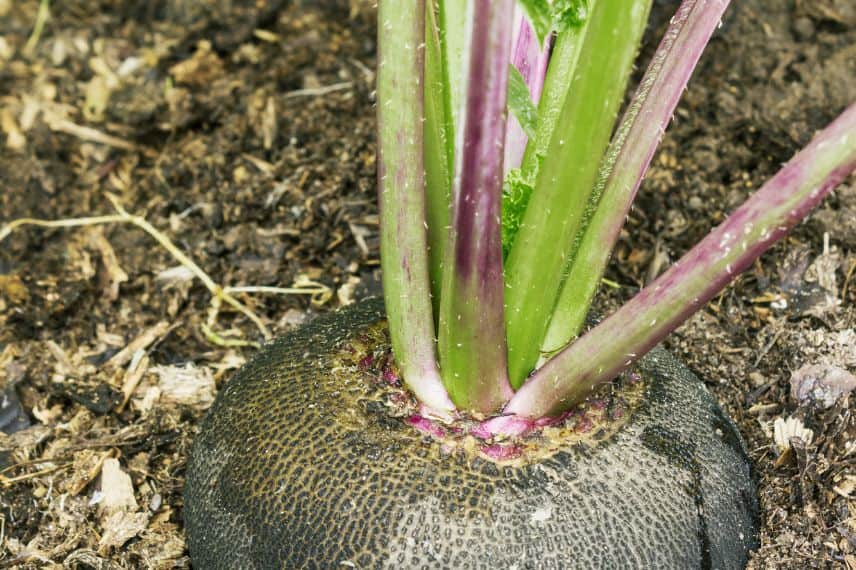
If your rows of black radishes are not mulched, it is important to manage weeding to prevent adventive plants from competing with the radishes.
Finally, it is crucial to keep a close eye on slugs and snails that may attack the young shoots. Discover all our solutions: 7 ways to fight slugs effectively and naturally
Read also
How to choose your radishes?When and how to harvest black radish?
Three months after sowing, you can start harvesting black radishes. However, it is preferable to wait until mid-September. Harvesting can continue until mid-November, that is, before the heavy frosts, depending on the region.
The pulling of black radish clumps is best done on a dry day, using a fork. They should be left to dry for a full day, meaning they should be allowed to dry on the ground. 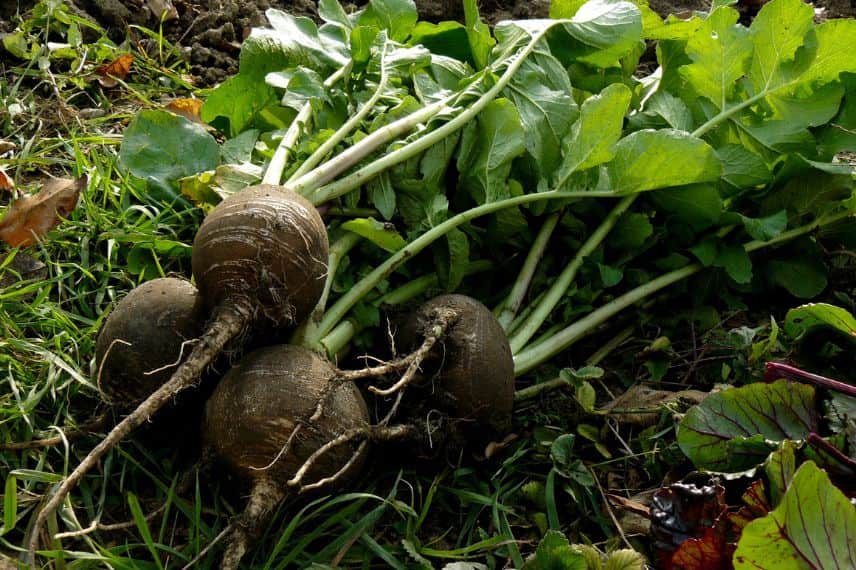
If you want to store your black radishes for consumption throughout the winter, pull off the foliage by simply twisting it above the collar. Removing the leaves is preferable to cutting them with a knife, as it minimises the risk of rot.
The preservation and consumption of black radishes
If black radishes are much better, firmer, and crunchier when consumed immediately after harvesting, they can still be stored for 4 to 5 days in the vegetable drawer of the refrigerator.
They can also be easily stored throughout the winter in an outdoor silo or in a wooden crate filled with sand and placed in a cool, dry, and well-ventilated room. They can be kept there for at least 3 months. For better preservation, it is advisable to place the black radishes upright and especially to harvest them on a dry day. Also, remember to remove any soil that may be stuck to them.
Otherwise, black radishes can be eaten raw, grated or sliced thinly. They can also be pickled. They are easy to incorporate into a soup, but can also be enjoyed as sautéed rounds in a little olive oil.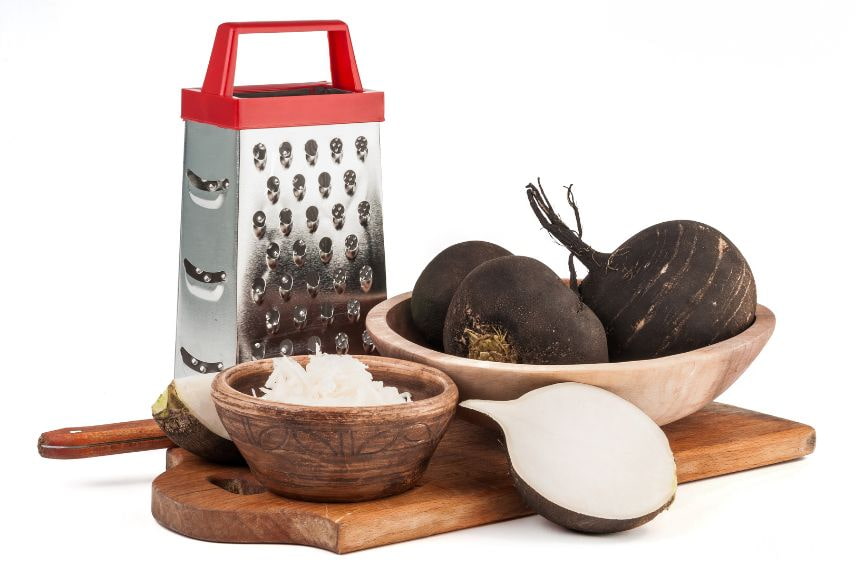
Which variety to choose?
There are several varieties of black radishes, among which some dominate the market:
- The ‘Long Black Winter’ offers very long cylindrical roots (up to 25 cm) with a very dark skin
- The ‘Large Round Winter’ is a variety with spherical radishes that have a pointed tip. Its flesh is firm and very white
- The ‘Large Long Winter of Paris’ produces roots up to 30 cm long
- The ‘Violet de Gourmay’ has a purplish skin and fairly sweet flesh
- The ‘Clock Weight Long’ produces cylindrical roots of 20 cm with firm white flesh
- Subscribe!
- Contents
Comments