


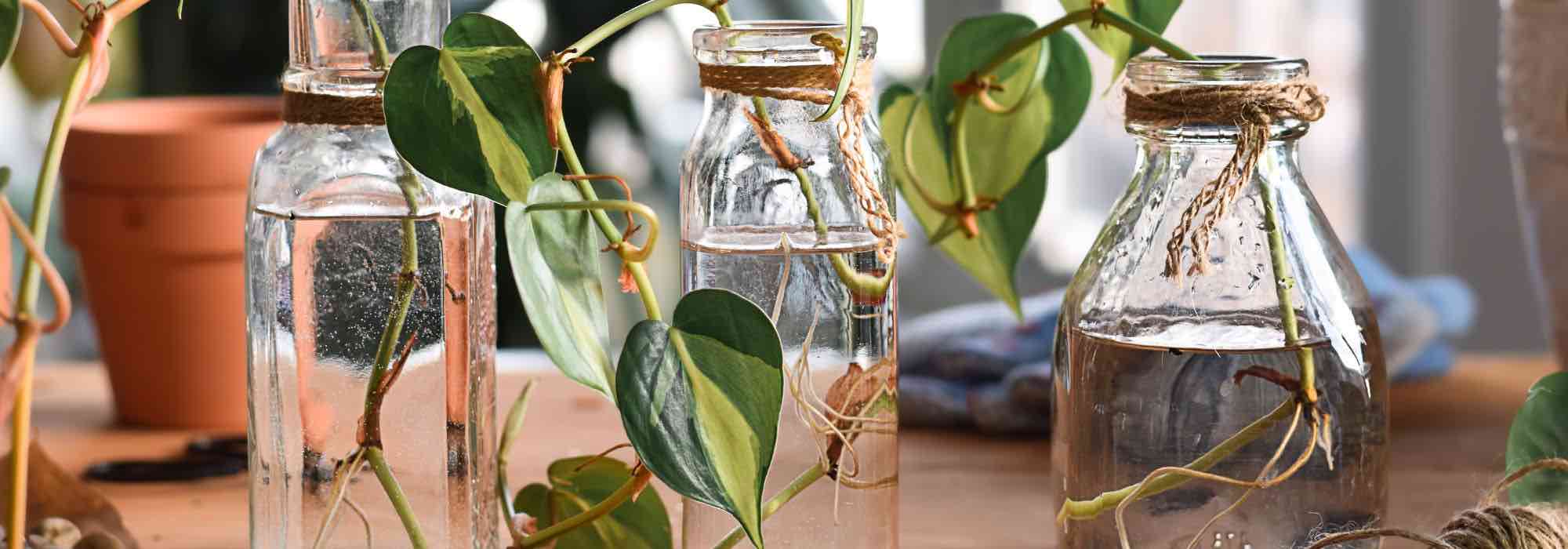
How to take cuttings from indoor plants?
Different methods for propagating houseplants
Contents
Indoor plant propagation by cuttings is an economical and rewarding way to create new plants from those you love. Whether you want to expand your collection of indoor plants, share your favourite varieties with friends, or rescue a plant that is looking a little poorly, propagation by cuttings is a rewarding activity in every respect, often quite straightforward to carry out.
Imagine the satisfaction of watching a new plant grow and thrive from a single cutting, creating a special connection with your beloved species.
Discover in this article the various methods of propagation by cuttings available and how to put them into practice.

Understanding propagation by cuttings: definition and exploration of the different methods
Propagation by cuttings is a vegetative propagation technique that involves growing new plants from fragments of a mother plant.
Several methods of propagation by cuttings can be used successfully for indoor plants, each with its own advantages and unique challenges. Depending on the species, some succeed better than others; it may be worth trying a few experiments or, alternatively, researching the appropriate methods for a given plant.
From the plant, one can take either a piece of stem, a leaf or a root to take cuttings.
Different propagation media
- Water cuttings: Some plants can be rooted directly in water; this is the most common method for stem cuttings.
- Sphagnum moss cuttings: Sphagnum moss is a natural medium that can be used to root cuttings, providing constant humidity.
- Potting compost cuttings: Potting compost is a versatile propagation medium, ideal for many types of indoor plants.
- Vermiculite/perlite cuttings: These substrates help with water retention and air circulation, thereby promoting rooting.
- Clay pebbles cuttings: Clay pebbles are commonly used for hydroponic cuttings, providing physical support for the cuttings.
- Passive hydroponic propagation: This substrate-free method involves growing cuttings in a nutrient solution, thereby accelerating root growth.
- Humidity-assisted cuttings: By placing cuttings in a humid, confined environment, rapid rooting can be encouraged.
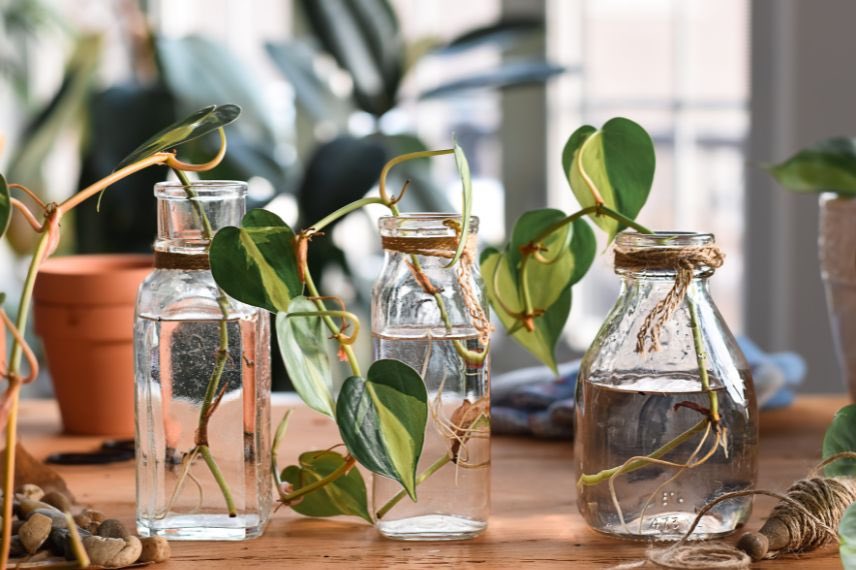
Cuttings are also decorative elements
When to take cuttings?
The success of propagation by cuttings depends on the right moment to take cuttings. Generally, spring and summer are the most favourable seasons, as plants are in active growth and daylight is at its peak. Taking cuttings in December is much more challenging to achieve in our latitudes.
Before taking a cutting, ensure the mother plant is healthy and disease-free. Choose young and vigorous stems or leaves for best results. Do not take cuttings from a plant that is too young or too small, not sufficiently developed.
It can also happen that a cutting is taken to save a still-healthy part of a diseased or ailing plant. This is well worth trying to regrow a cherished plant from a small cutting that you are losing. In that case, isolate your cutting from other cuttings to avoid spreading a disease.
How to take cuttings?
Tools and materials needed
To succeed with propagation by cuttings, it is essential to have the right tools and materials to hand. You’ll need clean, sharp garden scissors to cut cuttings, sterilised with 90% alcohol. Also have appropriate containers or pots for rooting and suitable substrates if you are not taking cuttings in water (potting compost, sphagnum moss, vermiculite, etc.).
Taking a cutting
From the plant, three types of segments can be taken:
- Stem: Stem cuttings are among the most common and straightforward. They involve cutting a section of a healthy stem containing several nodes, then rooting in a suitable medium.
- Choose a healthy, non‑flowering stem from the mother plant.
- Use clean, sharp garden scissors to cut the stem just below a node (the point where leaves are attached to the stem).
- Remove leaves from the node and below the node to prevent them from rotting in the propagation medium.
- Keep 2 to 3 leaves above the node, but remove the rest.
- If desired, dip the cut end in a rooting hormone to stimulate root growth.
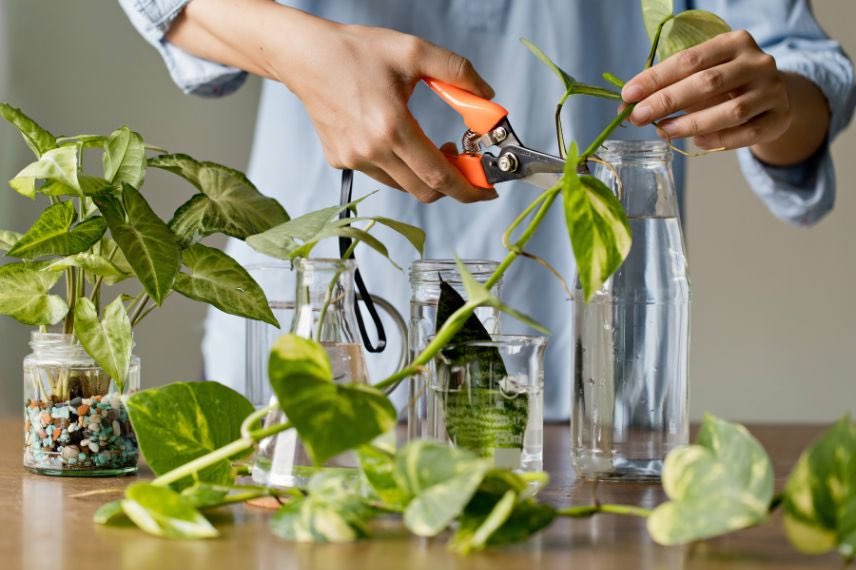
Cut stem just below a node
- Leaf: This type of cutting involves splitting a healthy leaf into sections and rooting them to form new plants. Or sometimes leaving the leaf whole. This method is often used for certain types of begonias and for succulent plants.
- Select a healthy leaf from the mother plant.
- Optionally cut the leaf into sections (not for succulent plants), ensuring to include a portion of the central vein.
- Place the leaves or leaf sections in an appropriate substrate, based on potting compost or sphagnum.
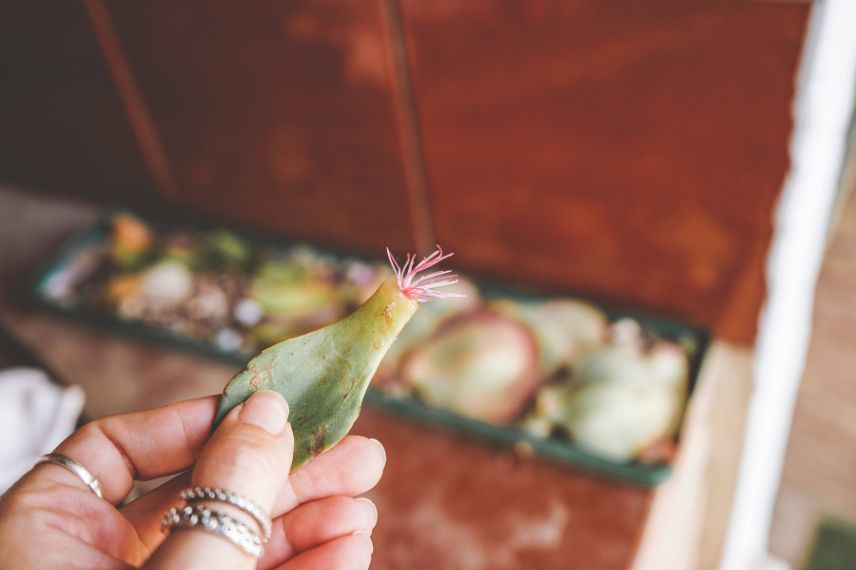
A single succulent leaf laid on potting compost forms roots
- Root: Root cuttings involve cutting healthy roots into pieces, which are then encouraged to produce new shoots. This method can be used for plants in the Araceae family, for example. Root cuttings are less common, but can be effective for some plants.
- Select healthy, fleshy roots from the mother plant.
- Cut the roots into pieces about 2 to 3 cm long.
- Plant the root pieces in a well-drained potting compost–based substrate, with the cut end facing down.
- Alternatively, lay the roots horizontally on a bed of sphagnum. Ensure the segments are in good contact with the sphagnum.
Then place the cutting in the chosen propagation medium, keeping light, steady humidity. Place it in a well-lit area, but without direct sunlight.
Read also
How to repot a houseplant?How to root?
Some methods are more suitable than others depending on plant types. But often several methods are suitable for a plant. It’s worth experimenting, but you can also find information on appropriate methods by researching your specific plant.
Water propagation
Many plants can be propagated directly in water. It is a visually appealing method that makes it easy to monitor root development. It only works for stems.
- Cut a healthy section of stem from the mother plant as described above and place it in a clear glass container filled with water.
- Ensure that the lower nodes are submerged in the water.
- Regularly change the water to avoid stagnation and ensure that roots begin to form before transplanting into an appropriate substrate.
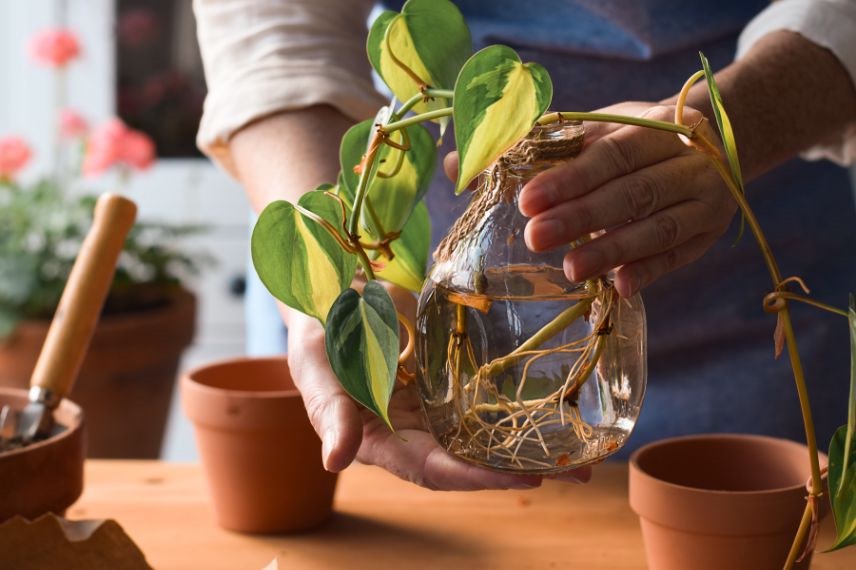
A water-propagated plant that has developed enough roots to be transplanted
Sphagnum moss or potting mix cuttings, in a humid environment
Sphagnum moss is a natural substrate that maintains constant humidity, ideal for propagation by cuttings. It is used on its own. There are special propagation potting mixes. Drainage materials such as perlite and vermiculite are added to lighten the potting mix and promote rooting. This method is suitable for leaf and root cuttings.
- Place cuttings in a pot or container filled with substrate or sphagnum moss, pre-moistened.
- Couvrez le pot avec un sac en plastique transparent ou une cloche en plastique pour créer une atmosphère humide.
- Placez le pot dans un endroit lumineux sans soleil direct jusqu’à ce que les racines se développent.
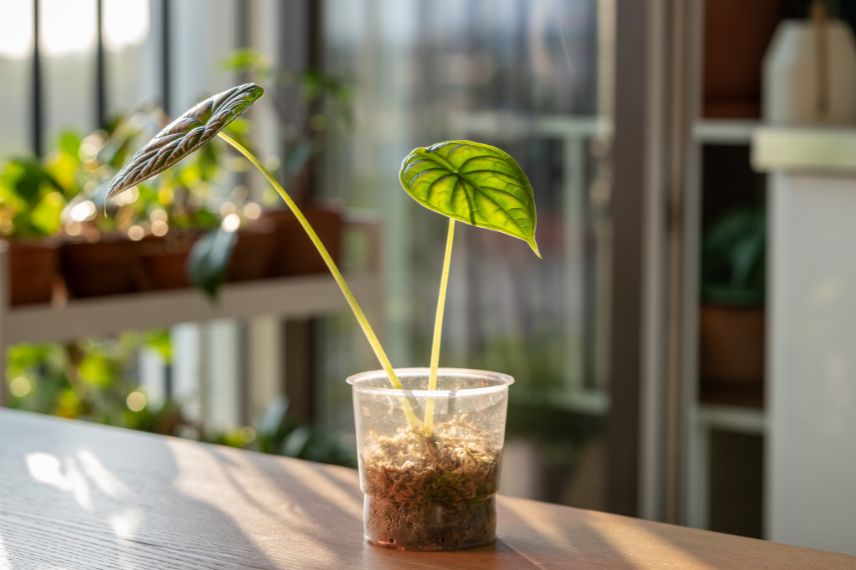
A plant in pure sphagnum moss
Passive hydroponic propagation: vermiculite/perlite or clay balls
These methods involve placing cuttings in various mineral components to encourage rooting.
- Choose a transparent plastic pot (like orchid pots) with drainage holes.
- Fill it with an equal mix of perlite and vermiculite or fill it entirely with clay balls.
- Place this container in another slightly larger, transparent container, partially filled with water.
- Set your cutting in the upper container.
- Ensure the water reaches the top few centimetres of the substrate.
Water will rise by capillary action into the upper container and supply the cutting with what it needs. Sometimes, for this method, nutrients are added to the water.
By using these various propagation-by-cuttings methods, you can experiment and discover which technique works best for each type of houseplant you want to propagate.
After propagation by cuttings
Caring for cuttings
During rooting, cuttings require careful attention.
- For cuttings kept in a humid environment, maintain constant, light humidity in the propagation medium.
- For cuttings in water and in hydroponics, change the water regularly and check the water level.
Transplanting the rooted cutting
Once the roots are well developed, it is time to transplant the rooted cutting into an individual pot with suitable substrate. Adjust the watering to suit the new environment.
By mastering the art of propagation by cuttings of indoor plants, you can create an abundance of new plants from your favourite specimens. Whether you are a beginner or an experienced gardener, propagation by cuttings is a valuable skill that will enrich your experience with indoor plants. So dive in and create your own flourishing indoor garden using this rewarding and eco-friendly method.
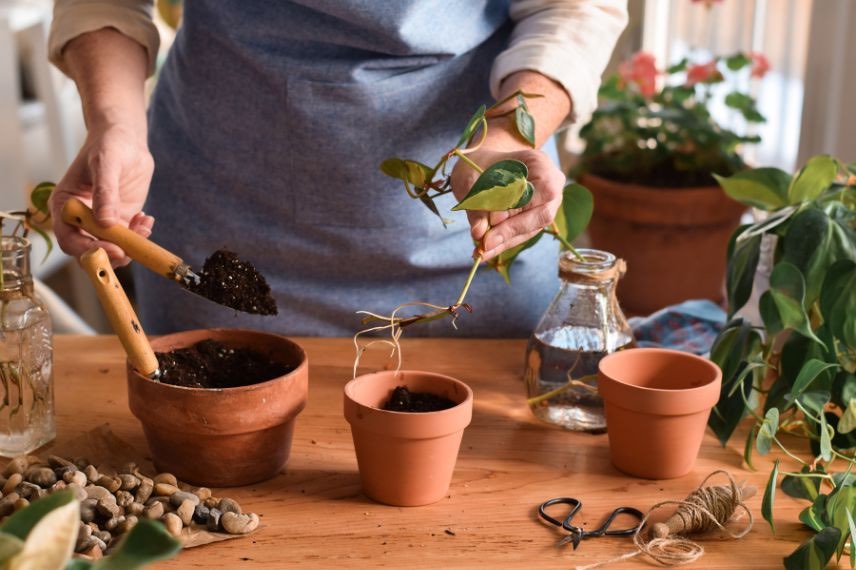
It’s time to pot up the cutting into potting compost
- Subscribe!
- Contents

Comments