


Identifying the main parasitic insects and plant diseases
The Basics
Contents
Aphids, scale insects, downy mildew or powdery mildew: unfortunately all gardeners know these disease- or parasite-related problems, which weaken plants, damage their foliage, their flowering, ruin the harvests, and sometimes threaten the survival of plants. It is important to know how to recognise the symptoms and to identify them as early as possible to limit the damage, especially since a parasite or a disease that is not controlled risks spreading to other plants in the garden… Discover all our tips for identifying the most common diseases and parasitic insects, avoiding them and knowing how to react when plants are affected!

The main parasitic insects
Aphids
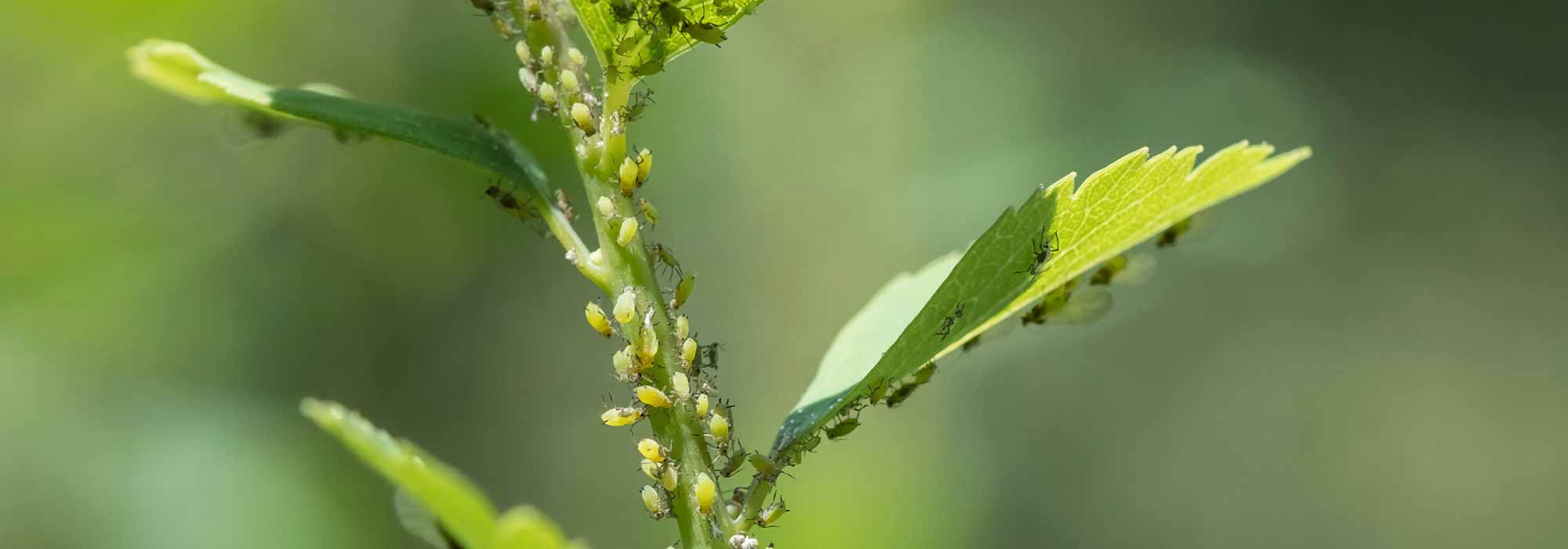
Aphids are small black or green insects that pierce plant tissues and suck sap for nourishment. They are usually found in groups on new shoots and undersides of leaves. They weaken the plant and can cause leaf deformation. They also produce a sweet substance called honeydew, which promotes the development of sooty mould, a blackish fungus that covers the surface of leaves and limits photosynthesis.
Control methods: Initially, you can disperse aphid colonies with a jet of water. However, in cases of heavy infestation, we recommend using black soap (15 to 30 g per 1 litre of water), to spray onto the plant. As a last resort, use a pyrethrum-based insecticide. For a more ecological approach, introduce natural predators such as ladybirds, hoverflies or lacewings into your garden.
Our advice sheet “Aphid: identification and treatment”
Mealybugs
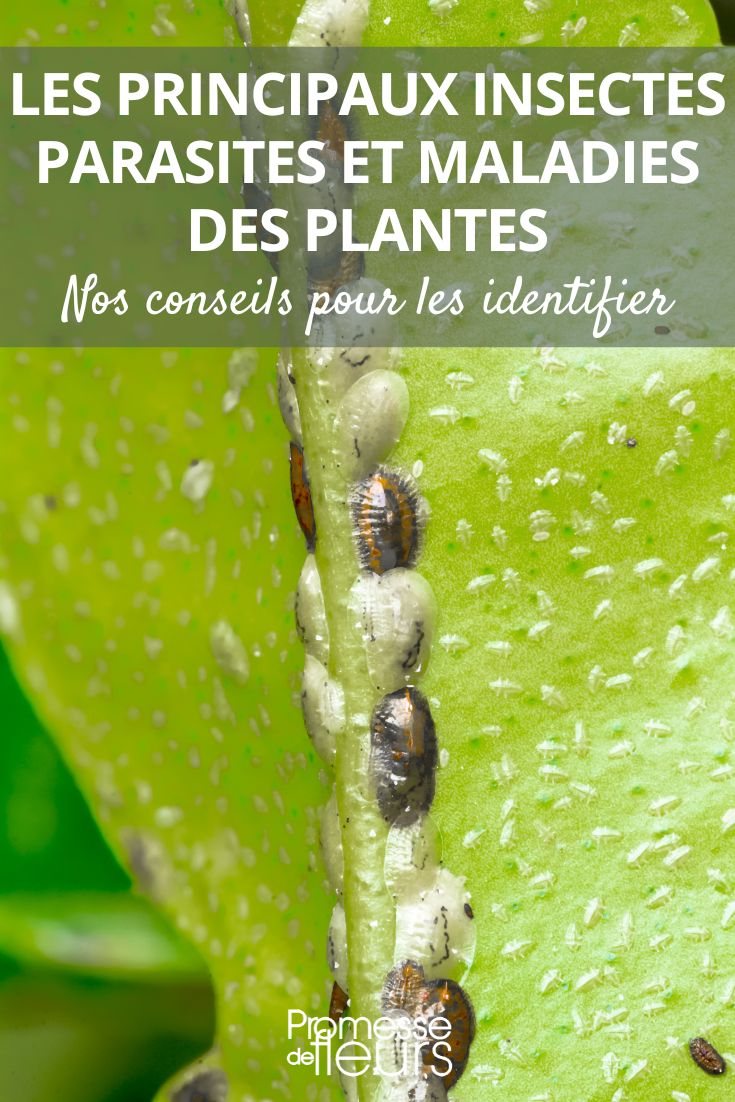
Mealybugs are small piercing-sucking insects that attach firmly to plants and feed on their sap. There are several types: mealybugs, armoured scale insects and shield scale. Small and discreet, they are often hard to spot. Mealybugs favour confined, warm and humid environments. Like aphids, they weaken plants by sucking their sap and produce honeydew that promotes the appearance of sooty mould.
Control methods: You can remove mealybugs with a cotton swab dipped in 90° alcohol or soapy water. For shield scale, use a knife to lift the waxy shells from the stems, taking care not to injure the plant. You can also make an anti-cochineal solution by diluting a teaspoon of black soap, a teaspoon of alcohol and a teaspoon of rapeseed oil in a litre of water. Mix and spray on affected plants. Also encourage biodiversity in your garden by installing insect hotels. Ladybirds, hoverflies, bugs and lacewings are natural predators of mealybugs.
Our advice sheet “Mealybug: identification and treatment”
Red spider mites
Red spider mites or tetranychus tisserands are tiny mites barely visible to the naked eye. They weave fine webs on plants, usually on the undersides of leaves. Red spider mites suck the contents of plant cells, causing yellow or white spots on leaves. With severe infestation, leaves may drop.
Control methods: You can combat red spider mites by spraying water on the plants (they hate humidity). In case of heavy infestation, mix a few drops of rosemary essential oil into some black soap and rapeseed oil. Dilute everything in a litre of water, then spray on the plant. Chrysopa larvae feed on the eggs of red spider mites; place an insect hotel near your plants to attract them.
Our advice sheet: “Red spider mite: identification and treatment”
Whiteflies
Whiteflies, also called flying whiteflies, are small winged insects white in colour that fly off in swarms as soon as you approach the plant. They reproduce quickly (the female can lay up to 600 eggs) and can attack a wide range of plants, mainly in greenhouses, but also indoors and in the garden. Their larvae are found on the undersides of leaves. Whiteflies suck sap and also produce honeydew. Leaves sometimes yellow and drop.
Control methods: You can install yellow sticky traps to catch whiteflies. If needed, also use black soap added with vegetable oil, diluted in water and sprayed on the plant. Geranium essential oil is also effective against whiteflies.
Our advice sheet “Whitefly or aleurode: identification and treatment”
Thrips
Thrips are small elongated insects, measuring between 1 and 2 mm long, and are generally dark brown or black. Thrips pierce plant cells to suck their contents, causing white or silvery spots on leaves. These may dry and drop. Young shoots, flowers and fruits can also become deformed and necrotic.
Control methods: Thrips enjoy warmth and dryness, so you can limit infestation by spraying water on the foliage. You may also use blue sticky traps with thrips attractant to catch adult males and limit reproduction. You can also use black soap, neem oil or, as a last resort, a pyrethrum-based insecticide.
Discover our sheet “Thrips: identification and natural treatment”
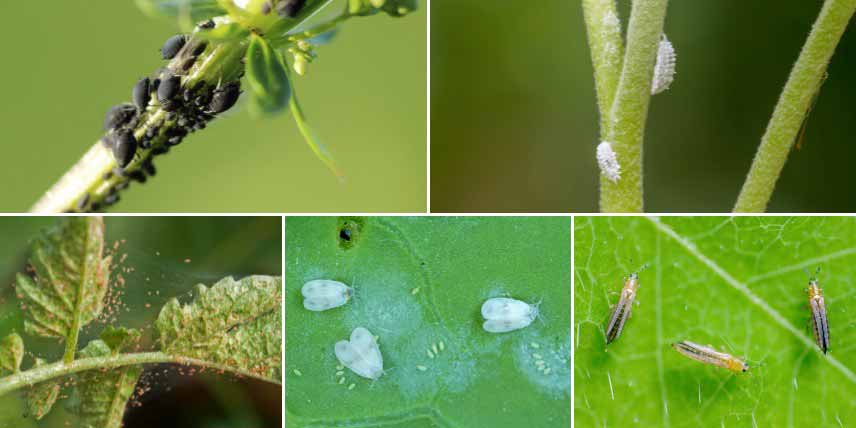
From left to right and top to bottom: aphids, mealybugs, red spider mites, whiteflies and thrips
The most common diseases
Powdery mildew
Powdery mildew is a cryptogamic disease (caused by a fungus) that manifests as a white-grey, floury deposit, on leaves, young shoots and flower buds. It Weakens the plant and can cause leaf distortion and dropping, and sometimes ultimately the plant’s death. It affects notably the roses, asters, the courgettes, cucumbers, tomatoes… This disease is favoured by a confined environment, with warm and dry air.
Treatment method : You can treat powdery mildew using a sulphur-based fungicide. Preventing powdery mildew often involves keeping the plants well spaced for good air circulation. On vegetable plants, powdery mildew usually appears late in the season, and it is often unnecessary to treat.
Our advisory sheet “Powdery mildew or white disease”
Botrytis
The Botrytis cinerea, also called grey mould, causes brown spots on the leaves, which then become covered with a grey felt. Botrytis also leads to the wilting of flowers and the rotting of fruit. This disease notably affects peonies, tulips, begonias, tomatoes, cucumbers, courgettes, strawberries… It is favoured by damp, warm conditions, mainly in spring or autumn. As a precaution, avoid planting too closely and prune foliage to allow a good air circulation.
Treatment method : Remove and discard the infected parts of the plant. We also recommend preparing a garlic decoction or using a sulphur-based fungicide.
Our advisory sheet on botrytis.
Sooty mould
Sooty mould is caused by a fungus that grows on the honeydew secreted by aphids, scale insects, whiteflies… The leaves then become coated with a black film, resembling soot. It is not a very serious disease in the sense that it does not directly threaten the plant’s survival, but it does nevertheless block photosynthesis, which weakens the plant.
Treatment method : The treatment consists of controlling the insects that produce the honeydew, on which sooty mould grows. Clean the leaves with a damp cloth to remove the sooty mould.
Our advisory sheet: “What is sooty mould?”
Rust
Rust is caused by microscopic fungi, and appears as orange-rust pustules on the underside of the leaves. It can cause yellowing and leaf drop.
Treatment method : Remove infected leaves and use a fungicide such as the Bordeaux mixture or sulphur. Prevention includes avoiding water on the leaves when watering.
Discover our advisory sheet: “Getting rid of rust disease”
Anthracnose
Anthracnose is a cryptogamic disease that causes brown spots, often with a yellow halo, on leaves, stems and fruit. It notably affects vegetables such as beans, peas and melons, soft fruits such as redcurrant bushes, raspberries and strawberries, but also vines, cherry trees, walnut, the plane tree… This disease can cause leaf, flower and fruit drop.
Treatment method : The treatment involves removing the infected parts of the plant and using fungicides. Prevention includes keeping a clean garden and good air circulation between plants.
Our advisory sheet on anthracnose
Chlorosis
Chlorosis is not really a disease, but rather the symptom of a deficiency. The most common is iron chlorosis, indicating a problem with iron uptake, often caused by too high a pH or an excess of lime in the soil. It shows as yellowing of the leaves while the veins remain green, and is most often observed on roses, ericaceous plants (rhododendrons, camellias…), citrus… Chlorosis can slow the plant’s growth and in severe cases cause leaf drop.
Treatment method : The most important thing to avoid chlorosis is to choose plants suited to your soil. If the soil is calcareous, avoid planting ericaceous shrubs or other lime-sensitive plants. You can nevertheless grow them in pots in a suitable compost, mixed with ericaceous peat.
However, if your plants are chlorotic, we recommend applying well-decomposed compost, plus a little heath soil, watering with rainwater, and mulching with pine needles. If that is not enough, apply a product containing chelated iron, to be diluted in the watering water.
Our advisory sheet “Iron chlorosis”
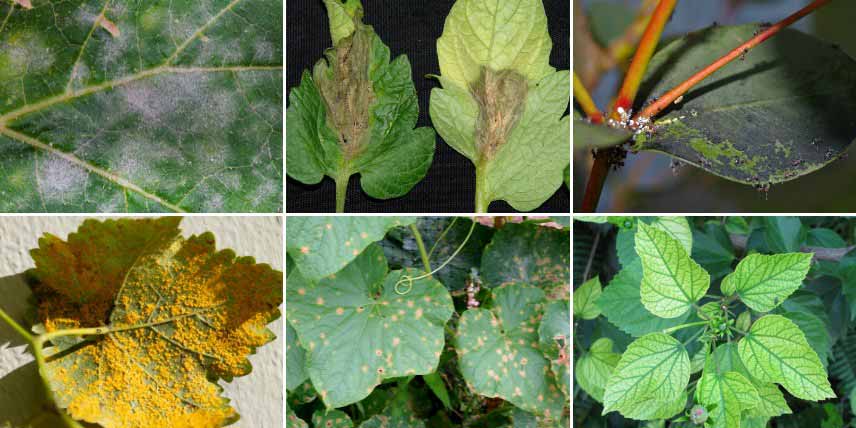
Powdery mildew, Botrytis (photo: Scot Nelson), sooty mould, rust, anthracnose and ferric chlorosis (photo: Malcolm Manners)
Detect pests and diseases as early as possible
Regular monitoring of your garden is essential for early detection of pests and plant diseases and to limit their spread. Here are a few tips to help you with this process:
- Examine the leaves: Regularly check the foliage of your plants to quickly detect damaged leaves: yellowing, wilting, spotted or deformed… The presence of small holes may indicate that an insect is feeding on your plants, while the spots or the powdery mildew on the foliage is often a sign of a disease. Remember to look at the undersides of the leaves: insects or their eggs are often hiding there. If the leaves wilt, become soft or dry, this may indicate, for example, that the roots are suffocating or that a fungus blocks the sap flow within the plant…
- Observe the insects and learn to identify them, to know whether they pose a danger to your plants or not. Conversely, you may be able to spot beneficial insects, such as lacewings, which are predators of aphids.
- Follow the growth cycle: If your plants do not develop as expected or if their growth seems delayed, this can be the sign of an underlying problem: nutrient deficiency, disease or presence of parasitic insects…
- Watch for colour changes: Fungal or bacterial diseases can often cause colour changes in plants. For example, powdery mildew appears as a white deposit on the leaves, while black spot causes black spots on rose leaves.
Preventive measures
Here are some tips and measures to keep your plants healthy:
- Adjust watering your plants to their needs : Excess moisture can cause root rot and promote the spread of certain fungal diseases, while if your plants lack water and suffer from a water deficit, they also become more fragile. You should consider your plants’ needs and the soil type to tailor the watering accordingly. To check whether a plant needs water, scrape a little soil from the top centimetres to see if it is dry, and look at the leaves: if they are soft and droop, your plant is probably thirsty. It is best to water at the base of the plants, avoiding wetting the foliage. We also recommend installing a layer of organic mulch to keep the soil cool for longer.
- Also adjust fertilisation: Plants need nutrients to grow and defend themselves against pests and diseases, but preferably provide compost rather than fast-acting fertilisers. Likewise, excess nitrogen leads to rapid growth, but makes plants more fragile and more attractive to certain insects.
- Avoid planting densely and prune from time to time to ensure good air circulation. Thin out the foliage when it is dense. Plants need good air flow to prevent fungal diseases. Avoid confined environments: for example, if your plants are under a greenhouse or under a frame, think about ventilating regularly.
- In the kitchen garden, practice crop rotation: This practice helps prevent the buildup of pests and diseases specific to certain plants in the soil. Also consider companion plants: the marigold, for example, is known to repel whiteflies, flea beetles and aphids.
- As soon as you see them, remove dead or diseased parts by pruning, and remember to disinfect your pruning tools for cutting. Likewise, burn or discard parts attacked by diseases or pests, but do not compost them, to prevent them from spreading to other plants.
- You can make nettle manure: this natural preparation strengthens the plants’ defences, helps prevent diseases, and repels aphids. Fern manure and the wormwood manure also have insect-repellent and fungicidal properties. The horsetail decoction also strengthens plant defences and is particularly useful against powdery mildew and botrytis.
- Encourage biodiversity in the garden by installing nest boxes, hedgehog shelters, insect hotels… Maintaining good biodiversity in your garden helps control pest populations. This includes planting a variety of plant varieties and preserving natural habitats for wildlife. Similarly, introducing natural predators into your garden is an excellent biological control strategy. This includes ladybirds, hoverflies and lacewings that feed on many plant pests. Hedgehogs also play an important role: they feed on slugs, snails, cockchafers and wireworms…
- Choose resistant plants : Some varieties are naturally more resistant to pests and diseases (ADR-certified roses, etc.). When buying new plants, look for varieties known to be resistant in your area. Also choose plants suited to your climate and soil type.
- Take care of soil life : a fertile, living soil will make plants more resilient and better able to resist pest attacks.
Our advice sheet “Fighting diseases and pests in greenhouses”
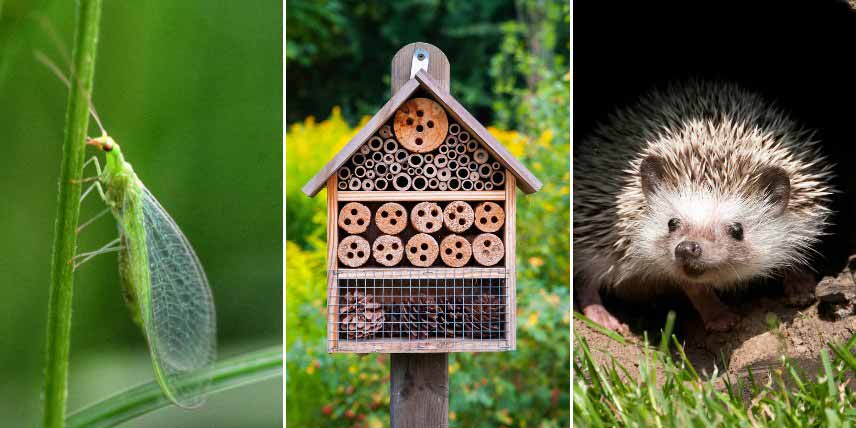
To help prevent the main plant pests, welcome biodiversity in your garden by installing insect hotels, hedgehog shelters, and nest boxes…
- Subscribe!
- Contents
Comments