




























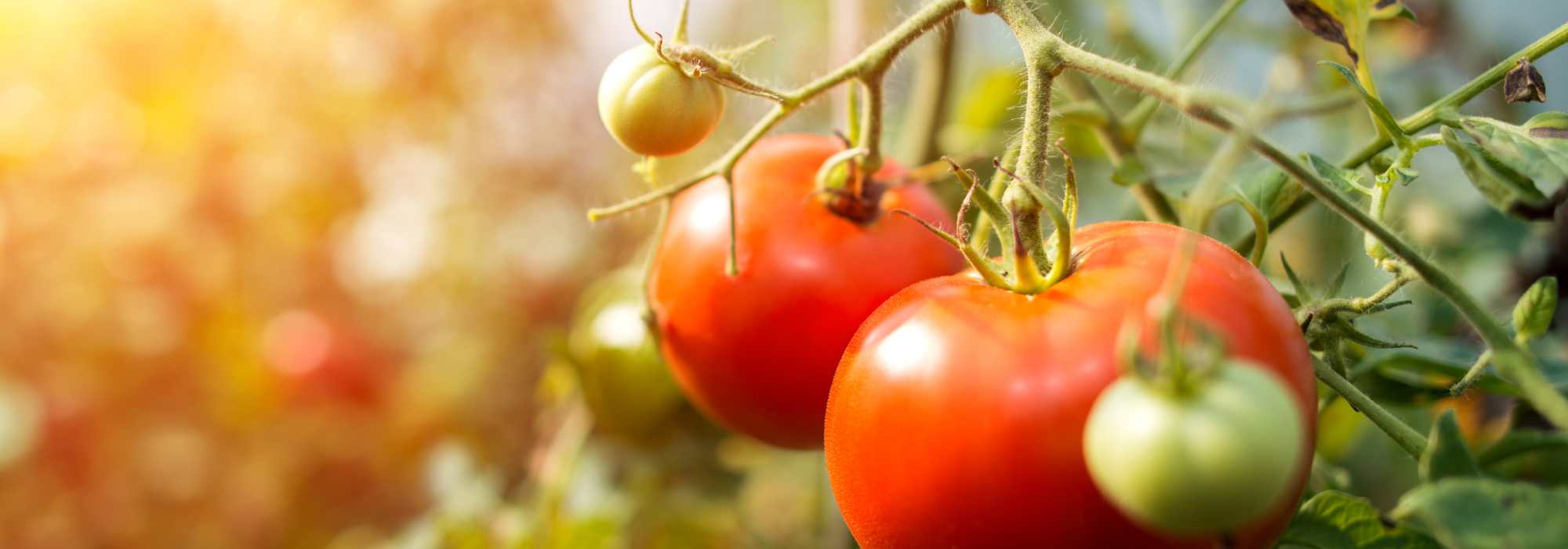
Is it really possible to grow tomatoes without water?
Discover all our tips for growing your tomatoes with hardly any watering
Contents
If you’re a keen gardener, you’ll no doubt come across a few cultivation tips on the Internet (and especially on our site since you’re reading this!). The web is rich with innovative ideas, clever and sound advice, shared experiences, but also nonsense, misinformation and rumours that spread faster than your vegetables can grow! In this context, you’ve probably come across videos of gardeners, professionals or amateurs, or even market gardeners such as Pascal Poot or Thierry Belsack, based respectively in the Hérault and the Puy-de-Dôme, who explain their method for growing their vegetables, and particularly the tomatoes, without water. Utopia or reality? Indeed, can one really adopt in one’s own vegetable garden the techniques and cultivation methods of these professionals?
Let’s look together at tips that could be adaptable in your own vegetable plot for growing your tomatoes without watering? And let’s try to separate fact from fiction, what is possible from what is impossible, in order to obtain delicious tomatoes (almost) without water.

No irrigation rather than no water
From the outset, it is essential to make a distinction. We do not grow tomatoes without water, but rather tomatoes without irrigation. Indeed, water is vital for vegetables just as it is for people or animals. So a minimum amount of water is still needed for tomato plants to develop, flower and bear fruit. Saying that tomatoes can be grown without water is more hype than truth…
It is more sensible to say that tomatoes can grow without irrigation supplied by humans, at least throughout growth. Indeed, water is added during sowing under cover, and especially when planting in the outdoor vegetable plot. The rest of the time, these tomatoes could make do with rainfall, for example during a nice summer storm, or with a few small waterings in case of prolonged heatwaves or severe drought.
By withholding water from the tomato plants, one can imagine that they would develop a more robust and, above all, deeper root system to draw water from where it is. Similarly, in the face of water shortage, tomatoes, like other vegetable plants, limit the development of their foliage to prioritise the survival and continuity of the species. So they flower and bear fruit to produce seeds.
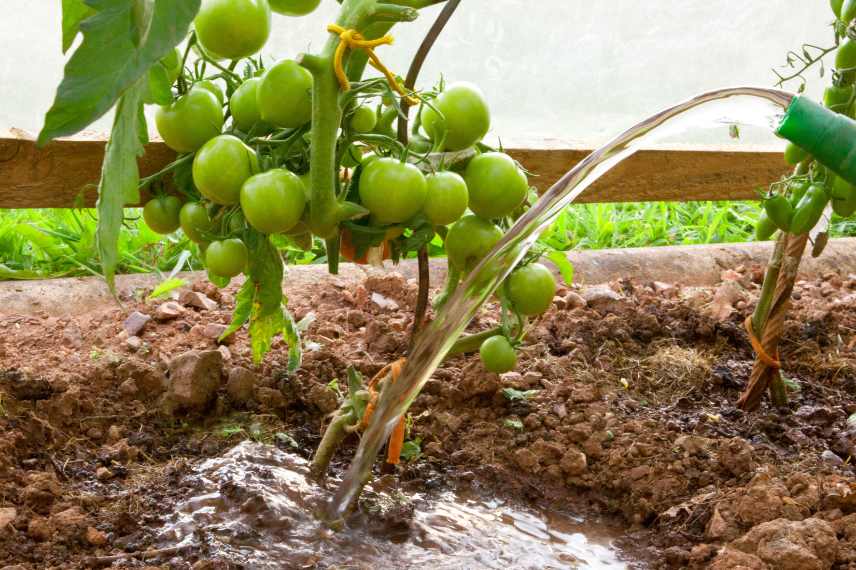
Watering tomatoes, a thing of the past?
Nevertheless, growing tomatoes without irrigation requires a perfectly suited site. Thus, clayey, marl-rich soil retains water more easily and limits evaporation more than sandy or calcareous soil. Likewise, the soil must be rich and kept covered. Furthermore, soil baked by sun for most of the day will have more difficulty retaining water than a slightly shaded soil.
Thus, growing tomatoes with little irrigation may be possible, but highly variable from one region to another, from one site to another.
Read also
Watering the vegetable garden: our tipsTo begin with: rich soil for growing beautiful tomatoes
To have beautiful tomatoes capable of withstanding very limited watering, you first need good soil, rich and fertile, well-aerated and loosened. Indeed, in well-worked, loosened soil, water infiltrates rather than running off the surface. Simply work the soil at the surface without going too deep to avoid disturbing the microfauna.
Next, it is essential to amend the soil. Applying an amendment improves soil texture, and thus makes water retention more effective. A rich soil more readily retains rainwater or irrigation water. That’s why, to limit, or even drastically reduce tomato watering, one must absolutely apply well-decomposed compost or manure, which act as a sponge and retain the small amount of water provided by irrigation or rain. Moreover, in enriched soil, an active microfauna develops that transforms organic matter into humus.
The application of fresh manure can be carried out in autumn, alongside digging with a spade and fork or simply working the soil with an organic fork. Tomatoes are heavy-feeding fruit vegetables that benefit from this good supply of manure. In spring, compost is added to top up.
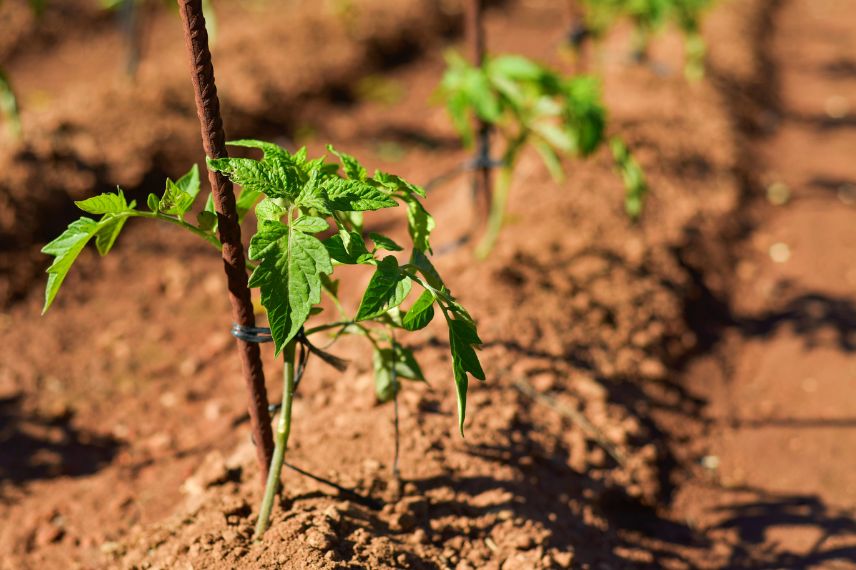
To limit water inputs, tomatoes should have rich, humus-bearing and well-aerated soil.
In the same vein, to loosen and aerate the soil, it is possible to sow green manures. Indeed, the roots of green manures improve soil structure by breaking up clods. The root systems of the Poaceae (oats, rye, barley), and also those of the twining types of the faba beans, of the mustard and of the phacelia, are very effective at loosening soil and thus facilitating deep root development for tomatoes. Green manures such as mustard can thus be sown as early as February–March: in two months they have time to grow to make room for the tomatoes.
Mulching, an obvious choice
The other element to nearly eliminate watering for tomatoes is mulching. Indeed, this mulch laid in a thick layer helps retain a degree of moisture at the roots of the tomato plants. Thus, irrigation can be greatly reduced, or even spaced out. For this mulch to be effective, it must comprise organic and natural materials that, as they decompose, will render the soil more humus-bearing. Among the organic materials usable in the vegetable garden, one can include dried lawn clippings, straw or hay, dead leaves, crop residues, pruning waste from trees and shrubs, finely shredded, and possibly adventive weeds before flowering. You can also add young nettle shoots or comfrey. The essential thing is that this mulch is precisely balanced between dry and moist materials, to provide as much carbon as nitrogen. 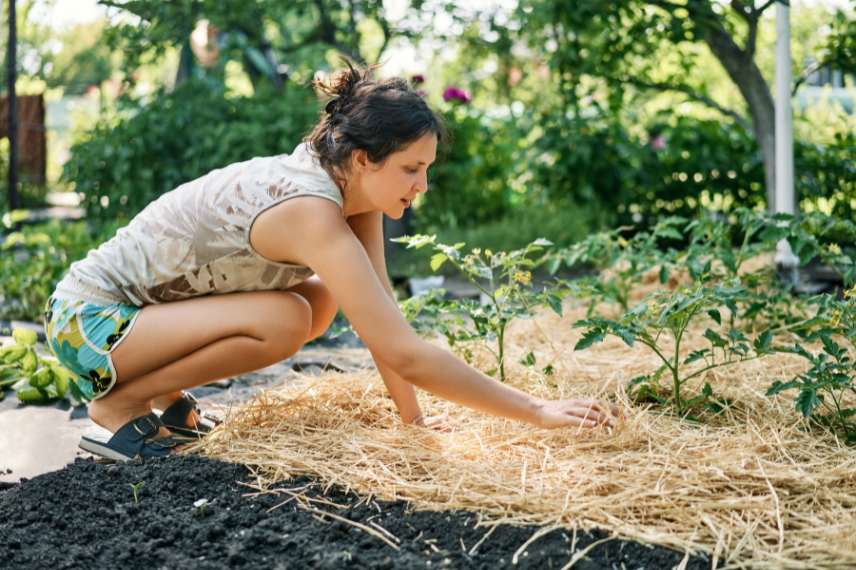 To enable your tomatoes to go without irrigation, it is very important to establish a thick layer of at least 30 to 40 cm, as early as possible in the season. Thus, Thierry Belsack, a gardener from the Puy-de-Dôme, who is also an advocate of no-irrigation gardening, mulches his vegetable plot from September onwards and throughout the winter. Come spring, he lifts back the mulch and plants his tomatoes.
Harvest your own seeds to harden off your tomato plants
That is perhaps the key to watering your tomatoes less. A solution that requires a little patience.
Indeed, according to Pascal Poot, The act of sowing your own tomatoes allows them to harden off and acclimatise to the region’s climate and to various stresses such as heatwaves or drought. In the first year, you sow your seeds, under cover, in a veranda or behind a window, or better yet under a heated greenhouse. Once the first leaves have appeared, you transplant them into pots (with great care not to damage the roots) then you take them outside by day to acclimatise. Then, after planting, you subject the plants to watering restrictions. Yields will be lower; the tomatoes will still ripen, probably small but tasty, as they are not waterlogged. The seeds are harvested as late as possible and dried to be sown the following year. Over the years, these seeds accumulate in their genetic capital the cultivation conditions they have experienced. And over the years, they will more readily withstand drought and adapt to the climate and cultivation conditions of your local area. So a little patience and a lot of perseverance are required. And perhaps, in a few years, the tomatoes grown from your own seeds will need no water at all…
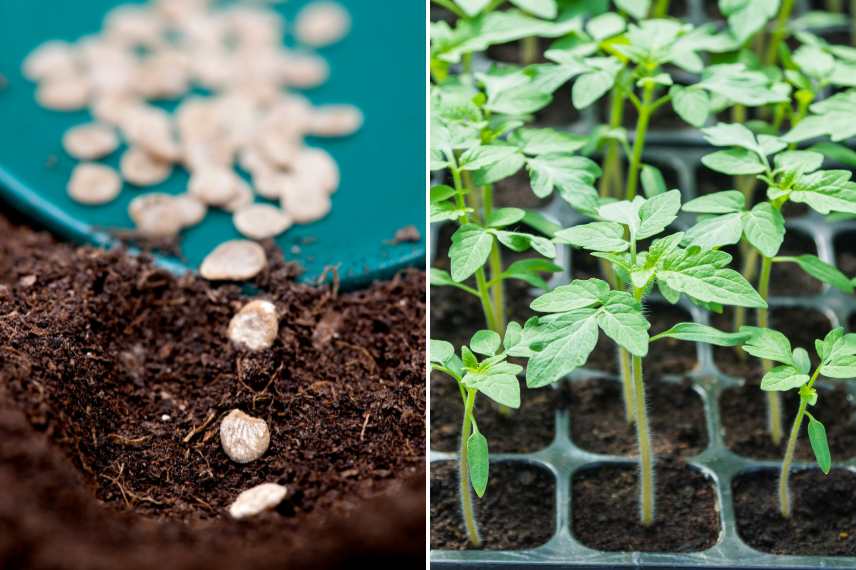
Starting your own tomato sowings helps acclimatise them to water scarcity over the years
Of course, it is preferable to select heirloom tomato varieties. As for F1 tomatoes, they do not breed true.
A well-tended planting
However, it is not enough to harvest and sow your own seeds. It is also important to tend to the planting. Between mid and late April, tomato seedlings are transplanted into the ground. This planting should take place before the first hot spell.
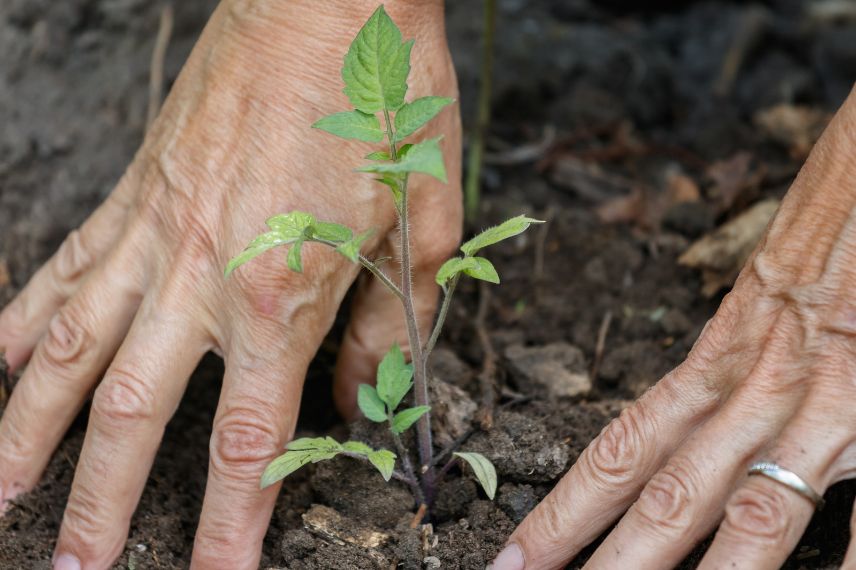
During tomato planting, a good watering should be provided. After that, they should (almost) manage on their own.
- Plants are buried very deeply so that they develop roots along the full length of the stem
- Tomatoes should be planted slightly inclined in the direction of the prevailing wind
- It is essential to leave a space of at least 40 to 50 cm between each tomato plant to avoid lack of ventilation and, above all, the formation of a soil crust if you need to move around the vegetable patch
- It is essential to give a very generous watering directly at the base of the tomato plant to remove air bubbles and allow the soil to cling to the roots
- Staking is not obligatory, unless you have a small space. Leaf removal and pruning are not obligatory either
- Subscribe!
- Contents
Comments