





























Japanese maples: the most beautiful autumn colours
Discover the stars of autumn foliage
Contents
Japanese maples are certainly stars when it comes to evoking the splendid colours of autumn foliage. From spring, when their new foliage appears, to autumn, when they express themselves in a festival of warm and golden hues, they often treat us to wonderful surprises. Let’s explore, in this article, the stars of the show—a selection of Japanese maples that, in autumn, offer the most explosive colours.

Acer palmatum 'Emerald Lace'
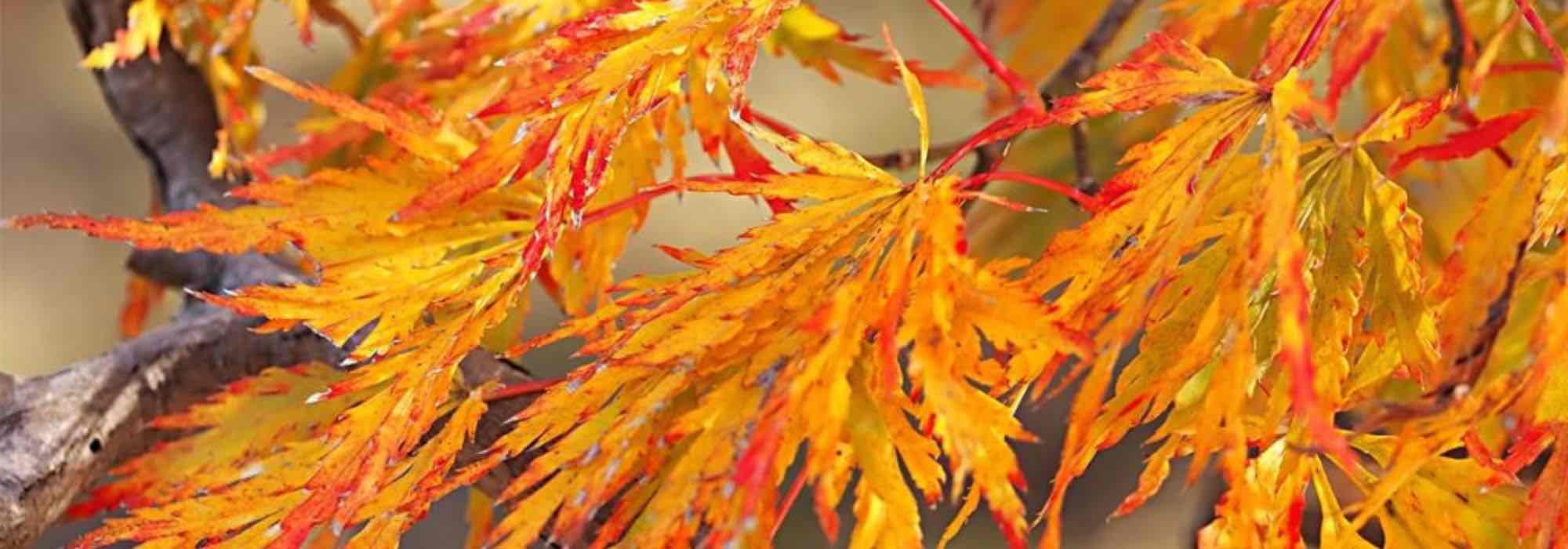
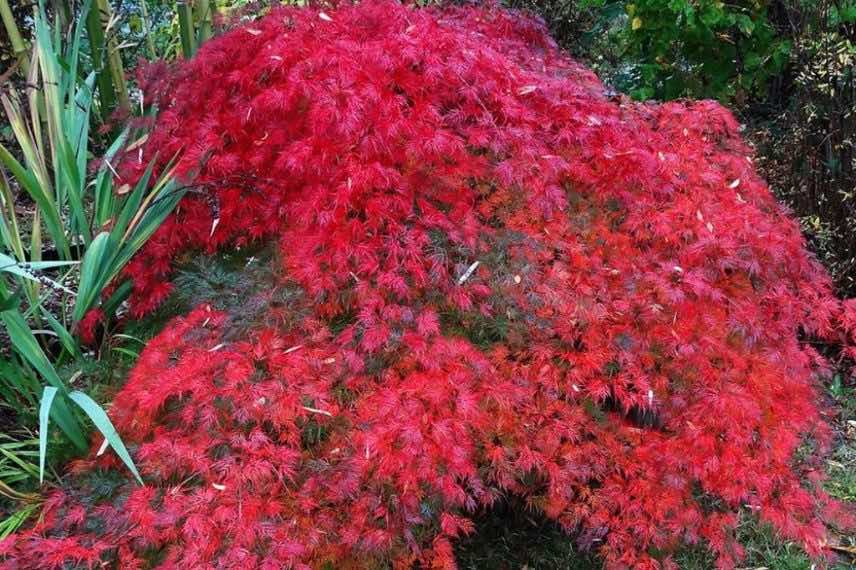
Acer palmatum dissectum ‘Emerald Lace’ is part of these maples with intensely dissected, incredibly fine and graceful foliage. It has a semi-weeping habit, on a single trunk covered with decorative green bark striped with cream. Its laciniate foliage, with 5 to 7 lobes finely cut, is strongly dentate at the margins. It changes colour with every season: pale green in spring, deep green in summer. In autumn, it turns scarlet red and bright orange before shedding its leaves.
It can be planted as a stand-alone specimen on a lawn, where its silhouette, leaf shape and colours make a striking display. It can also be trained into a magnificent bonsai by starting from a small plant. It can enliven a terrace in a large container. As with most Japanese maples, it prefers partial shade, but tolerates sun in cool climates and soil that stays cool, as well as fairly dry conditions and occasionally dry, slightly calcareous soil. In that case, position it in partial shade, or even in shade.
Acer japonicum 'Vitifolium'
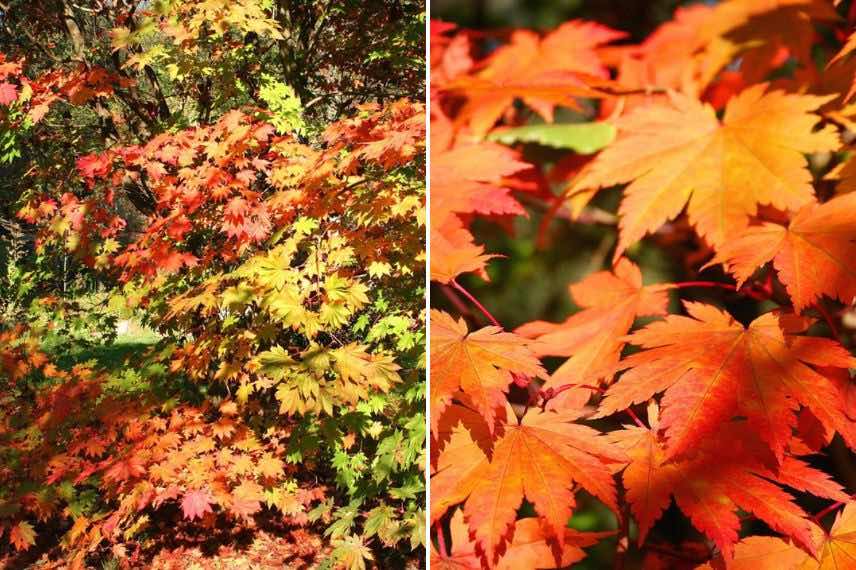
The Acer japonicum ‘Vitifolium’, or vine-leaf maple, has lobed leaves, but fuller, reminiscent of grapevine leaves. It forms a medium-sized bush with a rounded habit, very spreading in width. It starts its spring growth in soft green, continues in summer in dark green before taking on sumptuous colours in autumn: bright orange to crimson red. The more acidic the soil, the more intense the foliage colour.
It is fairly tolerant of full sun, but it also prefers dappled shade and cool, moist soil. If you have the space, pair it with other Japanese maples with different leaf shapes and colours, such as Acer dissectum with very dissected leaves or those with red foliage all year round. Also plant it with acid-soil-loving plants such as Chinese azaleas or pieris. Hydrangeas, which prefer not to be in scorching sun and form substantial shrubs, are handsome companions.
Acer pseudosieboldianum 'Ice Dragon'
Acer pseudosieboldianum ‘Ice Dragon’ is a hybrid cross between Japanese maple and Korean maple. It offers a cascading, slightly trailing habit, unique. It reaches just over 2 m in height and 3 m in width at maturity. In winter, once the foliage has fallen, it reveals sinuous branches. Its laciniate, graceful foliage unfurls in spring in pale red and orange hues before turning green, a perfect representative of its family.
This cross between species makes ‘Ice Dragon’ less exacting about soil type and light exposure. It tolerates sun and heat better. Its compact size makes it perfectly suited to container cultivation and to small gardens, where it provides a sculptural presence. Plant it alongside the Fargesias, non-invasive, purple-leaved shrubs such as the berberis or the physocarpus. Add the soft or brighter flowers of the wild camellias.
Acer palmatum 'Seiryu'
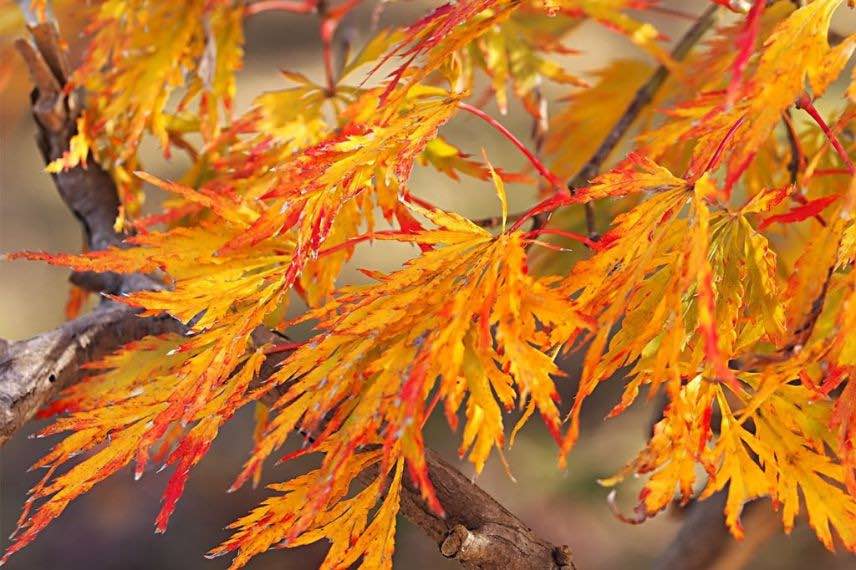
Acer palmatum ‘Seiryu’ has laciniate foliage that stands out with very vivid colours. In spring it lights up the garden with its soft green, almost fluorescent. In autumn it dons beautiful yellow-orange and purple-red tones. It starts its growth with a dense growth habit from the base, upright, and with age it develops a layered habit. Its branches are heavily coloured red during the winter season. At maturity it reaches 3 m in height and 4 m in spread.
Very decorative, ‘Seiryu’ deserves to be seen from afar. If you plant it in the garden, accompany its soft green foliage with variegated-leaved shrubs such as dogwoods, or with very dark-leaved varieties for a contrast that can enhance its bright spring green. In autumn, its shimmering colours pair beautifully with the same tones of Hydrangeas, with golden-leaved Heathers at their feet.
Acer palmatum 'Orange Flame'
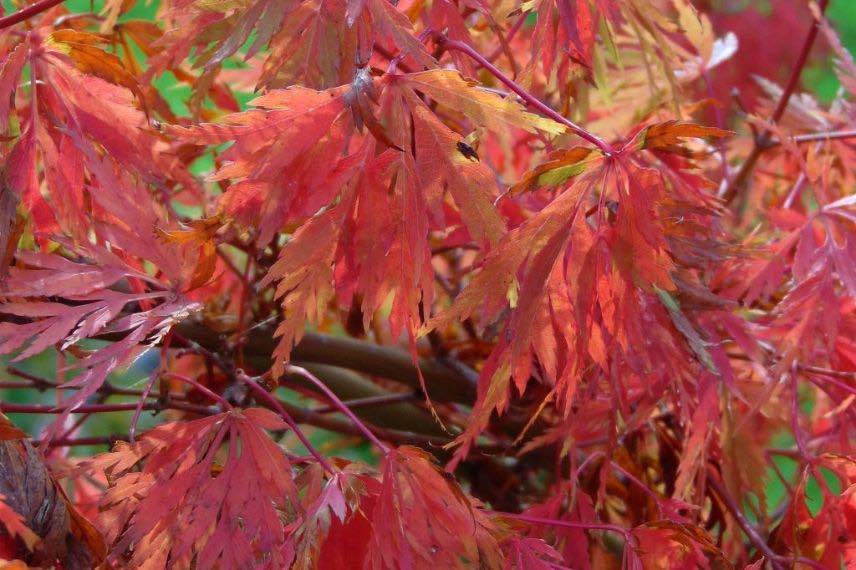
Not as finely cut in its foliage as a dissectum maple, the Acer palmatum ‘Orange Flame’ can boast the very elegant shape of its leaves, with deeply lobed and elongated lobes. It begins the spring season in soft orange to light brown tones, before turning green to carry it through the summer. Autumn sees it blaze in a festival of yellows, oranges and reds, in a magnificent combination. Vigorous, it has a spreading, rounded habit and reaches 3.5 m in height with a 2.5 m spread at ten years of age, with fairly rapid growth. At maturity, it reaches 4.5 or 5 m in height.
Its handsome size makes it a superb specimen for isolated planting in a small garden, on the lawn. In a large garden, on the edge of tall trees, it is sheltered from prevailing winds and the fierce rays of the sun. Plant it with a black elder with purplish, lobed foliage, for a striking colour contrast.
Acer palmatum 'Osakazuki'
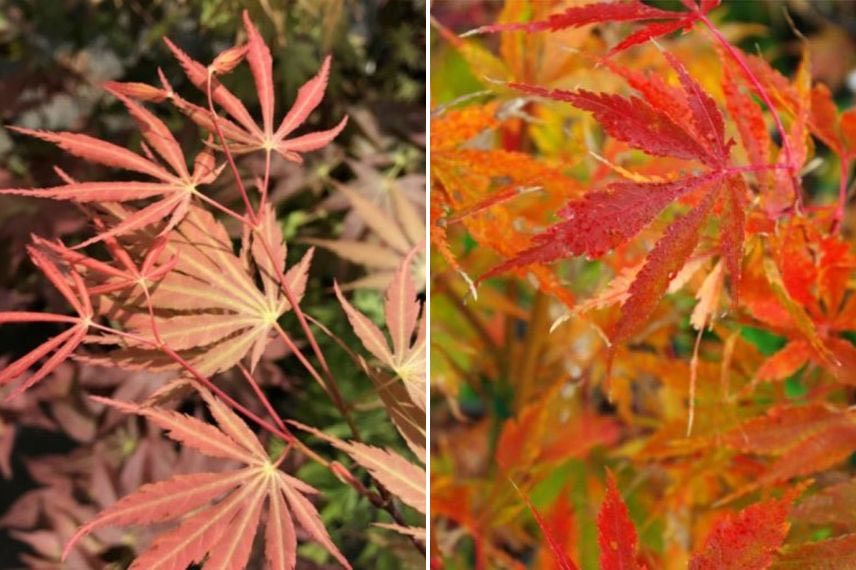
Renowned for its blood-red autumn foliage, stunningly bright, l’Acer palmatum ‘Osakazuki’ forms a small tree reaching 4 m in height and 5 m in width at maturity, with a rounded habit, bearing brown bark. Its fairly large, palmately lobed leaves with seven lobes emerge pale green and gradually turn bright red. It is undoubtedly one of the brightest Japanese maples in autumn!
We recommend a position in partial shade or even shade, to avoid scorching its leaves, and plant it as a specimen to give it space, in an open and airy spot.
Acer japonicum 'Aconitifolium'
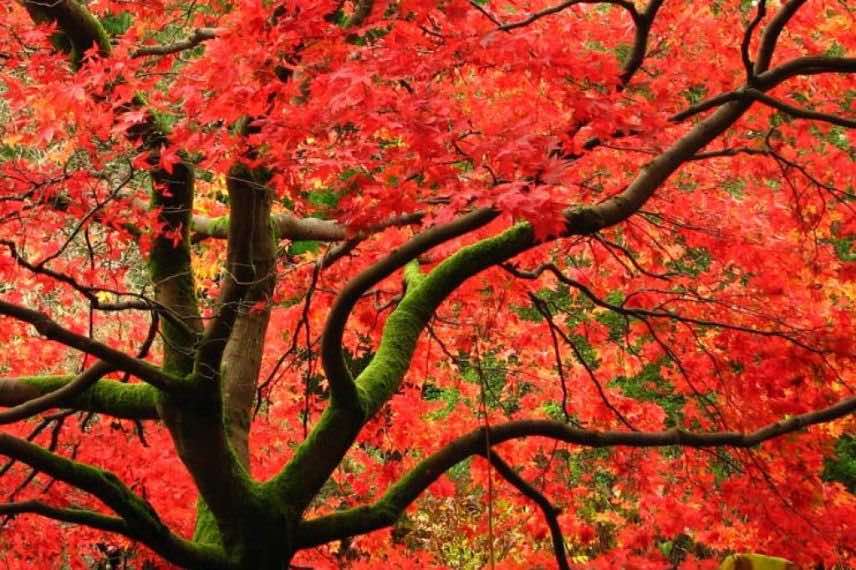
The Acer japonicum ‘Aconitifolium’ is a variety with distinctive foliage, since its leaf evokes the aconite leaf, beautifully lobed with 7 or 11 dentate lobes that overlap slightly, giving a fairly rounded and large leaf. Apple-green, a little brown and red in spring, then bright apple-green, turning to ruby red in autumn. It is earlier to break bud than other varieties: it flushes out quite early, takes on its autumn colour from the end of September and its leaves fall earlier than those of other maples.
It reaches 3 m in height at maturity with a 3.5 m spread. In a semi-shaded border, it partners well with hostas, ferns, rodgersias and Hakonechloa.
Acer palmatum 'Orange Dream'
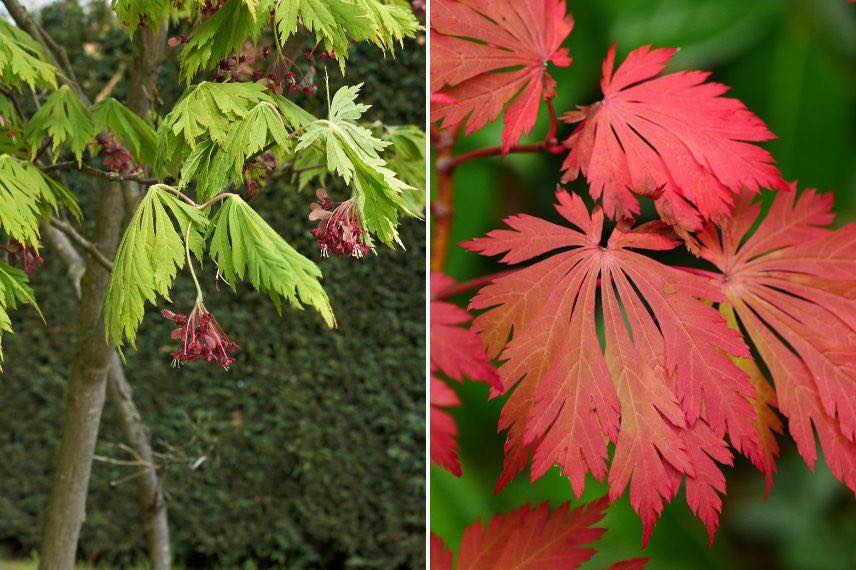
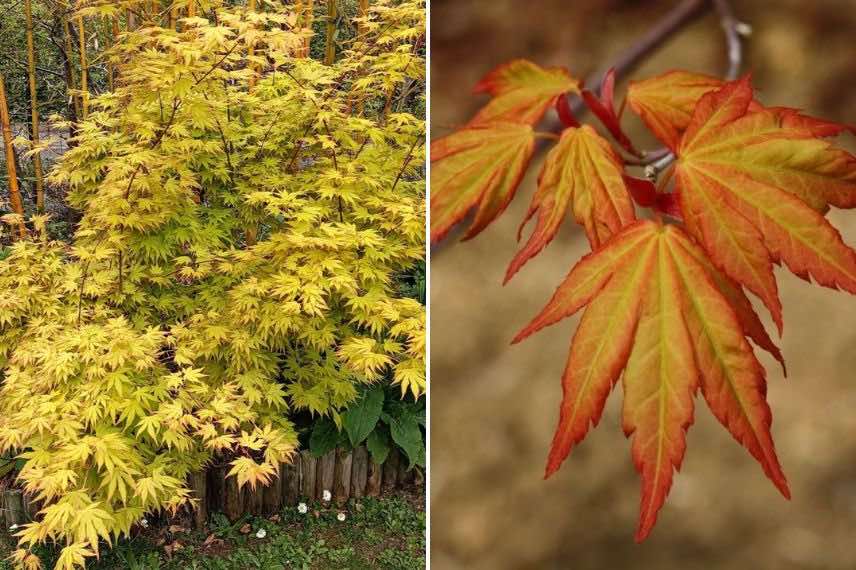
Acer palmatum ‘Orange Dream’ is a variety known for its particularly flamboyant foliage, which does not wait for autumn to turn orange. It bursts into spring with a bright orange colour to its foliage, before mellowing in summer to a calmer light green, in order to dazzle us again in autumn with golden-yellow and bright orange hues. It bears new orange-tinted wood, which later turns brown. The leaf shape is palmately lobed, with 5 to 7 well-cut and dentate lobes.
This cultivar is sensitive to heavy soils and excess moisture. In summer, high temperatures can scorch the foliage. Take care in planting it and treat for scale insects and Verticillium wilt. Plant it in a shaded position to bring out its colours, alongside gold-leaved heathers, purple-leaved Heucheras and Azaleas.
Acer palmatum 'Brown Sugar'
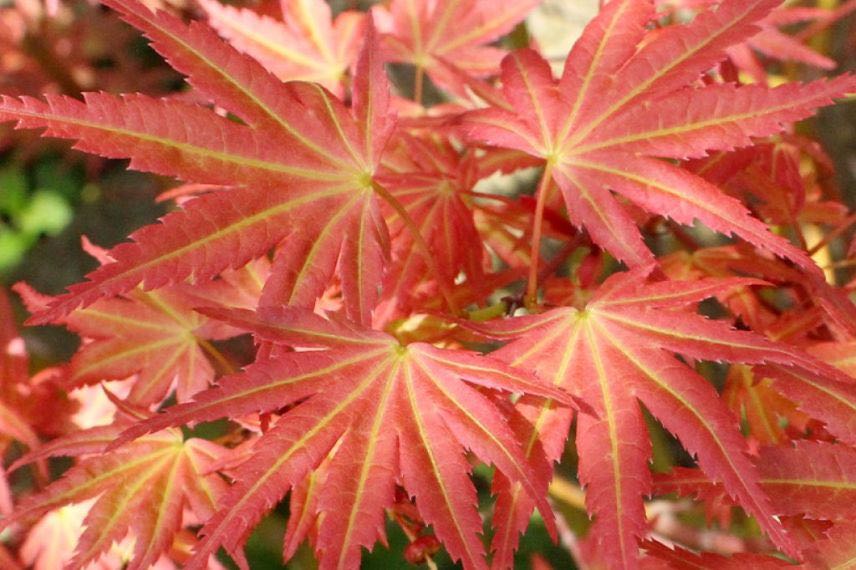
Acer palmatum ‘Brown Sugar’ is a relatively new cultivar in the world of Japanese maples, in which ‘Emerald Lace’, ‘Orange Dream’, or ‘Seiryu’ stand as veterans. Slow-growing, it does not exceed about 2 m in height and 1.5 m in width in maturity. Its leaves are divided into seven elongated, acuminate lobes, dentate. New shoots in spring and summer are a reddish-brown, a touch of chocolate, before turning dark green. Autumn colour takes on orange, then red. In winter, the red colour of the twigs is revealed, giving each season its own characteristic, creating renewed interest.
Plant it in a border that retains winter interest, with a Hamamelis, and a Cornus alba. Add red or pink Persicaria and other autumn-flowering plants. ‘Brown Sugar’ is, of course, perfectly suited to container planting, east-facing, for morning sun and afternoon shade.
- Subscribe!
- Contents

Comments