


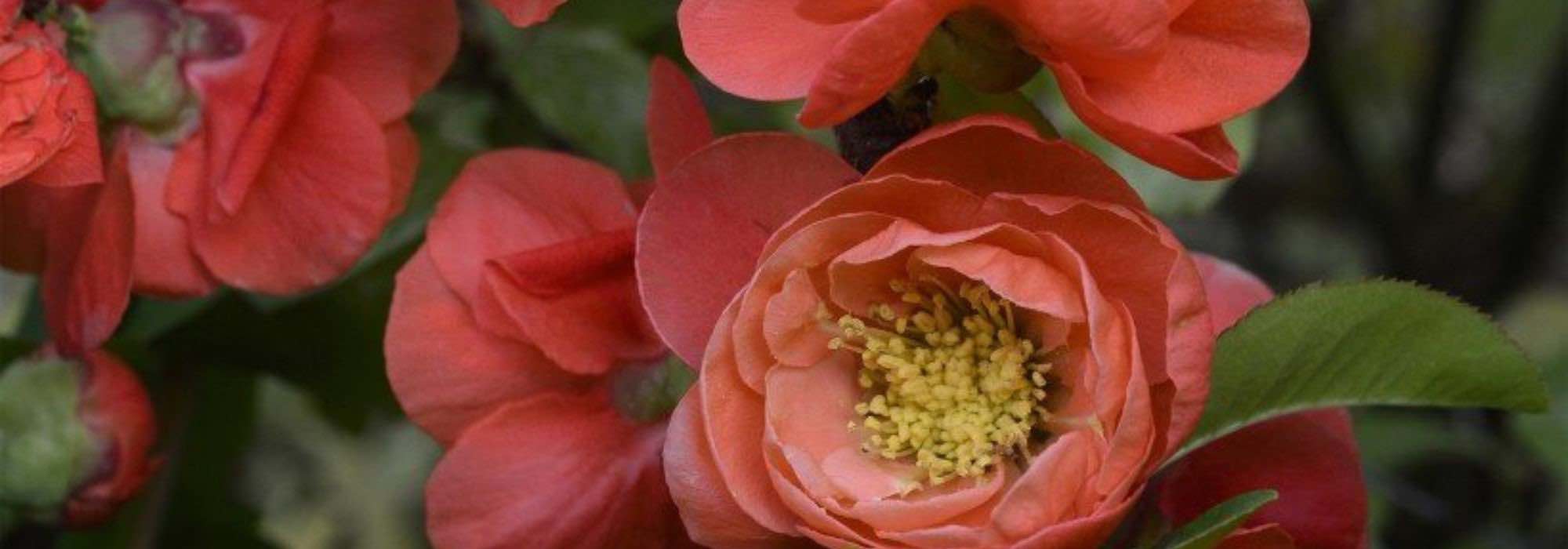
Japanese quince with orange flowers: for a vibrant garden in late winter
Vibrant flowering bushes
Contents
Japanese quince with orange flowers are essential bushes to brighten up the garden from the end of winter. With its vibrant flowers adorning the still naked branches, the Chaenomeles, as it is known in Latin, offers a colourful and striking display. Hardy, easy to grow, and low-maintenance, it fits well in hedges, borders, on slopes, or even trained against a wall. Discover the most beautiful varieties, planting tips, and the best combinations to create a colourful garden.

Why choose Japanese Quince with orange flowers?
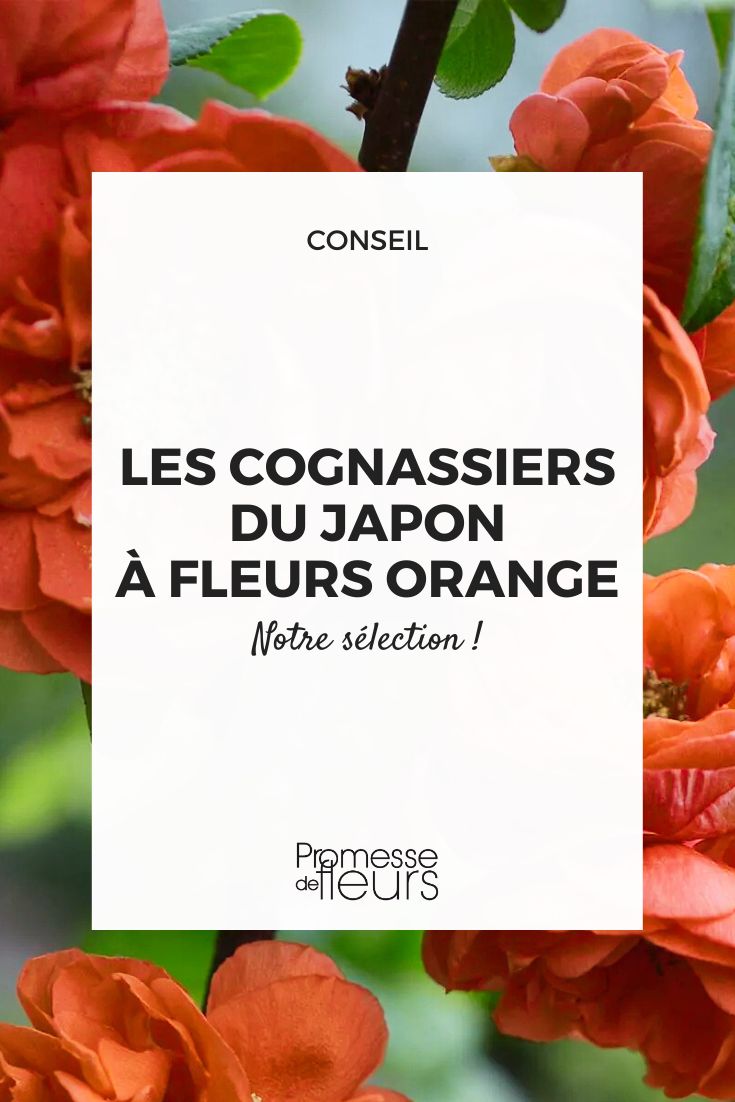
The orange flowers of the Japanese quince immediately catch the eye in the garden. This bright and warm hue symbolises energy and vitality. It creates a striking contrast with the green of the evergreen foliage and the more neutral tones of winter. At a time when few plants are in bloom, the orange of Chaenomeles brings light and warmth.
From late winter (February to April), the flowers appear on the still bare branches, forming a unique colourful display. The intense orange stands out among the usual softer colours of early spring (white, pink, yellow) and adds a touch of originality to the garden.
Orange pairs beautifully with purples, blues, and yellows. The Japanese quince finds its place in flowering beds, mixed hedges, or as a standalone, where it becomes a bright focal point.
Beyond their beauty, the orange flowers of the quince nourish pollinators (bees, bumblebees) in early spring, a crucial time for biodiversity. This dual aesthetic and ecological role makes it a must-have in the natural garden.
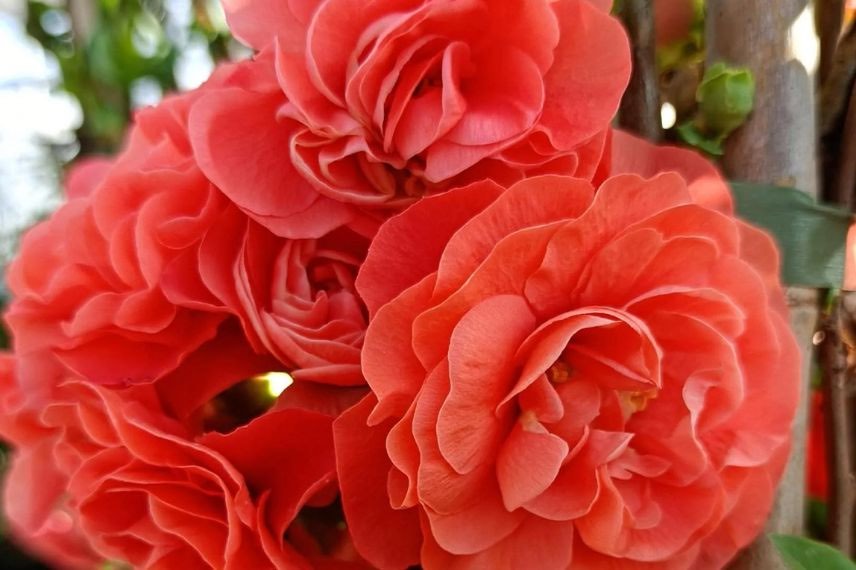
The vibrant flowers of ‘Orange Storm’
The must-have varieties of Japanese quince with orange flowers
Japanese Quince ‘Orange Storm’
Its spectacular double flowers, reminiscent of camellias, display a bright and vivid orange. These flowers burst forth in early spring on thornless branches, transforming the bush into a true floral firework. Perfect for informal hedges, borders, or cut flower arrangements, it captivates with its striking appearance and forms a compact, rounded bush, reaching 1.20 m in height and 1.20 m in width.
Chaenomeles speciosa ‘Mango Storm’
With its sumptuous coral-orange flowers with salmon highlights and a golden centre, this variety heralds spring in grand style. The flowers, large and double, open on bare thornless branches. Dense and compact, it is suitable for both hedges and borders, reaching 1 m in height and 1 m in width.
Chaenomeles japonica ‘Orange Beauty’
This variety stands out for its abundant flowering of single, semi-open cup-shaped flowers in bright vermilion orange. These flowers cover thorny, bare branches in spring, bringing a natural glow to the garden. Perfect for hedges, borders, or trained against a wall, it enchants with its wild and luminous appearance, reaching 1.5 m in height and 2 m in width at maturity.
Japanese Quince ‘Sargentii’
The salmon-orange flowers of this quince do not fully open, creating a unique charm. They appear in March-April on thorny branches, transforming this small bushy shrub into a ball of colour. Its modest size makes it an ideal choice for small gardens or even for bonsai cultivation. Bushy and spreading habit, reaching 1 m in height and 1.80 m in width.
Chaenomeles superba ‘Cameo’
The Chaenomeles superba ‘Cameo’ is covered in March-April with a multitude of clusters of 2 to 4 double flowers in soft salmon pink. Very graceful, it can reach a height of 1.50 m.
Japanese Quince ‘Cido’
Ornamental and fruit-bearing, ‘Cido’ adorns itself in spring with bright red-orange flowers. Its flowering precedes the formation of large yellow fruits, resembling small quinces, harvested in autumn. Its bright flowers and edible fruits make it a bush that is both beautiful and useful. ‘Cido’ is as tall as it is wide, around 1.25 m in all directions.
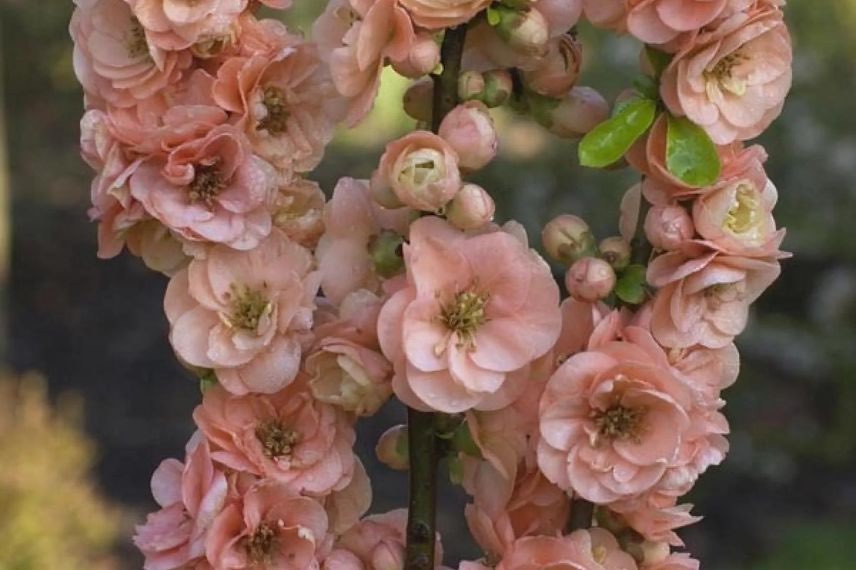
The Chaenomeles ‘Mango Storm’
Planting and caring for a Japanese quince
Where to plant a Japanese quince?
The Japanese quince thrives in well-drained soil, neither too heavy nor too dry. It adapts to many garden soils.
What exposure does the Japanese quince need?
For a vibrant flowering, favour a position in full sun. However, it also tolerates partial shade, although the flowers may be slightly fewer.
To plant a Japanese quince:
- Dig a hole two to three times wider than the root ball.
- Lighten the soil if necessary with sand or compost.
- Plant the root ball at soil level, without burying the collar.
- Firm the soil well, water generously, and mulch to retain moisture.
When to prune a Chaenomeles?
Pruning of the Japanese quince should be done just after flowering, between May and June. This ensures that the flowering of the following year is not compromised, as it flowers on the wood of the previous year. At this time, you can shorten any overly long branches and remove dead or damaged ones.
Read also
6 shrubs for late winter floweringGarden Design Ideas
As a defensive hedge or on a bank
Japanese quince, particularly the thorny varieties like ‘Orange Beauty’ and ‘Sargentii’, is ideal for forming defensive hedges. It creates an impenetrable natural barrier while offering a stunning display of flowers in spring.
On a bank, they form beautiful associations with groundcover roses, creeping ceanothus with intense blue flowers, or blue-flowered rosemary. These plants enhance each other through contrasting colours and textures.
In a flowering bed
Plant it alongside other spring-flowering shrubs (forsythia, flowering currant) or with flowering perennials. The orange-flowering quinces add a touch of warmth and create striking contrasts. They also pair well with other shrubs that flower at different times. Before their flowering, winter honeysuckle (Lonicera fragrantissima) offers a delicate fragrance, while after their flowering, lilacs or buddleias take over, extending the floral appeal of the garden.
As a specimen plant
As a specimen plant, Japanese quince becomes a focal point in the garden thanks to its bright flowers that appear on still bare branches. Its early flowering makes it a centrepiece of the decor from the end of winter.
Trained against a wall
Due to its ability to withstand pruning, some varieties like ‘Mango Storm’ or ‘Orange Beauty’ can be trained against a wall. This arrangement highlights the flowering while saving space in small gardens. It can be accompanied by winter jasmine, whose yellow flowers precede those of the quince, ensuring a smooth and bright transition. Spring-flowering clematis, with their elegant flowers, also blend well with its flowering branches.
In a bouquet
Finally, the flowering branches of the quince are perfect for creating natural, rustic bouquets. Paired with forsythia branches, they bring a rustic charm and a touch of spring freshness to the interior of the home.
For further reading
Are the fruits of the Japanese quince edible?
Yes, the fruits of the Japanese quince are edible, but their flesh is very firm and acidic. They are mainly used in cooking to make jellies, jams, or liqueurs. However, there are a few exceptions: the ‘Cido’ variety with orange flowers is particularly valued for its fruits, sometimes referred to as “Northern lemons” due to their high vitamin C content.
How to prevent diseases?
The Japanese quince is robust, but it can sometimes be affected by powdery mildew (a white fluff on the leaves). To prevent this, be careful not to overwater the foliage and prune overly dense branches to promote air circulation. Aphids may also appear in spring, but they are easy to eliminate with soapy water or natural predators (like ladybirds). For other diseases and pests of the Japanese quince, see our article below.
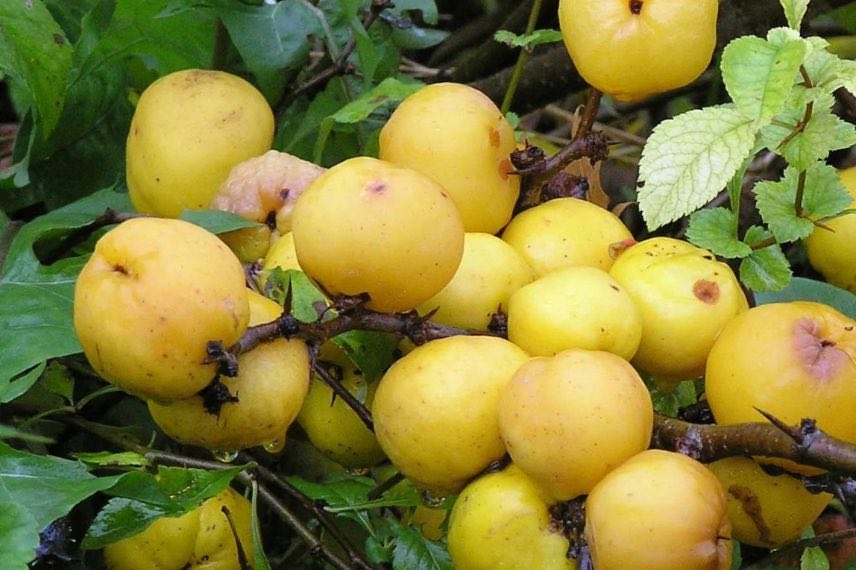
The fruits of ‘Cido’
- Subscribe!
- Contents
Comments