




























FLASH SALES: discover new special offers every week!
Lagerstroemia, crape myrtle: 7 pink-flowered varieties

Lagerstroemia, crape myrtle: 7 pink-flowered varieties

The most beautiful varieties

Contents

Modified the 12 January 2026  by Leïla 6 min.

Lagerstroemia are majestic shrubs that catch the eye in any garden. Often called crape myrtle, they are renowned for their spectacular flowering, with crumpled petals, whose signature colour is first and foremost a bright, vibrant pink, but they also bear red, white and mauve depending on the variety. Foliage takes on shimmering colours in autumn and the bark is also decorative, marbled with several soft tones (cinnamon, brown, pink, cream…).

Lagerstroemia require a sunny, warm position sheltered from winds. They tolerate ordinary soil but prefer slightly acidic, cool, well-drained soils. While they do appreciate some atmospheric humidity, once mature they can tolerate drought.

Let’s explore seven exceptional Lagerstroemia varieties in different shades of pink, with varying sizes and foliage, green or purple, each bringing a unique touch of beauty and brilliance.

→ Read the crape myrtle fact sheet.

Difficulty

Lagerstroemia indica 'Bergerac'

The Lagerstroemia indica ‘Bergerac’ offers a bright red to magenta-pink summer flowering and golden-yellow stamens. This deciduous bush develops a bushy habit, bright green foliage that colours in autumn and decorative bark. It thrives in sun and heat, particularly in the south.
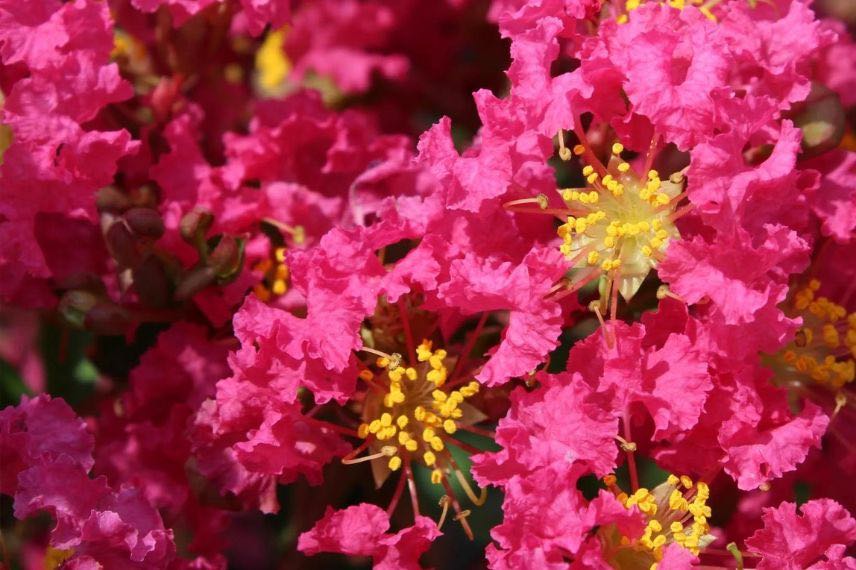
‘Bergerac’ reaches 2–3 m in height with a 2 m spread, with rapid growth. Its flowering, from July to October, features dense panicles of flowers, in a dark and intense colour. The dark green foliage becomes yellow or red in autumn, and its beige to reddish-brown bark is striking.

Adapted to South-West gardens, ‘Bergerac’ thrives in humid and warm conditions, and can acclimatise in colder areas with a carefully chosen site. Ideal as a standalone bush, as well as in a bush border, a flowering hedge or with perennials, it pairs well with asters or clary sage. In a pot on the terrace, it is spectacular in summer and autumn.

crape myrtle

Lagerstroemia indica 'Berlingot Menthe'

The Lagerstroemia indica ‘Berlingot Menthe’, an American variety of crape myrtle, is characterised by its compact size and summer flowering in clusters of deep pink flowers edged with white. Its changing foliage and its red-marble bark in winter make it attractive year‑round. It enjoys warmth with a touch of coolness in summer, and is ideal as a specimen in a small garden or in a pot on the terrace.
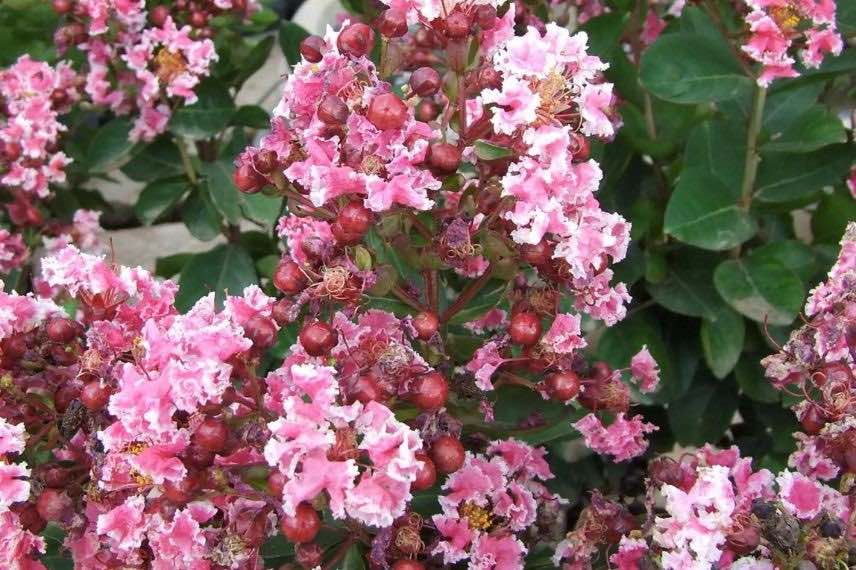
The Lagerstroemia indica ‘Berlingot Menthe’ (Peppermint Lace) has a bushy, ramified habit. It grows to 1.5 m tall and 1.25 m in diameter, with slow growth. Its flowering, from July to September, produces dense inflorescences, with wine-red buds opening to deep pink edged with white. The foliage, bronze-red in spring, becomes dark green and glossy, then orange or red in autumn. Its beige and dark red bark is also remarkable.

This small tree pairs perfectly with cotinus and spindle trees (deciduous) for a showy autumn display. It also pairs well with perennials in blue or purple hues such as Agapanthus or lavender, to form a harmonious border in soft tones.

lagerstroemia indica

Lagerstroemia indica Black Solitaire® (Black Diamond) 'Blush'

Lagerstroemia indica Black Solitaire® (Black Diamond) ‘Blush’ has almost-black foliage and fluffy white flowers turning pale pink, creating a stunning contrast. Easy to grow, it prefers well-drained soils and sunny positions.
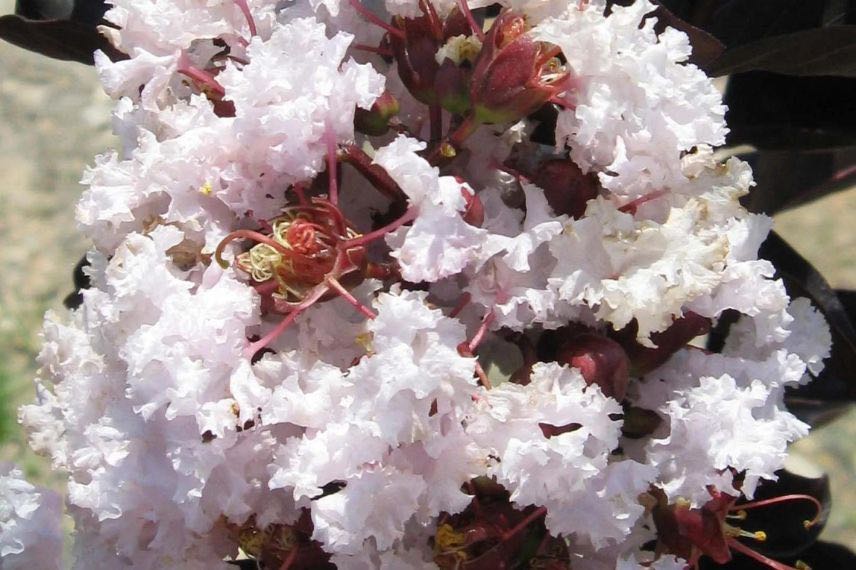
Selected in Texas, ‘Blush’ is hardy to zone 7b, well-suited to hot areas and shows good tolerance to dry soils. It has a bushy habit and reaches 2.50 m in height with a 2 m spread. Its flowering, from late July to September, features dense inflorescences with undulate petals. Foliage, almost black in spring and summer, turns purple in autumn.

To enhance the beauty of its very dark foliage and its contrasting flowers, a silver-leaved groundcover such as Stachys byzantina or the Artemisia can be planted at its base.

pink summer flowering

Lagerstroemia indica 'Soir d'Eté'

The Lagerstroemia indica ‘Soir d’Été’ stands out for its early and prolonged powder-pink summer flowering. Reliable even north of the Loire, it flowers from July through to autumn. This deciduous bush also charms with its supple habit and glossy green foliage that takes on attractive colours in autumn.
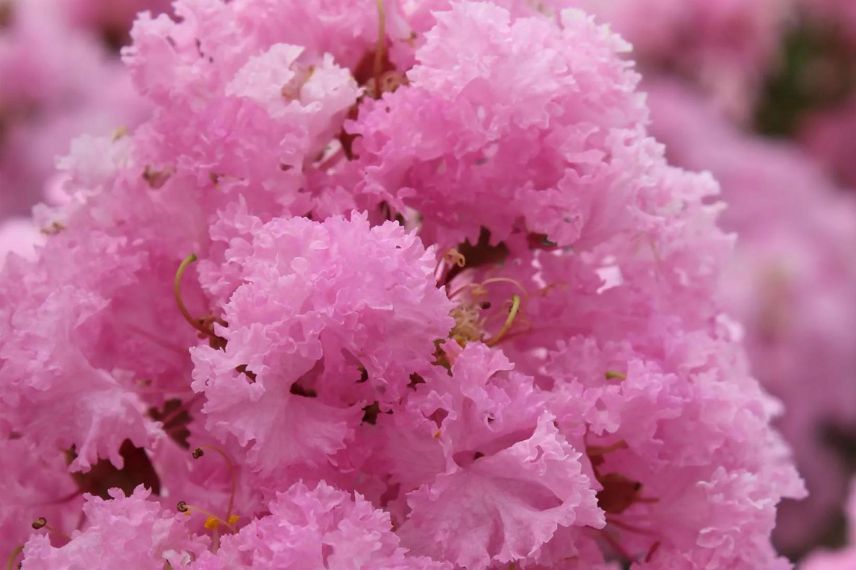
The crape myrtle ‘Soir d’Été’ reaches 3 to 5 m in height with a spread of 3 m at maturity, with rapid growth. Its flowers, in large panicles, are a pastel pink punctuated by golden-yellow stamens. The foliage, dark green and glossy, takes on yellow or red hues in autumn. Its bark, smooth and coloured, adds to its charm.

It pairs well with white-variegated foliage or white-flowering groundcovers such as Iberis sempervirens. In autumn, it enhances the colours of the Asters.

Crape myrtle with pink flowers

Lagerstroemia indica With Love 'Babe'

The crape myrtle ‘With Love Babe’ (‘Milaperl’), from the With Love series, is a compact, frost-hardy variety ideal for pots and small gardens. It bears charming clusters of pale pink flowers and ornamental bark year-round. Preferring warmth with a touch of coolness in summer, it is easy to grow in a wide range of regions, including areas north of the Loire.
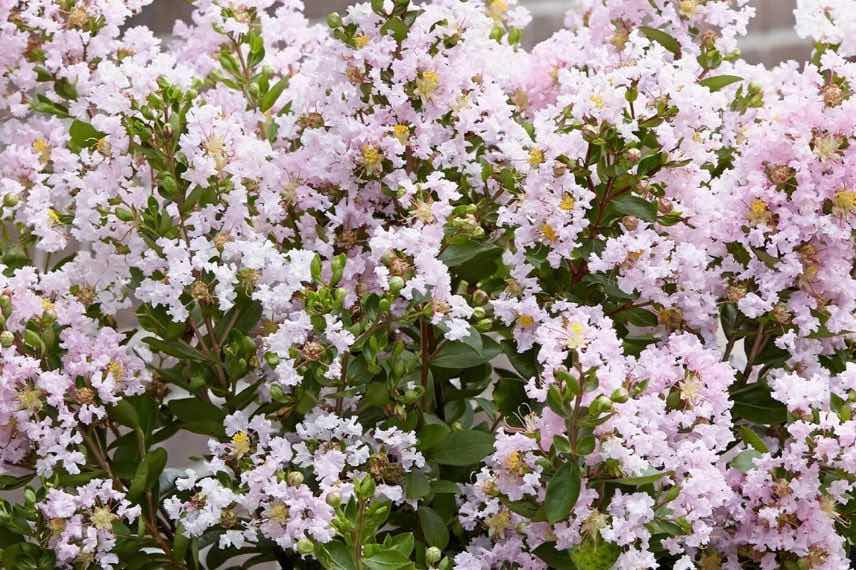
Lagerstroemia ‘Babe’, developed in Italy, is among the hybrids selected for their compactness and floribund flowering. It reaches only 70 cm tall by 40 cm wide. Its flowering, from July to September, features dense panicles of pale pink flowers. Foliage bronze in spring then green, turning orange or copper in autumn.

Adapted to South-West gardens, ‘Babe’ can also thrive on the Côte d’Azur with summer watering. It is suitable for colder zones, in isolation or in a shrub border. Paired with plants with brighter colours, such as some Hibiscus syriacus or small Buddleias, it creates beautiful contrasts. For a romantic duo, Lavateras with white or pale pink flowers are ideal.

dwarf bush with pink flowers

Lagerstroemia indica Summer Charm 'Tuscarora'

The Lagerstroemia indica ‘Tuscarora’ from the Summer Charm® series is remarkable for its long flowering in a shade ranging from deep pink to coral-red colour, a unique colour among these plants. Cold-hardy and less susceptible to powdery mildew, it is perfect as a specimen in a small garden or in a container on the terrace. Its smooth, coloured bark and its autumn colours are appreciated all year round.
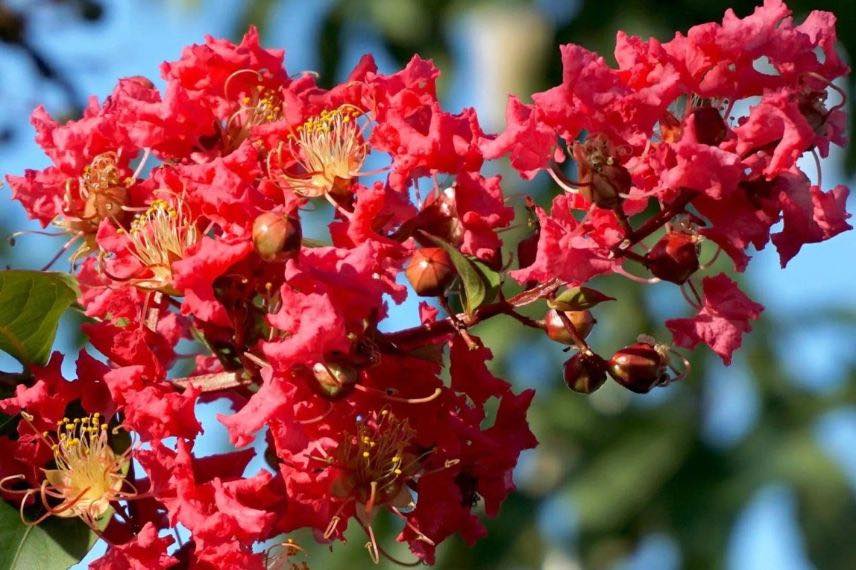
Derived from a cross between the Chinese Lagerstroemia indica and L. faurei from Korea and Japan, ‘Tuscarora’ is part of a series of hybrids selected for their distinctive colours and cold hardiness. Of considerable size, it can reach 5 m in height and 3.5 m in diameter, with rapid growth. Its flowering begins in July and lasts until September, producing long, ramified flower clusters. They can reach up to 30 cm long. The flowers, in a rich coral-pink, contrast beautifully with the dark green foliage that turns orange or coppery in autumn.

‘Tuscarora’ pairs well with ornamental grasses such as Miscanthus or Stipa, which add texture and movement to the garden. To enhance the natural, cottage-garden effect, pair it with hardy perennials such as Echinacea, which come in red and coral or orange tones, well suited to the colour of crape myrtle.

crape myrtle

Lagerstroemia indica 'Rhapsody In Blue'

The Lagerstroemia indica ‘Rhapsody In Blue’ is a compact, upright-growing variety. Its dark pink-to-purple flowering lasts from summer to autumn, a period when few shrubs match its generosity. It is also distinguished by its purplish foliage, harmonious with its flowering clusters. Suitable for small gardens and pot culture, it thrives in full sun in fertile, light soil.
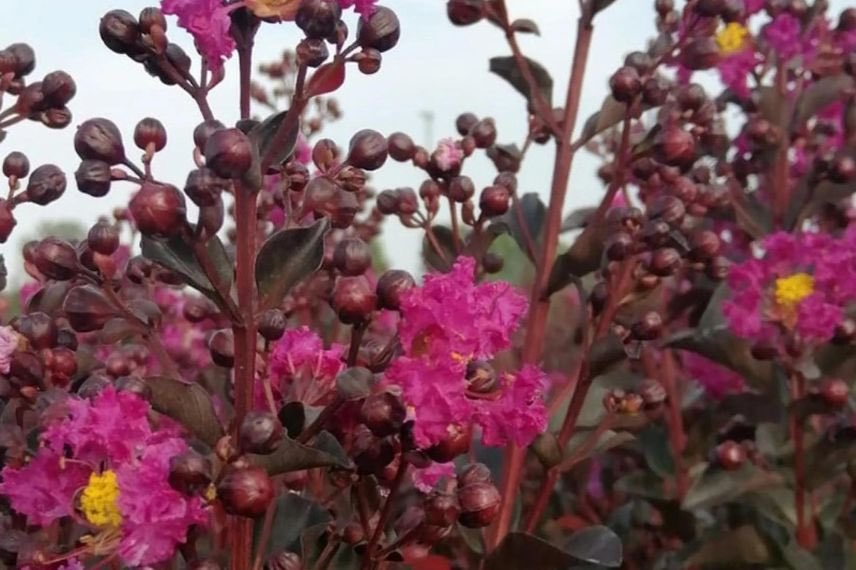
Lagerstroemia is fairly hardy, withstanding temperatures down to -10°C to -15°C. However, it requires warmth to flower, limiting its appeal in northern regions. ‘Rhapsody in Blue’, at a height of 1.50 m, has deciduous purplish to burgundy-red foliage and a dark pink-to-purple flowering. The dense inflorescences bear five-petalled flowers with undulating petals and a yellow centre.

This Lagerstroemia requires cool, but well-drained soil, a sunny exposure and annual pruning in late winter. It is suitable for container cultivation, particularly in cold regions, with regular watering in summer. To create contrasts, pair ‘Rhapsody in Blue’ with golden-leaved shrubs such as the Physocarpus ‘Dart’s Gold’. For a subtler contrast, the Caryopteris ‘Grand Bleu‘ with its grey-green foliage and dark blue flowering is an excellent choice.

deciduous shrub

Comments

Lagerstroemia indica 'Bergerac'