





























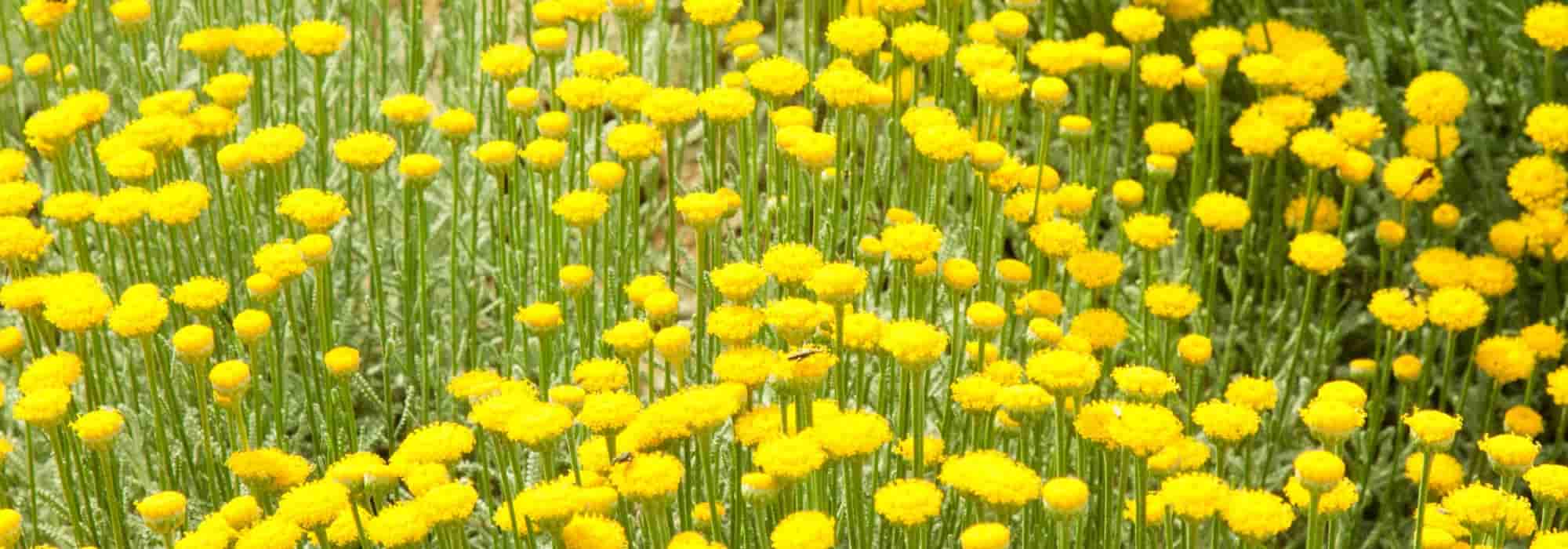
Low-maintenance plants for slopes
Our ideal selection for low-maintenance slopes
Contents
Designing a slope is often a real challenge for gardeners. The constraints of a slope often make maintenance more difficult than in a flat garden and impractical. Between soil erosion, water runoff, limited accessibility for gardening tasks, and dry soil in certain areas, the challenge is considerable. Vegetation must therefore perform several functions: stabilise the soil, withstand sometimes harsh conditions, and, of course, minimise maintenance. To succeed in this landscaping, it is important to select robust plants that can thrive with minimal care while providing an attractive appearance.
Fortunately, some plants are particularly well suited for landscaping a slope with minimal effort. They require little maintenance and are perfectly capable of thriving while helping to control erosion. We will look at the best plants to achieve an attractive slope without having to spend too much time on it.

Groundcover plants: a natural solution to prevent soil erosion
Thanks to their dense rooting, groundcover plants effectively limit soil erosion, preventing runoff, reducing weed growth, and requiring little maintenance. These plants are perfect for quickly covering large areas without regular interventions.
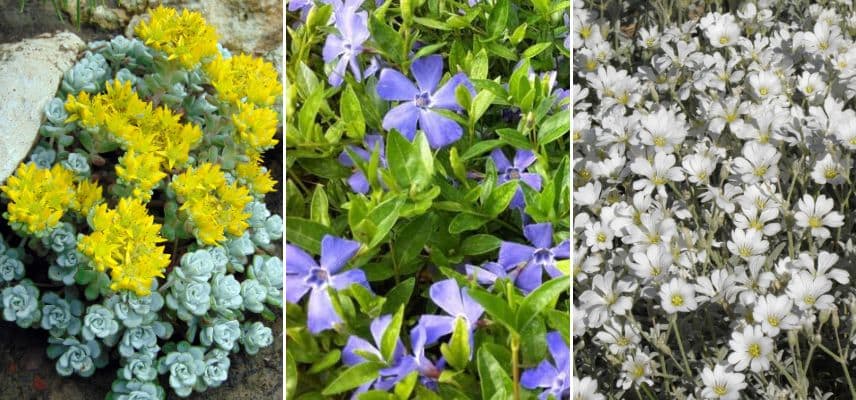
Among the best suited, you will find Sedums, succulent plants that thrive particularly well in sunny spots and on dry, well-drained soils. They resist harsh conditions and are hardy (up to -30°C depending on the variety). Their fleshy foliage, ranging from purple to green-grey, provides an attractive decorative touch all year round, and they require little maintenance once established. Among the many varieties, you will find Sedum creeping ‘Cape Blanco’, with its silvery foliage and golden flowers, which does not exceed 5 cm in height, while Sedum ‘Chocolate Cherry’, reaching 30 cm, offers attractive purple-tinged foliage. With sedums, there is no shortage of choice!
Another excellent choice for shaded or semi-shaded slopes is Vinca minor (little periwinkle). Its evergreen foliage forms a dense carpet all year round and adapts to a wide range of soils, preferring those that are slightly damp and well-drained. Very hardy (up to -29°C), it tolerates harsh winters and spreads itself across the slope, deterring most undesirable weeds. Its spring flowering in small blue-violet flowers adds a splash of colour to the slope. This plant requires almost no maintenance, apart from an occasional pruning to control its spread. Note that it is less invasive than its cousin, the greater periwinkle.
For sunny slopes, Cerastium tomentosum, commonly called mouse-ear, is an ideal groundcover plant for slopes and rockeries. Adapted to poor soils, it tolerates drought and chalky soils, as well as regions with wet winters, provided the slope remains well-drained. Its silvery-grey evergreen foliage and small spring white flowers stabilise the soil while creating a sober and elegant aesthetic. Very hardy, it requires only minimal maintenance and adapts to most regions.
Read also
5 mountain shrubs to revegetate a slopeConifers and evergreen shrubs: structure and low maintenance
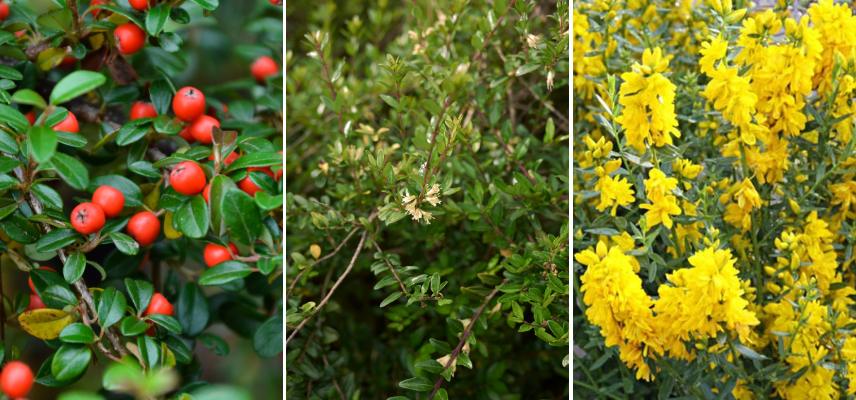
To give structure and volume to a slope while reducing maintenance, conifers and evergreen shrubs are ideal allies. Cotoneaster dammeri, for example, is particularly well suited. This evergreen groundcover forms a dense carpet quickly, thereby preventing weeds from taking hold. Very drought-tolerant once established, it is ideal for poor, well-drained soils and sunny or semi-shaded exposures. In addition to stabilising the soil with its deep roots, it offers pretty white flowers in spring, followed by red berries in autumn, which add decorative interest.
Lonicera nitida, evergreen and very hardy shrub, spreads rapidly to cover large areas. It tolerates both drought conditions and poor soils, while offering dense, glossy green foliage all year round. Easy to care for, it only requires occasional pruning to maintain its shape.
Another drought-tolerant shrub is creeping broom (for example, Genista tinctoria ‘Plena’). Its small yellow flowers in summer and spreading habit make it an excellent choice for stabilising sunny slopes with dry, poor soil, requiring little maintenance.
Ornamental grasses: beauty and hardiness
Ornamental grasses are perfect for landscaping a bank, bringing lightness and movement. Their slender silhouette and their inflorescences swaying in the breeze create a beautiful natural effect. But beyond their aesthetic appeal, they also possess great resilience to difficult conditions, such as drought or wind.
Among many varieties, one may name the Blue Fescue (Festuca glauca), with its blue-silver foliage, is particularly well suited to sunny, dry banks. It requires virtually no maintenance and retains its architectural look all year round. Very hardy, this grass stands up well to winters and poor soils.
You may also steer your choice towards Pennisetum alopecuroides, notably the variety ‘Piglet’ or ‘Hameln’, for their soft, silky inflorescences in summer. They also adapt well to well-drained soils and to sunny or lightly shaded sites. These grasses, although deciduous, retain a graceful look even in winter thanks to their dry, golden spikes. They require only an annual pruning at the end of winter to make way for new spring shoots.
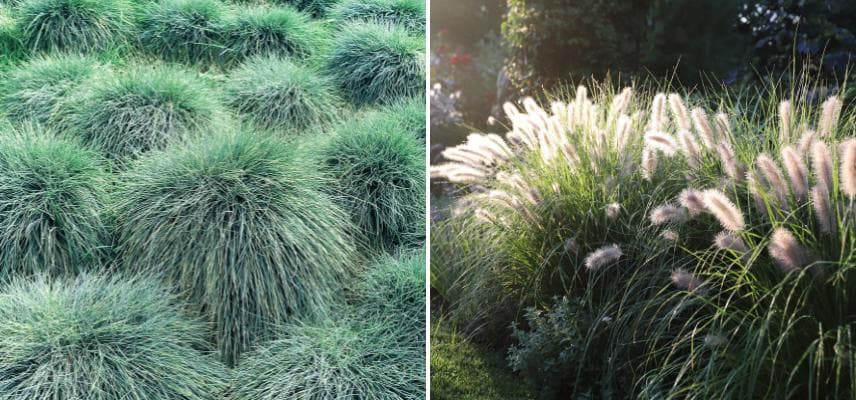
Festuca glauca and Pennisetum
Read also
7 perennials ideal to landscape a bankMediterranean plants: drought-tolerant
Mediterranean plants are ideal candidates for sun-exposed slopes subjected to drought conditions. Adapted to poor soils and arid climates, they offer both robustness and aesthetic appeal without requiring special care.
How could one not think first of the iconic Lavender (Lavandula angustifolia) ? Its silver-grey foliage and fragrant flower spikes attract pollinators while adding Provencal charm to the slope. Very hardy (down to -20°C in some cultivars) and evergreen, it only requires an annual pruning, if desired, to maintain its dense form. Once well established, it requires no additional watering, even during drought periods.
Santolina (Santolina chamaecyparissus), with its silver foliage and small yellow flowers, is also a good choice for dry and rocky soils. It requires very little maintenance and tolerates heat and summer droughts well. Evergreen, it retains its foliage year-round and only requires a light pruning, too, to maintain its compact form.
The Geranium macrorrhizum is a perennial variety, excellent for dry slopes, regardless of exposure. Its aromatic, semi-evergreen foliage turns red in autumn, adding a further touch of colour. Very hardy and drought-tolerant, this geranium adapts to poor and dry soils and offers a generous flowering of small pink or purple flowers in spring. It requires little maintenance and helps stabilise soils while attracting pollinators.
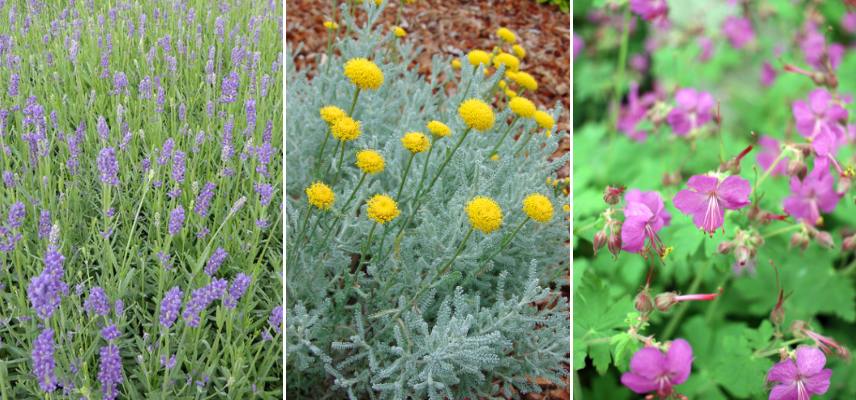
Lavender, Santolina chamaecyparissus and Geraniummacrorrhizum
Hardy carpet-forming plants: for a natural and colourful effect
If you want a colourful and easy-to-maintain slope, creeping, hardy ground-covering plants are an ideal solution. These plants, lying close to the ground, quickly cover the soil while providing a beautiful diversity of colours and stabilising the soils naturally. Wild thyme (Thymus serpyllum), for example, is particularly suited to dry, sunny slopes. Forming a dense carpet of small aromatic leaves, it blooms pink flowers in spring, thereby attracting pollinators. Very drought-tolerant and hardy (to -15 °C), it requires little watering and no special pruning. However, it is important to ensure the soil is well-drained, as this plant does not cope well with excess moisture, especially in winter.
Aubrieta is also a small creeping plant ideal for sunny or lightly shaded slopes. Its abundant spring flowering produces purple flowers that form a true colour carpet. Hardy to -30 °C and easy to care for, it tolerates poor, well-drained soils in many regions.
Another equally attractive plant is the Alyssum, commonly known as basket of gold, a perennial with bright yellow blooms in spring. It thrives in dry, rocky soils, creating a stabilising carpet that requires little maintenance while bringing a splash of vibrant colour. Very hardy (to -30 °C), it withstands harsh winters, as long as the soil remains well-drained.
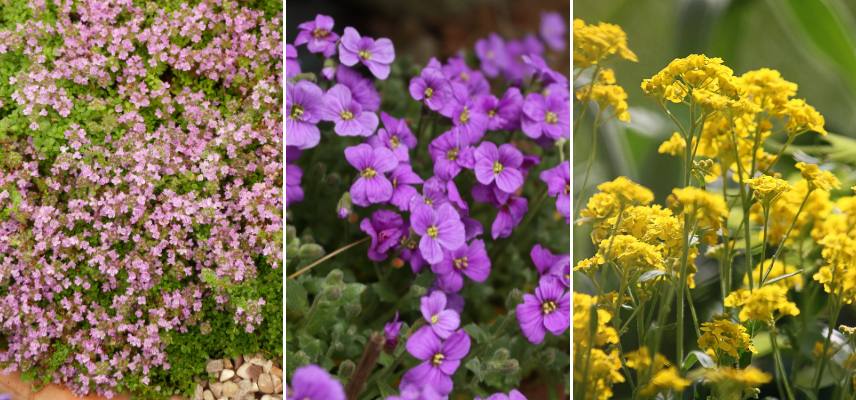
Thymus serpyllum, Aubrieta and basket of gold
And many more
There are many other perennial groundcovers and shrubs suitable for slopes, such as Ajuga reptans for semi-shaded areas, the Iberis sempervirens (silver basket) ideal for dry, sunny sites, or Pachysandra terminalis for stabilising shaded soils. You can also consider varieties such as Cup-leaved Honeysuckle (Lonicera pileata) or St John’s wort (Hypericum calycinum) for quick and attractive groundcover.
- Subscribe!
- Contents
Comments