





























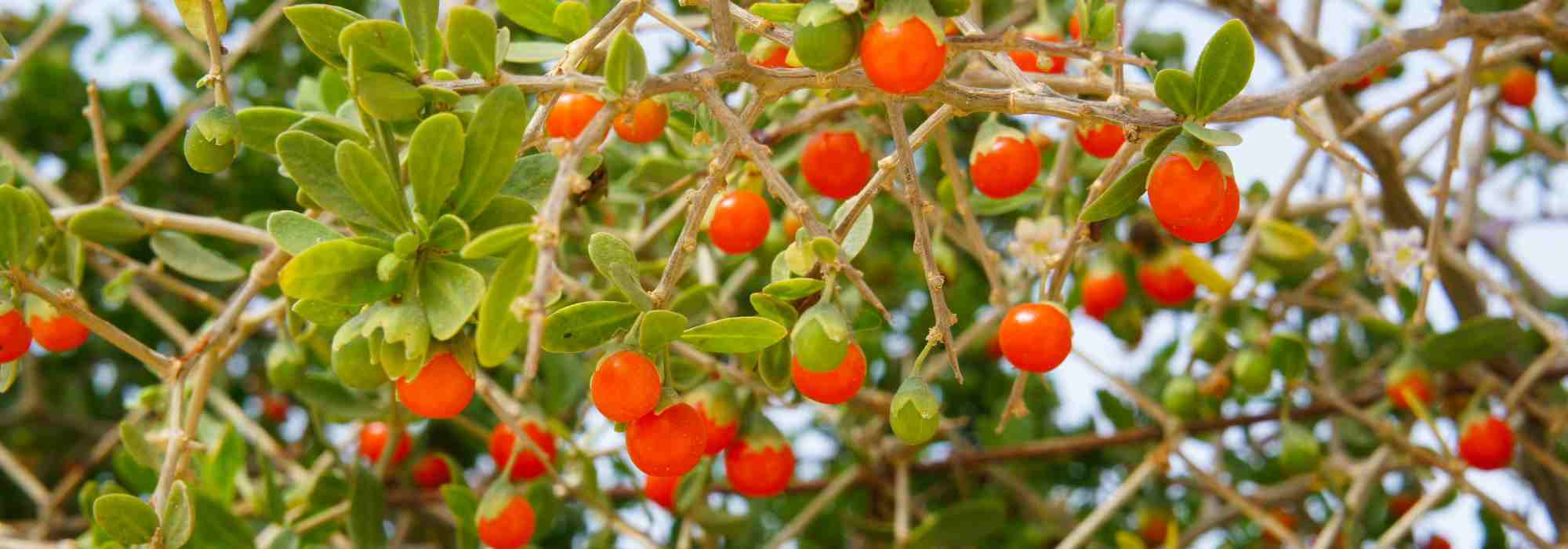
Lycium barbarum: which variety to choose to enjoy goji berries?
Our buying guide to Lycium barbarum varieties tailored to your growing conditions, criteria and preferences
Contents
Wherever you live and garden, you can enjoy your own goji berries. Indeed, Barbary goji (Lycium barbarum) is a shrub in the Solanaceae family, hardy to -20°C and particularly drought-tolerant. Moreover, it is hardly demanding when it comes to planting, tolerating all soil types, including calcareous or saline soils.
It forms, moreover, a shurb never exceeding 3 m in height, highly ramified, which easily integrates into a fruit hedge or even a defensive hedge, thanks to its slightly spiny shoots, or can be trained to climb. Aesthetically speaking, it has a supple, upright and spreading silhouette. Its foliage turns grey-green with age, and its flowering occurs in spring, with a second flush from June to September. The flowers are small, a pretty mauve-purple, and both melliferous and nectariferous.
But we mainly cultivate Barbary goji, a self-fertile shrub, for the goji berries it quickly produces. These berries are considered superfruits, rich in antioxidants and vitamin C. To be enjoyed fresh or dried.
Are you convinced by this shrub? Yes, but which variety should you choose? In this text, I will guide you in selecting the variety best suited to your growing conditions, your preferences for flavour or colour, or your productivity needs.
For more on goji berry cultivation, please read our article: Barbary goji: planting, caring for and harvesting goji berries

For the flavour of fruits
In our latitudes, goji berries, rich in vitamins A, B and especially C, are often enjoyed mixed with other fruits with cereals for breakfast, in juice, in smoothies, or as an aperitif. In China, the cradle of goji berries, they are regarded as guarantees of longevity. And the Chinese often integrate them into savoury dishes, meats, fish, salads or even broths and soups. It must be said that goji berries offer a just balance between sweetness and tartness. The first bite releases the sweetness, before giving way to a certain form of bitterness, far from unpleasant. Goji berries recall a little the flavours of cranberry, dried raisins and green tea.
The choice of Lycium barbarum variety therefore depends on your tastes. If you are looking for goji berries where sweetness predominates, the variety Princess Tao® is best suited to your needs. Indeed, this French-origin variety, developed by selection, offers berries with a bright vivid red, larger in size than other varieties, and especially very rich in sugar. Non-astringent and very sweet, these berries can be consumed fresh or dried, from July to November. And from the first year, in small quantities. This variety also has the advantage of having a tiered habit, easy to train on a stake. This Lycium barbarum also shows a hardiness of around -30°C.
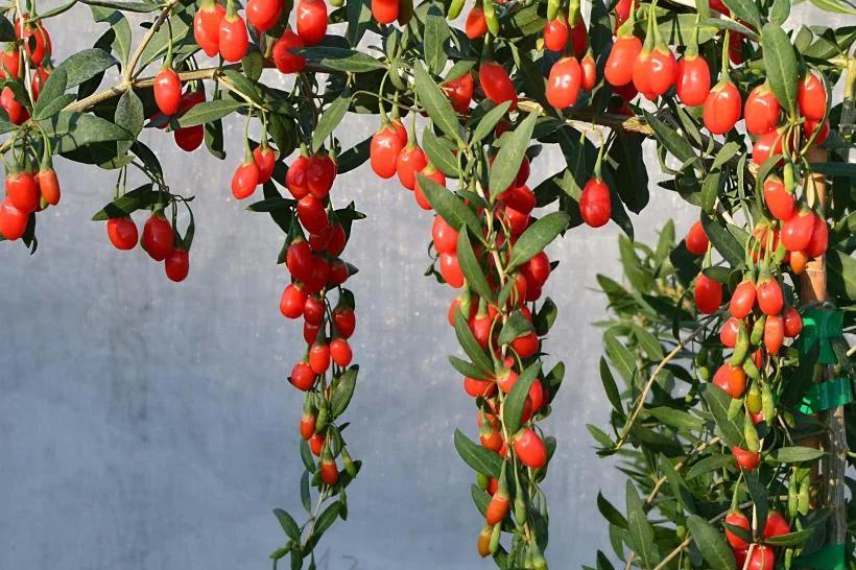
The variety ‘Princess Tao®’ is renowned for the very sweet flavour of its berries
The other variety recognised for the flavour of its fruits is Gojidelys®, developed by the French plant breeder Verdia. The red berries of this variety, 1.8 cm long, are particularly tasty due to the balanced sweetness and tartness. They are harvested from August to October and fruiting is very rapid after planting.
For the colour of the fruits
If you are looking for different goji berries, the Lycium barbarum ‘Amber Sweet®’ variety stands out. Simply because its berries are yellow in colour, more precisely amber. In fact, the berries of this variety developed in China (‘Huang Se Medlar’), introduced to the horticultural market since 2016, differ in colour but retain the same nutritional values as the bright red berries. However, they could have been placed in the previous category since their flavour is particularly sweet and sugary, with no bitterness. At 2 cm long, these berries are quite fleshy and very pleasant on the palate. They can be eaten both fresh and dried, and are harvested from August to October.
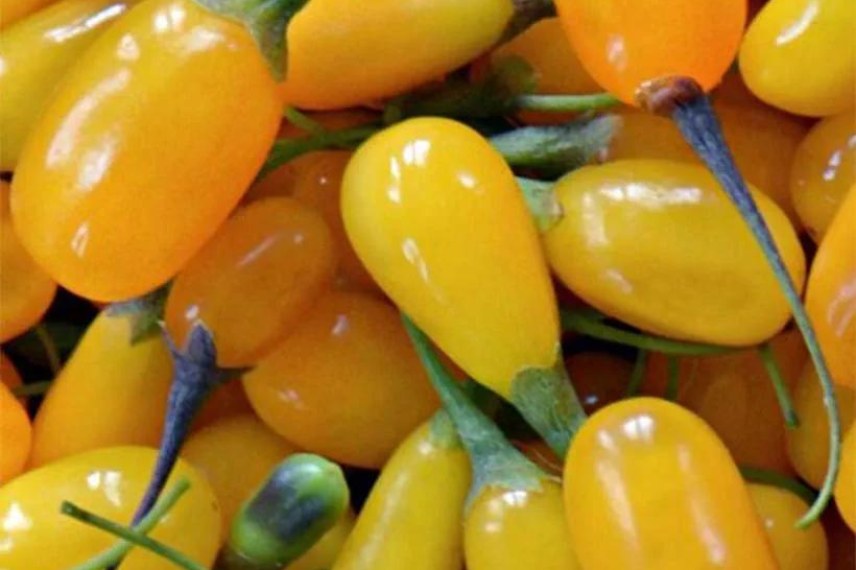
Amber Sweet® offers amber-yellow goji berries
According to the shrub's habit
Lycium barbarum is a bush with a loose habit, ideal for hedge planting. At maturity, it can easily reach 3 m in height and 2 m in width. If you have a small garden, or simply a balcony or a terrace, it is perfectly possible to grow Lycium barbarum. However, you will need to choose a variety renowned for its more shrub-like habit and compact form. The variety Lycium barbarum ‘Sweet Lifeberry®’ is recognised for these characteristics, making growth in pots or in a small space possible. This variety also features smaller leaves, and berries that are noticeably more numerous and sweeter.
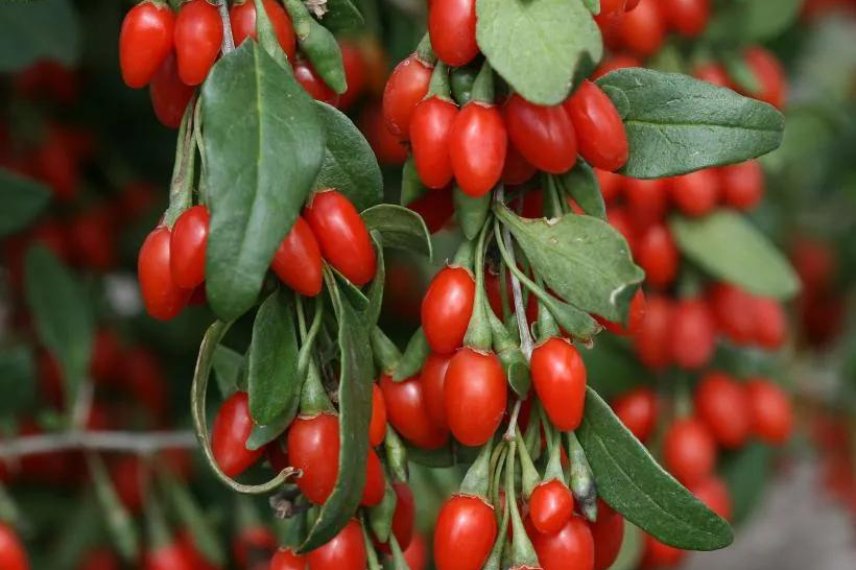
The variety ‘Sweet Lifeberry®’ is ideal for small gardens or pot culture
The variety ‘Instant Success®’, often referred to as ‘Sweet Success®’, is also very well suited to a small garden or pot cultivation. Indeed, it will rarely exceed 1.50 m in height with an equivalent spread. However, it is a productive variety of elongated berries of orange-red colour, which grow in clusters along the shoots. These berries are particularly valued for their very slightly sweet flavour and their fleshy texture.
According to the yield
The typical Lycium barbarum variety is already known for its productivity and rapid fruiting. But the development of cultivars has increased productivity and the size of the fruits. So if you are looking for a very productive goji berry variety with large berries, choose ‘Big Lifeberry®’. This cultivar, which takes the form of an upright and spreading bush, stands out for its very abundant fruiting from August to October. It is therefore recognised for its productivity superior to other varieties, as well as for the size of its round, sweet-tasting berries, which are also larger than the others. If you want to boost your vitamin intake, this hybrid variety is the one to cultivate! Moreover, its vernacular name leaves little doubt about its main qualities!
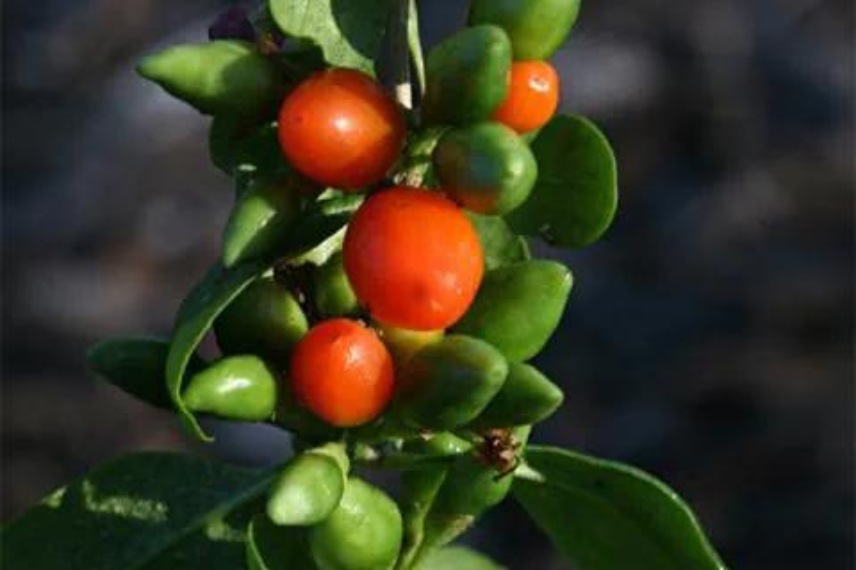
‘Big Lifeberry®’ is recognised for its large berries and productivity
- Subscribe!
- Contents
Comments