





























Manures in the garden: when to use them? How to dose and apply them?
The complete guide to using different manures in the garden and the vegetable patch
Contents
Anyone who cultivates their garden or vegetable plot organically will be familiar with plant manures. Plant manures, which are intended as natural preparations rich in nutrients, minerals and active substances, are true elixirs for your crops. Indeed, these nettle-based manures or those from other plants benefit from an undeniable curative action, coupled with a preventive effect. For all that, even though they are completely natural plant extracts, caution is warranted. Their use must follow the same precautions as commercial products, in terms of handling, but also of dosage and application.
Discover how to dose and apply the different plant manures according to the use you wish to make of them

Which manures for which uses?
Manures are natural preparations based on plant extracts, wild or cultivated, ideal for the maintenance and care of the garden and the vegetable plot. They are a biological alternative to synthetic products. If there are ready-to-use manures on the market for busy gardeners, plant manures remain relatively easy to prepare. It is indeed enough to ferment, for several days or several weeks, leaves, stems, flowers or roots of plants in rainwater. Filter and it’s ready!
The benefits of plant manures
Plant manures differ from the decoction which involves boiling the plants in water. And to obtain a plant infusion, one adds the plants to water that has already boiled and leaves to steep for at least two days. But back to our plant manures…
Plant manures offer different benefits, depending on their composition. They can thus be regarded as fortifiers for plants, by virtue of their nutrient richness. They are, in effect, natural fertilisers. Others will have a protective action against pests, either as a repellent or as an insecticide. Other manures prove effective against the main cryptogamic diseases, such as the ‘powdery mildew or the downy mildew. They are therefore effective antifungal agents. Finally, plant manures also help to amend and feed the soil thanks to the supply of nutrients such as nitrogen.
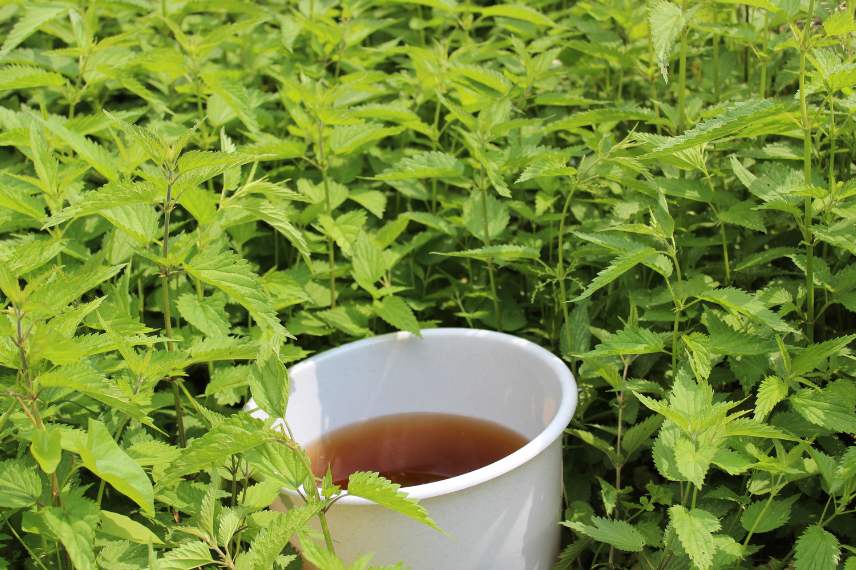
In addition to its insecticidal and fungicidal properties, nettle manure fertilises the soil
The different plant manures and their uses
Let’s quickly inventory the different plant manures to prepare for the garden:
- The nettle manure is certainly the most versatile manure in the garden, as it is both a growth stimulant due to its nitrogen richness and a repellent against aphids, flea beetles and mites. The nettle manure also helps develop the plants’ defences and their rooting, while preventing cryptogamic diseases. It is also an excellent compost activator
- The comfrey manure : as a preventive, comfrey manure stimulates growth and strengthens defences against insects and plant pests. It is also a compost activator
- The horsetail manure : thanks to its richness in potassium, the horsetail manure helps prevent and combat powdery mildew, the rust, gray mould, moniliosis and peach leaf curl. It also has a positive effect on plant growth
- The eagle fern manure : above all an excellent repellent against aphids, slugs and snails, wireworms, but also a preventive treatment against powdery mildew and rust. It can also be used as a fertiliser and as a compost activator
- The tomato manure : it can be used as a fertiliser, but also as a repellent against flea beetles, the cabbage white butterfly and the carrot fly. It is also effective at eliminating aphids
- The dandelion manure : rich in potassium, silica and phosphorus, the dandelion manure contributes to plant growth, and thereby to their resistance to diseases
- The tansy manure : it is ideal for repelling whiteflies, vegetable flies and the vine weevils, the potato beetles, the carpocapses, the pierids… or to combat rust and powdery mildew
- The rhubarb manure : it is primarily a repellent against insects, notably aphids
- The wormwood manure : it is radical against mites, slugs and snails, the cabbage white, the carrot fly, flea beetles, caterpillars…
- The elder leaf manure : it has repellent and insecticidal properties against the mole, the field mouse and the vole, but also against caterpillars and aphids
- The banana peel manure : it is a natural fertiliser rich in potassium
- The ivy manure : it is known for its repellent and insecticidal virtues against aphids, whiteflies and mites
- The lavender manure : it is excellent as a repellent against insects.
This list is not exhaustive, and there are other manures with stimulating or insecticidal properties.
When should manure be applied in the garden?
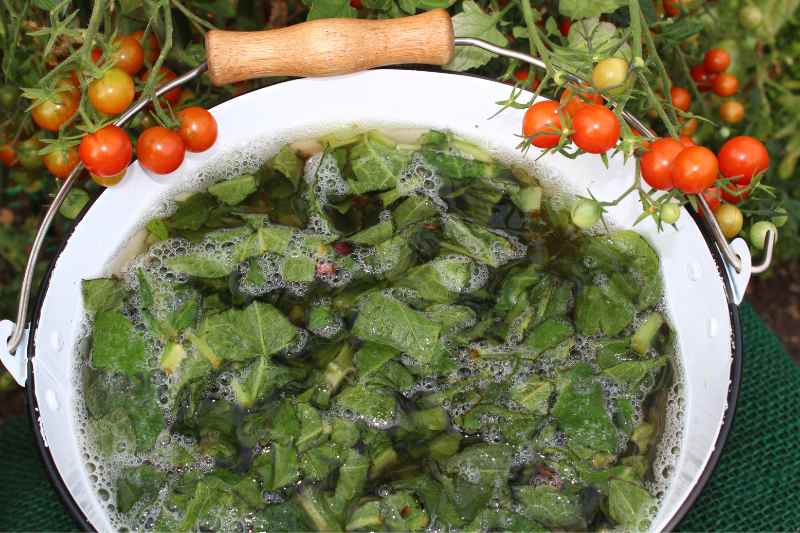
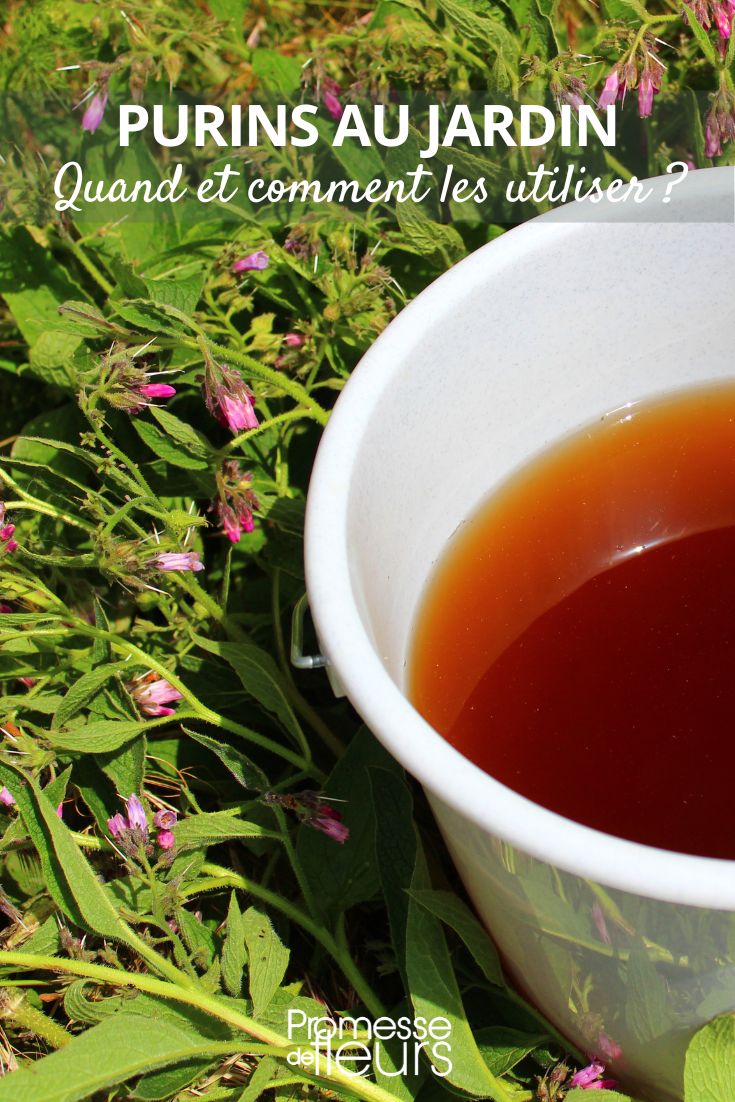
Comfrey manure
Depending on the intended use, plant manures are used mainly from spring through to early autumn. Indeed, a manure with properties that stimulate growth, flowering and fruiting is used in spring and summer. But it can also be used at the very start of autumn, when many plants prepare to face winter by building up reserves. The manures effective as repellents or insecticidal agents will be sprayed prior to spring invasions and throughout the insects’ mating and life cycles, varying by species.
However, it is essential to apply your manure on a day with no rain and no sun. Indeed, these manures are leachable and do not withstand strong sunlight. Therefore, before spraying manures, it is advisable to check the weather forecast! As for application, it should be done in the evening or very early in the morning.
Manures should never be applied to dry soils or to plants under water stress. It is therefore preferable to have moist soil to enhance the effectiveness of the manures.
Overall, the application of plant manures should be renewed every two weeks. But not in excess, because, with their concentration of active substances, they can have the opposite effect to that intended.
Finally, perhaps it is useful to recall that precautions must be observed when using manures, even though they are natural products. It is advisable to wear gloves and a mask and keep them out of reach of children.
How to dose and apply different plant manures?
Depending on how you intend to use these manures, the application can be carried out in two ways: either by foliar spray or by watering at the base of the plant.
A spray or a watering
Thus, if your manure is used as a growth stimulant, as a preventive against certain diseases, or as a repellent or insecticide to combat pests, spraying is the most recommended method. Generally, the foliage is sprayed most, but in the event of a pest attack, the stems and the undersides of the leaves should also be sprayed.
By contrast, if you use your plant manure as an activator of the soil’s microbial life or as a soil amendment, it is preferable to water directly at the base of the plant. And if you use your manure as a compost activator, apply directly to the heap.
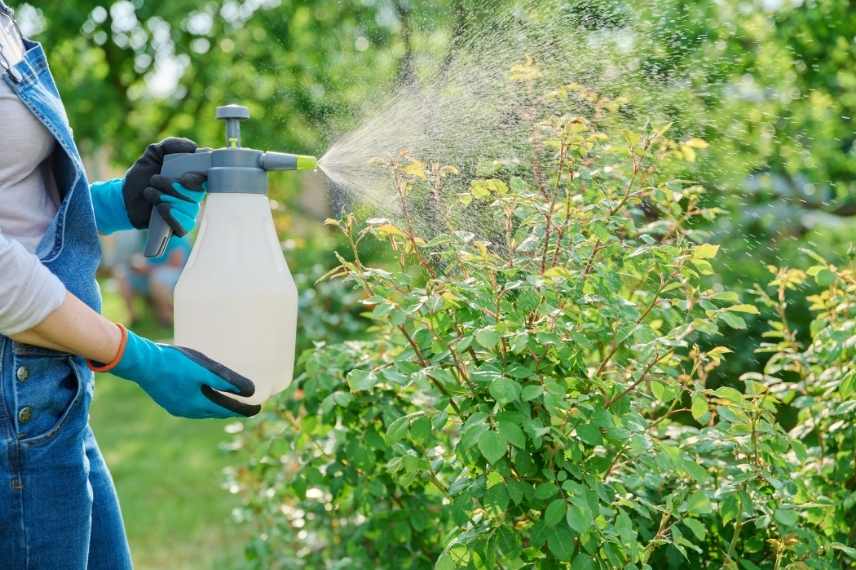 Plant manures are applied by foliar spray or watering at the base
What dosage for plant manures?
Apart from the method of application, with plant manures, it is essential to ensure the proper dosage. Generally, all manures are used diluted in water, preferably rainwater. Indeed, although perfectly organic, these manures are particularly high in nutrients and minerals. An excessive application could be harmful to plants.
This dilution mainly depends on how you will use your manure in the garden or allotment. I present the different dosages to follow for the most common manures. For information, diluting to 10% means mixing 1 litre of manure with 9 litres of water; diluting to 20% means 2 litres of manure with 8 litres of water…
- The nettle manure should be diluted to 10% or 20% for watering or foliar spray
- The comfrey manure should be diluted to 5% for foliar spray, 20% for watering
- The horsetail manure should be diluted to 5% to strengthen young plants, 20% on fruit trees
- The fern manure is used neat for curative treatment, diluted 5–10% as a preventive
- The wormwood manure is diluted to 10%, sprayed on the foliage
- The rhubarb manure is used diluted to 10% or 20%
- The tansy manure is generally used undiluted
- The elder manure is very effective when diluted to 10%
- The lavender and dandelion manures are diluted to 20%
- Subscribe!
- Contents
Comments