





























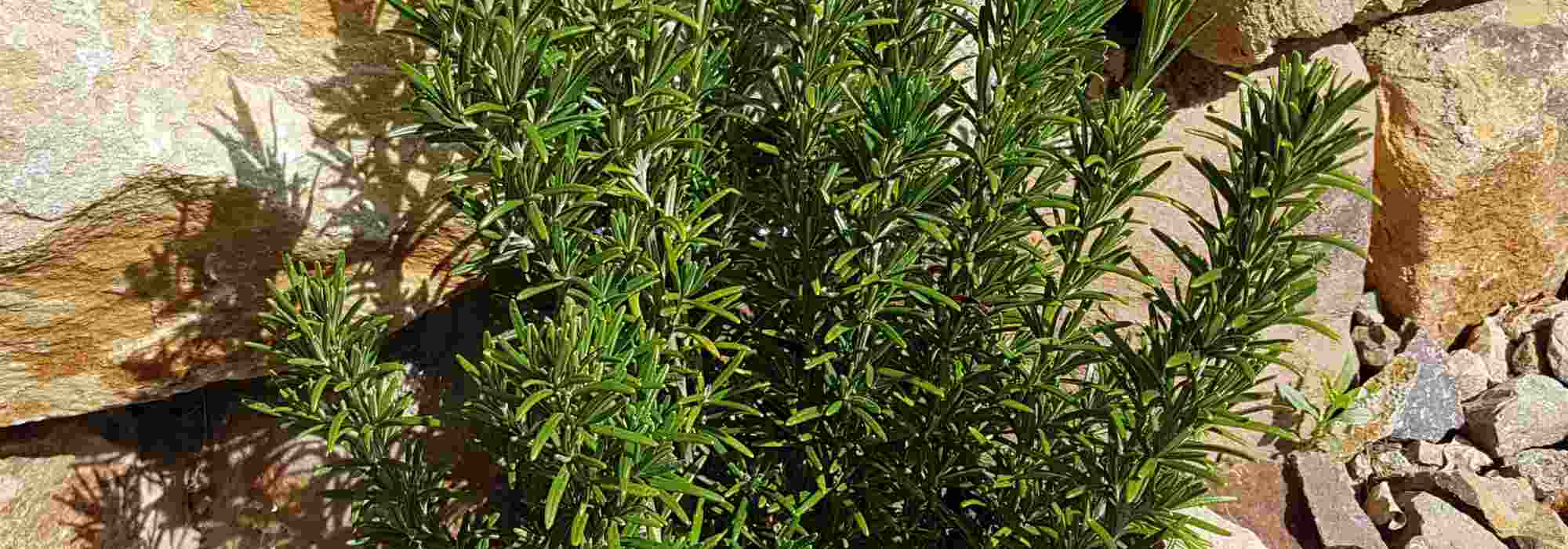
Must-have garrigue plants
Iconic garrigue plants for a waterwise fragrance garden
Contents
Garrigue, a word that almost sings to our ears, with the accent! These landscapes, close to the maquis, remind us of plants that are often aromatic, and perfectly suited to rocky, calcareous and dry soil in the Provence hinterland, Occitania or Languedoc. We are adopting them more and more, climate change notwithstanding, for their peerless endurance to waves of repeated heatwaves that await us year after year. Garrigue plants are characterised by their small leaves, foliage sometimes greyed or bluish to resist the scorching sun’s rays, aromatic fragrances, prostrate or low-growing habit, and a generally good hardiness, as these plants must endure wide temperature swings and cold winters.
What plants are most commonly found in the garrigue? Discover our selection of emblematic bushes and perennials of the garrigue to make your gardens sing!
→ Find our complete range of garrigue garden plants in our online catalogue.

Thymes
Which plant should be named first in this anthology of garrigue plants? Certainly thyme, or rather thymes, which alone account for over 300 species, native from the Mediterranean basin to Asia Minor. Aromatics, thymes are indeed the shrubs most typical of the rocky landscapes of the garrigue. Just like rosemary (see below), these are plants that have adapted perfectly to heat, their tiny leaves helping to reduce water loss. Bound to dry and calcareous soils, they are either prostrate, ground-hugging like wild thyme (Thymus serpyllum), or of dwarf form, very compact, growing in bushy cushion-like mats of varying heights, such as Thymus cilicicus or the Thymus capitatus. Some hybrids give off a lemon scent such as lemon thyme (lemon thyme), or bear variegated or golden foliage. Their spring flowering (May–June) or summer flowering is pink to mauve or white, made up of small heads formed at the ends of the stems. All are used in cooking to flavour grilled meats and summer dishes.
♥ Our favourites: wild thyme, the most wild; common thyme (Thymus vulgaris, called farigoule in the south), Corsican thyme (Thymus herba barona) with cumin-scented and strongly lemony foliage.
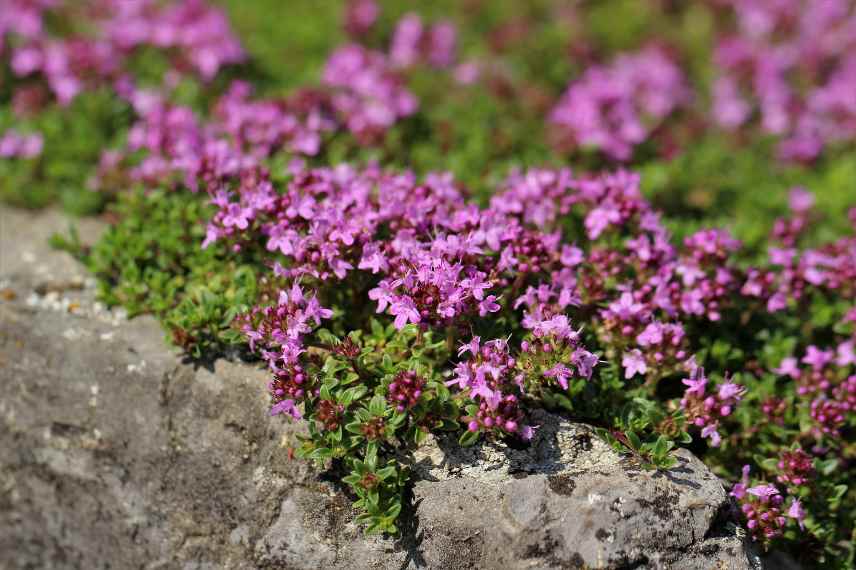
Thymus serpyllum
Read also
Designing a terraced gardenGarrigue spurge
Euphorbias also provide a fine example of the Garrigues flora endemic to the garrigue. There is even one that has taken its name, the Garrigues Euphorbia, or Euphorbia characias. It is often seen in gardens and landscaped spaces, flowering for a long time with its huge acid-green panicles between March and June, growing on sturdy and upright stems. The foliage is very ornamental, arranged in whorls, with a glaucous green. This perennial takes on a shrub-like habit as it reaches about a metre in height at full bloom and appears semi-woody. It self-seeds freely, producing plenty of baby plants when it is happy.
It clearly thrives in rocky or sandy soils, always well-drained and calcareous, and if it loves the sun, it also grows very well in partial shade. In borders or rock gardens, it provides a handsome presence all year round. Just beware of the latex that oozes from its stems when pruning.
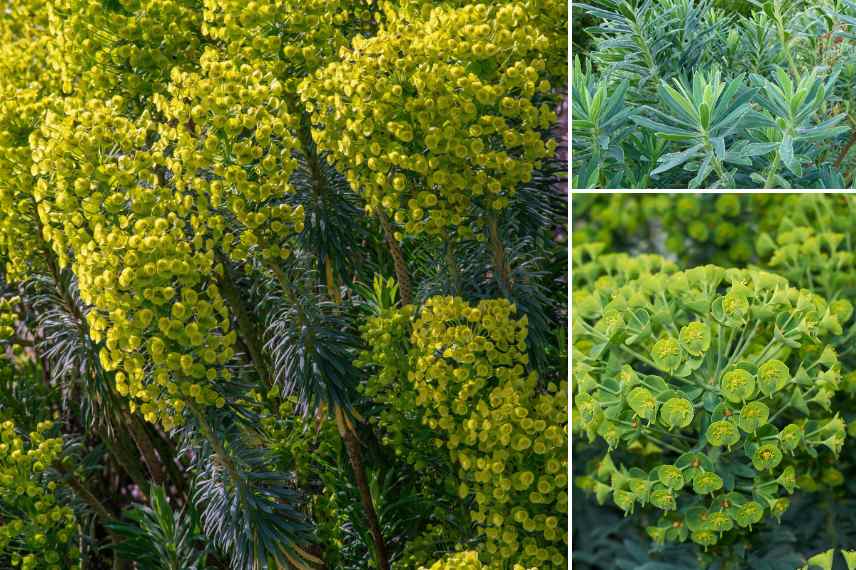
Euphorbia characias : habit, foliage and flower.
Rockroses
These hardy perennials are interesting for a garrigue-style garden: very heat-tolerant, suited to calcareous soil, fairly hardy depending on the species. They grow wild on Provence’s rough soils, like Cistus laurifolius. Cistus form compact, evergreen shrubs, revealing delicate, pink-tinged flowers for at least a month from April or May; the blossoms resemble those of the wild rose but are larger and crumpled. This flowering is the main draw, as the blooms open in abundance, each wilting by the evening, but the profusion of flowers means the cistus is one of the longest-flowering plants. They can be white with purple blotch, or pink to mauve. The cistus forms low, upright cushions or spreading shrubs. It can be a frost-prone plant often seen in coastal gardens for this reason.
♥ Our favourites: Cistus pulverulentus, with a very spreading habit (about 50 cm tall and 1 m spread) and pink flowering; Cistus skanbergii, floriferous with light pink flowers; Cistus creticus; Cistus corbariensis and Cistus x florentinus, both with white flowers.
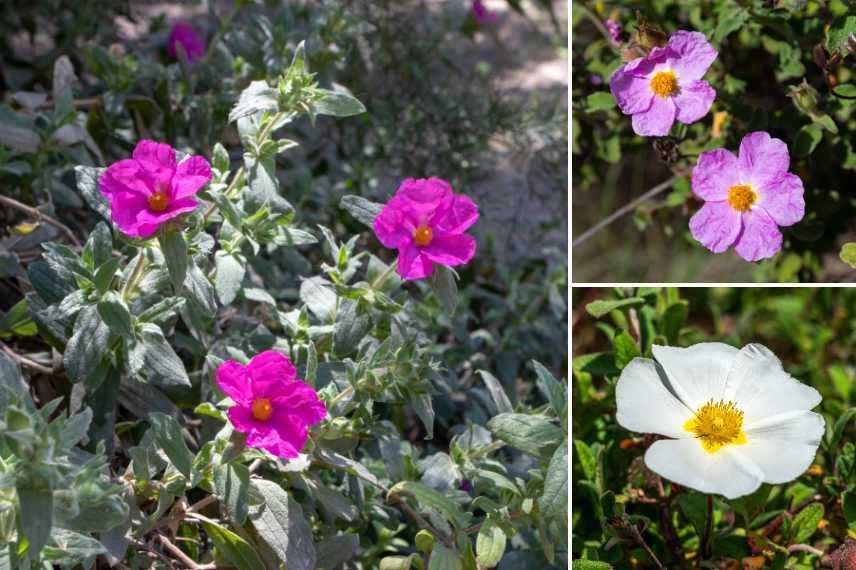 Cistus pulverulentus, Cistus creticus (top right) and Cistus corbariensis (bottom right).</caption]
Lavenders
Lavender is one of the essential plants in the garrigue. In Mediterranean gardens, its low water requirements, its good tolerance to cold, and its need for sun predispose it to become a go‑to plant in a garden with poor, dry and stony soil. Here too, lavenders should be spoken of in the plural, as there are many species, of which the most used is English lavender (Lavandula angustifolia) and its varieties. The most common have mauve to violet flowers, though there are also white‑flowering varieties.
Melliferous, lavenders are among the plants adopted in garrigue gardens for their foliage and flowering that are particularly aromatic and fragrant. They form rounded clumps about 60 cm in diameter, attractive in bloom and providing structure thanks to their evergreen foliage.
♥ Our favourites for the garrigue: Lavandula angustifolia, Lavandula latifolia (spike lavender) with larger leaves and a more camphoraceous scent, Lavandula lanata with very grey, woolly-looking foliage, hardy to -15°C.
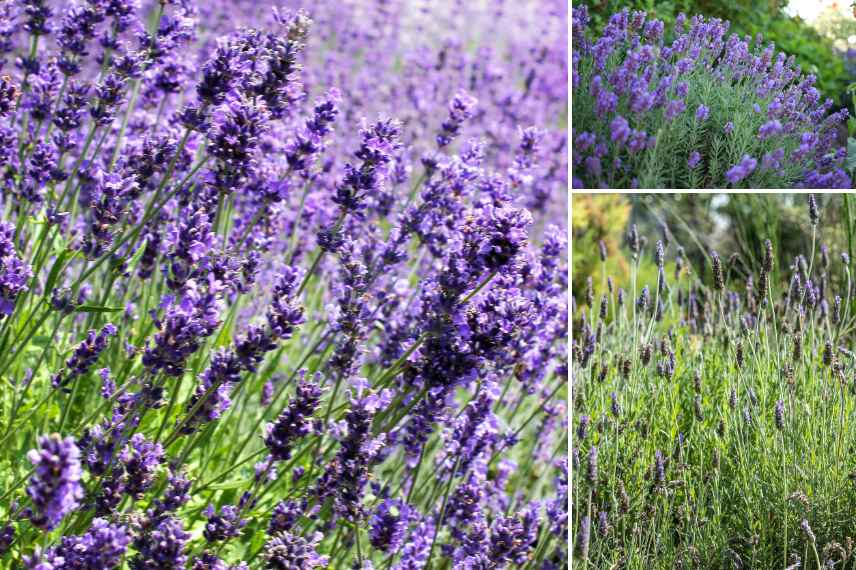
Lavandula angustifolia, Lavandula x intermedia Dutch group ( © FD Richards), and Lavandula latifolia.
Myrtle
Here is another fine evergreen shrub, representative of the garrigue flora. While the Myrtaceae family genus includes many shrubs of southern origin known for their essential oils, here it is the common myrtle (Myrtus communis) that is valuable in the garrigue flora.
A little less hardy than the other plants in this selection, it still tolerates temperatures down to -10°C once established. The common myrtle will grow to a height of between 2 and 3 m, fairly slowly. Its small dark-green, glossy foliage, very dense, is enhanced by white flowers appearing in summer, from June to August. The 2 cm-diameter flowers are scented and attract bees; they have prominent stamens, and will turn into bluish-tinged berries that are blue-purple to purplish-black. Particularly drought-tolerant, it hates excess water and therefore grows perfectly in very well-drained, poor and rocky soil. Given its relative frost sensitivity, we recommend planting in spring rather than autumn, so it has time to establish its root system in the first year. Perfect in a dry or garrigue garden, and obviously by the sea, it is also possible to plant it in a pot where it will stay smaller in size.
→ Note: ideally plant along a well-sheltered wall, always in full sun. The myrtle is well suited to pruning, but you can let it take a more natural form without intervention.
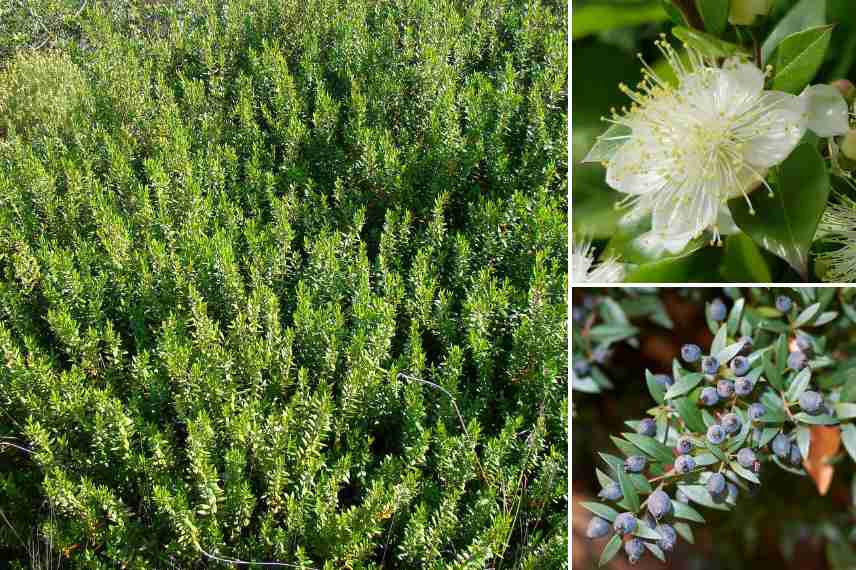
Myrtus communis : habit, flowers and fruits
Helichrysum or immortelles
Here is a herbaceous, perennial plant, with countless species worldwide, but iconic of southern garrigue landscapes: the Helichrysum or curry plant. In recent years it has become popular as a plant that’s pleasant to touch and smell, and it is often called the curry herb or curry plant. And for good reason, a simple brush of its silvery stems releases its powerful spicy fragrance, unmistakably resembling curry. The most common is the Helichrysum italicum, or Italian immortelle, but one can also readily find the Helichrysum angustifolium, with needle-like leaves, the Helichrysum stoechas, the dune immortelle, and the Helichrysum orientale. All share silvery foliar adapted to strong sun and heat by reducing the foliar surface, as well as flowering in small yellow florets, attracting pollinators. These plants form regular, spreading cushions once pruned, between 30 and 50 cm tall. Immortelles are planted in full sun, in dry, stony, well-drained soil, only fearing stagnant moisture, as they are hardy to −10°C/−12°C. They are perfect for rock gardens.
♥ Our favourites: the type species and the Helichrysum orientale, but also the Helichrysum petiolare, with rounder leaves, creeping habit, interesting in pots.
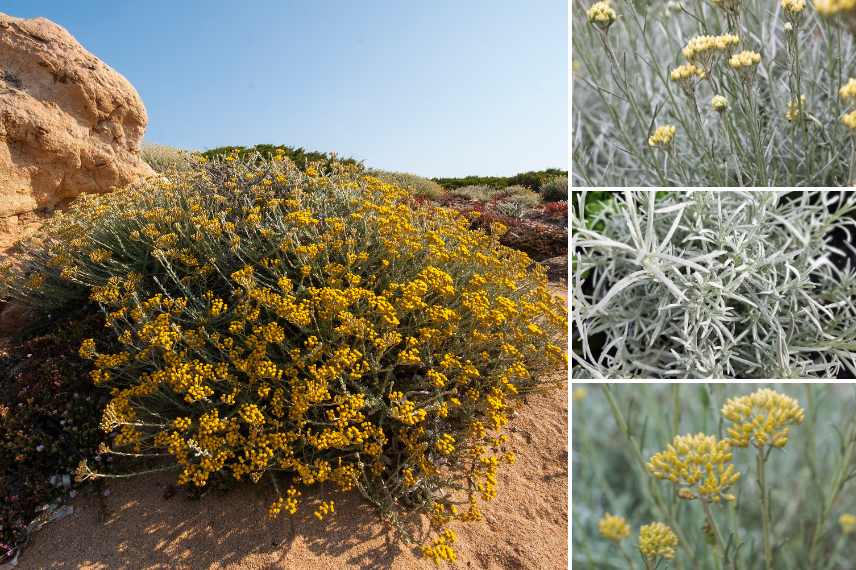 On the left, Helichrysum italicum var microphyllum. On the right, flowers and foliage of the Helichrysum italicum.
Cade juniper
With the Juniperus oxycedrus, more commonly known as cade juniper or prickly cedar, we are instantly transported to the garrigue or scrub vegetation. It is, moreover, part of one of the flagship ranges of a famous Provencal perfumer. This juniper species is identifiable by its small, spiny leaves, very sharp, arranged in verticilles in threes. It grows around the Mediterranean basin as far as Morocco and Iran, up to elevations of 1,200 m, in rocky terrain. Slow-growing, it thrives just as well on the acidic soils of the maquis scrub vegetation as on the calcareous soils of the garrigue. Low maintenance, compact, it forms a small shrub up to 1–2 m tall, hardy to -28°C, it fears neither frosts and winds nor the blazing sun, and its water needs are minimal. Blooms between February and May, turning its flowers into red berries that brown as they ripen. The cade juniper has two requirements: sun and dry, well-drained soil.
→ Did you know? : cade wood, very hard and rot-resistant, was used by Provençal shepherds to make stakes for enclosures or for vines.
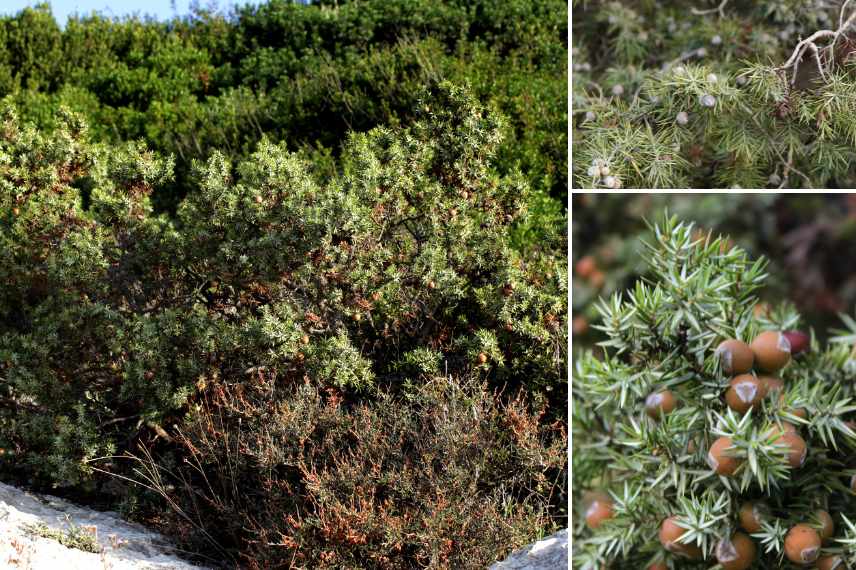
Juniperus oxycedrus
Rosemary
Let us finish this list with the rosemary, a shrub with evergreen foliage that is easy to identify and an essential for the dry garden. Rosemarys are native to the Mediterranean basin, where they grow wild and where they are called incense trees. Their narrow, leathery leaves, grey-green on the underside, are highly aromatic, and they are thus part of the herbs de Provence, along with thyme and oregano. In our gardens, these garrigue plants require calcareous, well-drained soil, like that found in their natural habitat. They flower several times a year, in a repeat-flowering habit, with their labiate flowers typical of the labiates, melliferous and nectariferous, most often blue to pale blue, sometimes white or pink. Rosemarys grow in sun or partial shade in different habits and heights depending on the species: in a bushy, rounded habit, upright to 1.50 m (Rosmarinus officinalis), creeping to 30 cm in height as with the Rosmarinus officinalis ‘Prostratus’. A woody shrub, it behaves a bit like lavender, not resprouting if pruned back to the old wood. Once established, it tolerates temperatures down to -12°C/-14°C. An herb with numerous medicinal, aromatic and ornamental virtues, not fearing drought or cold if planted in well-drained, dry soil, used since antiquity… it’s the must-have of garrigue planting!
♥ Our favourites: Rosmarinus officinalis ‘Pointe du Raz’ for its superb prostrate habit, ideal for a dry rock garden, and the classic rosemary, usable in many garden situations at the jar
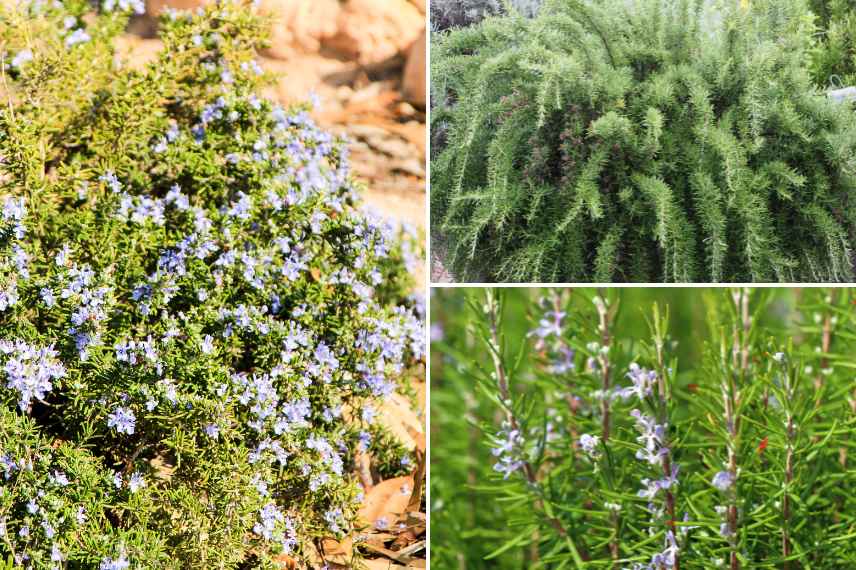
Rosmarinus prostratus, Rosmarinus repens and Rosmarinus officinalis
But also...
We could also mention the mastic tree and the carob tree (Ceratonia siliqua) for planting around the Mediterranean perimeter, and elsewhere, due to their hardiness: the strawberry tree and the Hippophae (sea buckthorn), Aphyllantes monspeliensis (the Montpelier carnation), and many other undemanding plants such as Provençal heathers and gorses (Ulex parviflorus), Narcissus assoanus, the Bupleurum fruticosum, the Dorycnium hirsutum or goose’s-foot, etc.
- Subscribe!
- Contents
Comments