





























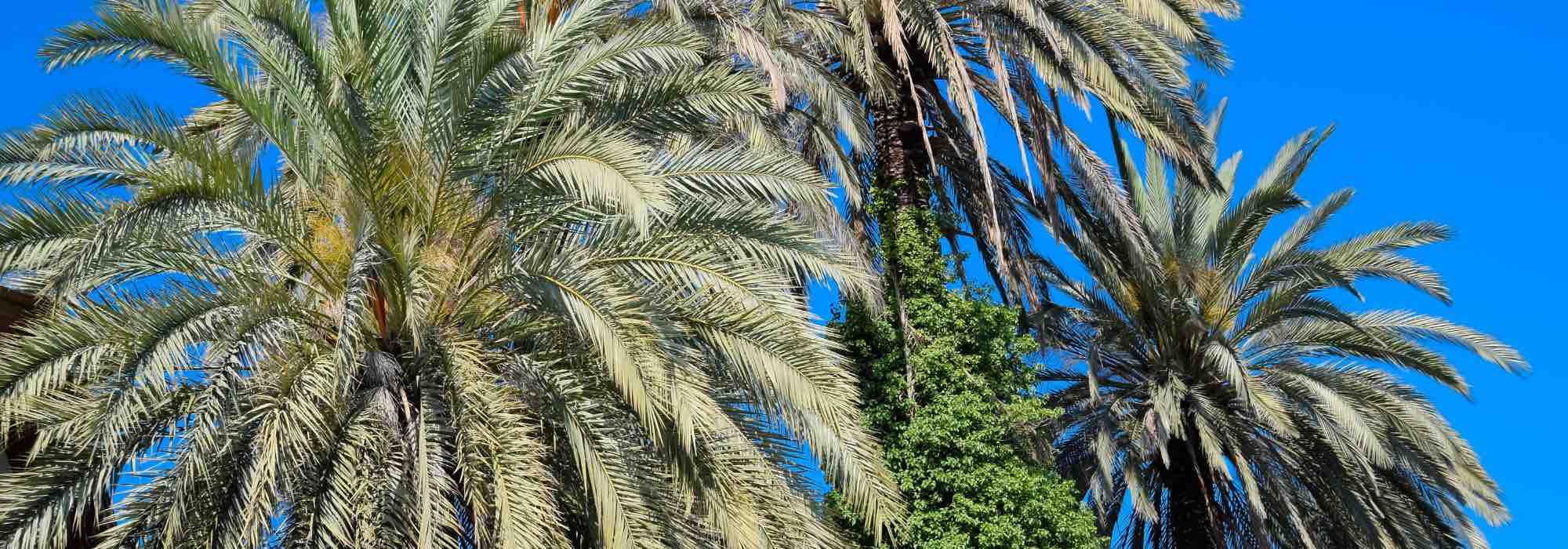
Nematodes for palm pests: why and how to use them in the garden?
Effectively and organically treat red palm weevil and palm moth
Contents
Palms are majestic plants that bring a touch of exoticism and refinement to our gardens. However, they face two formidable pests, the red palm weevil and the palm moth, which can cause significant damage, even leading to their death. To protect your palms, the use of nematodes, tiny round worms, proves particularly effective and environmentally friendly.
Discover in this article why and how to use nematodes against palm pests, and choose a natural and responsible solution for the health of your trees.

The dreaded palm pests: Red palm weevil and Palm moth
Palms, these exotic and elegant plants that thrive in mild climates, are threatened by two major threats: the red palm weevil, the larva of a beetle called Rhyncophorus ferrugineus, and the caterpillar of a butterfly named Paysandisia archon. These pests can cause substantial damage, or even lead to the death of the palm.
The red palm weevil
The red palm weevil is a beetle native to Southeast Asia, which has been accidentally introduced to Europe in recent decades via imported plants. It is also considered a serious threat by the European Commission, which has taken emergency measures to prevent its introduction and limit its spread. In France, the decree of 21 July 2010 also makes the reporting of the infestation site and the taking of immediate preventive and eradication measures obligatory. This beetle is now present in Var, Bouches-du-Rhône, Alpes-Maritimes and Corsica, as well as in parts of the Occitanie region. It tends to establish itself on the Phoenix canariensis, but may attack the Cocos nucifera, Brahea armata, Butia capitata, Chamaerops humilis, Livistona australis, Phoenix dactylifera, Sabal umbraculifera, Trachycarpus fortunei and Washingtonia.
It can reproduce rapidly, with up to four generations per year, multiplying its population by nearly 40 every four months.
In the gravest cases, infestation by the red palm weevil can kill the palm in just a few months.
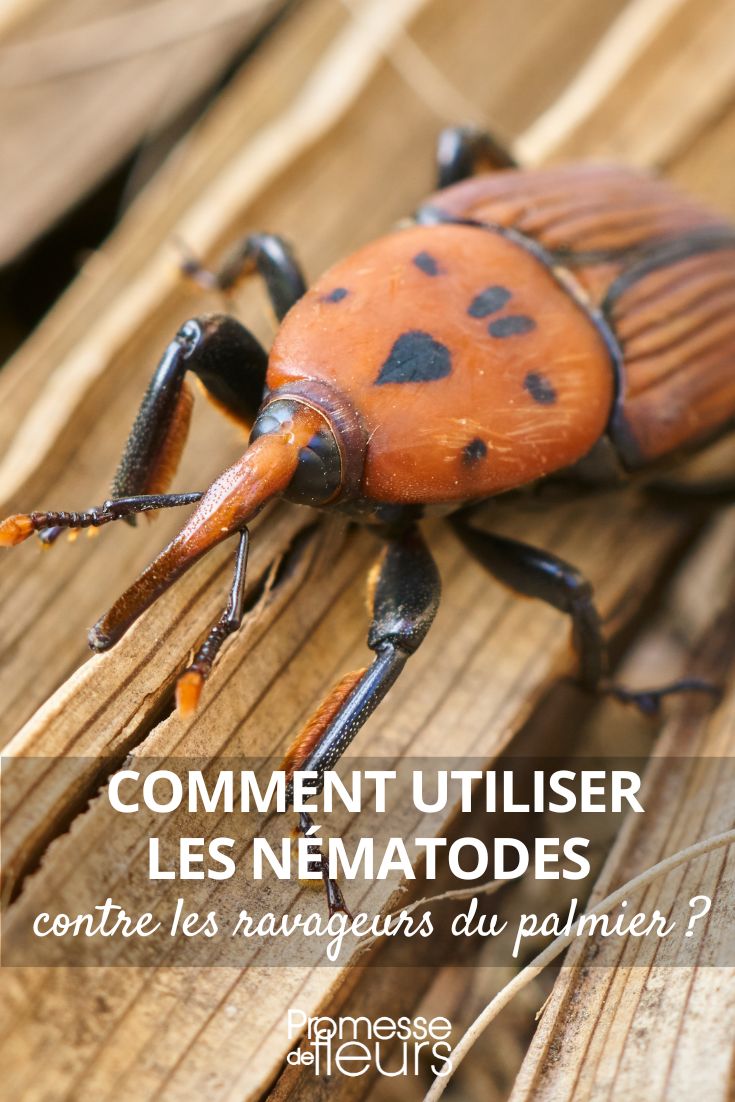
Rhyncophorus ferrugineus is a large beetle that measures about 2.5 cm long on average, brick-red in colour with black stripes on the elytra. It is equipped with a long rostrum, a sucking organ that allows it to bore a hole in the stipe or false trunk of palms. Its larva, plump and cream-coloured, has a small brown head. Females lay their eggs in the soft tissues of the fronds, where the larvae develop by burrowing and feeding on the sap of the tree. The problem is that the symptoms only appear late: the fronds become deformed, dry out and fall, and a fetid odour and a brownish liquid emanate from the stipe. Adults are capable of flying long distances, which facilitates their dispersal and invasion of new territories.
Controlling the red palm weevil is complex and requires the implementation of preventive and curative measures. Among preventive methods, one can cite the removal of infested palms, the strengthening of plant resistance through appropriate fertilisation, and the use of pheromone traps to detect the weevil population.
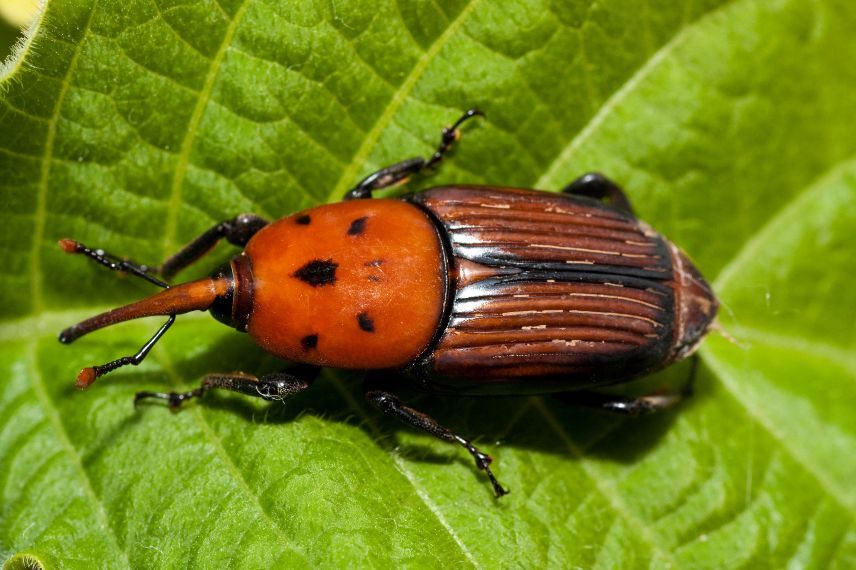
Rhyncophorus ferrugineus or red palm weevil
The palm sphinx moth
The second enemy of palms, the palm moth or palm sphinx, by its Latin name Paysandisia archon, is a large diurnal butterfly native to Uruguay and central Argentina, accidentally introduced to France in the 1990s. It is mainly active in Spain, but also in the south of France. This pest settles on various palm species including Chamaerops humilis, Phoenix canariensis, Phoenix dactylifera and Phoenix reclinata, Livistona, Trachycarpus fortunei, the Washingtonia filifera and some Sabal.
It is the larva, a large whitish caterpillar, 8 to 10 cm long, that causes very serious damage: it bores into the fronds, hollows out holes and galleries, therefore causing the fronds to dry up and ultimately killing the palm. The presence of holes at the base of the rachis, the main veins of the fronds, sawdust on the stipe, perforation of the fronds and cocoons are the usual symptoms. The butterfly itself measures 9 to 11 cm across, the female usually larger than the male, but also less coloured. Its forewings are dark bronze-green with brown stripes, the hindwings are a bright orange-red with black and white markings. It has club-shaped antennae. This butterfly flies from June to September, and it is easy to spot during the hottest hours of the day, between 12:00 and 14:30, not far from palms.
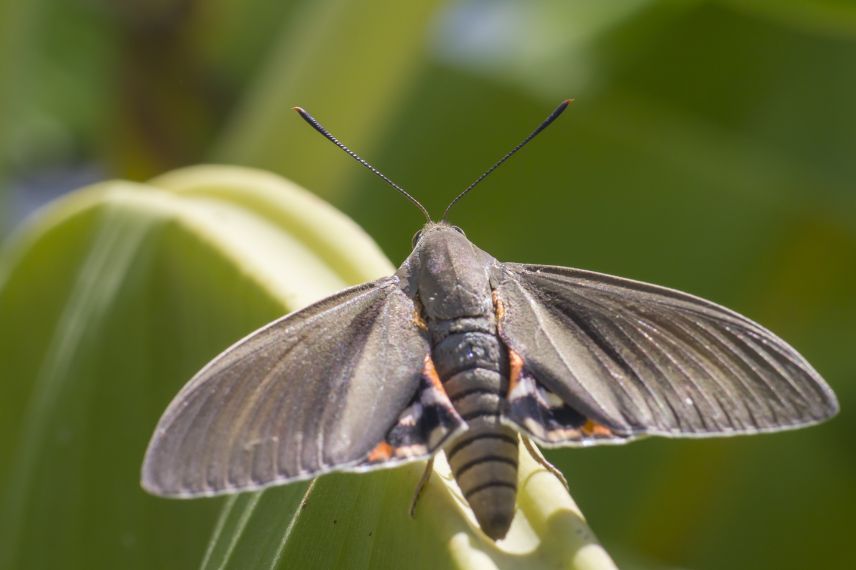
Paysandisia archon
Why choosing organic control for your palm trees?
Auxiliary or biological control is a method of protecting plants that uses living organisms to manage pests and diseases. This ecological and sustainable approach aims to maintain the natural balance of ecosystems, by promoting biodiversity and reducing the use of chemical products. Among the most effective and widely used biological control agents, there are nematodes, tiny roundworms that play a key role in pest control.
Nematodes are microscopic worms that naturally live in soil and decomposing organic matter. There are more than 25,000 nematode species, some beneficial to plants and others pests. Entomopathogenic nematodes, that is, those that parasitize insects, are particularly useful for garden auxiliary biological control. They are capable of effectively controlling many pests.
The mode of action of entomopathogenic nematodes is simple and formidable. Once applied to soil or plants, they actively seek out their prey by moving through the water present in the medium. When they encounter a pest, they penetrate it through natural entry routes and release symbiotic bacteria that multiply rapidly inside the host. These bacteria produce enzymes that degrade the insect’s tissues, thus causing its death within a few days. The nematodes then feed on the liquefied tissues and reproduce inside the cadaver, before going off in search of new prey.
The use of entomopathogenic nematodes in auxiliary biological control offers numerous advantages. First, they are highly specific, meaning they attack only the targeted pests, without harming other beneficial organisms. In addition, they are harmless to plants, pets and humans, which makes them a safe and environmentally friendly alternative to pesticidal products.
Nematodes are also easy to use and apply. They are usually sold as powder or gel forms, mixed with an inert carrier such as clay or turf. It is enough to dilute them in water and spray them onto the soil or plants, following the doses and application conditions recommended by the manufacturer. Nematodes are sensitive to UV rays and desiccation, so it is important to apply them late in the day or in overcast weather, and to keep the soil moist in the days following application.
For the two palm pests namely the red palm weevil and the palm sphinx moth, biological control is achieved using the species Steinernema carpocapsae, a pale, tiny soil nematode naturally present in European soils, hence cold-tolerant. The nematodes parasitize the red palm weevil at larval and adult stages and the palm pest moth at larval stages.
The effectiveness of this treatment is rated at 100% when carried out properly. This is indeed the essential condition for the complete success of this type of treatment: you must strictly follow the usage guidelines, or your efforts may not be rewarded.
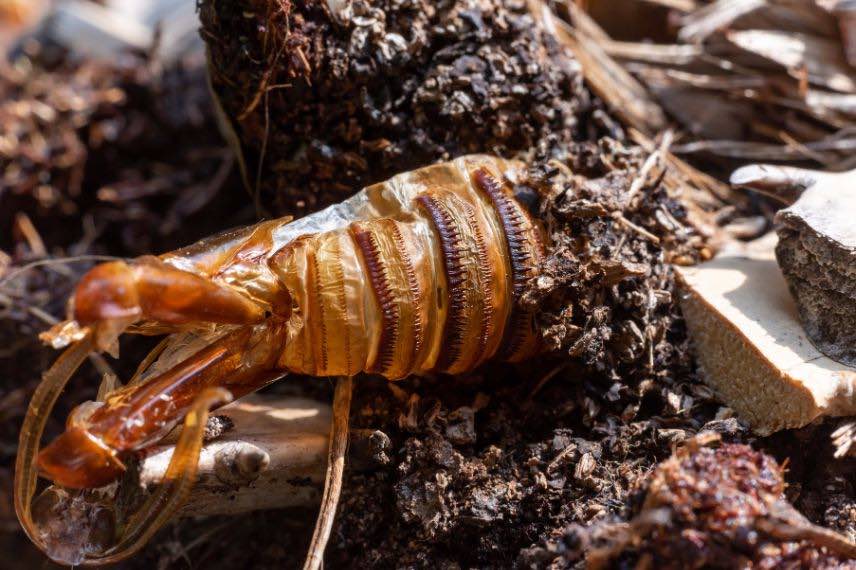 A cocoon of the palm butterfly[/caption>
Guidelines for using nematodes
As a reminder, damage caused by the red palm weevil is only visible late on the palm, but it can be detected using a specific pheromone trap.
The treatment can be applied in open ground or in a greenhouse, as a preventive or curative measure, ideally once per month, from March to November, depending on the pest targeted. A box containing 25 million nematodes allows treatment of between 1 and 3 palms, depending on the infestation level and the size of the trees.
The treatment is possible when the internal temperature of the palm, which can be measured using a meat thermometer, is between 14 and 35°C.
Do not use chemical treatments in the week preceding application and for 1 month afterwards. Also beware of certain fungicides that can be toxic (notably those based on carbendazim, dodine, sulphur). All nematicide use must be prohibited.
For the red palm weevil, treatment should be carried out from March to June, then in September–October, possibly in July–August and in November if the temperature allows. The Decree of 21 July 2010 relating to the control of this pest recommends monthly sprays.
For the palm borer moth: treatment should be carried out from April to June and in September–October.
After application on the top of the stipe and on the leaves of the palms, the nematodes actively seek their target and penetrate it via its natural entry routes. Their digestive system then releases specific bacteria that digest the host tissues, which are thus readily assimilated by the nematodes. The parasitized larvae die within 24 to 48 hours, releasing new nematodes that will go in search of new prey.
How to proceed?
It is very important to use nematodes as soon as possible after receipt to avoid any risk of reduced effectiveness. In the meantime, keep the box in a fridge at 4–12°C (maximum shelf life until the use-by date shown on the packaging). Nematodes must never be exposed to sunlight, as they are very sensitive to UV rays.
Useful nematodes are mixed with clay powder, used as an excipient to facilitate application.
As noted above, nematodes are active when the palm’s internal temperature is between 14°C and 35°C, on wet foliage.
- Moisten the tops of the palms 30 minutes before application with 10 litres of water to aid the dispersal of nematodes.
- Broadcast the nematodes with plenty of water over the top of the stipe and the leaves.
- Keep moist for the following 15 days after application.
- Prefer to treat in the morning or in the evening, outside sunny hours or in overcast conditions.
- Subscribe!
- Contents
Comments