





























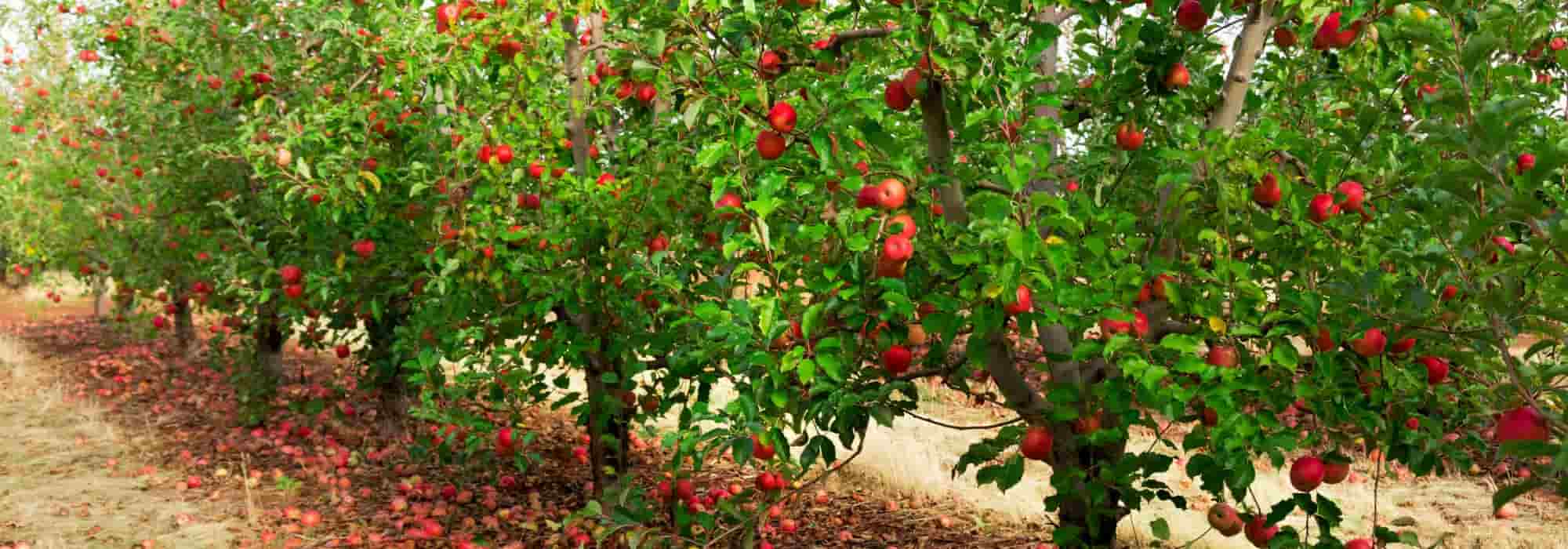
Orchard: what distance should be maintained between two fruit trees?
Our tips for planting your fruit trees correctly
Contents
When deciding to plant an orchard, the first question to consider is the planting distance between two fruit trees. Apple trees, pear trees, plum trees… whether in a U shape, palmette, or standard form… the young fruit trees you have just acquired will grow well. The planting distances between fruit trees are important to ensure good development and fruiting. You will also need to know your land well to choose the right varieties, as well as take into account the exposure, the influence of winds, and the climate of your region. Similarly, depending on the space you have, it will be necessary to choose the most suitable tree forms. Discover our tips and the rules to follow regarding the different planting distances between fruit trees.

Why is it important to respect the planting distances between two fruit trees?
To grow and develop properly, and even to bear fruit, plants need water, but also light and air. This applies to vegetable plants, perennials, or annuals, trees and bushes, but also (and especially) to fruit trees.
That’s why it is essential to respect the correct planting distance between fruit trees. If they are too close together, they can quickly compete, with one tree developing and fruiting better than the one touching it. A fruit tree needs space to spread out in order to produce.
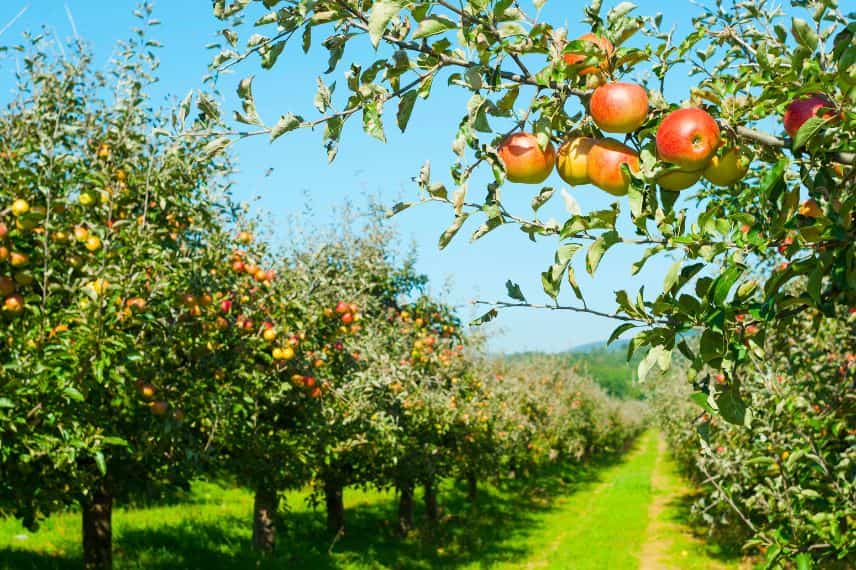
The planting distance between two fruit trees allows for good development.
Similarly, not leaving enough distance between fruit trees risks encouraging the appearance of fungal diseases or the invasion of pest insects.
Finally, by respecting the proper planting distances for fruit trees, the tasks of pruning, care, and harvesting are made easier.
So, when planting your fruit trees, pay close attention to the size of the species at maturity. Of course, take into account the shape of the tree you have chosen. The same variety of apple tree, offered as a standard or a fan shape, will obviously not reach the same height and spread.
Planting distances between trained fruit trees
If you have a small garden, the solution of espaliered trees may be worth considering. Fruit trees are indeed grown as espaliers, against a wall or along a pathway. These espaliered fruit trees are generally very attractive, but they require significant pruning and training as they grow.
There are different forms of training, with the cordon being the most common:
- The horizontal cordon with one or two arms involves having one or two main branches extending from the trunk. This form of fruit tree is ideal for apple trees of low vigour, grafted onto a similarly low-vigour variety. On average, the distance between two fruit trees trained as single or double cordons should be 3 m apart.
- The simple U-shaped espalier means that the tree is pruned into two vertical, parallel main branches forming a U. The branches are spaced 30 to 50 cm apart depending on the varieties of trees. Trained this way, they require less space, and the distance between the two fruit trees can be limited to just 1 m.
- The double U or verre espalier: the branches are also pruned vertically but form two U shapes side by side. The branches can reach a height of 3 m. Again, the planting distance between two fruit trees is reduced; 1.20 m is sufficient.
- The oblique espalier with one or two tiers: the main branches develop in tiers of two oblique shoots at a 45° angle. For this form, a distance of 2 m between each fruit tree is required.
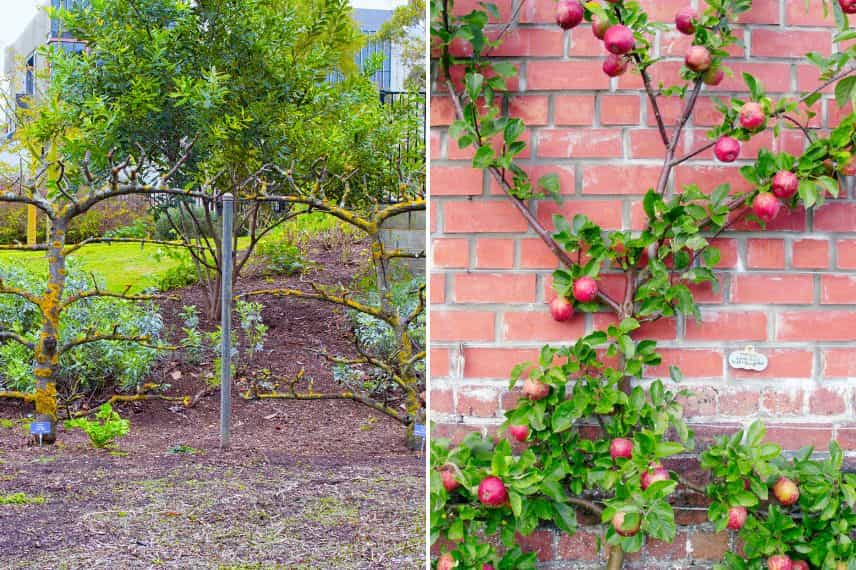 The planting distance for espaliered fruit trees never exceeds 2 m
In general, these pruning forms are mainly reserved for apple and pear trees. They are very suitable for small orchards because, ultimately, the planting distances for fruit trees do not exceed 2 m.
Discover other Fruit trees
View all →
Available in 1 sizes
Available in 0 sizes
Available in 1 sizes
Available in 1 sizes
Available in 2 sizes
Available in 1 sizes
Available in 1 sizes
Available in 1 sizes
Available in 1 sizes
Available in 1 sizes
What distance should be maintained between two fruit trees grown in an open free-form style?
Free-form fruit trees grown in open air have not undergone formative pruning, they grow freely, following their natural habit. However, they will require a cleaning pruning.
Cultivated this way, these fruit trees produce a lot of fruit and have good longevity. It is necessary to wait a few additional years for the first fruiting, which is about 5 years.
On the other hand, these trees develop much more in height and width, as they are not constrained in any way. Pruning is therefore more challenging, as is harvesting.
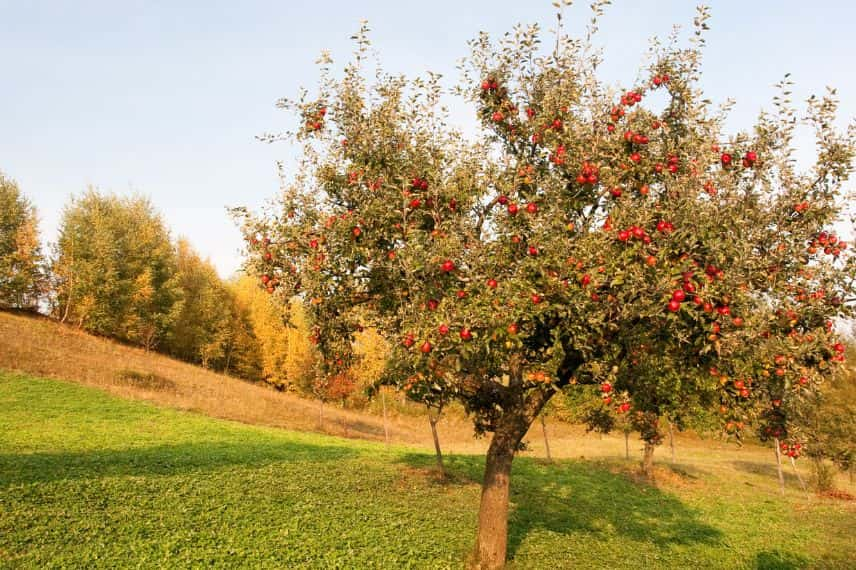 Fruit trees grown as standards have a large spread
There are two types of free form:
- Standard fruit trees: the trunk reaches a height of 160 to 180 cm
- Half-standard fruit trees: the trunk measures from 1 m to 1.50 m in height.
These fruit trees can reach heights of 6 to 10 m, and even 15 m for certain varieties of cherry trees. As for the spread, it can reach 10 to 15 m. This is why you should allow between 5 and 7 m of planting distance for these fruit trees: apricot tree, fig tree, persimmon tree (kaki), medlar tree, plum tree or peach tree. The apple trees, cherry trees, and pear trees will be spaced a bit more, between 7 and 10 m, or even more than 10 m depending on the varieties for cherry trees.
The planting distance between standard low-stem fruit trees
These fruit trees develop on a trunk of 40 to 80 cm and rarely exceed 4 m in height. As for their spread, it generally ranges around 4 to 6 metres. This is why they require less space. Similarly, pruning, care, and harvesting present fewer difficulties and efforts. Fruits often appear as early as the 2nd or 3rd year.
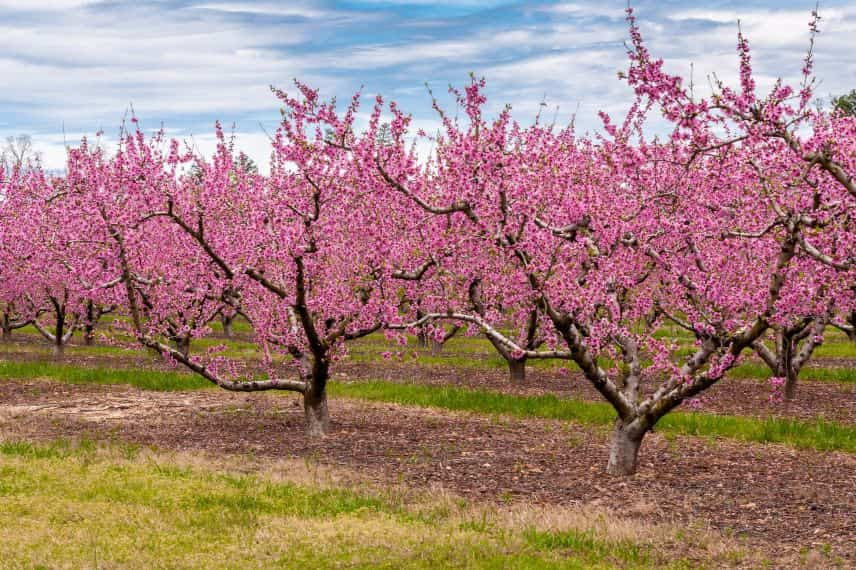 Peach trees grown as young plants
Again, several pruning forms exist:
- The spindle, fuseau, or pyramid: several tiers of branches develop on a central main branch. The trees remain small and rarely exceed 3 m in height and 3 metres in width.
- The goblet: the main branches develop from the trunk, somewhat like high-stem and half-stem trees. Fruit trees generally take up more space than those grown in a spindle form.
In general, the distance between 2 fruit trees grown as young plants should be 4 metres apart.
The planting distance for shell fruit trees
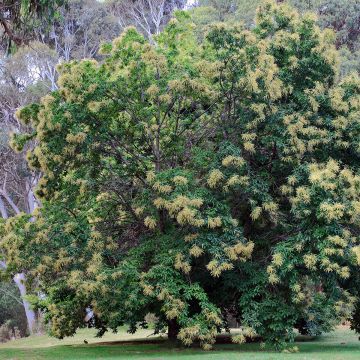
By shell fruit trees, we mean walnut trees, chestnut trees, almond trees, or hazel trees. Chestnut trees and walnut trees are large trees that should be spaced at least 10 metres apart.
Hazel trees have a significantly smaller spread, allowing them to be planted in hedges. Therefore, a distance of 2 m between each young plant is ideal.
For almond trees, a distance of 5 to 6 m between each trunk will be ample. This is especially true for self-sterile varieties, which should never be spaced more than 15 metres apart.
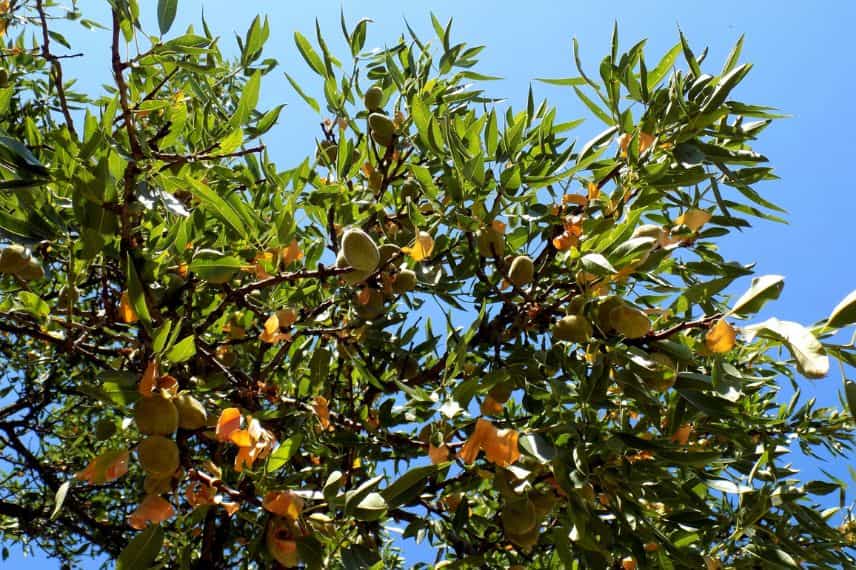
An almond tree
- Subscribe!
- Contents
Comments