


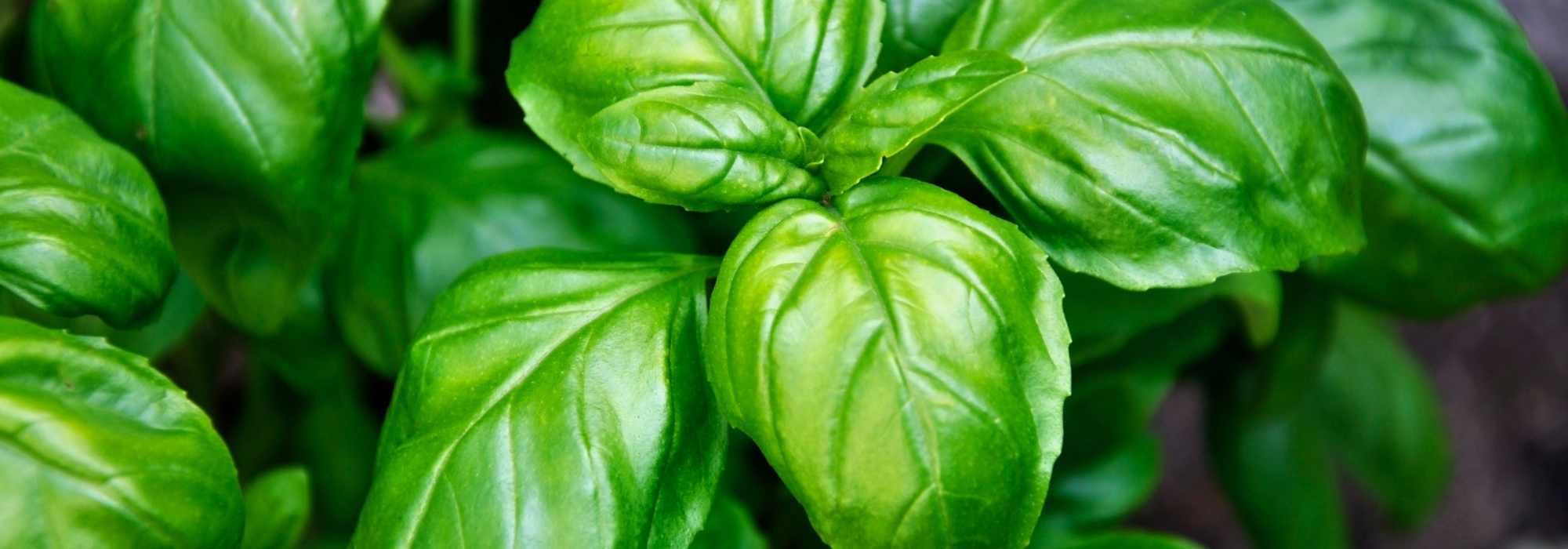
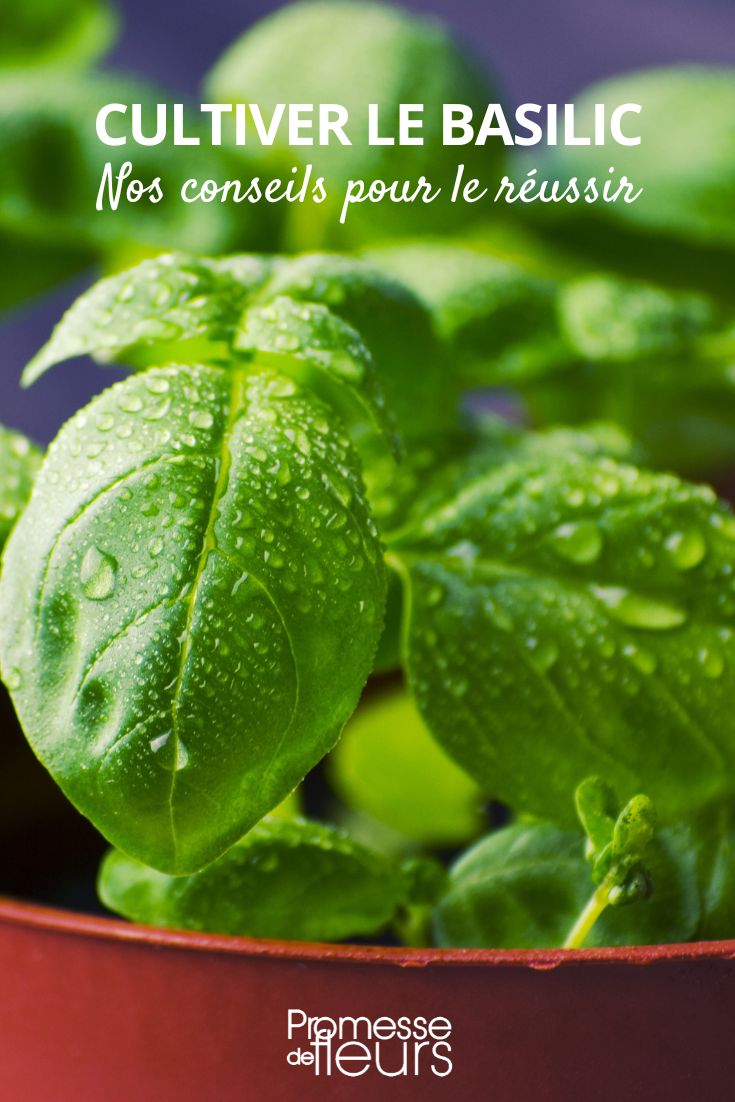
Growing basil: Our best tips
All our tips for sowing, planting and caring for basil in the garden or in a pot
Contents
Have you ever imagined enjoying tomato and mozzarella without basil? An essential of Italian cuisine and our summer tables, this annual, aromatic and edible herb is indispensable for adding a twist to any dish. Starting with pesto. With leaves of various shapes, colours and aromas, basil is the quintessential aromatic herb of summer. Whether you plant it in the ground, in the vegetable patch, possibly in association with other vegetables thanks to its repellent properties, or in a pot, basil delights the palate throughout the summer season with aromas that are both bold and subtle. Although relatively easy to grow, it can be somewhat capricious and may bolt to seed very quickly. As a result, it becomes far less edible.
So how can you guarantee success with basil every time? We share all the tips you need to obtain beautiful, fragrant and tasty basil leaves.
For further reading: Basil: sowing, planting, growing.

Basil sowing
Basil seeds are black and very small. So they are fairly fiddly to handle. However, sowing remains accessible to all and relatively straightforward. The key is that seeds receive sufficient warmth and light. Basil sowing is carried out either warm-started between February (in the warmest regions), March and April, or direct in the ground from May.
Warm-start sowing
To start basil sowing from February to April, a constant temperature of 15–20 °C is required. Below these temperatures, seeds will not germinate. Basil will therefore be sown warm, but not excessively, at home, or under a heated shelter, or in a conservatory. Light must be ample to promote germination, but young shoots will not tolerate full sun. So beware of sun shining through glass!
Seeds are sown in individual pots or seed trays, which must be well drained. That’s why holes will be drilled in the bottom of the containers. These small pots and trays will be filled with a seed-starting compost, very light. It is possible to add a little sand and perlite to lighten the medium.
The sowing method:
- Fill the pots or seed trays to two-thirds full with the seed compost mixed with a little sand
- Gently firm the surface of the medium
- Place the seeds, spacing them at least 2–3 cm apart in the trays. In pots, three seeds are enough
- Do not bury the seeds, but only cover them with a thin layer of seed compost, just to hide them
- Firm the surface of the medium with a trowel
- Lightly water with rainwater using a spray
- Cover pots or seed trays with a glass pane to trap warmth and light. This mini-greenhouse should be opened during the day to prevent overheating, especially after the first leaves appear.
The seeds germinate in about ten days. The growing medium must be kept consistently moist but not waterlogged, or risk of seeds rotting.
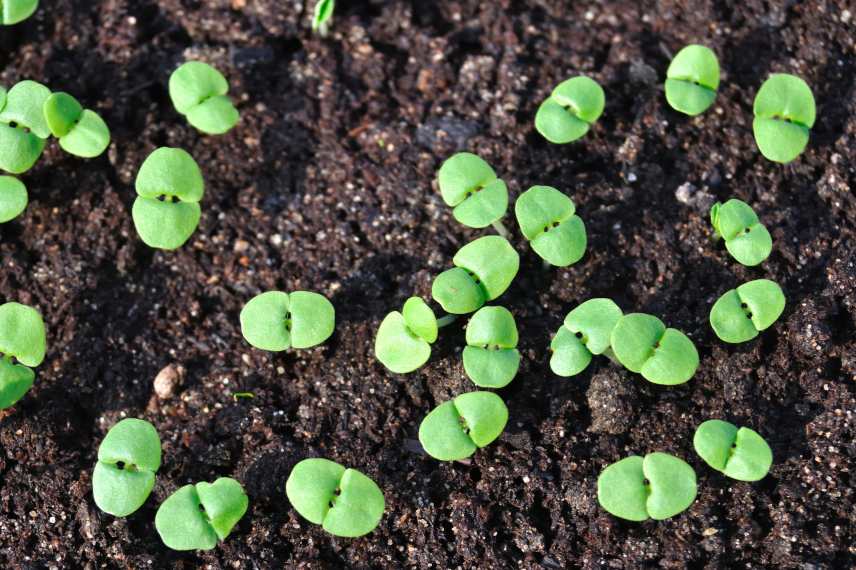
Basil seedlings require warmth and light
Direct sowing in the garden
Basil is sown in the garden once all frost risks have passed. The soil must be sufficiently warmed. Therefore, it is best to wait until mid-May and, in particular, the Ice Saints, to sow basil in open ground. It continues through July. In situ, sowing in open ground is more tricky than under cover. The soil must be very light, possibly with added sand. You can sow in rows.
To succeed with this sowing, the thermometer should read a constant temperature of 15–20 °C. That is why sowing under cover is preferred.
Whether sowing in pots or in open ground, space them out monthly, varying varieties, and thus flavours and colours.
Read also
Choosing basil: our buyer's guideBasil planting
From late April to the end of May, basil seedlings can be transplanted into the ground. They should have at least 3 to 4 leaves, excluding cotyledons. But before transplanting them, hardening your pots or seed trays to your climate is recommended. Simply taking them outdoors in daylight is enough, a little longer each day, for a full week. Of course, these recommendations depend on that year’s climate. If it is cold or if the weather is too damp, this hardening can wait.
Planting in the ground
Basil needs a cool, humus-bearing soil rich in organic matter and nutrients, perfectly drained and weeded with care. Before transplanting, the soil should be worked deeply to loosen it. It is possible to incorporate manure or compost. Each plant should be spaced at least 30 cm apart.
In terms of exposure, full sun is recommended, except in regions with very hot summers where partial shade is preferable. Nevertheless, your basil plants will also appreciate the partial shade provided by other vegetables such as tomatoes. Basil is also an excellent companion plant for tomatoes, as the basil roots have nematicidal properties. Thus, nematodes that parasitize the tomato root system are eliminated. Basil may also help repel whiteflies and protect tomatoes from blight. Basil also pairs very well with pumpkins, cabbages, peppers, aubergines and beans. Or strawberries, with which it also pairs very well on the plate.
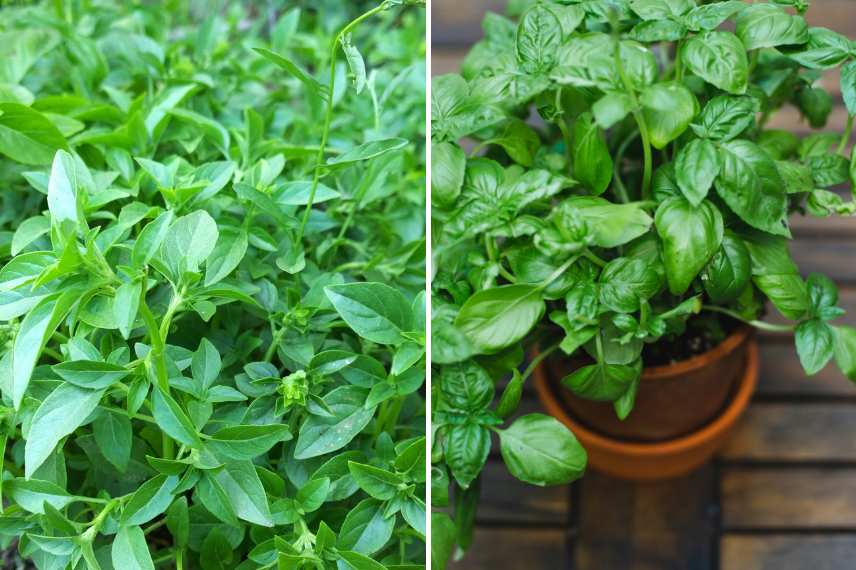
Basil grows just as well in the ground as in pots
Planting in pots
Basil adapts very well to growing in pots. Here are our tips for planting basil in pots:
- Place a layer of expanded clay balls at the bottom of the pot
- Fill the pot with a substrate made from potting compost and compost
- Transplant the young plants, taking care not to damage the very fragile root system. A distance of 5 cm between each seedling should be observed
- Water with a fine spray of rainwater
- Place the pot in full sun at the start of summer, then in partial shade during periods of high heat. It should receive at least 6 hours of sun per day
The substrate must be constantly moist without being waterlogged.
Caring for basil
Proper basil care is the key to success. Indeed, to achieve good harvests, basil care rests on two essential actions: watering and pinching.
Let’s start with watering. It should be followed, especially if basil is grown in a pot. For basil grown in the ground, watering should be plentiful once a week. If summer is very hot, even scorching, watering may be two or three times a day. Installing a mulch of dry lawn clippings helps retain a certain level of moisture while fertilising the soil. Basil grown in pots should be watered more regularly and more abundantly. In very hot weather, you may even need to water once a day, ideally with rainwater. However, check weather forecasts before watering, as excess water is detrimental to basil. Indeed, an overwatered basil plant can develop collar rot or root rot. To sum up, the basil’s substrate or soil must never be waterlogged nor dry. And it’s best to water with rainwater at room temperature.
The second essential step for successful basil cultivation lies in pinching the tips of the stems. To promote dense, branching foliage, cut the tips of the stems between the thumb and forefinger. The use of a pruning shear is not recommended, as there is always a risk of oxidation. This operation remains manual once the plants reach around 20 cm in height. Likewise, remove the flower buds as soon as they appear. Indeed, the development of flower spikes occurs at the expense of the foliage.
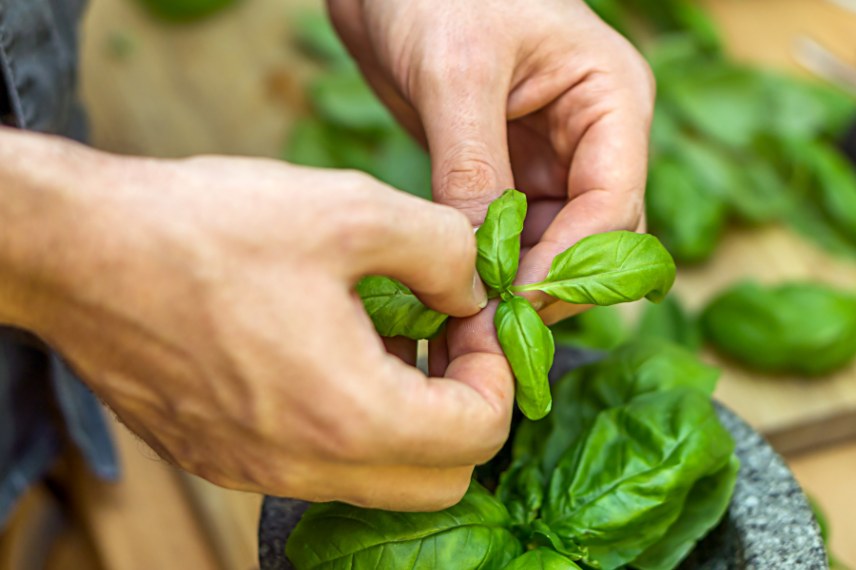
Pinching the tip of the stems allows basil to branch out
Harvesting leaves also helps basil to branch out.
Finally, basil grown in the ground should be weeded carefully. Weeds compete with basil for water and nutrients. However, the soil should be carefully raked with a hand hoe.
Read also
How to grow basil in a pot?Harvest of basil leaves
The harvest of basil leaves is carried out as needed. Simply pick the leaves with your fingers, favouring the upper leaves. The more leaves are harvested, the denser the growth will become. As for the flowering, it will be delayed.
Leaves don’t keep for long. However, they freeze easily. Drying them removes a large part of their fragrance.
Can you overwinter a basil plant?
Basil is an annual plant, particularly frost-tender. So it does not survive outdoors. If grown in a pot, it may eventually be placed in a veranda or a kitchen, but it will tend to languish. The best is to make new sowings in August in pots outdoors. The seedlings will have time to soak up the sun before being brought indoors for the winter.
- Subscribe!
- Contents
Comments