





























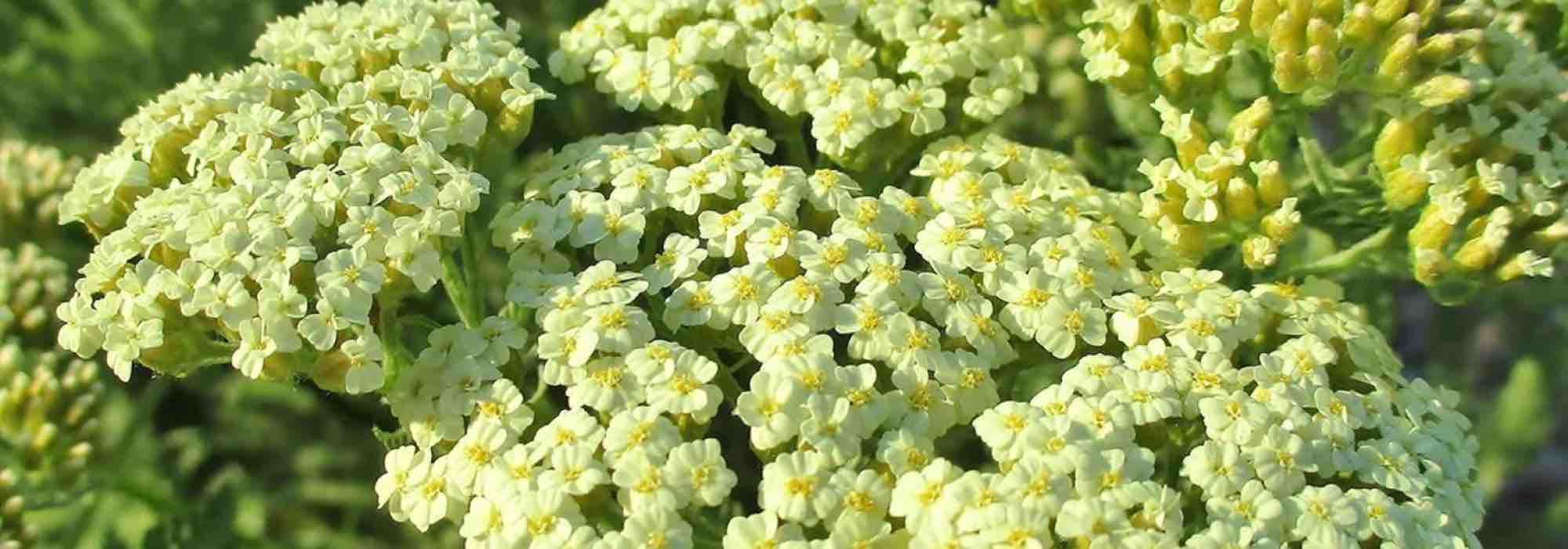
Our evergreen yarrows for a beautiful garden all year round
Colourful and hardy perennials
Contents
Achilleas are hardy and versatile perennial plants, simple and rustic. Some species develop evergreen foliage and ornamental, present all year round. Their abundant, long-lasting flowering in colourful umbels easily fits into many types of gardens, including Mediterranean or naturalistic styles.
These plants, valued for their low maintenance, withstand harsh conditions such as drought or poor soils, and some evergreen species adapt to clay soils, provided they are well-drained. Their generous flowering attracts pollinators, for a choice that is as aesthetic as it is ecological.
In this article, discover Achillea with evergreen foliage, and learn how to plant and care for them.

The benefits of evergreen yarrows
Evergreen yarrow plants offer numerous benefits, both aesthetically and practically. Their hardiness and versatility make them essential plants for a garden that is beautiful and easy to maintain.
Evergreen-leaved yarrow are valued for their ability to brighten the garden year-round. Their foliage remains attractive, even in winter, helping to structure flower beds or cover bare soil and to maintain a harmonious display when other plants are resting. Their grey-green or silvery foliage, in particular, brightens the garden by catching light in a unique way. When they come into bloom, from May to September for most, their umbels of colourful flowers bring cheer and vitality, with shades of yellow, pink or white.
In addition to their beauty, evergreen yarrow plants play an essential role in biodiversity preservation. Their nectar-rich flowers attract numerous pollinators, such as bees and butterflies, contributing to the balance of the ecosystem. Some species also produce seeds that provide food for birds during autumn and winter.
While most yarrow tolerate harsh conditions such as drought, strong winds or poor soils, some evergreen species tolerate heavy clay soils, provided they are very well-drained. Their robustness and low water requirements make them ideal for eco-friendly gardens and areas where maintenance should be minimal. Once well established, they require little maintenance, making them an ideal choice for beginner gardeners or those seeking sustainable solutions.
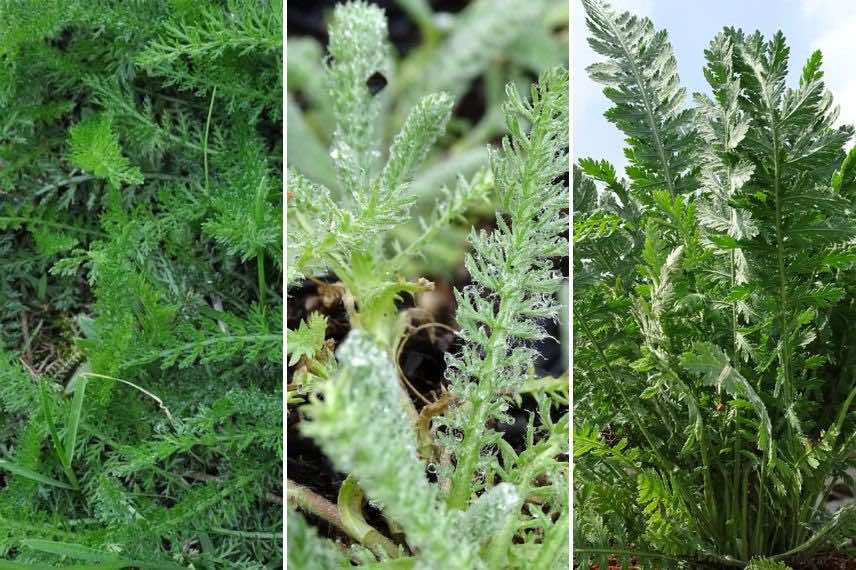
Different evergreen yarrow foliage
Read also
Achillea : planting, growing and careAchillea species with evergreen foliage
Persistent yarrow varieties come in a few species and hybrids, each with its own botanical and aesthetic characteristics.
Achillea crithmifolia
Achillea crithmifolia is a low-growing species, with foliage not exceeding 20 cm in height. It adapts perfectly to drained calcareous or clay soils, even when dry in summer. Its evergreen, grey-green and finely cut foliage forms a dense, homogeneous carpet, ideal as groundcover and as an alternative to lawn. In summer, it produces tiny white flowers in small umbels, adding a light, airy touch to gardens. Very useful for stabilising slopes or filling difficult areas, it spreads quickly, tolerates light foot traffic, and combines practicality with aesthetics.
Achillea odorata
Adapted also to clay soils and drained calcareous soils, the Achillea odorata can also be used as a lawn substitute. It differs from the former with finer, greener, slightly aromatic foliage. It is adorned in early summer with small, cottage-style umbels on slender stems of a slightly grayish-white.
Achillea filipendulina
One of the most spectacular species, Achillea filipendulina or filipendule yarrow and its cultivars such as ‘Gold of Cloth’ (which reaches 1.20 m in bloom) are known for their large yellow flower umbels and their grey-green feathery foliage. With its tall, majestic silhouette, it draws attention in borders and provides an interesting vertical structure. Highly prized for cut flowers, it is a true ornamental asset.
Achillea tomentosa
This species, also known as “turkey grass”, is compact, reaching 30 cm in height. Its evergreen foliage offers bright yellow flowers that brighten borders and rockeries. Achillea tomentosa, with its downy green foliage covered in white hairs giving it a grey-silvery appearance, forms a dense groundcover that remains decorative year-round, and its abundant flowering makes it an ideal plant to add colour in dry or minimalist gardens.
Achillea umbellata
Small and charming, the Achillea umbellata forms a very low cushion-groundcover, about 15 cm tall, with evergreen, finely toothed, grey-silvery foliage, bright in winter and turning almost white in summer. Its pure white flowers appear in light umbels in spring. It is ideal for rockeries or as a border in tight spaces, where its refined appearance catches the eye. It helps suppress weed germination and development.
Achillea sibirica var. camtschatica
Originating from cold regions and tolerating them very well, Achillea sibirica var. camtschatica is quite different from its cousins. Its foliage, dark, glossy with silvery reflections, consists of narrow leaves about 10 cm long with strongly dentate margins, arranged in a circle around the stem. It is broader and less dissected than that of the other yarrow. Its flowering, in white or pink tones, is particularly delicate, for example the pretty bloom of the cultivar Rose Parade. Medium-sized, around 60 cm in height, it is perfect for adding a soft and elegant floral touch to naturalistic gardens. Although it adapts to any well-drained soil, it prefers loamy, fertile and light soil.
The persistent hybrids:
Achillea kellereri
Achillea x kellereri is a spontaneous hybrid probably arising from a natural cross with A. clavennae and another Central European-origin species, from the Eastern and Southern Alps to the Balkan Peninsula. This compact species is a true gem for rockeries. Its finely cut, silvery foliage is evergreen and highly ornamental, while its small white flowers add a bright touch. Its short height, 25 cm in bloom, and dense habit make it an excellent choice for rockeries and dry gardens.
Achillea x lewisii ‘King Edward’
Achillea x lewisii ‘King Edward’ is a hybrid between A. tomentosa x A. clavennae. It offers evergreen, grey-green, dense foliage and a low habit, ideal for borders. Its flowering, borne on short stems, consists of umbels that open from fawn-yellow to cream-yellow, a shade not so common. It is perfect for small gardens, slopes or rockeries, ideal for ground cover in dry and lightly trafficked areas.
Achillea ‘Credo’
Resulting from the cross between A. filipendulina and A. millefolium, the Achillea Credo combines typical evergreen, finely cut grey-green foliage with spectacular yellow flowering, in broad, flattened umbels of bright flowers evolving from sulphur yellow to cream yellow. Ideal for borders, it grows to around 70 cm in height, bringing both structure and lightness thanks to its wide, elegant umbels.
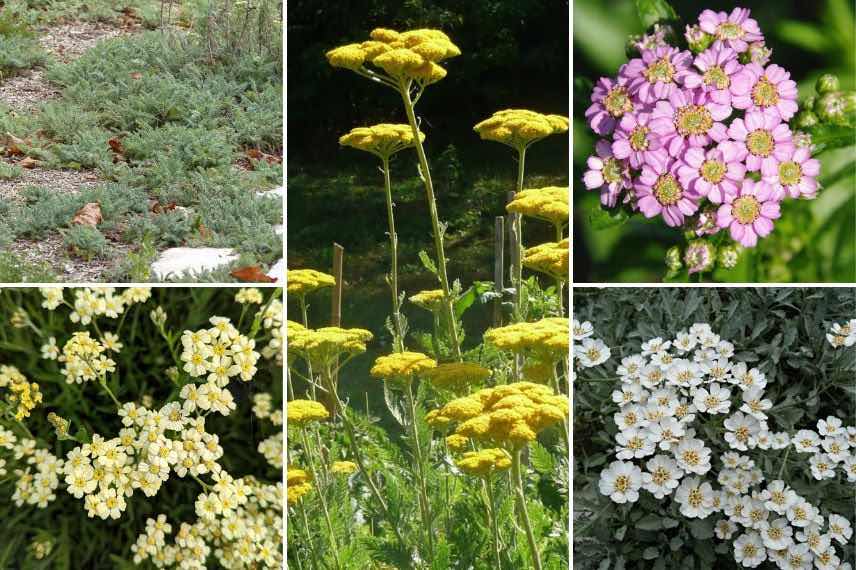
Clockwise: Achillea crithmifolia, Achillea ‘Cloth of Gold’, ‘Love Parade’, Achillea umbellata, Achillea x lewisii ‘King Edward’
Where to plant and how to care for evergreen yarrow?
Where to plant my yarrow?
Exposure :
Yarrow plants prefer full sun, a condition essential for abundant flowering and vigorous foliage. Although they tolerate a little shade, this can reduce flower production and weaken their growth.
Soil type :
The majority of yarrow prefer well-drained, stony, sandy or poor soils. However, some species, such as Achillea crithmifolia and Achillea odorata, adapt to heavier clay soils, provided they are not waterlogged and are well-drained. If your soil is too compact or retains water, consider amending it with gravel to improve drainage. For certain species, very poor soil is required in addition to good drainage, otherwise their longevity may suffer.
How to care for yarrow?
Watering :
Yarrow plants are drought-tolerant and require little watering once established. Occasional watering can be helpful during prolonged droughts, but they tolerate periods of water shortage well. However, avoid excess moisture, which can harm their health.
Pruning :
- After the first flowering, cut back the stems to encourage a second flowering in late summer or to maintain a tidy appearance.
- At the end of winter, tidy the foliage by removing dry or damaged parts to prepare for spring growth.
Fertilisation :
Yarrow plants are content with poor soils. An annual application of compost or organic fertiliser in spring can nevertheless stimulate their flowering, especially in very impoverished soils.
Diseases and pests :
Yarrow plants are hardy, but they can be susceptible to powdery mildew, particularly in damp conditions. To limit this risk, ensure adequate spacing between plants for good air circulation and avoid excessive watering.
Propagation :
- Divide clumps every 3 to 4 years, in spring or autumn, to rejuvenate the plant and obtain new plants.
- Yarrow also propagates easily by sowing, harvesting the seeds after flowering.
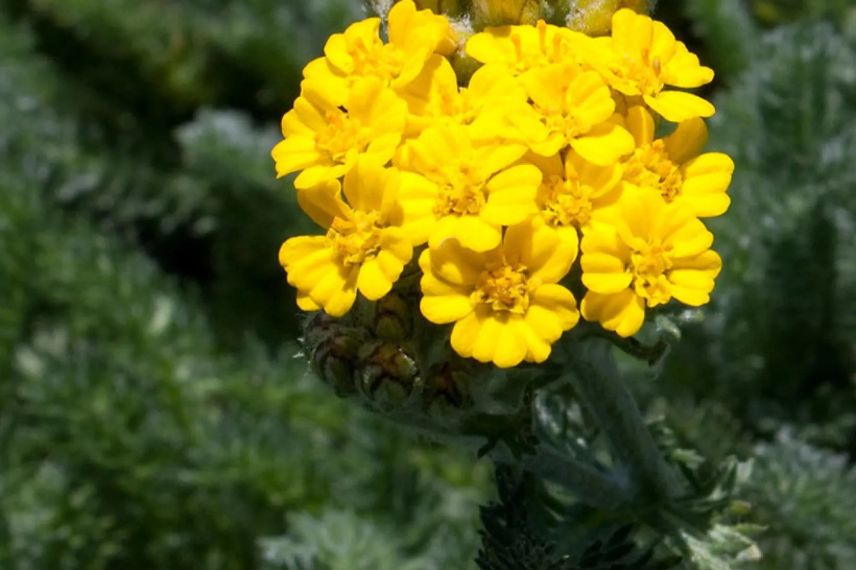
Yarrow plants require undemanding soil: well-drained, even poor soil, no fertilisation, little watering and plenty of sun. Here Achillea tomentosa ‘Aurea’
- Subscribe!
- Contents

Comments