





























Our list of unusual citrus trees to discover!
Our selection
Contents
The world of citrus trees is teeming with fascinating varieties, far beyond the usual oranges, lemons and grapefruits. These fruits, known for their vibrant flavours and vitamin-rich content, offer an incredible range of shapes, colours and flavours. In this article, we invite you to discover our list of original citrus trees. From red lime trees to twisted lemon trees, and through surprising hybrids, each selected variety promises to transform your garden or balcony into a veritable conservatory of exotica!

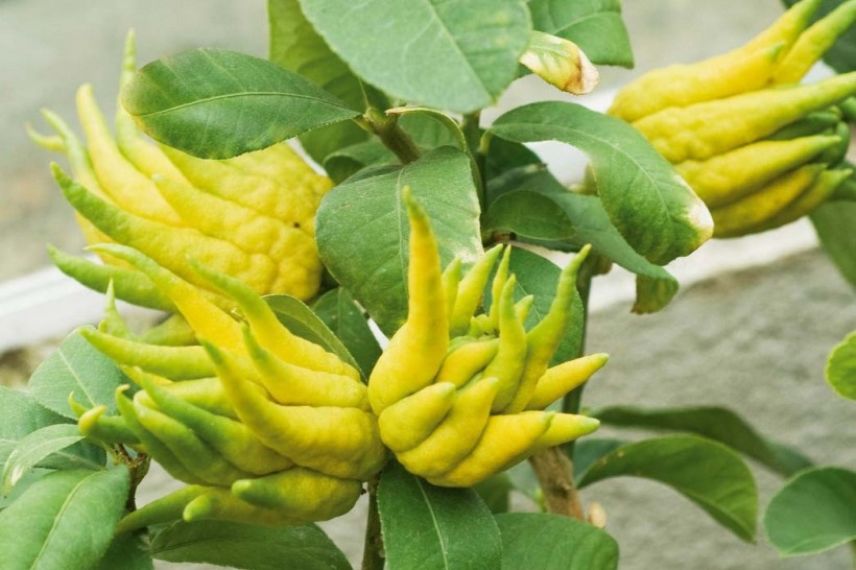
Buddha's hand or Citrus medica digitata
Buddha’s Hand, which Latin name is Citrus medica digitata, is distinguished by its unique appearance and captivating fragrance. This citron variety, arising from a spontaneous mutation common among citrus trees, takes the form of a dense bush or a small tree with thorny branches and an irregular habit. From early spring, it bears white or purple flowers grouped in clusters, exhaling an intense fragrance. These flowers give rise to remarkable fruits, divided into segments resembling fingers, evoking the image of a human hand. Although the flesh of these fruits is generally scant, the rind, rich in fragrance, is highly prized, particularly for its aromas reminiscent of cedar.
This bush grows slowly and can reach up to 3 metres in height. Sensitive to cold, it cannot withstand temperatures below -3°C and is mainly grown in pots in less temperate regions. In Asia, Buddha’s Hand is commonly used to decorate interiors and fragrance spaces. In cooking, its rind can be candied or used as zest. The segments can be thinly sliced and added to salads or fish dishes, imparting a light bitterness.
Finger lime or Citrus australasica
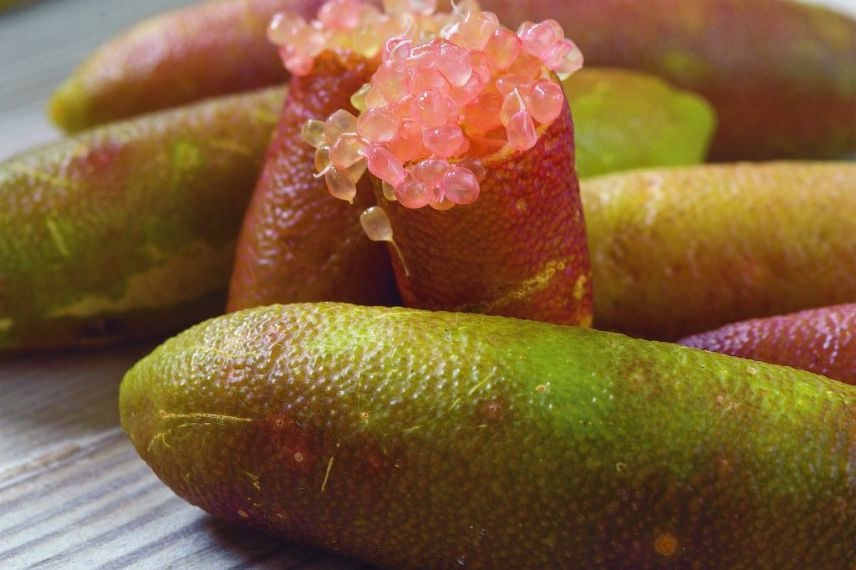
Finger lime, in Latin Citrus australasica or Microcitrus, is renowned among Michelin-starred chefs worldwide for its originality and unique flavours. This evergreen shrub native to eastern Australia is characterised by its small size, its fine branches, and its tiny leaves and thorns, as well as its small, fragrant white flowers. The fruits, finger-shaped and sometimes likened to gherkins, are distinguished by pulp formed of juicy pearls that burst in the mouth, delivering an explosion of tangy and fresh flavours.
Adapted to pot cultivation due to its compact growth, the Caviar lime is ideal for amateur gardeners wishing to grow an uncommon citrus. In winter, it is recommended to protect it from the cold by placing it under a greenhouse, while in warm frost-free regions, its cultivation outdoors is possible.
The fruits, in a range of colours from green to black, including yellow, red and brown, harvested from October to December, enrich savoury and sweet dishes with their crunchy texture and deliciously tangy flavour. The evergreen, aromatic and slender leaves are also used in cooking, as a seasoning adding a distinctive note to dishes.
Combawa or Citrus hystrix
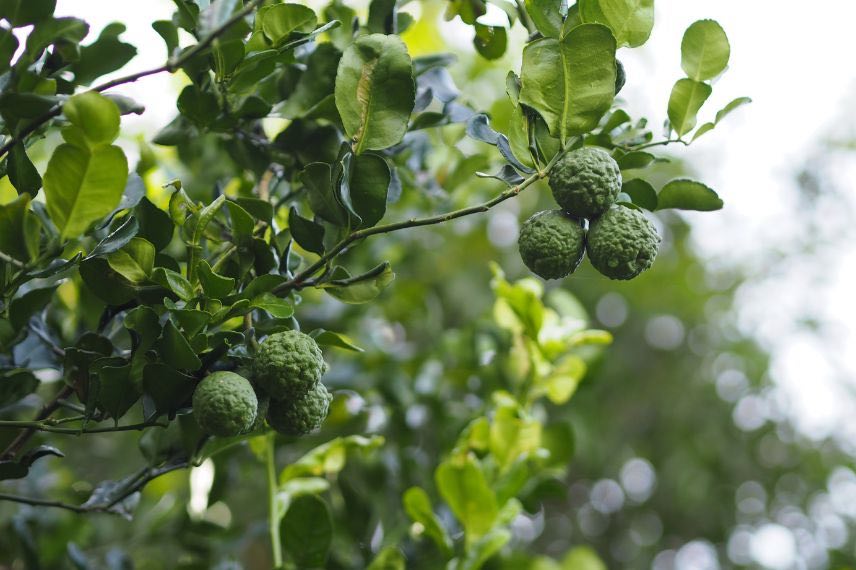
Combawa, or Citrus hystrix, is an ancient citrus, cultivated for the intoxicating fragrance of its fruits and leaves. This small tree, with modest growth but highly productive, puts forth in spring star-shaped white or pink flowers, a prelude to the formation of green fruits with a knobbly skin. Its cultivation is suited to hot regions or in pots to be protected in a greenhouse during winter, as it cannot withstand temperatures below -4°C.
Under various names such as Makrut or Kaffir, this large spiny bush thrives in warm conditions, making it a favoured choice for Creole gardens on Réunion Island. Its leaves, with a distinctly winged petiole, and its fruits, whose white-greenish pulp is both sour and bitter, are highly valued in Asian and Creole cuisine.
Combawa stands out in cooking, where its leaves and zest enhance the flavours of exotic and Creole dishes. The leaves, sliced into fine strips, introduce a distinct lemongrass note in preparations such as tomato rougail or Thai curries. The zest and juice of the green fruits, harvested for their richness in essential oils, enrich drinks and dishes with a refreshing touch of bitterness.
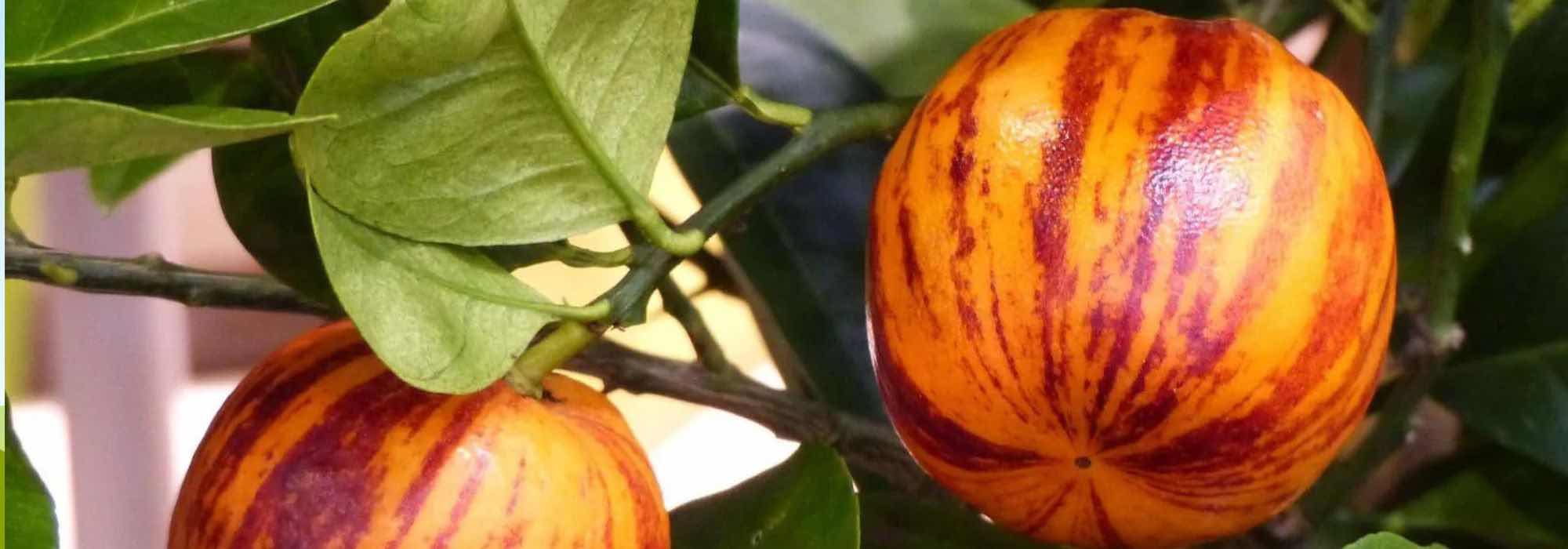
Blood Meyer lemon tree or Citrus 'Doppio Sanguino'
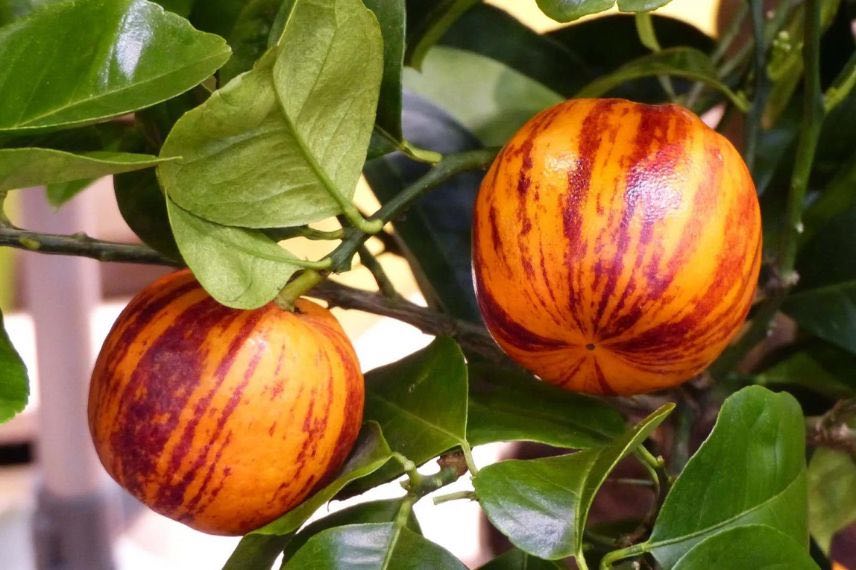
The Citrus meyeri ‘Meyer’ (x) sinensis ‘Doppio Sanguigno’, often referred to as Citrus meyer sanguin or arcobaleno, is the fruit of a horticultural innovation combining the Meyer lemon tree with the double blood orange. This variety attracts attention from a young age with its medium-sized fruits, whose peel is distinctly striped with red on an orange background. Although its flavour elicits mixed opinions, the ornamental aspect of this bush leaves no doubt, notably thanks to its large white star-shaped flowers, streaked with red, diffusing a pleasant fragrance in spring and sometimes in summer.
Hardy down to -8°C, it adapts perfectly to in-ground cultivation in Mediterranean coastal zones, but is also suitable for pot cultivation. With a bushy habit and a dense crown, Meyer sanguin is expected to reach about 2.50 metres in height and 1.50 metres in spread at ten years of age, depending on growing conditions. Its robust shoots, slightly thorny, bear evergreen leaves, aromatic to the touch, which complete its aesthetic appeal.
Flowering occurs mainly in spring, giving rise to pink-red flower buds that open into large white star-shaped flowers, marked with red. These flowers are then followed by oval or rounded fruits, whose skin shifts from green to vivid orange streaked with red at maturity, enclosing red, sweet-tart and juicy flesh. Although the flavour is medium, this sweet pulp is used in various culinary preparations, notably to flavour desserts or to craft fruit juices and cocktails.
Twisted lemon tree or Poncirus trifoliata 'Flying Dragon'
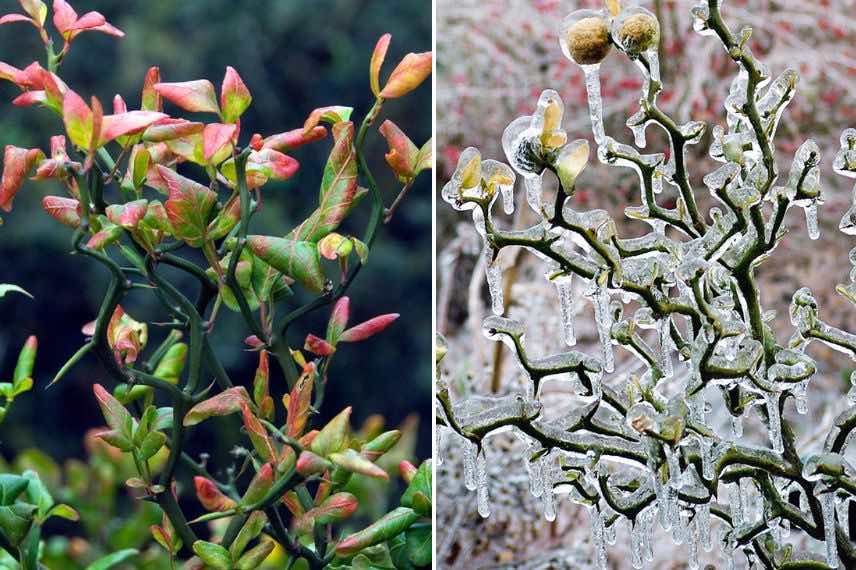
The Poncirus trifoliata ‘Flying Dragon‘, also known as the twisting citrus tree, is distinguished by its hardiness, making it an exception among citrus trees, allowing its cultivation in a wide variety of gardens in France. This bush features an upright and twisted habit, creating a captivating visual display thanks to its undulating branches bearing green thorns. Its ornamental value is enhanced by a spring flowering of white, slightly scented flowers, evolving into decorative yellow fruits with a light orange tint, reminiscent of small mandarins. Although these fruits are not edible due to their acidity, the rind has culinary uses.
Cultivated for its striking appearance, the Poncirus trifoliata ‘Flying Dragon’ requires full sun and well-drained, lime-free soil. Its slow growth allows it to reach about 2 metres in height and 1.3 to 1.4 metres in width. The peculiarity of its twisted branches and its numerous thorns contributes to its distinctive look, while its changing foliage offers an autumn colour palette ranging from green to vermilion red, depending on climatic conditions.
The Poncirus trifoliata ‘Flying Dragon’ is an outstanding ornamental plant. Its hardiness and beauty make it a preferred choice for gardeners seeking a citrus tree capable of adapting to the French climate, delivering a striking display from spring to winter. It tolerates frost down to about -18°C.
Lime 'Red Lime' or Citrus aurantiifolia
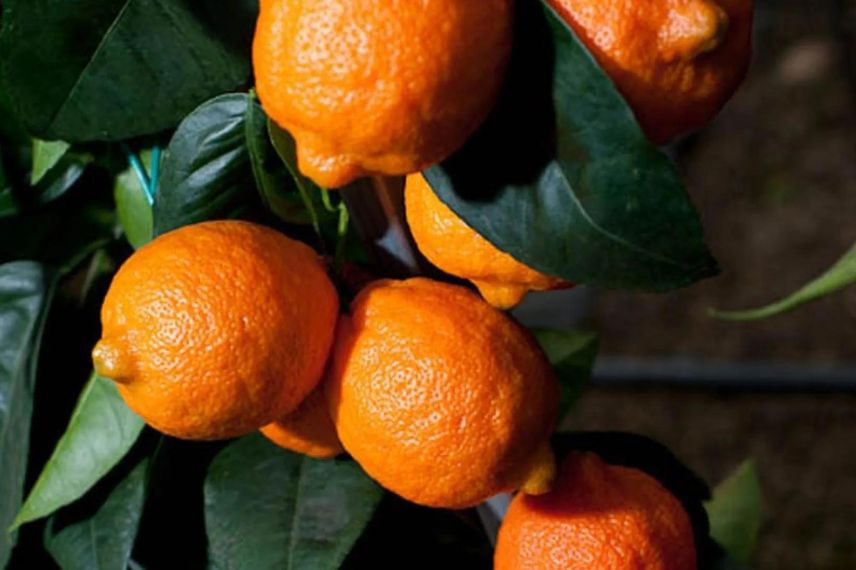
The Citrus x aurantiifolia ‘Red Lime’, also known as the red lime tree, is a moderately vigorous citrus tree that offers a handsome, bushy habit, enhanced in spring by small star-shaped white flowers with a delicate fragrance. The uniqueness of this bush lies in its small spherical fruits with a red-orange rind and dark red flesh, tart and highly aromatic. Although less hardy than its citrus relatives, requiring protection from cold below -3°C, it finds its place in warm-climate gardens or in a lightly heated greenhouse during winter.
Originating in Southeast Asia, the red lime tree features in the culinary traditions of many countries, offering its juice and zest to enhance the flavours of savoury and sweet dishes, as well as in the preparation of drinks and cocktails. It offers a lime flavour, but more acidic. It tolerates well-drained soils, in full sun, preferring warm conditions all year round. Its self-fertile nature allows full fruiting even with a single plant.
- Subscribe!
- Contents

Comments