





























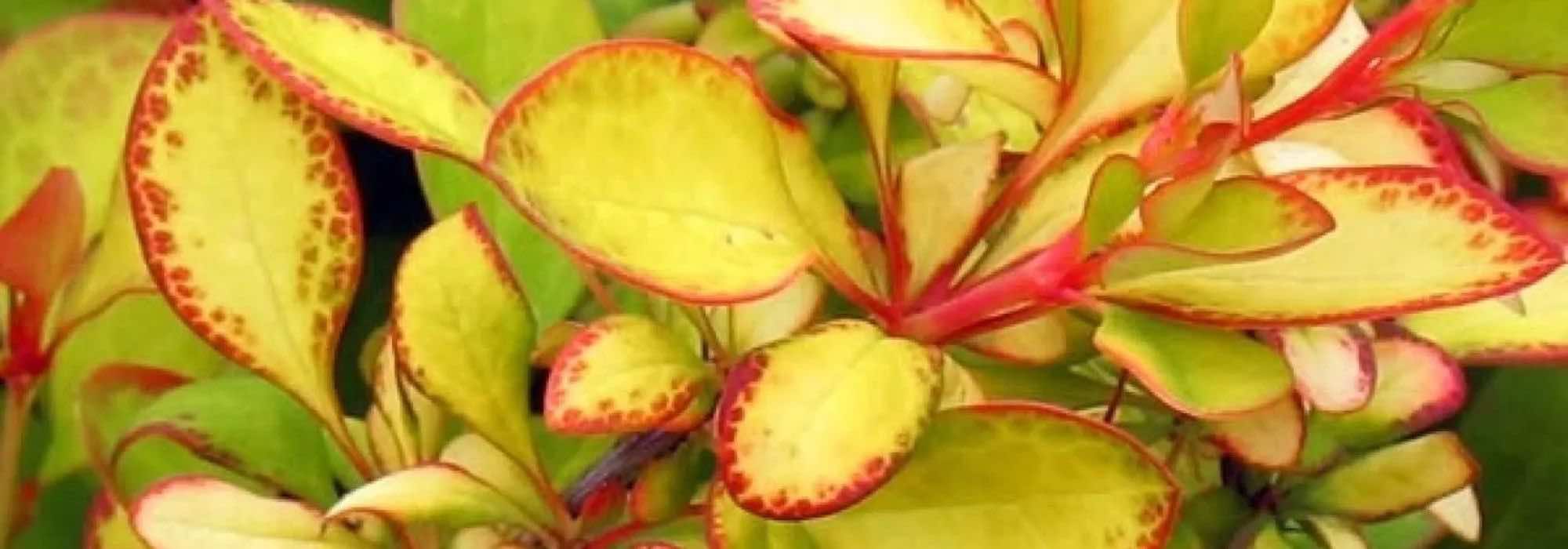
Our selection of Berberis with golden foliage: brighten up your garden or patio
A versatile and decorative shrub
Contents
Berberis, or barberry, are shrubs that can be spiny to varying degrees depending on the variety, deciduous or evergreen, and versatile in their use. Among them, the gold-leaved Berberis offers a luminous palette, ranging from bright yellow to intense gold, which enlivens borders, rock gardens or hedges. These hardy, low-maintenance shrubs come in a range of shapes and habits, from compact groundcover to a small upright shrub. In addition to their decorative foliage that changes with the seasons, they offer discreet but attractive flowering that attracts pollinators, followed by coloured berries in autumn. To brighten a shaded corner or define a sunny space, this selection of gold-leaved Berberis meets all your needs.

Berberis thunbergii 'Aurea'
Berberis thunbergii ‘Aurea’ is a bright variety of Thunberg’s barberry, valued for its stunning yellow foliage. In spring, its young leaves display a pale yellow colour that develops into golden yellow or chartreuse in summer, before taking on beautiful orange hues in autumn. This deciduous shrub, sometimes semi-evergreen in mild climates, produces in April–May small bell-shaped flowers, golden-orange striped with red, followed by decorative bright red berries that persist for part of the winter.
‘Aurea’ grows with a broad, bushy habit, slightly spreading, and quickly reaches 1.25 m in height with a spread of at least 1.50 m. Branches, ramified and slightly arching, bear spines that are not very sharp.
Not demanding, Berberis prefers a sunny position and moist but well-drained soil. It is hardy, disease-resistant and tolerates pruning well, making maintenance easier.
‘Aurea’ reveals its natural grace when used as groundcover, in a mixed hedge or in rockeries. Its ornamental qualities deserve a prime place in the garden, notably in front of purple-leaved shrubs such as Physocarpus ‘Midnight’ or the Sambucus nigra ‘Black Lace’, grey like Caryopteris ‘Sterling Silver’ or the Salix lanata.
Berberis thunbergii 'Tiny Gold'
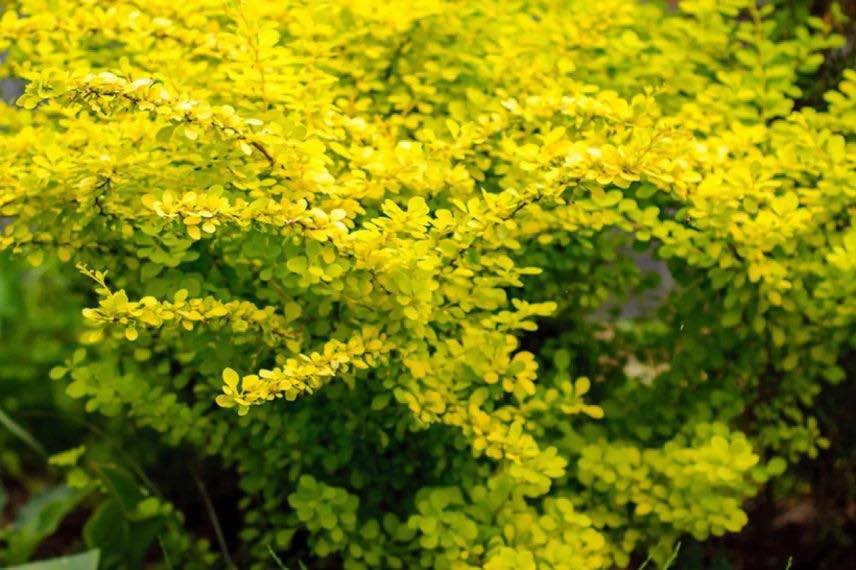
The Berberis thunbergii ‘Tiny Gold’ is a dwarf variety with a rounded cushion-forming habit. Its bright foliage ranges from fresh green to yellow-green. It grows to around 40 cm high and wide, forming a pretty coloured ball from spring to autumn. Its short branches, beige to light brown, bear small, not very sharp thorns, while its foliage, formed of small glossy obovate leaves 1–2 cm long, offers a distinctive sparkle in sunny gardens.
In spring, it is adorned with clusters of small pale yellow flowers, streaked with red. These flowers, bell-shaped and about 1 cm, give way in late summer to bright red spherical berries 6–8 mm in diameter, which decorate the shoots right through to winter. In autumn, the foliage drops to better re-emerge in spring.
‘Tiny Gold’ is versatile in the garden: in borders, rockeries or slopes, where it adds a structured and bright touch, or in a pot or in a large planter to brighten a terrace or balcony. Its colourful foliage complements the base of yellow-orange flowering shrubs such as Kerria japonica or Cytisus scoparius ‘Lena Orange’.
Berberis thunbergii Limoncello™
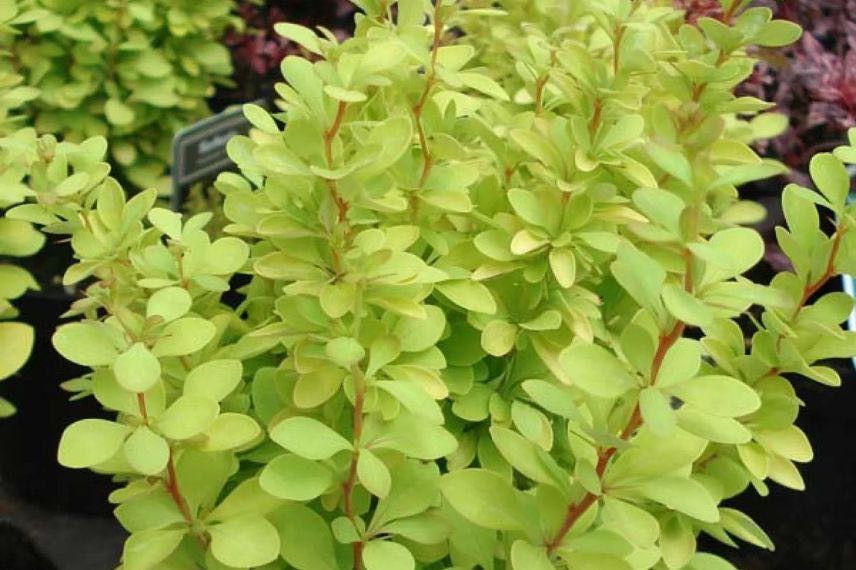
The Berberis thunbergii Limoncello™ is a variety with a rounded, dense and compact habit. It reaches 1 to 1.2 m in height and width at maturity. Its spiny branches, not overly vigorous, reinforce its ornamental and functional character. Its glossy foliage is chartreuse yellow, leaning toward green, beautifully outlined by delicate copper-red margins. It displays stunning autumn colours in orange, red and yellow before shedding.
Thanks to its bright foliage and tidy habit, Berberis Limoncello™ finds its place in shrub borders, where it highlights dark foliage or pink flowering displays such as those of Kolkwitzias and Abelias, or red like those of Weigelas and Japanese quince. It is also suitable for shaping slopes and rockeries, accenting path borders or forming low hedges.
Read also
Growing a berberis in a potBerberis thunbergii 'Golden Torch'
In an erect, compact, columnar habit, Berberis thunbergii ‘Golden Torch’ grows to about 1 m in height with a 50 cm spread, bearing dense vertical branches. Its lemon-yellow shoots in spring contrast nicely with the orange-tinted stems, while in autumn, the ovate, rounded leaves take on red-orange hues before dropping.
The natural form of ‘Golden Torch’ requires little pruning, except to emphasise its columnar habit or to maintain a compact silhouette.
This Berberis works well in borders, in shrub beds or in low hedges. Its bright foliage pairs harmoniously with blue-flowered shrubs such as Ceanothus thyrsifolius var. repens. It also pairs with evergreen foliage or within a palette of complementary greens to create elegant, colourful displays.
Berberis thunbergii 'Golden Dream'
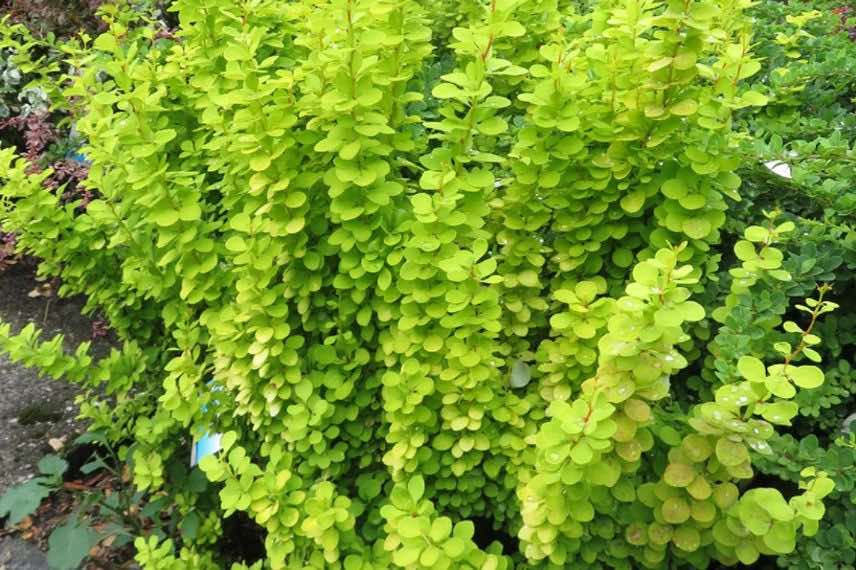
Berberis thunbergii ‘Golden Dream’ stands out with bright foliage and a low, spreading habit with gracefully erect and semi-arched branches.
Its small, ovate leaves measuring 2–3 cm provide striking contrasts all year round.
In spring, bright yellow new shoots accompany bright red stems, offering a dazzling display.
In summer, the foliage takes on lime-green colour before turning into fiery orange in autumn.
With a moderate growth habit, ‘Golden Dream’ forms a dense shrub reaching about 60 cm in height and 1 m in width at maturity.
Its beige to light-brown branches, slightly arched, bear small thorns and give the plant an open and elegant silhouette.
The contrast of its colours and form makes it an ideal variety to bring a dynamic touch to the garden.
This shrub blends in perfectly with colourful borders.
Its low, spreading habit is also ideal for covering slopes or forming bright groundcovers.
Paired with purple foliage such as Cotinus or grey foliage like Artemisia arborescens ‘Powis Castle’, it creates rich, contrasting combinations that energise the landscaping as a whole.
Berberis (x) media 'Dual Jewel'
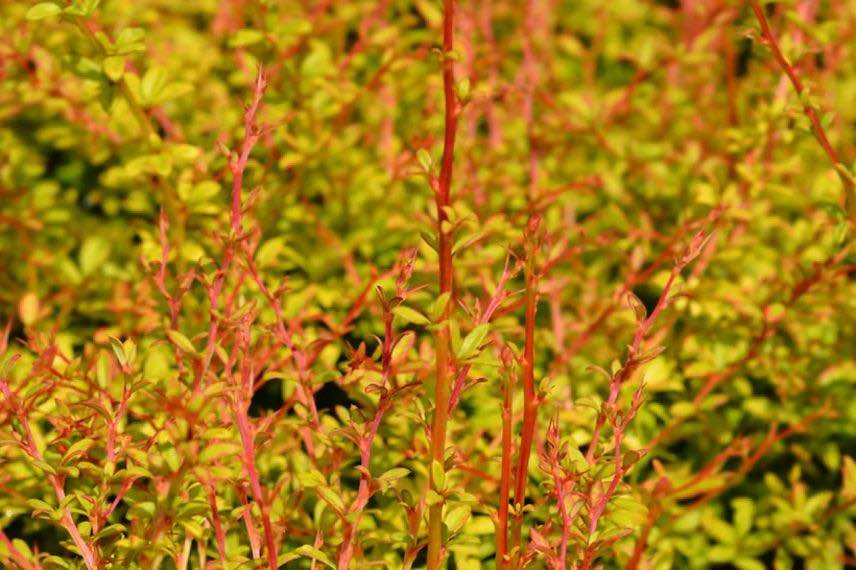
The Berberis (x) media ‘Dual Jewel’ is a compact and elegant hybrid variety, valued for its semi-evergreen foliage that changes colour throughout the year. Its young orange shoots unfold into small glossy leaves that transition from bright yellow to soft green in summer, then take vivid red-orange tones in autumn and winter, extending its decorative appeal even during the cold months.
This dense, slightly spreading bush reaches about 1 m in height and 80 cm in width at maturity. Its arching branches, cloaked in yellow-brown bark, bear simple or forked spines about 1.5 cm long. The leaves are ovate, 2–3 cm long, and offer a striking colour display that evolves with the seasons.
The discreet yet charming flowering of Berberis occurs in April–May in pendulous clusters of around ten pale yellow flowers, subtly flecked with purple. Nectariferous, these bell-shaped blooms attract nectar-seeking insects. In autumn, a few rare bright red oblong fruits appear and may persist on the shoots through winter, adding a further splash of colour.
Thanks to its dense habit and low-maintenance requirements, Berberis ‘Dual Jewel’ provides an excellent alternative to boxwood, particularly in low hedges, whether left natural or pruned. It also sits well in a shrub border, where it complements the seasonal flowering displays of forsythias, buddleias or repeat-flowering roses with pink or orange blooms. In pots, on a terrace or balcony, it offers a wonderful opportunity for elegant displays or topiary art. In front of a defensive hedge, it pairs well with Japanese quince, gorse or furze to create robust, colourful scenes.
Berberis thunbergii 'Golden Carpet'
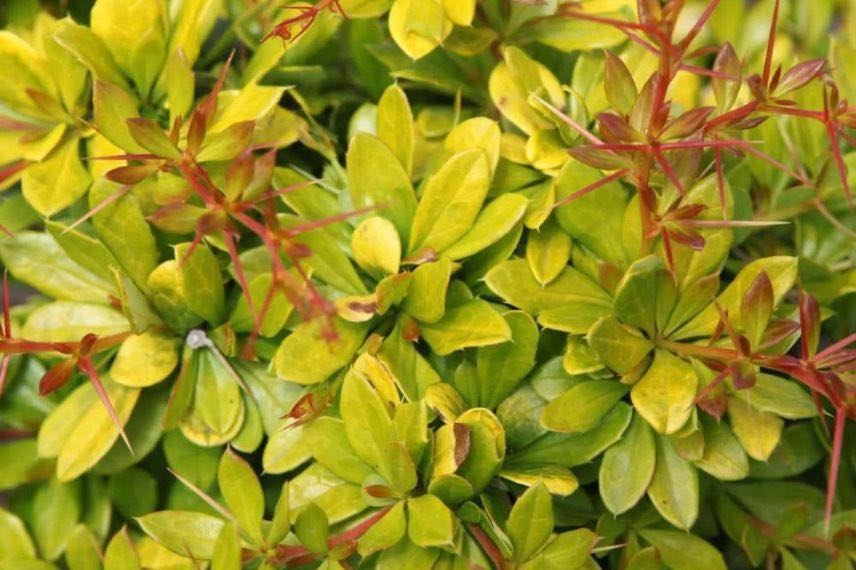
The Berberis thunbergii ‘Golden Carpet’ is a remarkable variety of Thunberg’s barberry, with a low, almost prostrate habit, and bright yellow foliage. This deciduous shrub reaches about 50 cm in height and 90 cm wide, forming a spreading, dense groundcover. Its horizontal branches carry compact foliage consisting of small yellow leaves in spring, which become a shade greener in summer before turning to vibrant orange in autumn.
The prostrate habit and the golden colour of ‘Golden Carpet’ make it an excellent groundcover, particularly effective for highlighting shrubs with darker foliage or for creating bright contrasts in borders. In groups of three or more, it elegantly carpets the foreground of borders or rock gardens. It can also be used to brighten up a slope or to be incorporated into container plantings for patios and balconies.
In combination, it harmonises with purple-leaved foliage such as Physocarpus ‘Little Devil’, grasses with bronze and yellow tones such as Carex, for a play of textures and colours. Its ornamental qualities shine in a colourful checkerboard blending Nandina ‘Fire Power’ and Juniperus x pfitzeriana ‘Old Gold’.
- Subscribe!
- Contents
Comments