


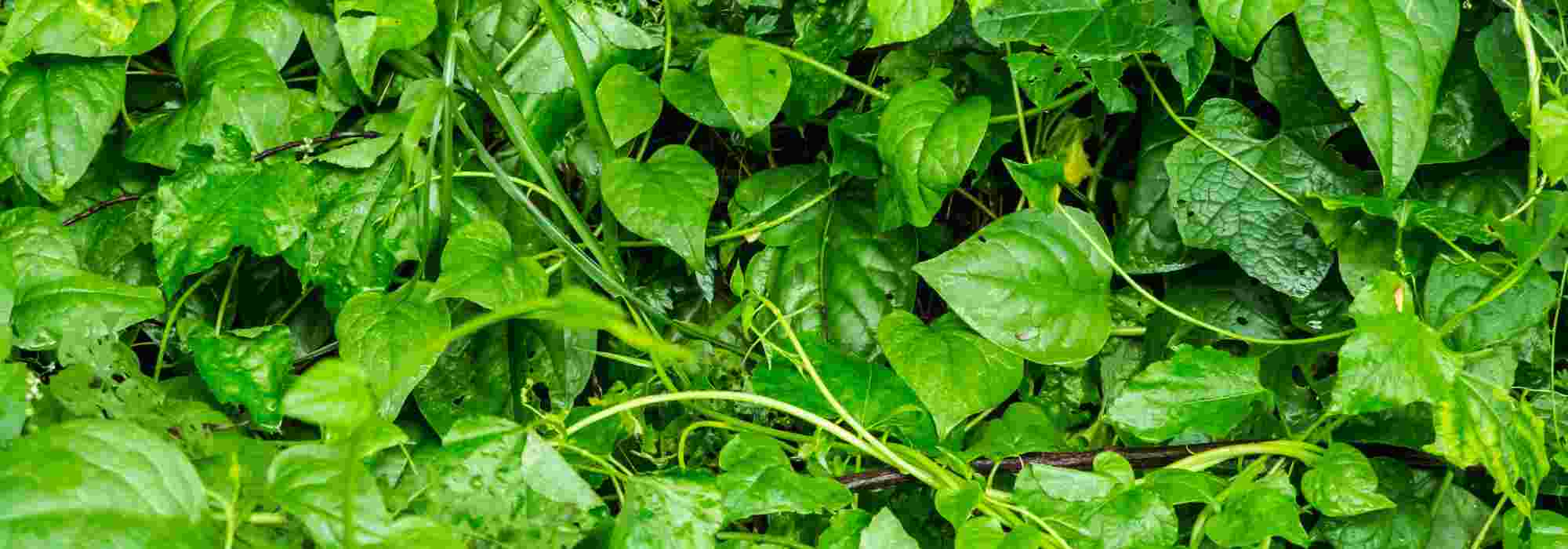
Our tips for growing basella or Malabar spinach
For a bountiful harvest
Contents
How about trying Basella or Malabar spinach (Basella alba)? This vegetable plant, climbing or creeping, offers an abundance of leaves with a flavour somewhere between spinach and sorrel, throughout the summer. Its delicious foliage can be eaten like spinach and lends itself to many recipes. Very easy to grow, Basella also makes a pretty ornamental plant which, after harvest, produces small white flowers followed by red fruits.
Discover all our tips on sowing, planting and care for Malabar spinach!

Basella, what exactly is this vegetable plant?
You love spinach (spinach (Spinacia oléracea)) and your vegetable garden is brimming with it. Unfortunately, growing these spinach slows in summer as they fear heat and drought that hasten their running to seed. That is why you broadened your horizons by cultivating the orache (Atriplex hortensis), also called false spinach or belle-dame, and tetragon (Tetragonia tetragonioides), often named summer spinach or New Zealand spinach. Another type of spinach: Basella alba! It is a perennial vegetable plant in its native range, but grown as an annual in our latitudes. Belonging to the botanical genus Basellaceae, this species is cultivated as a vegetable in many tropical countries with hot and humid climates. Originally from India (hence its vernacular name Malabar spinach, a region in the southwest of the Indian peninsula), Basella alba is also known as Ceylon spinach, Chinese spinach, or Angola spinach.
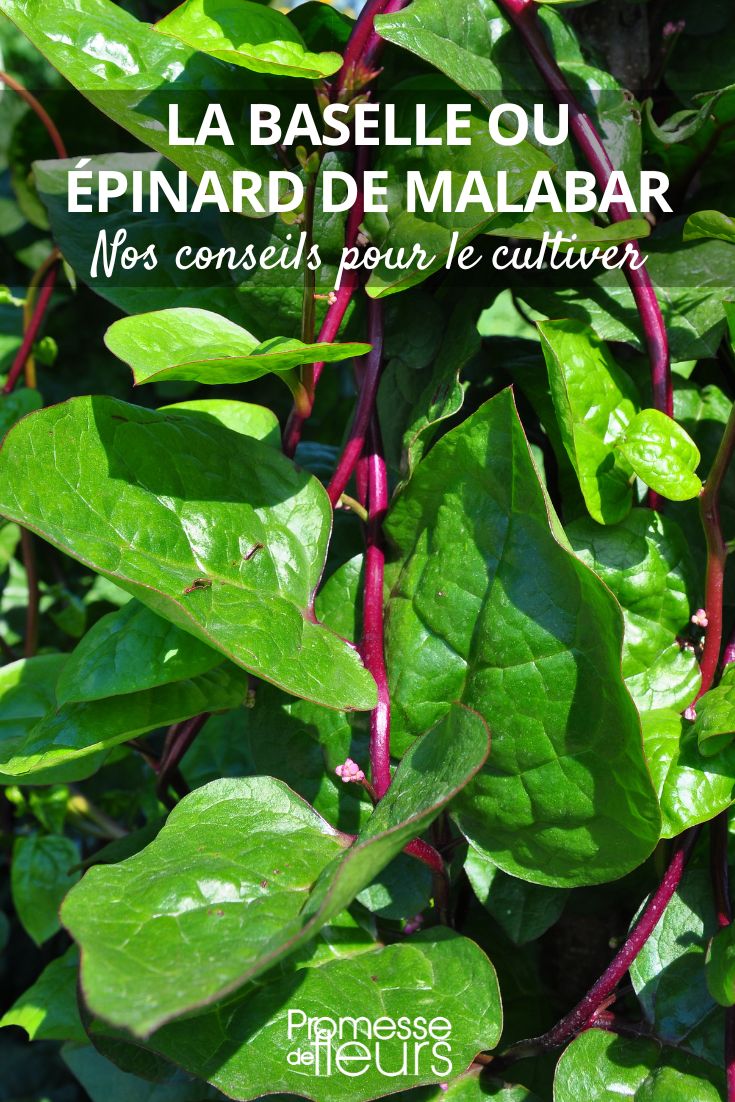
Climbing plant (or creeping without support), Malabar spinach has twining, very fleshy and vigorous stems that can reach 10 m long in hot, humid climates, but around 2 m in our region. Its stems bear oval to orbicular leaves, cordate at the base, wrinkled and mucilaginous, a fairly dark green. These leaves and young shoots are eaten as spinach throughout the summer.
The flowering occurs from July to September. Of little ornamental value, these flowers with a perianth varying from white to reddish and purple are grouped in axillary spikes. They then give rise to red to black utricles about 5 mm in diameter. These small berries secrete a violet juice with strong dyeing properties, used to colour certain foods or fabrics. They stain fingers quite badly.

Leaves, flowers and fruits of Basella alba, also known as Malabar spinach
Very rich in protein, fibre, and vitamins and amino acids, Basella leaves hold numerous medicinal properties. They are widely used in Ayurvedic medicine.
There are two main varieties: Basella alba, the most common form, and Basella alba ‘Select Red’, selected for its bright red stems that contrast marvellously well with the green foliage.
Malabar spinach sowing
Native to tropical regions, Malabar spinach is rather frost-tender in our climate. That is why it is grown as an annual. Germination follows the same logic since germination only occurs at temperatures of 20–22 °C, or 25 °C for optimal germination, and with good light. It should therefore be carried out in warmth and shelter, at the same time as tomatoes, i.e. between March and April. A conservatory, if heated, will be perfect for these sowings. Seedlings can also be placed in front of a window, but out of direct sunlight.
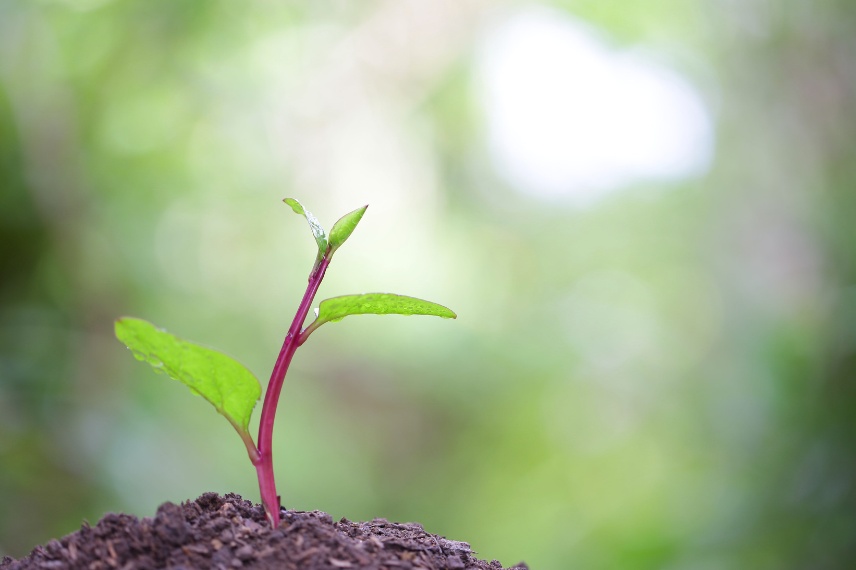
A young Basella seedling
Malabar spinach seed sowing is carried out in individual pots, filled with a seed-starting compost that is only lightly moistened. The method is simple:
- Soak Basella seeds for 24 hours in lukewarm water
- Place two Basella seeds in each pot and cover with a thin layer of seed-starting compost
- Water by misting with rainwater.
Germination occurs after 10–20 days. To speed germination, you can place a pane of glass over the pots, at least overnight. The pots should receive the same growing conditions throughout the seedling stage. The substrate must remain moist without being waterlogged.
When and how to plant Malabar spinach?
From mid-May, once all risk of frost has definitely passed, transplantation of Basella seedlings can be considered, either into the ground, or into a pot. Malabar spinach should benefit from a fertile, fresh and humus-bearing, well-aerated and well-drained soil. An autumn application of manure is advised. Then, at planting, you can add well-decomposed compost. The soil should be deeply loosened beforehand and weed-free.
To ensure its growth, Basella should be given a sufficiently sunny location. Similarly, Malabar spinach requires regular temperatures of around 22 to 25 °C by day and 15 °C at night. Thus, planting against a wall warmed by gentle sun rays suits it perfectly. In regions with cooler summers, Basella can be grown in a greenhouse.
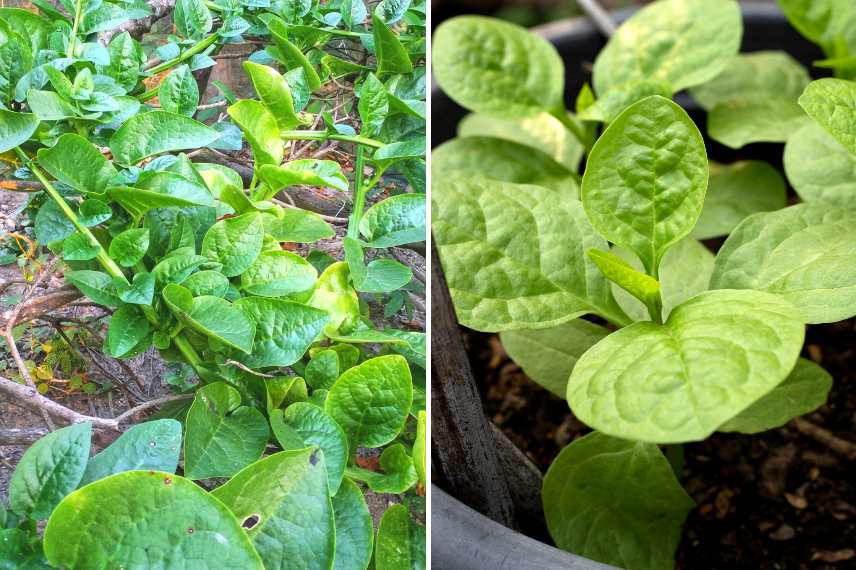
Basella or Malabar spinach is planted in the ground or in a pot
To allow its voluble lianas to climb, you will need a support such as a trellis. The first stems should be tied to the support. After that, they will manage on their own.
Basella can also be grown in a large pot at least 30 cm in diameter, in a substrate consisting of garden soil, potting compost and compost. A layer of expanded clay pellets will ensure drainage.
Read also
Orache: sowing, growing, harvestHow should you care for Malabar spinach?
If Malabar spinach benefits from the best weather and cultural conditions, it is very vigorous and grows very quickly. That is why it needs regular care, which mainly consists of watering. The soil must stay cool and moist without becoming waterlogged. If Malabar spinach lacks water, it starts to flower, and from then on the harvest becomes less desirable. After flowering, the leaves become too bitter.
To retain soil moisture, it is recommended to mulch around the base of the Basella plants.
To encourage the branching of the stems, feel free to pinch the new shoots at their tips.
How do you harvest Malabar spinach?
Harvesting of leaves and young shoots takes place before flowering, as required, and just before consumption. Leaves and the ends of the stems do not keep well for long. The young shoots can be eaten raw and finely sliced in a salad, or cooked. The leaves are typically cooked. Packed with mucilage, these leaves should not be cooked for too long, or they will become slimy in the mouth. This property allows them to be used as a thickener in sauces.
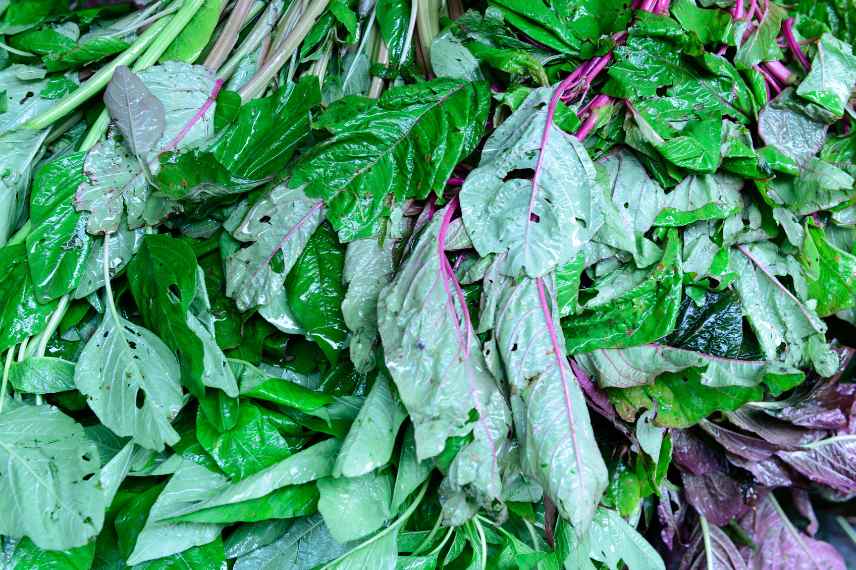
Leaves and young stems of Basella are harvested before flowering
- Subscribe!
- Contents
Comments