


Pairing red or purple flowers
How to pair them well in the garden?
Contents
With red flowers, the garden becomes vibrant and incandescent! It ignites in summer with scarlet plants to theatrical purples: Crocosmias, salvias, Cannas, monardas… Although joyful, it is a risky colour when paired with other flowers, as it dominates all shades. Too many red flowers may overpower a border. If not managed well, combinations with red flowering plants can become clumsy, or even garish in the worst cases.
To enhance the radiant red flowers, we offer some tips to maintain their vibrant effect, revealing the best combinations.
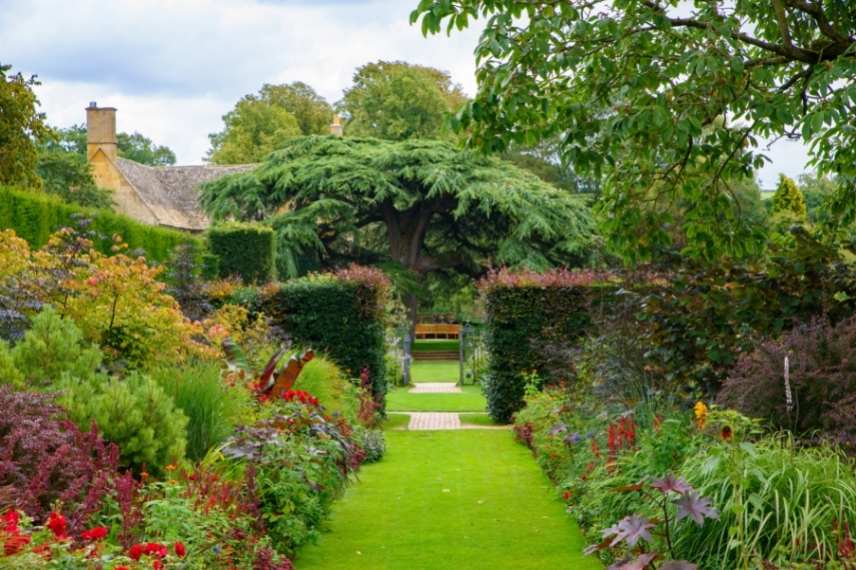
The famous “Red border” created around 1910 at Hidcote garden in England combines red flowers with green and purple foliage, a combination that is not so straightforward…

Red flowers in the garden
- Red flowers, like red roses, are synonymous with passion and fervour. They also express exuberance better than any other. It is the warmest colour of all on the colour wheel.
- Red flowers offer shades that are more or less vivid or muted, ranging from rosy red to subtly orange vermilion, crimson, and even purple when pigmented with blue. A rich palette of possibilities for combinations, but not all reds necessarily harmonise together.
- The colour red in the garden does not go unnoticed… but it can be intimidating in its use, as it is so powerful and energising, having the unfortunate tendency to overshadow other flowers. When proportioned correctly, in small doses, red flowers are perfect for awakening gardens by adding vibrancy to somewhat dull flowerbeds.
- The complementary colour to red is green: red flowers pair wonderfully with lush and vibrant foliage, a must for exotic settings, or with muted greens.
- Red flowerings, with a few exceptions, need light and sun. They are therefore rarely found in shady gardens.
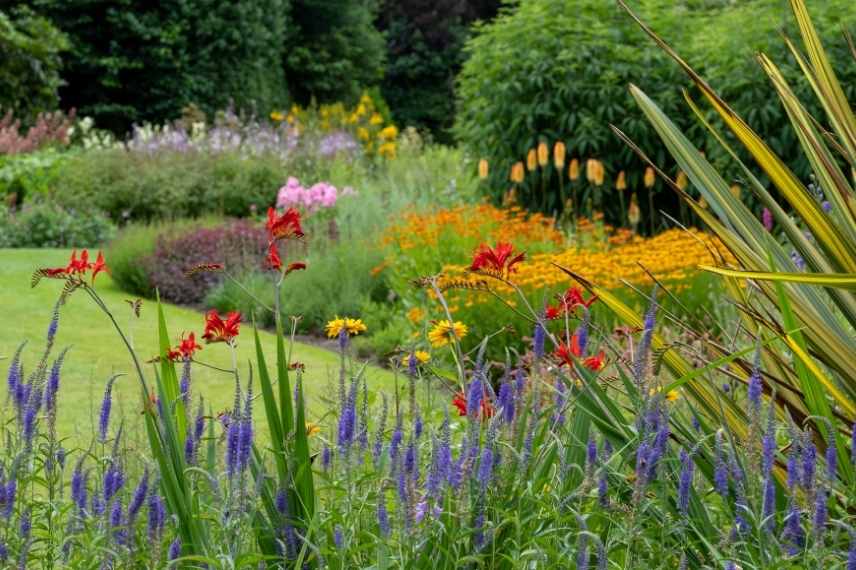
In small doses, red flowers integrate well into a flowerbed and in a large garden. Here, some airy Crocosmias spontaneously enliven the scene.
The essential red flowers
Less numerous than other colours, the range of red flowerings remains varied when considering shades from vermilion to garnet and purple. Here are some of the most iconic red flowerings:
- perennials: the Aloe arborescens, peonies, monardas, Oriental poppies, many salvias and pinks, astilbes, astrances and columbines, some Coreopsis and Gaillardias, many sanguisorbas and yarrow, hollyhocks, daylilies, hardy geraniums, Russelia equisetiformis, some Kniphofias, and among the bulbous plants, a wide variety of tulips, dahlias, gladioli and cannas
- shrubs: roses, numerous azaleas, rhododendrons and camellias, Japanese quinces, Loropetalum ‘Ever Red’, Calycanthus or anemone trees, hibiscus and fuchsias
- climbers: Trumpet vines, some clematis and passionflowers, a few bougainvilleas
- annuals: the extravagant love lies bleeding, cosmos including the remarkable Cosmos atrosanguineus ‘Chocolate’, numerous begonias and salvias, zinnias, snapdragons and pelargoniums
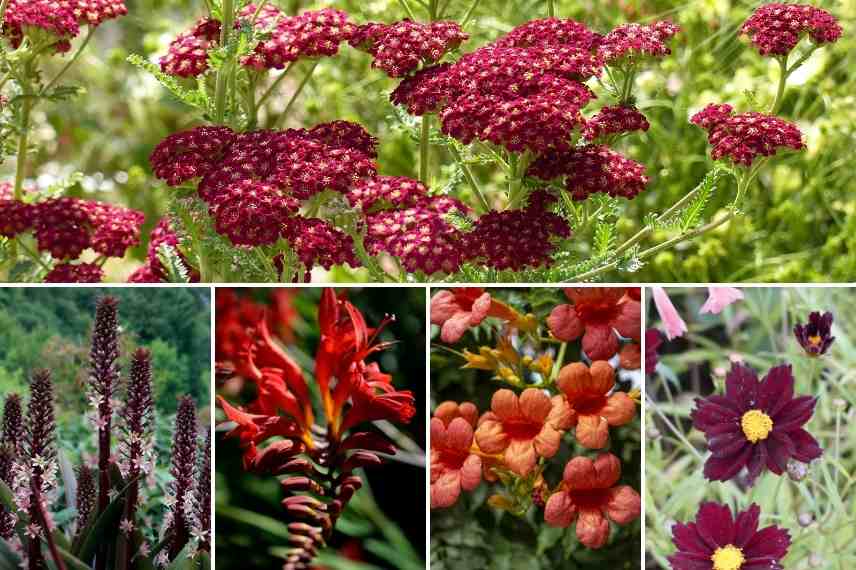
Among the most vibrant plant beauties: Achillea millefolium ‘Red Velvet’, Eucomis ‘Sparkling Burgundy’, Crocosmia ‘Lucifer’, trumpet vine and Coreopsis ‘Mercury Rising’
Discover other Red flowering perennials
View all →
Available in 0 sizes
Available in 1 sizes
Available in 1 sizes
Available in 1 sizes
Available in 1 sizes
Available in 1 sizes
Available in 1 sizes
Available in 1 sizes
Available in 1 sizes
Available in 1 sizes
Pairing red flowers with other colours
In a monochrome mode
A red garden or a bed made up of 100% red flowers is a bold choice, not necessarily within everyone’s reach. But at least, you can’t go wrong in this jumble of red flowers. Well… not quite! You should still avoid planting warm-toned reds (tinged with yellow) too close to cool-toned reds, shaded with blue… It’s better to group reds from the same “family” and be generous with foliage, bright ones like chartreuse greens and pale greens, with a few touches of purple foliage, to avoid a decor that is too dark or even gloomy when primarily using “cool” reds (carmine and magenta up to burgundy).
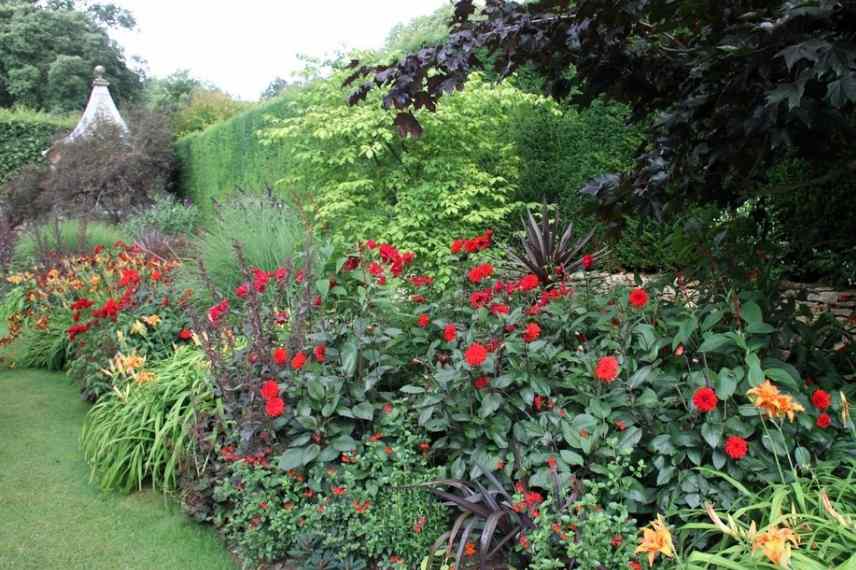
The “Red border” at Hidcote, a clever mix of red flowers and purple foliage (© David Catchpole)
In harmony with yellow and/or orange
Red blooms, in their scarlet to vermilion tones, pair beautifully with yellow and orange blooms, as they are neighbours on the colour wheel. This combination creates a sunny and spicy sensation where red flowers enhance yellow and orange flowers and vice versa. Combining these three colours in your garden is a lovely idea when it may lack personality, but you must be mindful of placement, as this vibrant trio leaves little room for other flowers, even completely eclipsing them: keep this in mind when planting, isolating or creating surprises in this bed.
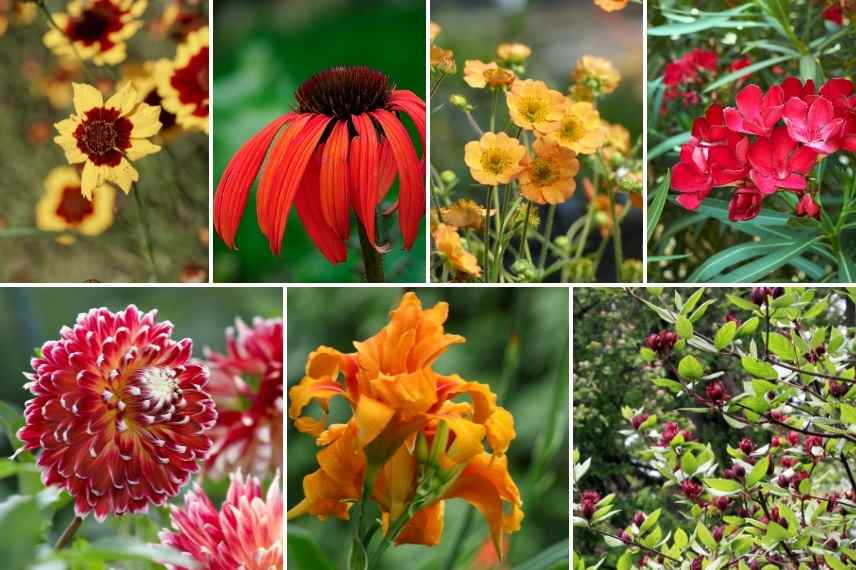
Coreopsis tinctoria, Echinacea ‘Tomato Soup’, Avens ‘Totally Tangerine’, Red Oleander, Dahlia, Hemerocallis fulva ‘Flore Pleno’ and Calycanthus floridus
In contrast with green
With its complementary colour, green, red flowers are certainly in good company! The contrast is strong, especially with bright and scarlet reds against vibrant greens. Muted or purple reds, on the other hand, are magical when paired with yellowish greens. It’s a dynamic marriage that always works, which can even be highlighted in a Japanese garden, for example, by introducing a red chair or small bench.
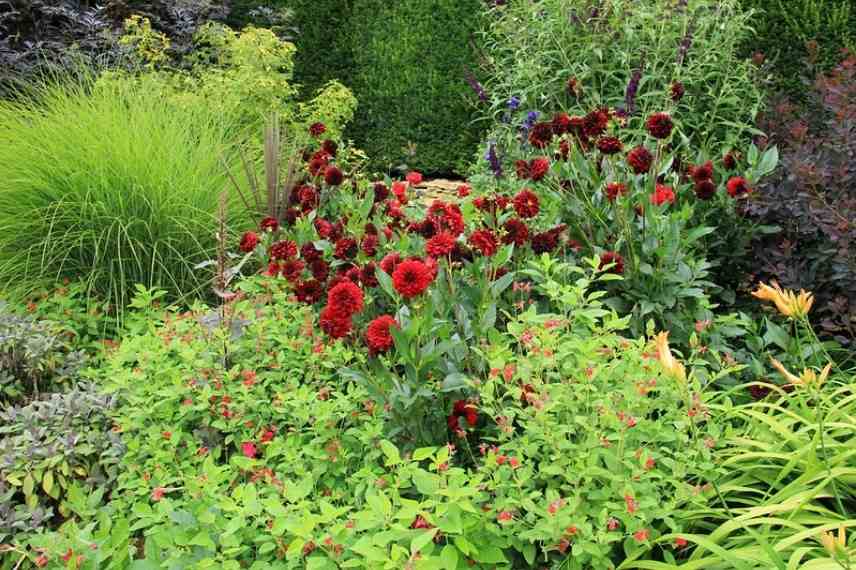
Dahlias in a sea of greenery (© Karen Roe)
With purple and cream
Here’s one of the strongest and most beautiful combinations: garnet red flowers, purple and green foliage, with a touch of cream or very pale yellow flowers. The cream note softens the whole that could seem dreary and prevents the sometimes flamboyant red from dominating the eye.
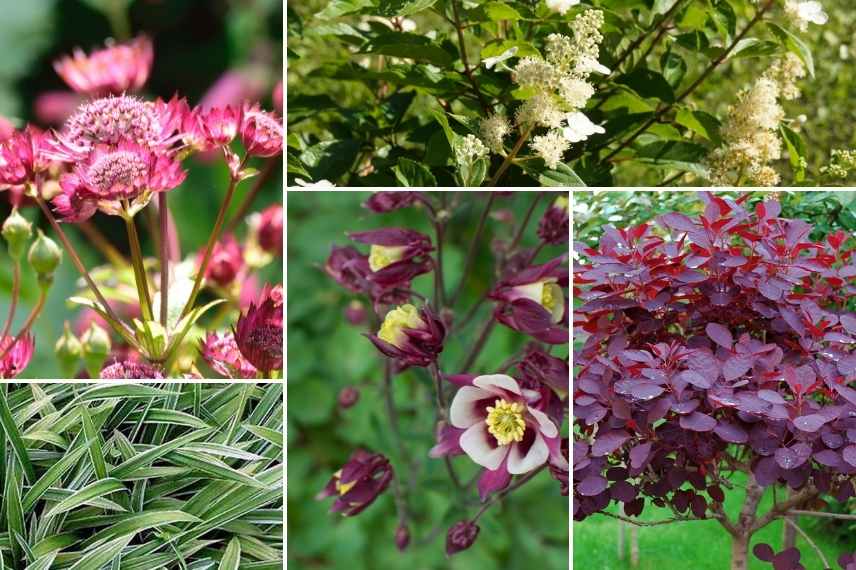
Astrantia, Hydrangea paniculata ‘Kuyshu’, Carex siderosticha ‘Variegata’, Columbines and Cotinus coggygria
With pink or mauve
This is a somewhat adventurous game, but scarlet or coral red flowers actually pair quite well with mauve blooms, especially if they are tinged with yellow or orange with a bright stamen heart, as in this example where Japanese Anemones and Crocosmias compete in beauty at the end of summer.
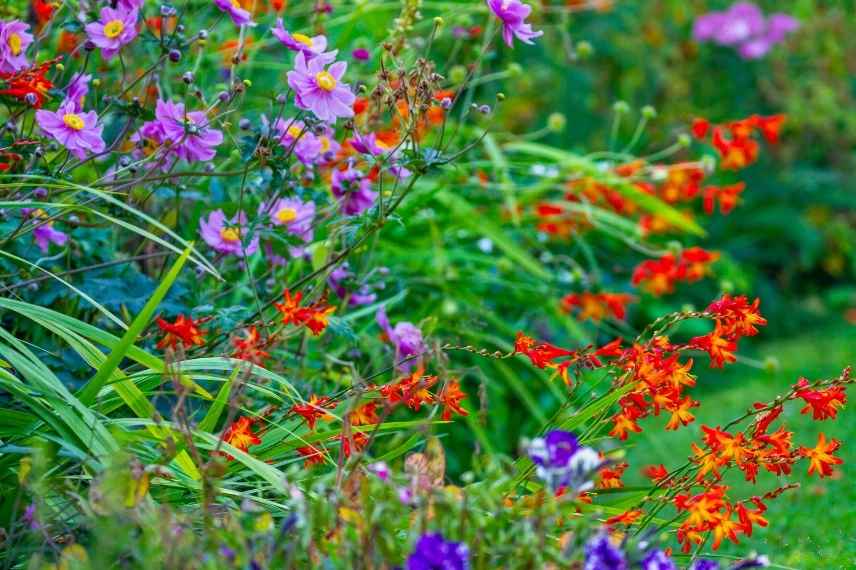
In a pastel bed
When you sprinkle just a few red flowers into a bed of soft hues (pink and purple, white and mauve…), they, far from stealing the show, serve to warm up the whole. To maintain the harmony of a pastel bed, it is essential to insert red flowers as accents rather than in mass: they should just pop up here and there to spice things up without disrupting! They should also be chosen for their small inflorescences like Sanguisorba or Knautias, for example.
With white
White on red, nothing moves? In any case, in the realm of landscaping, this is a combination of great modernity, yet very classic. This combination is, however, less obvious than that of pink and white. Red flowers instantly brighten neutral tones, but it is preferable to try this duo on a small surface, perhaps a terrace or balcony… unless you prefer to attempt it in a Japanese or contemporary inspiration (see below). Creamy whites to slightly pink ones will fit very well in this combination, and the reds should be chosen to be more pinkish.
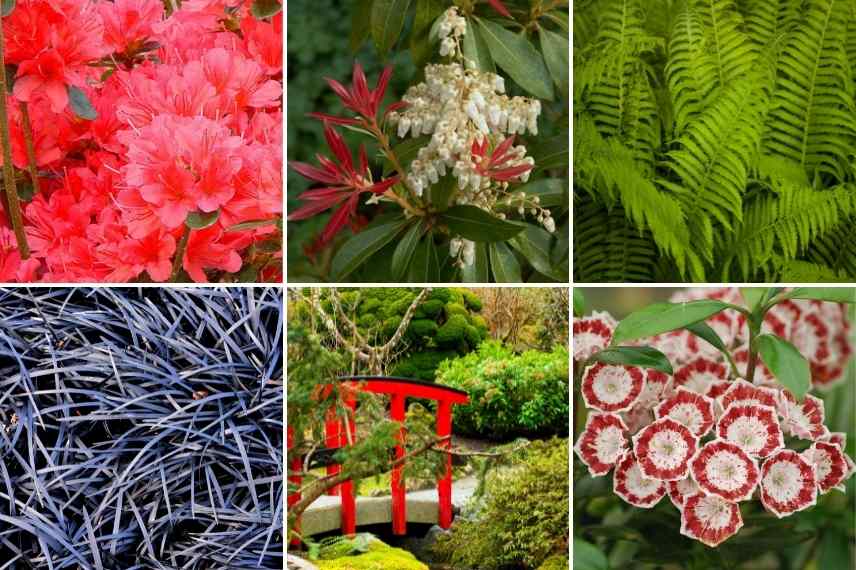 Japanese Azalea, Pieris ‘Forest Flame’, Dryopteris, Ophiopogon, conifers and Kalmia latifolia ‘Minuet'[/caption>
Pairing red flowers with foliage
As mentioned earlier, green is ideally the perfect match for red as it is its complementary colour. Foliage will therefore inevitably be “in tune” with red flowers. However, be careful not to use these two colours at full saturation, as this may result in a garish effect. Greens should be preferred in greyish, olive, or mossy shades, or conversely in cream or purple variegations, or even in fresh, yellowish greens.
Red flowers are also often associated with almost black purple foliage: this is a stunning combination that surprisingly tempers the intensity of red, provided that the foliage remains in limited quantities; otherwise, it can create a sad and gloomy effect. To counter any overly dark appearance, it is wise to use flowers in a lighter red, pinkish or orangey tones, or even some bicoloured red flowers, and to incorporate contrasting green foliage.
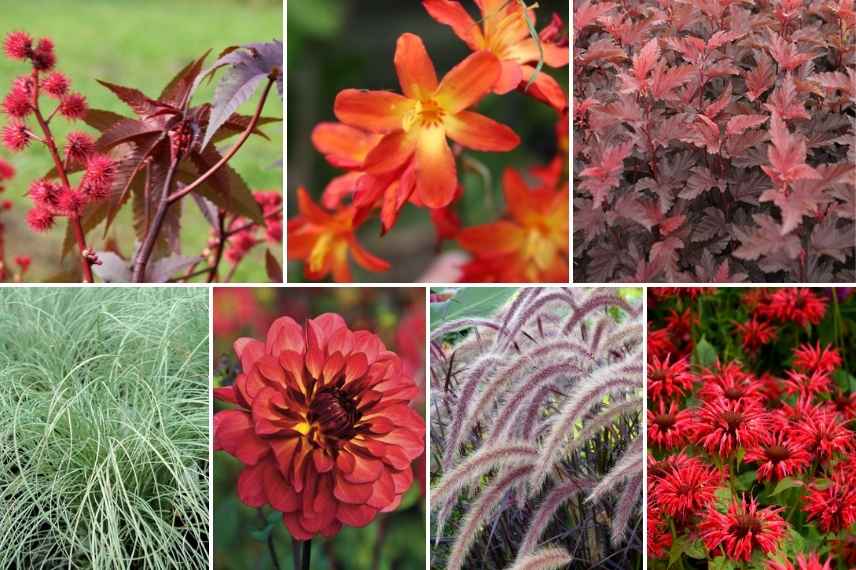
Ricinus communis, Crocosmia ”Carmine Brillant’, Physocarpus ‘Lady in Red’, Carex flacca, Dahlia ‘Antibes’, Pennisetum setaceum ‘Rubrum’ and Monardes
Pairing red flowers to match your garden style
You want a more vibrant and colourful garden? Integrate some red flowers, and it will reward you well. However, as mentioned, caution is needed when using red flowers, which are easier to incorporate in large beds and spaces, and will primarily enhance the following types of gardens:
An exotic garden
The combination of red, pink, and orange is far from a taste faux pas in the garden, transporting you to a different place, evoking the tropics. It is indeed interesting to mix all warm tones in the exotic garden to create this particularly lush atmosphere. This will be achieved, in addition to the chosen blooms, as much as possible from eccentric or unusual subjects like Leucospermum and Protea, through contrasts in foliage, broad and slender or linear, such as banana plants and cordylines, as well as contrasts in textures like Aloes and Grevillea… Also integrate some purple or variegated red foliage found in Phormium and Colocasia. Don’t forget some bright green foliage to avoid darkening these beds and to highlight the vermilion reds even more.
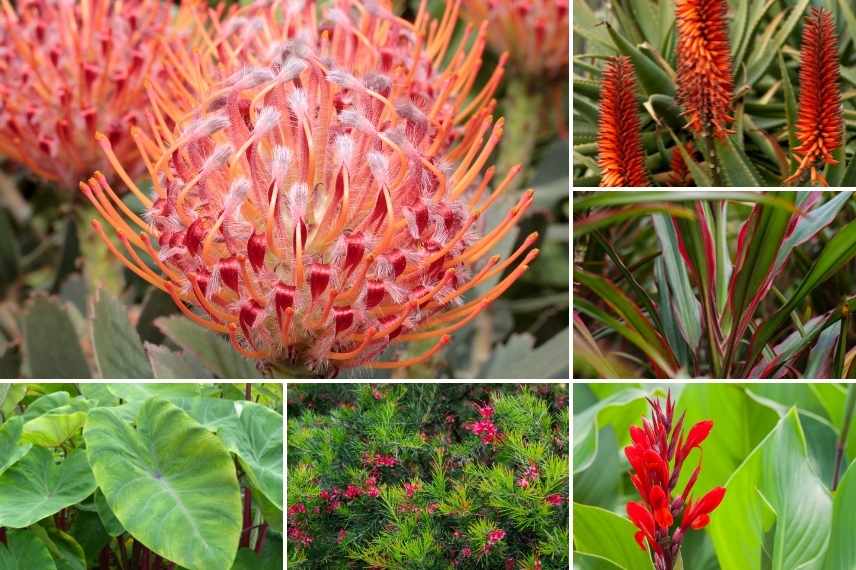
Leucospermum ‘Vulcano’, Aloe, Cordyline, Colocasia, Grevillea juniperina, and Canna
A contemporary garden
In minimalist architectural settings, based on strict lines, cold materials, and anthracite grey or white colours, red flowers bring warmth and energy while enlivening the minimalism of the spaces. Use them in a monochrome style or with light white flowers (like Gypsophila or Gaura) or structural ones like Arums, along with some graphic or upright foliage, to maintain the desired sobriety in this type of design garden. Melianthus major, voluptuous red Lilies, or Eucomis in purple, used sparingly, work wonders in contemporary style gardens.
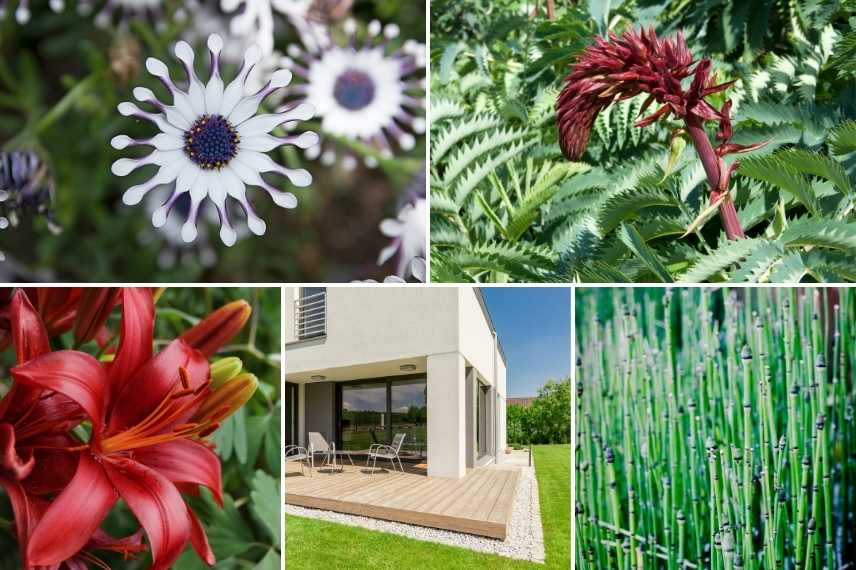
Prefer atypical inflorescences and graphic foliage, sticking to a duo of white and red, balancing vibrancy and sobriety. Here, a cushion of Osteospermums, a Melianthus major, a few orange-red lilies, and some horsetails are more than enough.
A country garden
Lightness will be the key for red flowers to thrive in a country garden. They should be chosen in purple shades or crimson reds, which are more natural in this context, paired with pale pinks or even salmon roses. Invite cottage garden plants like hollyhocks, sages, and Cosmos. A few touches of white are useful here and there to lighten the scenes. Choose soft habits, small or ethereal flowers, and finely cut or linear foliage that dances in the wind, along with some grasses to punctuate the whole.
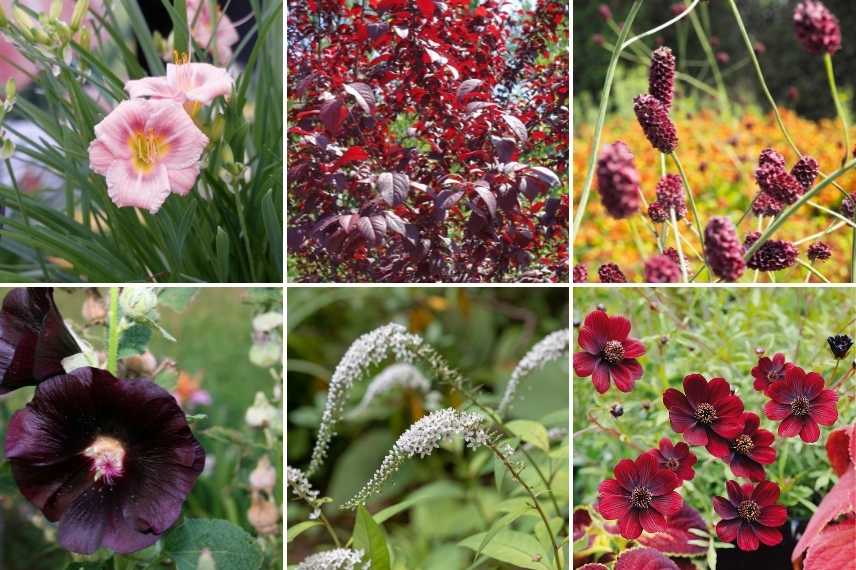
Pink daylily, Prunus ‘Pissardii’, Sanguisorba, purple hollyhock, Lysimachia clethroides, and cosmos atrosanguineus ‘Chocamocha’
A wild garden
Let your desires run free in this large garden, where red flowers can express themselves, always in small touches, as colour enhancers. Dark reds approaching purple are recommended in the naturalistic garden or meadow, but vermilion reds integrate well into a mass of yellow or orange flowers, as long as they remain sparse and accompanied by soft foliage and beautiful grasses.
Among the interesting red blooms for this wild garden: poppies resembling cornflowers, echinaceas, crimson sedums, cheerful gaillardes, Sparaxis tricolor or ‘Dunkelrot’, lychnis, achilleas, knautias, and scabious, sanguisorbas…
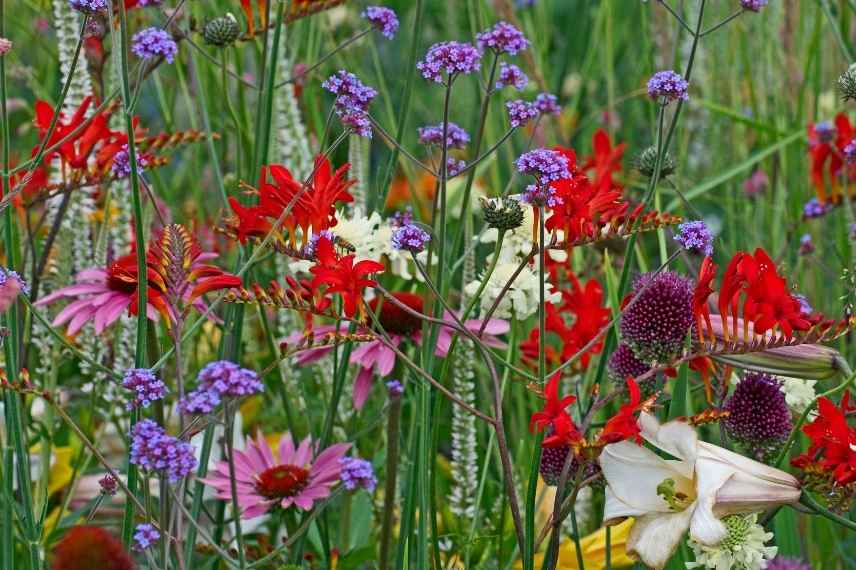 A jumble of wild-looking flowers like Buenos Aires verbena, echinaceas, and veronicas freely combine with a few red Crocosmias and more assertive Lilies.[/caption>
Finally, the French formal garden, with its grand classicism, often showcases red blooms in mass plantings. However, it remains a garden style that is not widely adopted by the general public.
Associating red flowers with different seasons
In spring
From April onwards, you can already count on numerous red-flowering bulbs such as tulips, followed by Caen anemones (Anemone coronaria) and ranunculus, the chocolate hues of certain tulips and hardy geraniums like the stunning Geranium phaeum ‘Chocolat’ or the foliage of Loropetalum, many of which, like ‘Ever Red’, display their lovely red, frayed flowers.
It is elegant to create simple, two-colour combinations in this season where the freshness of the colours alone brightens the garden. Purple flowers mixed with pale yellows are mutually enhanced, by inserting some aniseed or chameleon foliage like that of Berberis. Combinations of red and orange are even more vibrant, such as Caen anemones or ‘Miller’s Crimson’ candelabra primroses and Double Orange Asian Ranunculus. From May onwards, also play with columbines, azaleas, Akebia quinata, and the velvety red-brown of Calycanthus, followed shortly by the unique flowering of Feijoa sellowiana.
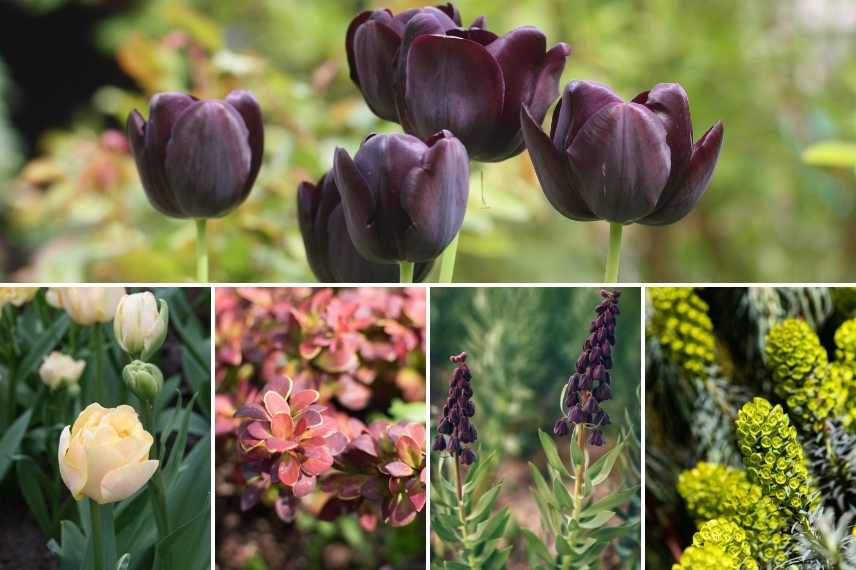 A bed of purple and yellow: Tulips ‘Queen of Night’, Tulips ‘Charming Lady’, Berberis ‘Admiration’, Fritillaria persica, and Euphorbia characias
In Summer
Summer is full of red blooms, and it is undoubtedly the season when they are best showcased without causing any taste faux pas in a profusion of colours in the garden. The palette of reds is very broad, ranging from orange-reds to garnet reds, and even brownish reds. Your choice will depend on your preferences for certain plants, allowing you to compose a fiery tableau in this season of endless possibilities! Muted reds, more subtle, lend themselves well to pairings with pink or mauve flowers.
Among the most enchanting flowers of beautiful summer, invite dahlias like ‘Arabian Night’, red daylilies, Coreopsis, Penstemons, crocosmias, and cannas, not to mention, of course, fiery roses like ‘Falstaff’.
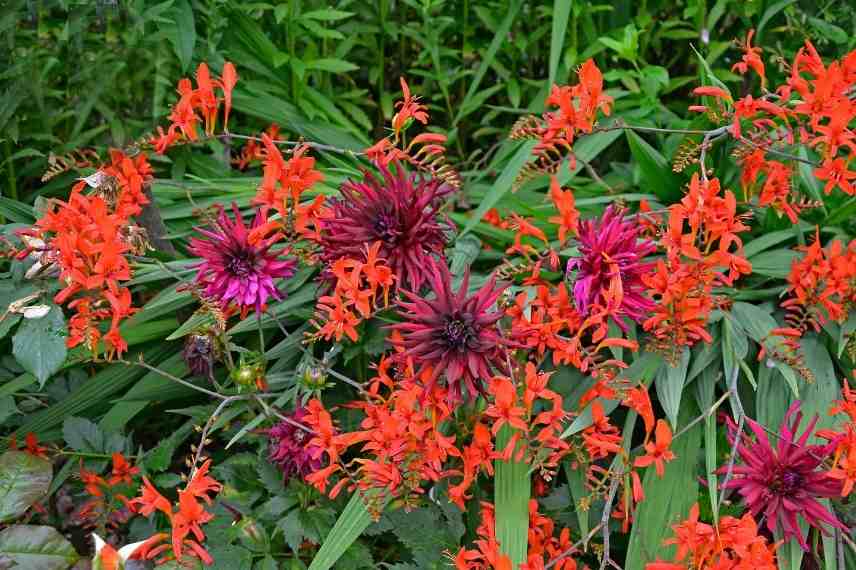 Summer is the season when bolder combinations can be embraced: here, red-orange crocosmias and purple dahlias create a vibrant alchemy, made possible under summer light.
In autumn
The autumn fires bring an extra brilliance to red flowers, whose flamboyance is heightened either in orange combinations or in marriages with purples and burgundies… or in a subtle compromise between the two! The golden light of October and November softens the colours and allows for some combinations that will not clash at all.
These elegant options also deserve to incorporate some white or light blue flowers, or even mauves for a final display imbued with a gentle autumnal softness (with colchicums, persicarias, asters, etc.). These additional tender colours aim for a visual soothing of bright reds like those of Fuchsia magellanica, and also allow for a magical transition to winter. The possibilities are quite numerous with flowers that extend their blooming like Dahlias and Cannas, the plum and aubergine tones of sedums, Camellia sasanqua which emerge, chrysanthemums, and some berries like those of Arum italicum or the fruits of ornamental apple trees that intensely colour the garden. We also take into account the changing foliage that supports the whole: the reddened foliage of winged euonymus and Hydrangeas quercifolia, those of Japanese maples or the yellow and orange tones of Ginkgo, Acer cappadocicum and serviceberries, and the straw colour of many grasses in an enchanting autumn display.
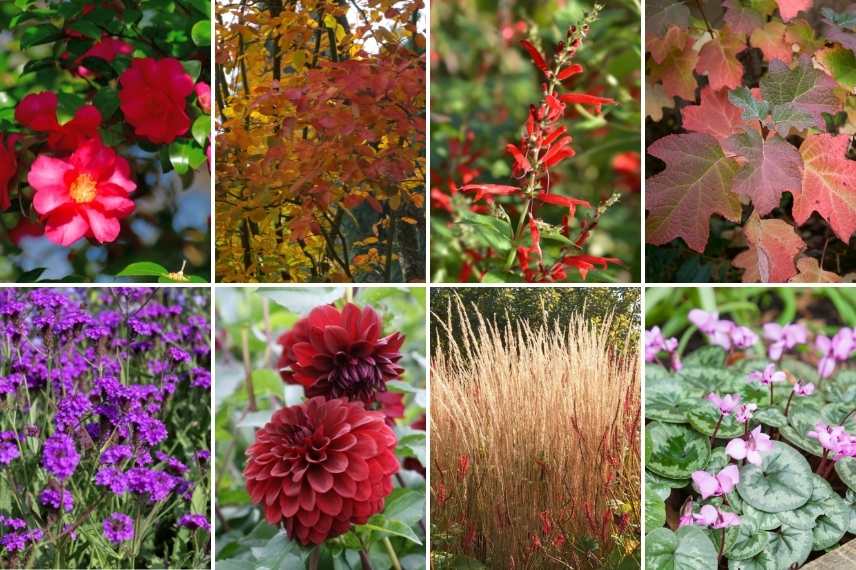 Autumn camellia, serviceberry, pineapple sage, Hydrangea quercifolia, Verbena rigida, Dahlia Obama, Calamagrostis, and persicarias, Cyclamen coum[/caption>
In winter
Just like orange flowers, which are less present in winter, red flowers are quite rare in this season, but some stunning varieties can be found, as a cheeky response to the surrounding cold, among Camelia japonica, some varieties of Hamamelis, certain winter-flowering clematis (the so-called waxy clematis) and interesting purplish-red hellebores. The red berries of winter also provide a spectacle, even if they remain discreet, such as those of holly, Gaultherias, and Cotoneasters.
They can easily be paired with the orange or purple woods of dogwoods like Cornus alba ‘Sibirica’, the bark of a Tibetan cherry, and with evergreen shrubs with white flowers like those of heathers or Sarcococca, and some blue conifers. It is wise in winter to insert some brighter touches like very soft yellows (found in Edgeworthia or Stachyurus praecox), but also subtle pink notes that look stunning with faded or purplish reds.
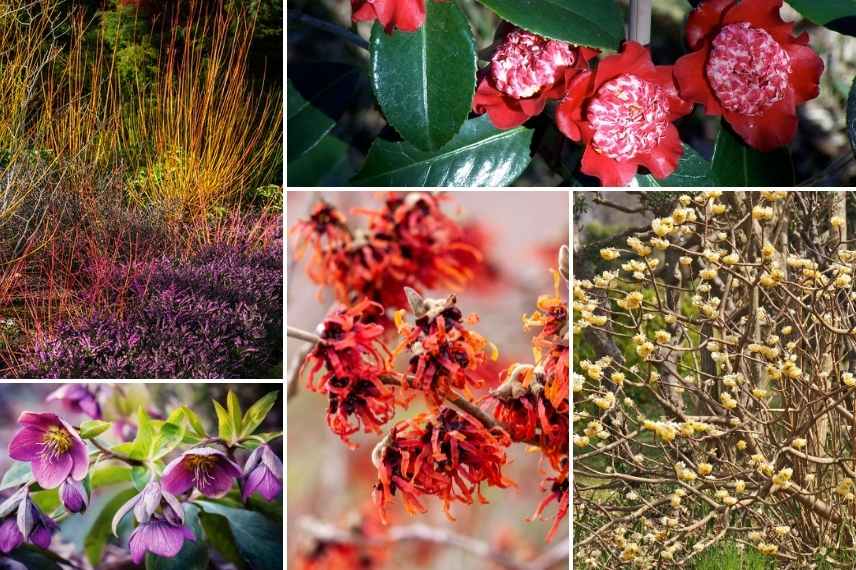 Cornus and winter heather carpet, Camelia japonica ‘Lipstick’, purple hellebores, Hamamelis x intermedia ‘Diane’, and Edgeworthia chrysantha[/caption>
- Subscribe!
- Contents
Comments