





























Plants that sucker
Beware of invasion
Contents
Some plants are spreading and multiplying by producing suckers. This phenomenon is called suckering. Although suckers can sometimes be a blessing (maintaining slopes, groundcover, young plants at a lower cost…), suckering plants can quickly become a nuisance if not managed properly.
→ Which plants produce suckers? Why do they do this and how can it be managed? We cover everything in our advice sheet!

Why do they sucker?
The term “suckering” means: producing suckers that emerge from the soil. These suckers appear from the roots, rootstocks, or stolons. Some suckers remain close to the parent plant, while others may emerge several metres away from it. This is a technique of vegetative reproduction, meaning it does not involve sexual reproduction, thus lacking genetic mixing. A sucker is therefore a perfect clone of the parent plant.
There are some advantages to suckering:
- The suckers help combat erosion by stabilising the soil more effectively than a bush alone;
- Suckers allow for rapid and efficient greening of bare areas;
- Suckers can provide small free young plants to move or give away.
But there are also quite a few disadvantages:
- Suckering bushes can become invasive. It is sometimes necessary to manage their vigour;
- Suckers can slightly weaken the parent plant by drawing some of the water and nutrients. In the case of fruit trees (apple trees, plum trees, etc.), this can reduce fruit production.
- Suckers may sometimes emerge from rootstocks on fruit trees as well as on ornamentals. They should be removed to prevent them from overtaking the main plant.
→ To learn more about plant suckering, read: “My bush is suckering. Why? What should I do?”
How to avoid this?
If you do not want to find suckers all over your garden, you will need to take action to prevent the plant from producing them or at least to channel them.
- First solution: plant in a container with a hole for small plants or plant within a root barrier to contain the plant within a definite area;
- Some plants produce offsets if they no longer find enough nutrients. The plant will then “move” through its suckers to see if “the grass is greener elsewhere.” This is the case with mint or, to a lesser extent, running bamboos. If the mother plant is well cared for, it is less likely to produce suckers;
- Some plants sucker heavily in response to stress: pruning, drought, soil disturbance too close to the roots…
- Forget about plants that sucker too much if you do not want to be overwhelmed. For this, make sure to research well before acquiring a plant from a nursery;
- Finally, some species sucker a lot, but their varieties or cultivars do so less or not at all. For example, Sorbaria sorbifolia is a nuisance, but its variety ‘Sem’ is much more manageable.
Finally, if suckers appear and you wish to eliminate them, you can simply mow them, prune them, or remove them by detaching them from the mother plant.
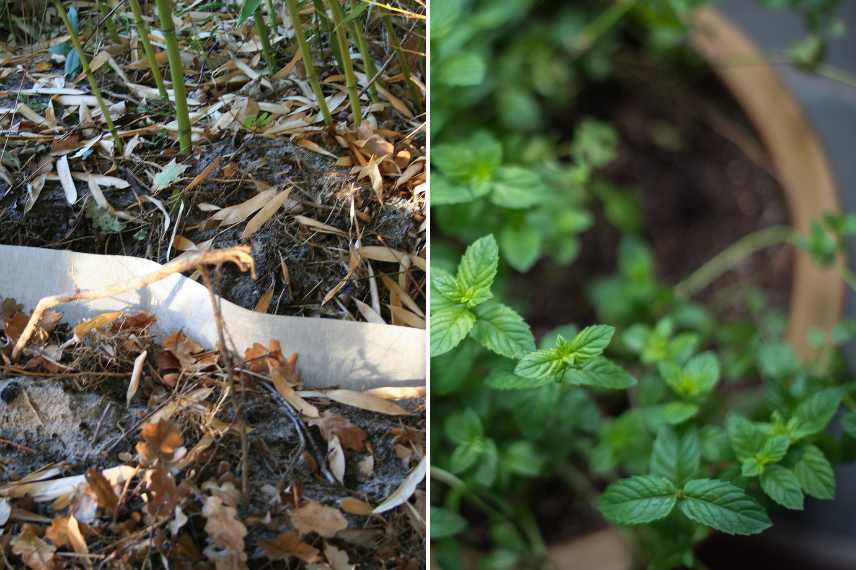
Opt for a root barrier at planting, or for certain plants like mint, plant in a pot
The most suckering plants
Annuals and Perennials
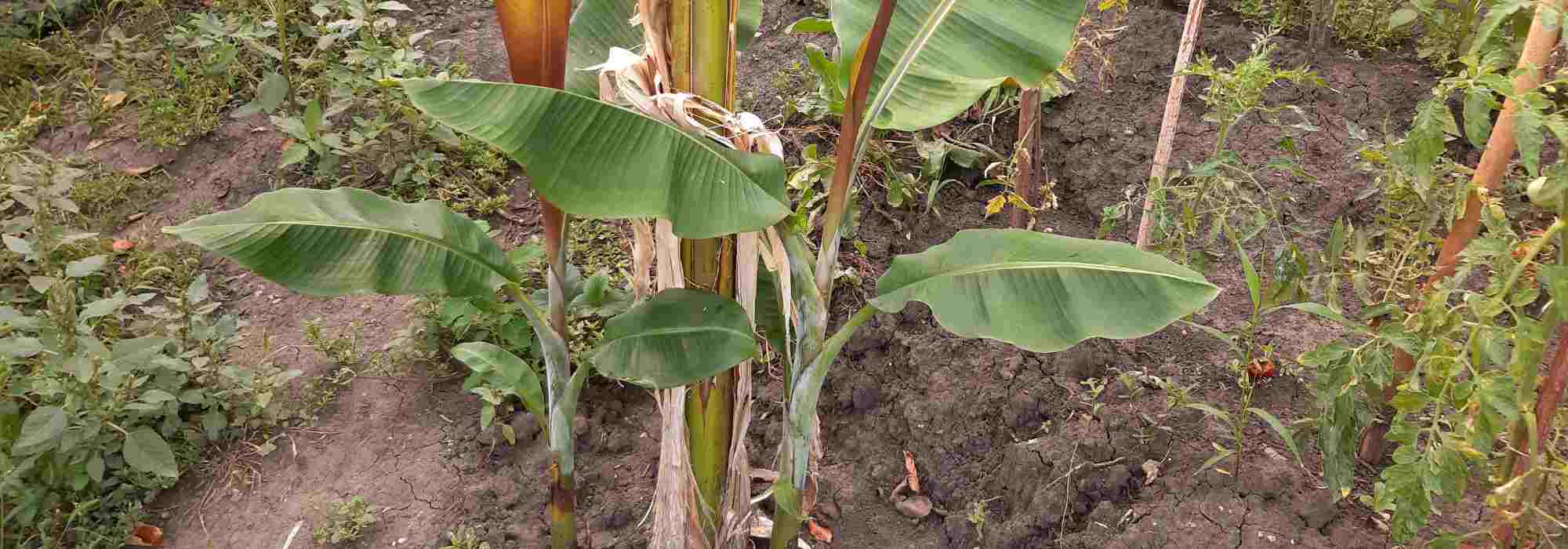
Some persicarias, mints, Euphorbia cyparissias, Aegopodium, Physostegia, nettle, certain asters like Aster ageratoides, balsam herb or mint-coq, a large number of agaves, physalis, banana plants…
Climbers
Bushes
The lilac, running bamboos (for example, the genus Phyllostachys), Rubus (notably raspberries), Mahonia, Virginia sumac, sea buckthorn, Sorbaria, blackthorn, bloodtwig dogwood, hazel, Rosa rugosa and its hybrids (as well as other old roses), oleaster, Clerodendron bungei, Tetrapanax, Japanese Kerria, Aralia elata, Xanthorhiza simplicissima, Symphoricarpos…
Trees
Ailanthus, poplars, false acacia, Toona sinensis, Pterocarya fraxinifolia, Acacia dealbata, Broussonetia papyrifera, Prunus avium, Prunus tenella, …
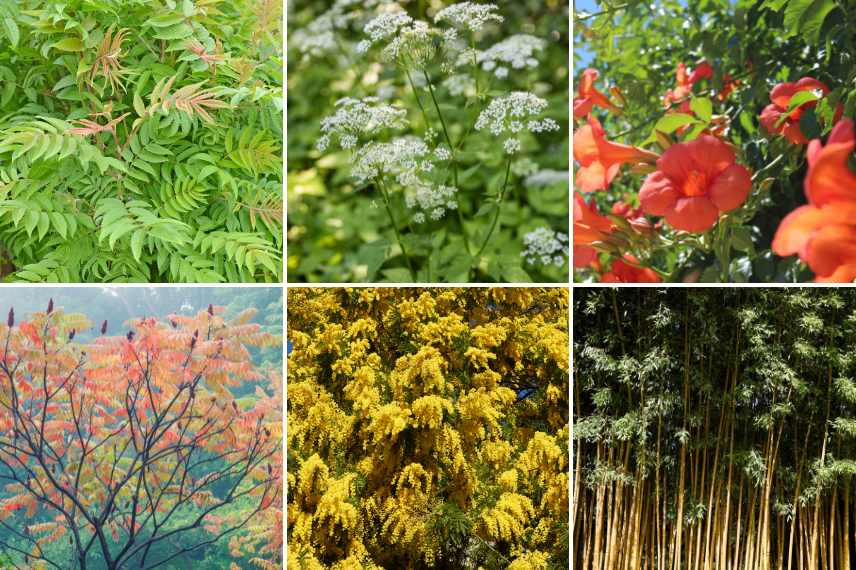
Sorbaria sorbifolia, Aegopodium podagraria, Campsis radicans, sumac, Acacia dealbata and Phyllostachys
- Subscribe!
- Contents
Comments