


Pollen allergy: what to plant in your garden?
All our tips and ideas for creating a hypoallergenic garden
Contents
Achoo! Repeated sneezes, a runny nose, watery eyes and conjunctivitis, an irritating cough, or even breathing difficulties or asthma attacks… Each year, in the early days of spring (even as early as February in some regions), the same phenomena recur if you are allergic to pollen. And all these hay fever symptoms last until June, or even until the end of summer for the most sensitive individuals. Authorities estimate, moreover, that 20 to 30 per cent of the French population are affected by these allergenic phenomena.
Obviously, the main culprit behind this ordeal for those affected is the pollen of the plants, bushes and trees that surround us. Both in the countryside and in urban areas, since allergenic species are often planted there. So what can you do to avoid the risks? As zero risk does not exist, you can at least create a hypoallergenic garden by removing entomophilous plants (whose pollen disperses by wind) and by planting non-allergenic plants.
Discover all our tips and ideas to create a peaceful plant and floral haven. What to plant when you’re allergic in a pollen-free garden where you can move about in complete serenity during the spring?

The most allergenic plants to avoid in your garden
Logically, before discussing hypoallergenic plants, let’s talk about plants, shrubs and trees that produce large quantities of pollen carried by the wind. That is the problem, since these pollens, suspended in the surrounding air, penetrate our bronchi and irritate our breathing passages. However, not all pollens are necessarily allergenic. Indeed, some plants are identified as highly, moderately or mildly allergenic. In any case, it is essential to ban these anemophilous plants (whose pollen is carried by the wind) from your garden in favour of entomophilous plants. For these plants, insects do the work of reproduction, so there is no risk of allergies.
Here is a non-exhaustive list of the most allergenic plants:
- Herbaceous plants: mugwort, ragweed, goosefoot, amaranth, plantain…
- The grasses: fescues (Festuca), giant stipa (Stipa gigantea), tufted hair-grass (Deschampsia cespitosa), Calamagrostis acutiflora, hare’s-tail (Lagurus ovatus), reed canary grass (Phalaris arundinacea), blue lyme grass (Leymus arenarius)…
- The trees and shrubs: the birch (Betula), the trees of the Cupressaceae family (cypress, thuja, juniper…), the European ash (Fraxinus excelsior), hazel (Corylus), alder (Alnus), the common hornbeam (Carpinus betulus), ash‑leaf maple (Acer negundo)…
For more information, I invite you to consult Marion’s article: Pollen allergy: how to protect yourself? The plants at risk and our tips to limit allergic symptoms
Similarly, the site of the National Aerobiological Surveillance Network (RNSA) lists allergenic plants and draws up a map of pollen allergy risk by department, updated daily.
Read also
Create a Japanese or Zen gardenWhat types of hypoallergenic gardens are there?
To avoid the dreaded hay fever, you should therefore ban from your garden all the plants mentioned above. The ideal lies even in the design of a garden free from allergenic or irritant plants, to minimise the risk of triggering allergies. That said, you want an outdoor space that is at once stylish, easy to maintain and a pleasure to live in…
Forget at once wild and natural gardens, rustic and rural gardens that celebrate wild plants. They certainly have undeniable bucolic charm, but they are often populated with herbaceous plants or grasses.
To stop sneezing, sniffing, blowing your nose, coughing and eyes streaming throughout spring, it is better to design gardens that are more elaborate, more cultivated, with a wide emphasis on entomophilous plants, but also on mineral elements. Several options are available to you:
- The classic French-style garden : when we speak of this garden style, Versailles and most French châteaux and grand residences inevitably come to mind… Obviously, the aim is not to recreate these gardens with geometric layouts exactly, but to take inspiration from them in their character. In this type of garden, gravel paths are laid and clipped hedges are used, lawns are complemented with ponds or small jets of water, decorative elements such as a statue or a fountain, with low-growing perennial plants such as miniature roses or Santolina… These are often gardens where green dominates, where boxwood, potentially allergenic, is replaced by boxwood alternatives, where the art of topiary is mastered, where constraints of size and mowing are numerous… These classic gardens are perfectly suited to people with allergies because they are regularly tended. The lawns there are mown two to three times a week, shrubs pruned before flowering… thus the risks are eliminated
- The Japanese-style Zen garden is defined as a balanced harmony between the mineral and the vegetative. With asymmetric and meandering lines, the Zen garden invites quiet and contemplation. Plants with colourful or tender foliage (Japanese maples, Prunus, flowering cherries…), ericaceous shrubs, trees pruned in clouds… which sit in perfect harmony with mineral elements (rocks, pebbles, stepping stones, statues…) but also water (waterfalls, ponds, Japanese fountains…)
- The Mediterranean dry garden is also a relatively mineral garden where rock garden plants, aromatic herbs, succulent plants, and even some exotic species are plentiful… The traditional lawn here is often replaced by lawn alternatives, pots are numerous (allowing those who do not live around the Mediterranean rim to over-winter the plants). This garden style requires little maintenance as the plants are very drought-tolerant. One just needs to ensure their hardiness in certain regions.
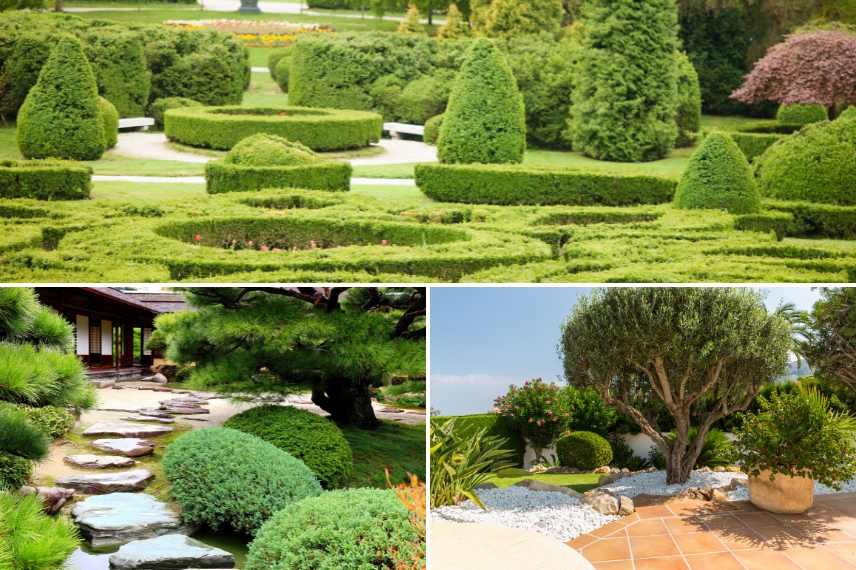 In these three garden styles, the risk of pollen allergy is reduced</caption]
Without necessarily adopting a specific style, you can also pick up ideas here and there to compose your own garden. Thus, whatever your space, you can easily install a pond populated with aquatic plants that have the ability to reproduce underwater. So no pollen to breathe in! In these ponds will be favoured aquatic plants such as the splendid Aquatic plants like the Water Lilies (Nymphaea), the papyrus…
Which plants should be grown in a hypoallergenic garden?
For building a non-allergenic garden, nature is well made and sufficiently rich. Indeed, there are many species of plants, bushes or trees that release little pollen — either because they are pollinated by insects, or because they are self-pollinating, or because they are sterile. Thus, be aware that double-flowered plant varieties produce little or no pollen, since the doubling is often due to the transformation of the stamens into petals, which affects pollen dispersal and hence fertility. Among the plants with the greatest number of double-flowering varieties, one can cite modern roses, camellias, carnations, peonies, and species in the Asteraceae family… You can therefore plant them in a hypoallergenic garden without any problems.
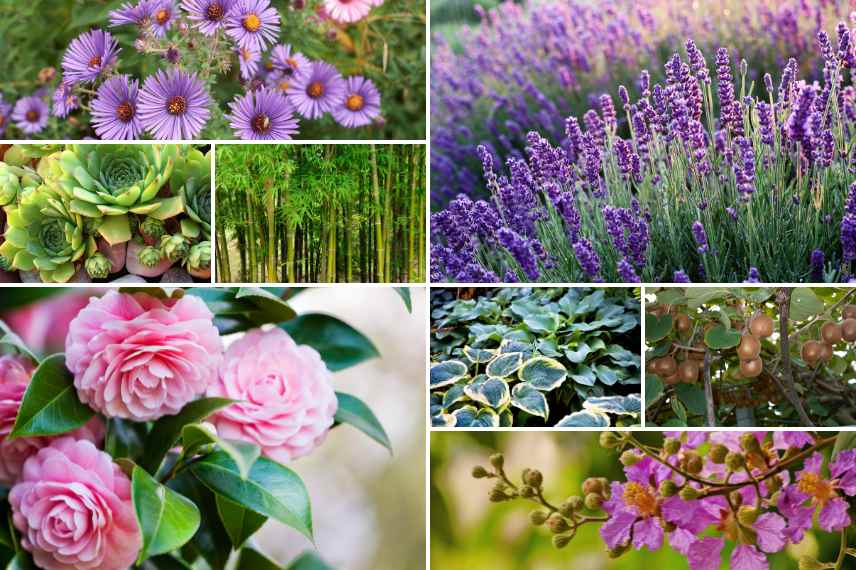
A small sample of plants to grow in a hypoallergenic garden
I offer you a whole selection of plants to prioritise in a healthy garden where you will be able to breathe easily:
- Entomophilous plants and shrubs are melliferous plants that attract insects to ensure pollination. And the list is impressive: ornamental allium, aster, chrysanthemum, centaurea, delphinium, echinacea, hellebore, iris, nepeta, muscari, Perovskia, poppy, Phlomis, shrub sage, broom, ranunculus, anemone, daisy, veronicas…
- Succulent or fleshy plants: sedum, sempervivum, delosperma, agave, yucca, cacti… which do not release pollen
- Ericaceous shrubs and plants, perfect for Japanese gardens: azaleas and rhododendrons, camellias, Japanese maples, gardenias, magnolias…
- Showy or highly scented flowering shrubs such as mock orange, lilac, crape myrtle…
- Bamboos running or clumping
- Non-allergenic grasses : 7 grasses for allergy sufferers
- Aromatic plants (sage, parsley, chives, mint, lavender, rosemary, Helichrysum, Santolina)
- Fruit-bearing shrubs and small fruits
- Climbing plants such as honeysuckle, Chinese wisteria, jasmine, Virginia creeper, jasmine…
- Plants with distinctive foliage : ferns, hostas…
Or simply female bushes or trees among the dioecious species since they do not produce pollen (kiwi, holly, Ginkgo biloba, yew, willow…)
- Subscribe!
- Contents
Comments