


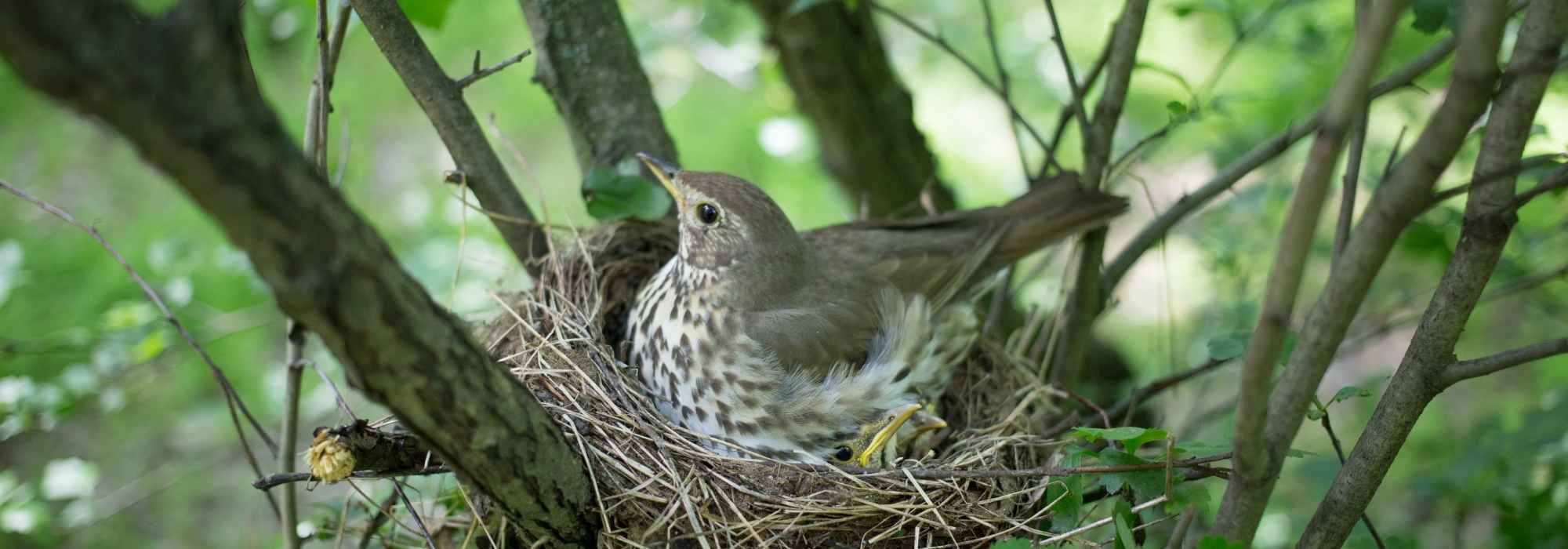
Protecting Bird Nests from Garden Predators
Create a haven for fledglings
Contents
How pleasant it is to offer a welcoming garden for wildlife, especially for birds: house sparrows and wrens, great tits and others, European robins, wren, dunnock, European greenfinch, tree sparrow, goldfinch… To achieve this, you will need to create a haven of peace by banning pesticidal products, planting a variety of plants (trees, bushes, perennials…), and providing water points… And the garden birds will come on their own.
But to help them, you might also consider placing birdhouses that are species-specific (for a single species) or more generalist. The freestanding birdhouses are mainly designed for so-called cavity-nesting birds (houses with a cavity) for great tits or sparrows, for example; or semi-open houses for the grey wagtail, wren, or even the black redstart. These birdhouses serve two functions: to help certain bird species reproduce and a more educational function, as the birdhouse will allow you to observe the lives of these birds and learn more about them.
Unfortunately, life is fraught with pitfalls. Especially when you are a tiny chick. And installing a birdhouse without caution can ultimately lead to disaster. Let’s explore together all the mistakes to avoid and the little tips to protect the nests of birds.
→ Pssst! Don’t forget our article: How to encourage bird nesting in your garden?

What are the predators of nestlings and small birds in the garden?
Garden birds: tits, finches, greenfinches, blackbirds, thrushes, sparrows… are hunted and killed by a large number of predators. This is also true for chicks during the breeding season, which spans, depending on the regions, from mid-March to mid-September.
- The birds
Nocturnal raptors (mainly Eurasian Pygmy Owl – Glaucidium passerinum) and diurnal raptors (mainly Eurasian Sparrowhawk – Accipiter nisus) represent significant natural predation. Although the Sparrowhawk is not ultimately that effective: only 10% of its attacks on birds are successful. Among nocturnal raptors, it is really only the tiny Eurasian Pygmy Owl that hunts birds and chicks.
In some cases, woodpeckers and a few corvids, such as the Eurasian Magpie, may raid the eggs from bird nests. However, this is quite rare contrary to popular belief.
- Mammals
Some rodents (dormice), some mustelids (weasel, marten, and polecat), and even the Red Squirrel can take eggs from nests. This predation remains relatively anecdotal.
- The domestic cat
Even though it is often demonised to the extreme, it must be acknowledged that the cat represents a significant part of the predation of small birds and chicks. However, not all cats are skilled hunters, and not all are specialised in birds. But, when in doubt, let’s keep our furry friends indoors as much as possible during the bird nesting period.
- Humans
We move out of the realm of predation stricto sensu. Nevertheless, humans are often responsible for the destruction or abandonment of nests in gardens. Pruning and trimming hedges during the nesting period, loud noises and sudden movements without reason around the nests, or simply creating a “garden” that is completely contrary to the needs of wildlife (gravel garden, bare lawn without any other vegetation…). Fortunately, if you have come across this article, it means you are not part of this segment of the population.
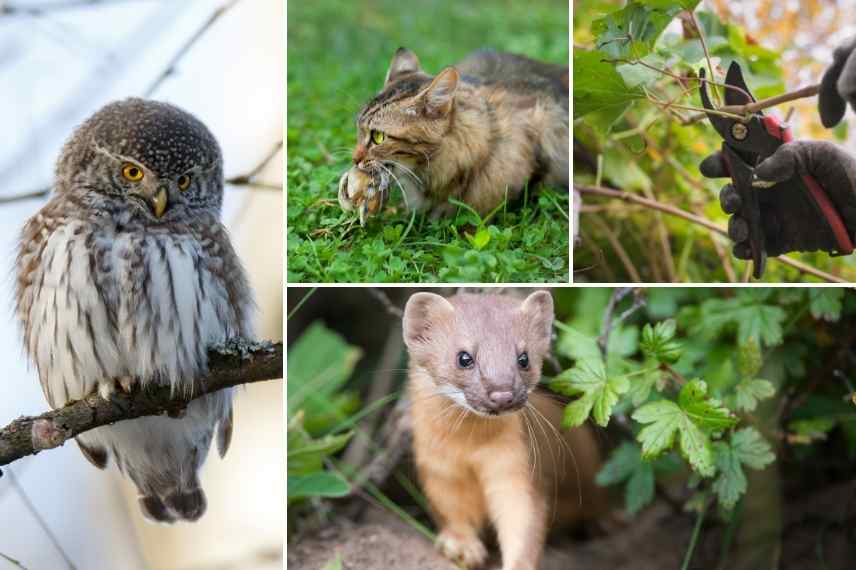 Eurasian Pygmy Owl, cat, polecat… but also human intrusion are dangers for birds and their brood.
Protecting the broods...
For “natural” nests, that is to say those built by birds, protection proves to be complicated. However, one can avoid excessive pruning of thorny bushes and remove a good portion of the lower branches of trees to prevent terrestrial predators from easily reaching the nests.
When it comes to installing birdhouses, it is easier to take action or at least avoid certain mistakes:
- Fix the birdhouses at a minimum height of 2 m;
- Remove the perch from the birdhouses: it serves no purpose for the birds and can facilitate a predator’s climb;
- A birdhouse roof made from a smooth surface (for example: zinc) and so-called balcony birdhouses reduce access for predators;
- Some mammals, such as the dormouse, gnaw at the access hole (in the case of birdhouses for cavity-nesting birds) to easily get through and eat the eggs or chicks. Installing a metal plate to protect the edges of the hole will prevent this;
- In the same vein, remove anything that would facilitate access to the birdhouse: branches under the birdhouse, fencing, piles of logs…;
- Do not place birdhouses near a window, balcony, ledge, or anything that a cat or other predator could climb onto to easily reach the nest;
- Cats do not like to walk on certain materials: chicken wire placed on the ground seems to work quite well to keep cats and mustelids away. Placing a pile of “prickly” branches at the base of the tree, using branches from hawthorn, blackthorn, dog rose… will prevent cats from attempting to climb (tested and approved by the author). Additionally, this pile of branches will provide protection for a whole range of wildlife, including some small birds (such as the wren, dunnock…);
- Some repellent scents can also be spread at the base of the birdhouses: peppermint, cayenne pepper…;
- To prevent access by cats and other terrestrial predators to the trunk on which the birdhouse is perched, there are commercially available solutions. These include: cat-repellent collars, spiked cat barriers, smooth protective sleeves… All of these should be placed on the trunk. They are as unsightly as they are unecological. Moreover, they cost money. It is better to find personal and more economical solutions.
Nota bene: forget overly intrusive solutions for cats such as ultrasonic devices, bell collars… Let’s avoid trying to save one animal at the expense of another.
→ Are you looking to create specific birdhouses tailored to certain bird species? You will find the plans you need at www.nichoirs.net
→ The LPO shop offers excellent birdhouses that are well-suited and ready to install.
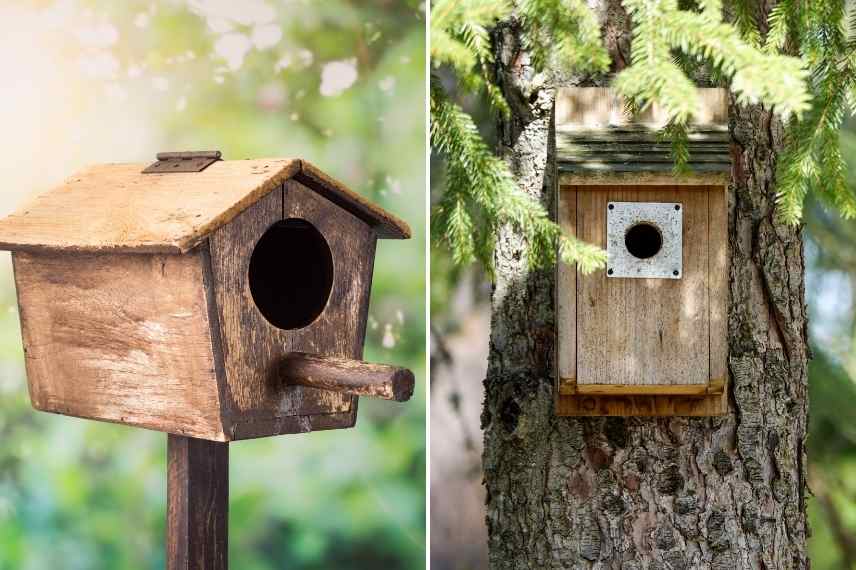 The perch serves no purpose… The high position in the tree, without easy access, is crucial.
But letting nature take its course is good too...
Predation when it is natural (birds of prey, mustelids, rodents…) is part of the balance of ecosystems. Therefore, even though it sometimes breaks our hearts, a sparrow hawk has every right to occasionally take a bird from the garden. It’s normal; it needs to feed itself and its young.
Moreover, predation helps regulate populations by removing the weak, the inexperienced, the sick… This natural selection creates stronger populations capable of reproducing effectively.
Natural selection is a concept that we struggle to grasp, as we humans try by all means to protect the weakest. However, in the study of Nature, it is always important not to fall into anthropomorphism.
- Subscribe!
- Contents
Comments