





























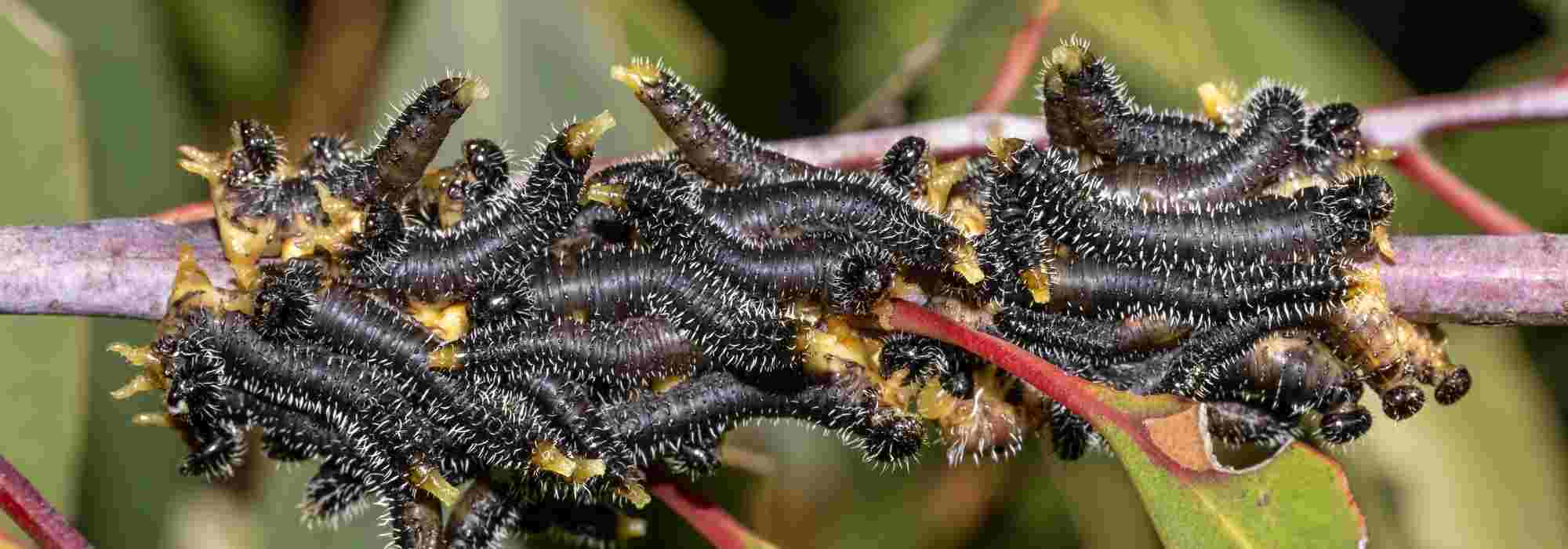
Sawflies: all you need to know about these false caterpillars
Get to know them better to protect your plants
Contents
There are many caterpillars that cause considerable damage in ornamental gardens, in orchards or in the vegetable plots. Pyralids, codling moths, pyrales, pine processionary caterpillars, noctuids… But can you imagine that, in addition to these larvae, offspring of the Lepidoptera, there are other insects that resemble caterpillars so closely that they are indistinguishable from them? I’ve named sawflies, commonly known as sawflies, which give rise to particularly voracious false caterpillars. Polyphagous larvae of sawflies feed on a wide range of plants.
Discover with us how to identify these insects, and understand the life cycles of the different sawfly species and their larvae, so as to better deal with them and get rid of them.

What is a sawfly?
Sawflies are hymenopterans, in the suborder Symphyta. The term “tenthrèdes” is a vernacular name that designates different species of flies. Since tenthrèdes are indeed flies that pose as wasps, albeit smaller in size! Indeed, their abdomen is entire, not petiolate. These flies are relatively inconspicuous, by their small size of around 1 cm, which allows them to pass unnoticed. Nevertheless, they display fairly bright colours, often yellow and black, or a fairly vivid green. They are found on several umbellifers which they like to forage on. It is fair to say that the adults are not much to fear.
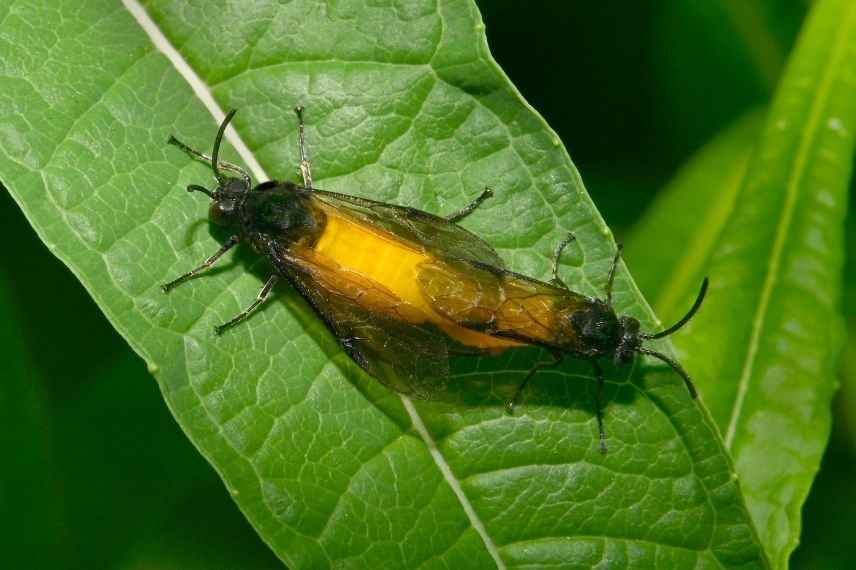
Gooseberry sawflies in full mating
By contrast, the larvae are more dangerous for our garden. If the adults resemble wasps, the larvae have the false appearance of Lepidoptera caterpillars. Even so, they are not caterpillars. These pseudo-caterpillars are indeed distinguished from real caterpillars by their two additional pairs of false legs, and their globular head punctuated by only one ocellus on each side (whereas caterpillars have several). Monochrome, these larvae display pale green, whitish or brownish colouring. Most have the ability to curl into an S shape when threatened, dropping to the ground. Sawfly larvae most often live in colonies.
To protect themselves from predators, these larvae deploy clever strategies: they spin webs, wrap the leaflets, fashion ‘cigars’ from leaves, or live in galls. Some mine the foliage.
What is the life cycle of sawflies?
To better tackle these pest caterpillars, it is essential to know their life cycle.
- Adults appear between April and June, depending on the climate.
- After mating, females lay eggs very quickly. They have the characteristic of possessing an ovipositor with saw-toothed valves, a kind of drill that allows them to incise plant tissue to insert their eggs. A female can lay up to 300 eggs.
- After a few days, the larvae hatch and feed directly on their host plant for 10 to 15 days. Very voracious, these false caterpillars grow very rapidly
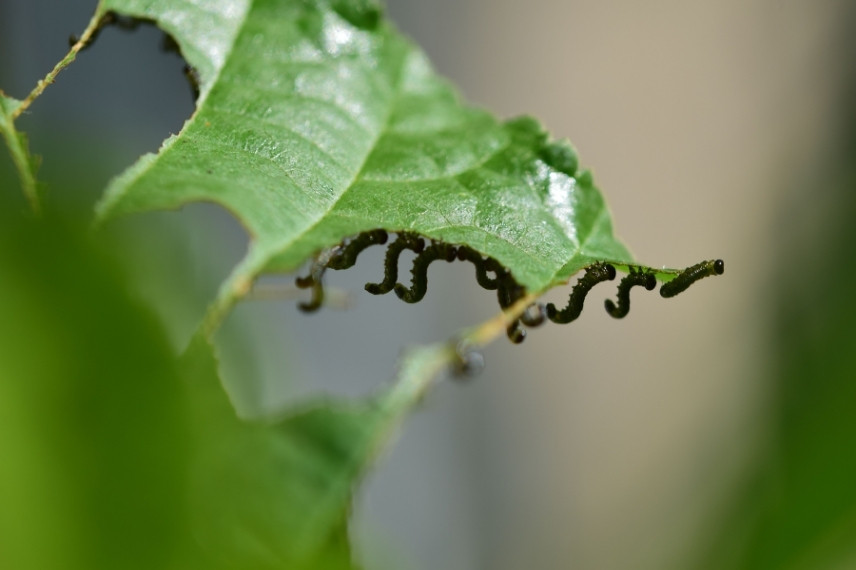
Sawflies adopt an S-shaped posture to deter predators
- Pupation occurs, either in a hard cocoon, slightly buried in the soil, or in a woody, tender shoot
- A second generation emerges between July and August, and the cycle begins again.
- A third generation may appear in early autumn.
- Then, the larvae hibernate in the soil as pupae for the whole winter.
Different species of sawflies and the damage they cause
Adults and sawfly larvae are found in a wide range of environments, from gardens to cultivated fields, from forests to hedgerows. They generally prefer cool, damp places.
Partial or complete defoliation
If the adults are harmless, merely nectaring or basking in the sun, the larvae are real destroyers. Moreover, oviposition is relatively abundant. The larvae, on or under the foliage, cut, bore into and devour it with precision, starting from the edge. They are all lined up, in sometimes unstable positions. They appear so ravenous that only the skeletons of the leaves sometimes remain. In this way these false caterpillars can be likened to lace-makers.
This defoliation, partial or total, considerably weakens the attacked plants which halt their growth and may die from time to time in cases of severe attack. By contrast, if the larvae are few in number, the damage is only cosmetic.
Sawflies specific to certain plants
There are fourteen sawfly families in total, twelve of which are represented in our area. They attack all types of plants, from fruit trees to trees, including herbaceous perennials, shrubs, roses, or vegetables such as Brassicaceae or crucifers (cabbage, turnip, radish, oilseed rape, mustard…)
-
- The rose sawfly (Arge pagana): the adult has a black head, thorax and legs, the abdomen yellow. The larvae have a pale green body punctuated with black spots and feed on young rose leaves. Eggs are laid in two parallel lines in a young shoot
- The currant sawfly (Nematus ribesii): the female is black and yellow, the male black, and the larvae green-yellow with black tuberculate points. They bore into and devour the leaves
- The birch sawfly (Craesus septentrionalis): the larvae, pale white to pale green, dotted with black points, also feed on the leaves of alder, ash, hazel, hornbeam, poplar, maple…
- The slug sawfly (Caliroa cerasi): the larvae are black, resembling small slimy slugs. They have a predilection for the leaves of cherry, pear and plum trees
- The rape sawfly (Athalia rosae): the adults are orange, the larvae dark brown. They develop on oilseed rape, beet, mustard…
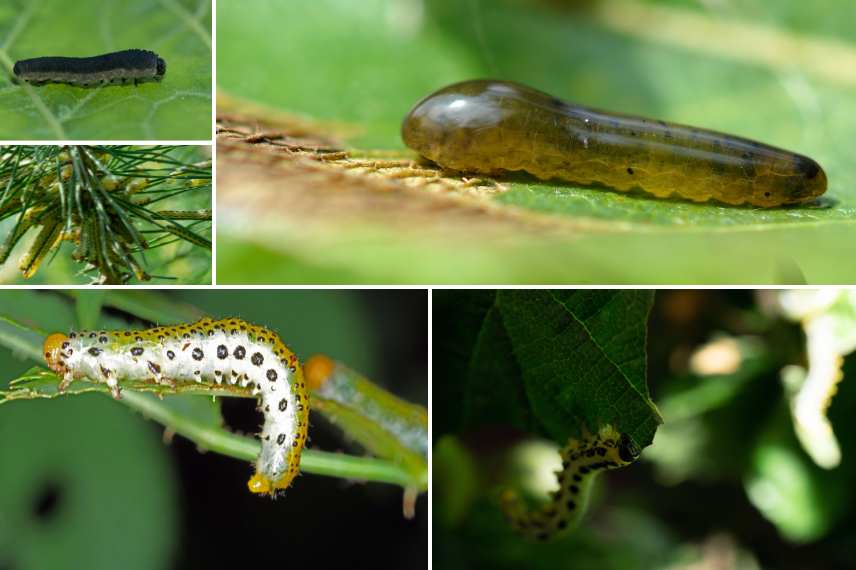
Different species of sawfly larvae
- Hoplocampa spp.: they attack fruit trees (pears and apples) in particular
- The woolly sawfly (Eriocampa ovata): adults are black, with a hint of red; the larvae are white. They favour the leaves of white alder (white alder) and glutinous alder (glutinous alder), as well as elm (elm) and hazel (hazel)
- The pine sawfly (Diprion pini): adults are black, sprinkled with orange-yellow; the larvae are pale cream-coloured and covered with black hairs. They feed on the needles of various pine varieties
- The brown sawfly (Neodipirion sertifer): this is also a major pest of the needles of the Scots pine (Pinus sylvestris) and the Japanese parasol pine (Pinus densiflora)
This list is not exhaustive!
How can I get rid of sawfly larvae?
If adult sawflies and their eggs are hard to detect, the larvae are easier to spot. Already by their numbers, but also by their ability to curl into an S-shape to frighten predators. Rest assured, these false caterpillars are not at all urticating, as can be the case with the pine processionary caterpillars.
To get rid of them, several methods can be employed. Starting with a simple manual picking of the larvae from accessible plants. Then simply drown them in a solution of soapy water. You may need to repeat the operation several times. In parallel, do not hesitate to remove shoots whose leaves have been eaten by the larvae.
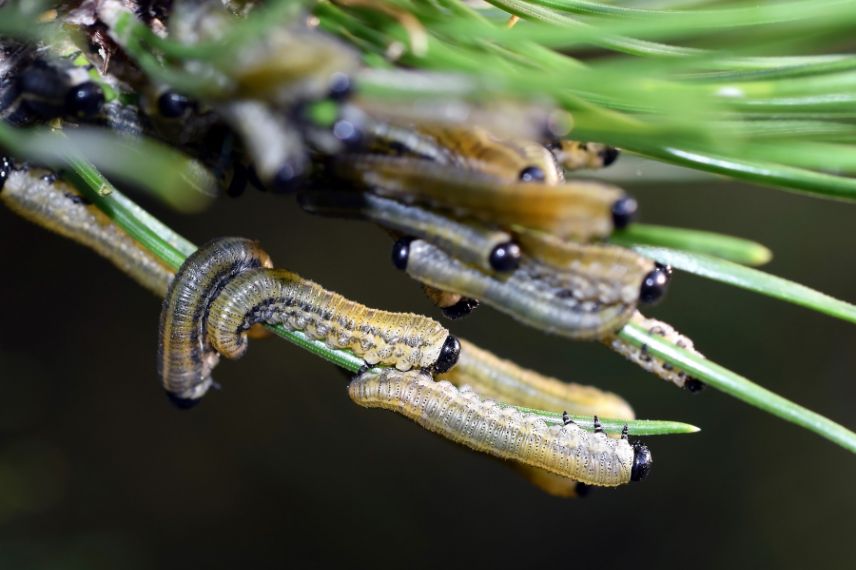
When the plants are accessible, manual picking of the larvae is possible, as they are not urticating
You can also rely on the beneficial insects of all kinds that thrive in your garden. Thus, sawflies can be naturally regulated by small wasps that parasitise the larvae. Similarly, garden birds will hardly distinguish between a genuine caterpillar and the sawfly larvae. The insectivorous birds will relish them, especially during the nesting season, where the nestlings are hungry. Shrews are also formidable predators of the larvae when they fall to the ground to pupate. To encourage the presence of this beneficial fauna, increase the number of feeders and nest boxes, or leave a few piles of wood in the four corners of the garden.
To be proactive, we also advise you to hoe the soil at the base of trees, shrubs, roses and perennials that may have been infested, to expose the pupae. They will be destroyed by the cold, eaten by birds or by your chickens if you have any.
If the infestation is really severe, treatment may be considered. Bacillus thuringiensis (Bt) is ineffective, as these larvae are not caterpillars. By contrast, the pyrethrum is effective, as is a simple solution based on black soap. These treatments, however natural they may be, should be used sparingly, as they are not very selective.
- Subscribe!
- Contents
Comments