


Scillas: the most beautiful varieties
Many species with a range of attractions
Contents
Scillas or Scilla are small perennial bulbs, among the first to bloom in spring. Many species colonise our woodlands in France and are marketed to form pretty carpets in our gardens. Hardy and vigorous, they are most often grown in partial shade, in well-drained soil. Most offer lovely deep blue flowers, in bells or star-shaped, elegant and graceful. There are also pretty forms with white or pink flowers.
Discover our selection of a few beautiful Scilla varieties, and enchant your garden with their wild beauty.
→ Also read our complete guide Scilla: planting, growing and care.

Scilla mischtschenkoana 'Tubergeniana'
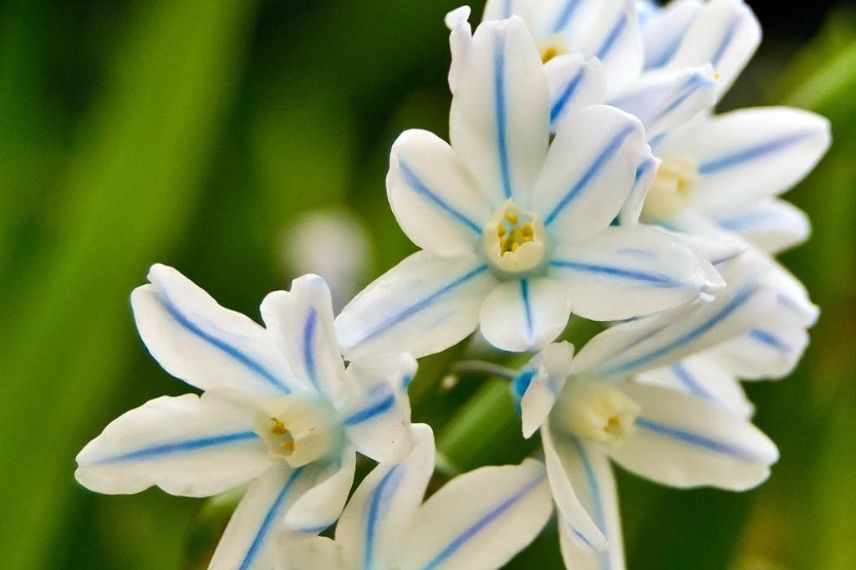
A true little jewel, the Scilla mischtschenkoana ‘Tubergeniana’ offers flowers with an iridescent texture, in a pale blue to white shade, variable. These flowers, 2 cm in diameter, are crossed by a central stripe of a deeper blue. They appear at the same time as the young foliage, very early in the season, as early as February or March, carried in clusters of 2 to 5 campanulate flowers, on top of a flowering stem, about 15 cm above the soil. Little known, this Scilla, awarded the Royal Horticultural Society’s Award of Garden Merit, deserves to be grown as it is so pretty. It originates from the southern Caucasus, southern Russia and northern Iran, accustomed to cold winters and dry summers. Its strap-like foliage is thick and narrow and rises 10-15 cm above the soil. It disappears in summer when the plant enters dormancy. This Scilla propagates via bulblets, as well as by sowing. It is easy to grow in sun in any well-drained soil, even dry in summer, and naturalises easily.
The flowering of the Scilla mischtschenkoana ‘Tubergeniana’ occurs between snowdrops and Siberian squills. Plant it in a sunny rock garden to admire it. Other small, delicate bulbous plants, such as Iris reticulata, botanical tulips, spring crocuses or the Ornithogalums are companions of similar height.
Read also
Scilla: planting and careScilla mischtschenkoana 'Tubergeniana'
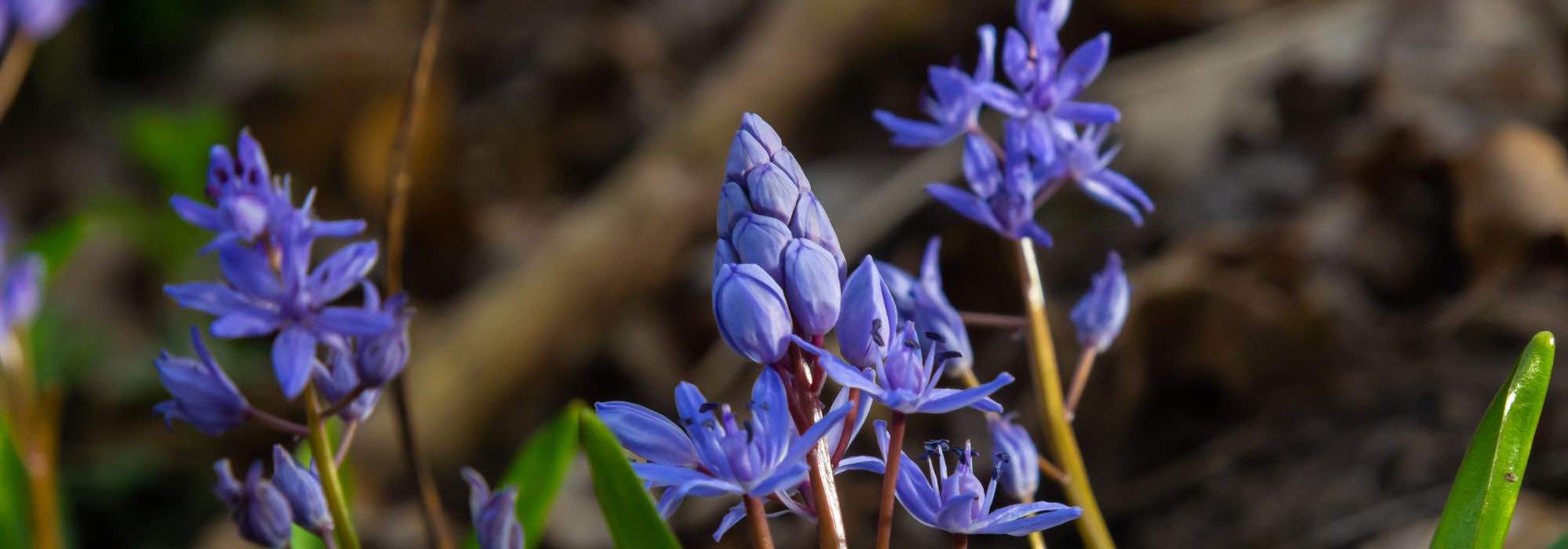
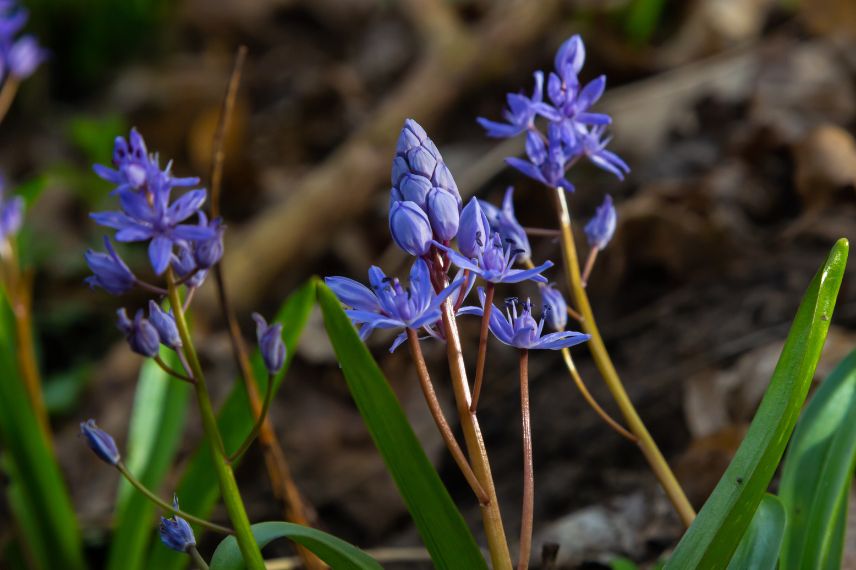
The Scilla bifolia, seldom cultivated in our gardens, grows naturally in France in light forests, in cool, damp areas up to 1,500 m altitude. It occurs spontaneously in central and eastern France. It is a hardy species, native to central and southern Europe as well as Turkey. It derives its name from typically having two leaves, more rarely three. Its flowering takes place in March and April, at the same time as the foliage appears, in clusters of 3 to 10 star-shaped flowers, 2 to 4 cm in diameter, in a deep blue colour. The very slender flowering stem, about 20 cm tall, is red or brown in colour. The foliage withers a few weeks after flowering, in early summer, while the bulb enters dormancy.
It is a hardy perennial that naturalises, never becoming invasive, in the cool, moist understorey of deciduous trees or shrubs, before they leaf out. Pair it with other hardy perennials that thrive in the same conditions, such as hellebores, Tiarella, primroses.
The Scilla bifolia ‘Rosea’ is a form with soft pink flowers.
Scilla siberica
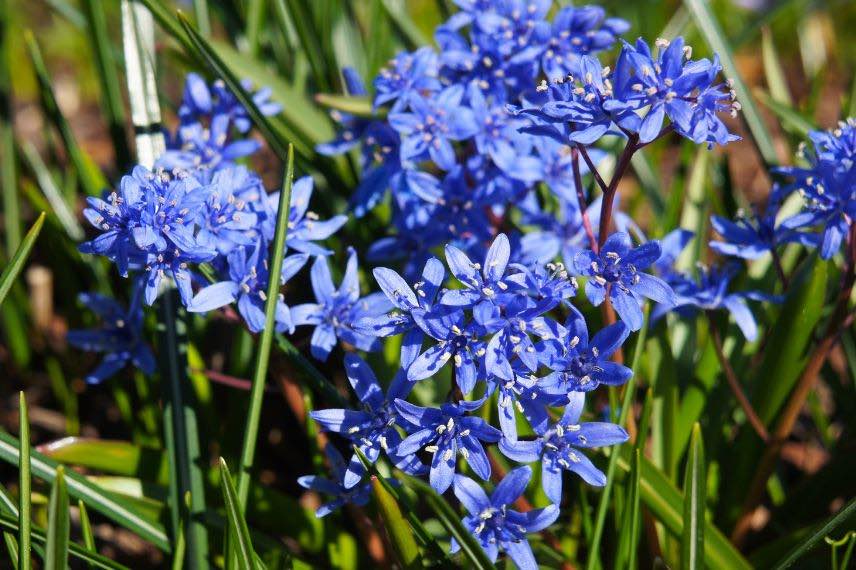
The Scilla siberica or Siberian squill closely follows the flowering of the Scilla mischtschenkoana ‘Tubergeniana’. Its pretty 1.5 cm-diameter flowers, borne in pendant bells, in an extremely vivid blue, deserve to naturalise in the garden. The flowering stems of 12 to 15 cm tall bear small clusters of four to five flowers featuring six tepals in a pure blue, veined with a deeper blue. The Siberian squill, contrary to what its name might suggest, originates from the southwest of European Russia (Belarus, Ukraine, Moldova, Crimea), the Caucasus and Turkey. Its natural habitat consists of damp meadows and deciduous woodlands that let winter sun through. It is very hardy. Reaching about 15 cm, it emerges from dark green, strap-shaped basal foliage.
Easy to grow, provided it is not in arid climates or exposed positions, it naturalises easily in the garden, in naturalistic areas, alongside the small botanical tulips, Muscari, and Chionodoxa which take over, they can be planted in a lawn left unmown until summer, when the plant goes into dormancy.
Discover also its white form: Scilla siberica ‘Alba’.
Scilla nutans or Hyacinthoides non-scripta
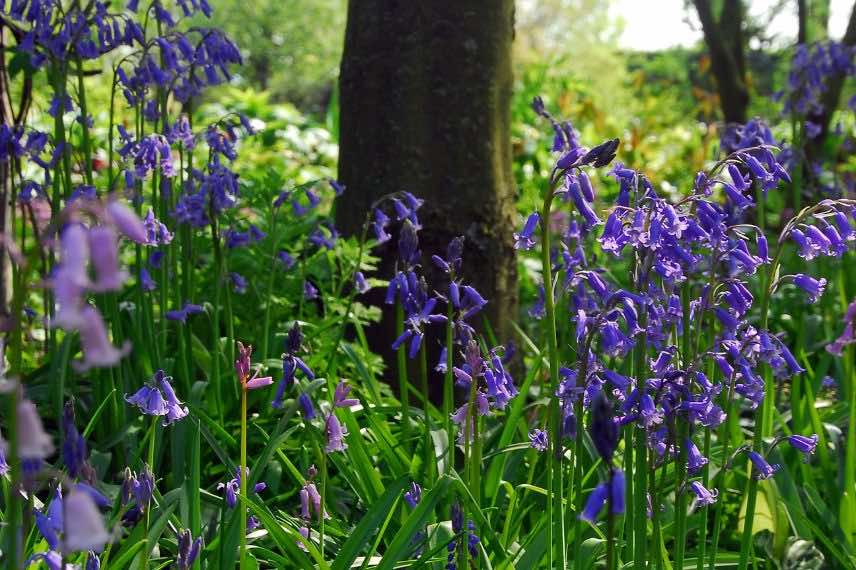
Best known as the wood hyacinth or wild hyacinth, Scilla nutans or Hyacinthoides non-scripta, is admired in spring during country walks, where it grows in large colonies in our cool woodland floors. It forms extraordinary low blue carpets, impressive in their extent. In the garden, under similar conditions, it is a low-maintenance plant, full of charm. Its bulbs multiply on their own and gradually spread, until it occupies large areas. It is found in western France, north of a line running from Bordeaux to Dijon to Reims. It is a protected species in most of western Europe. Higher than its cousins, Scilla nutans develops in spring a tuft of slender basal leaves, from which a flowering stem rises in April–May, 30 to 40 cm tall. Its pendant flowers have the form of a tube that flares into six curled lobes, blue-mauve in colour. They are arranged in groups of five to twelve, all on the same side.
A plant for light shade and open woodland, it prefers deep, humus-rich soils with a tendency to be slightly acidic. It can be planted in mass plantings along borders or beneath trees that let light filter through. Its natural companions are the wild narcissus, Narcissus pseudonarcissus, as well as Bear’s garlic or Anemone nemorosa.
Discover its white form: Scilla nutans ‘Alba’
Scilla peruviana
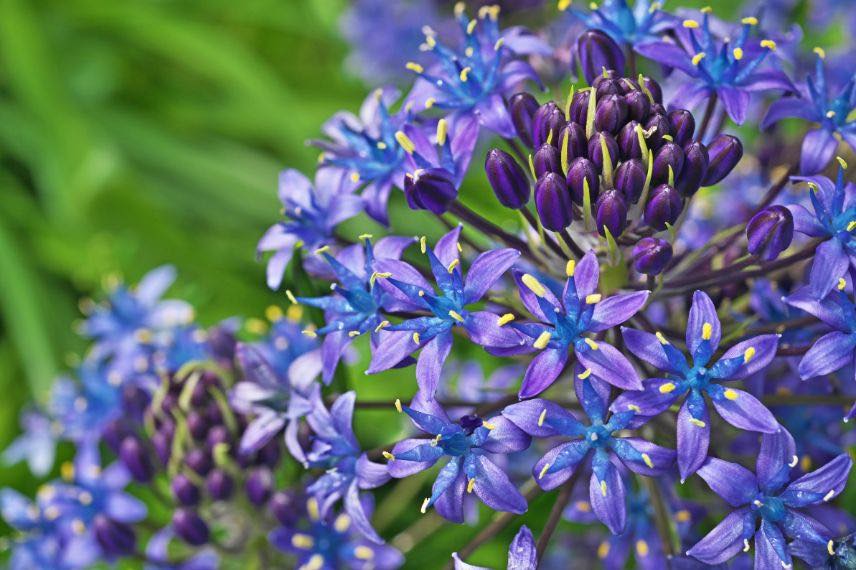
Quite unlike the Peruvian Scilla, Peruvian Scilla, Scilla peruviana or Oncostema peruviana, offers a larger and more spectacular flower. In April or May, each rosette of leaves produces a very large inflorescence up to 40 cm tall in the shape of a broad flattened cone, very dense, composed of a multitude of tiny star-shaped flowers in an intense blue-violet. The basal rosette of lanceolate leaves develops in autumn and winter and disappears after flowering. Another one whose name does not hint at its origin, this one is native to the Mediterranean rim: Portugal, Italy, Spain and North Africa, where it grows in meadows, damp rocky areas and coastal regions of these countries. It grows readily in a Mediterranean climate provided the soil is not too dry. It can also be cultivated further north, if the exposure is very sunny. Fairly frost-tender, hardy to around -10°C, in that case you provide a very well-drained soil and make sure to mulch well around the crown for the winter.
This Scilla lends itself well to pot culture, border edging and rock gardens, in the middle of thyme, lavender and rosemary, with Iris unguicularis or Algerian Iris whose flowering is earlier.
Urginea maritima
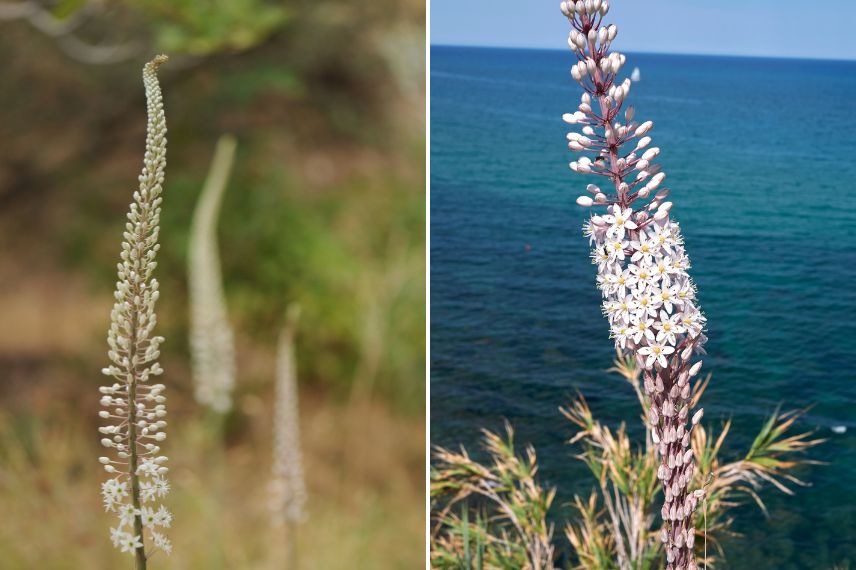
Finally, we present a rare plant for collectors, the Urginea maritima or Drimia maritima, also known as sea squill or maritime squill. This bulbous perennial flowers in late summer in the form of elongated spikes, measuring 15 to 35 cm long. These spikes are composed of a multitude of small star-shaped flowers, white with green striations on the outside and pinkish-brown on the inside. Before opening, the flower buds are pale greenish-purple. The flowering is fragrant and melliferous. The plant is leafless during flowering (nudiflory) – i.e., the flowers appear without foliage. The bulb measures up to 20 cm in diameter and weighs up to 2 kg; plant it so that it sits at soil level. The narrow, thick leaves, bright green in colour, measure from 30 cm to 1 m in length. They are erect and slightly undulating. The long central flowering stem reaches up to 1.2 m in height. It is therefore a bulb with many attractions, possessing an original and distinctive character.
Urginea maritima is a moderately hardy species, tolerating around -12° C, native to the Mediterranean. It is protected in France, where it occurs in the Alpes-Maritimes. It is a toxic plant; handle with gloves and do not ingest. It tolerates drought and sea spray and is grown in sandy or stony, very well-drained soil. It prefers calcareous soils and somewhat cool soils. It can be planted on a sunny slope or a dry rockery, or at the back of a small border, with grasses for a wild garden. The large bulb can also be planted on its own in a large pot, since it does not need to be buried deeply, and in that case the plant can be overwintered in cold or wet regions.
- Subscribe!
- Contents
Comments