





























Small gardens: how to make them look bigger?
Our tips for creating visual effects that make a space look bigger
Contents
What if your garden could easily look bigger? Thoughtful layouts, clever choices and a few optical illusions help transform a compact space into a tranquil retreat that feels more spacious.
Discover our tips to give your small garden the illusion of a larger space.

Divide the garden into distinct zones
By dividing a small garden into distinct zones and breaking up the lines, you can easily create a sense of space.
To do this, mark out 2 or 3 zones, such as a dining area, a reading and relaxation area, a children’s corner, or a vegetable plot. This allows you to create different ambiences, break up monotony and give the impression that there is more space than there actually is. To ensure a harmonious result, however, keep a unifying thread between these spaces: a colour, materials, plants, etc.
To delineate these spaces, use plants (for example, by creating low hedges), outdoor screens or trellises that are not fully opaque, to let light through and keep the view unobstructed.
Think about creating paths to connect these spaces easily. There’s no need to create paths that are too wide: winding routes between planting beds can be perfectly adequate and will slow the visitor’s pace, giving the impression of a larger garden. We advise against lawn in a small garden. It marks out the space too bluntly and, above all, is space that could be put to better use. Moreover, if it is walked on too much, it quickly becomes unsightly, giving the garden a neglected appearance. Prefer lawn alternatives such as some groundcover plants (to be chosen according to your growing conditions), lattice panels, a few paving slabs, etc.
Don’t hesitate to draw up a plan in advance to better visualise these spaces and know where to start.
Read also
Designing a small gardenMaximise space by playing with heights and perspectives
To add volume and a sense of space in a small garden, don’t settle for horizontal layouts alone. Also think about using vertical space, whether with decorations, plants or raised features.
Climbers to guide along a wall or trellis will be perfect for this purpose and will bring vitality to the garden: passionflower, ivy, wisteria, climbing rose, etc. You can also create raised beds and hanging planters. Also think about plants that will readily add verticality, such as the clumping bamboos, the grasses (giant Stipa, Miscanthus…), sunflowers, giant perennials like the Buenos Aires verbena, Acanthus, Delphiniums, the foxgloves, the hollyhocks, the Ligularias or the Virginia veronicastrums. There are varieties to suit every taste and garden style, whether rustic, romantic or contemporary.
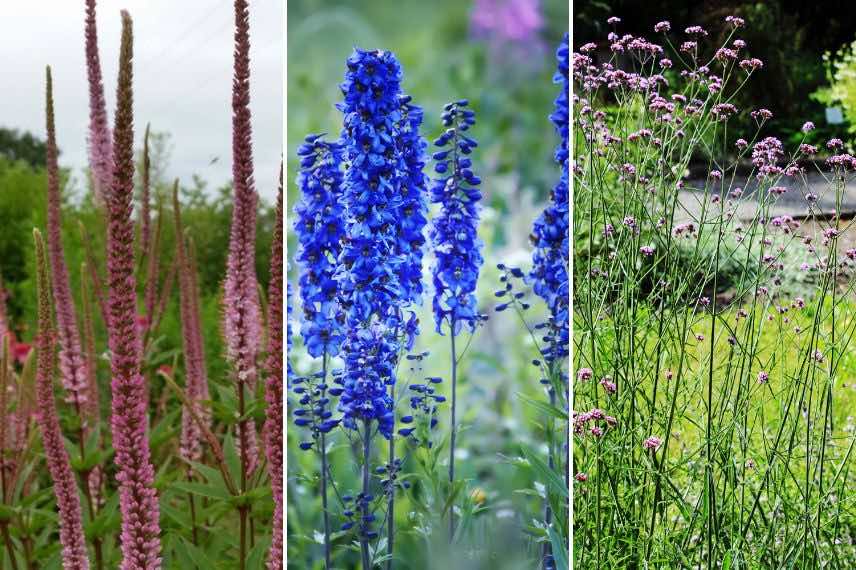
In a small garden, plant light, tall vertical perennials to add dynamism and lift the eye
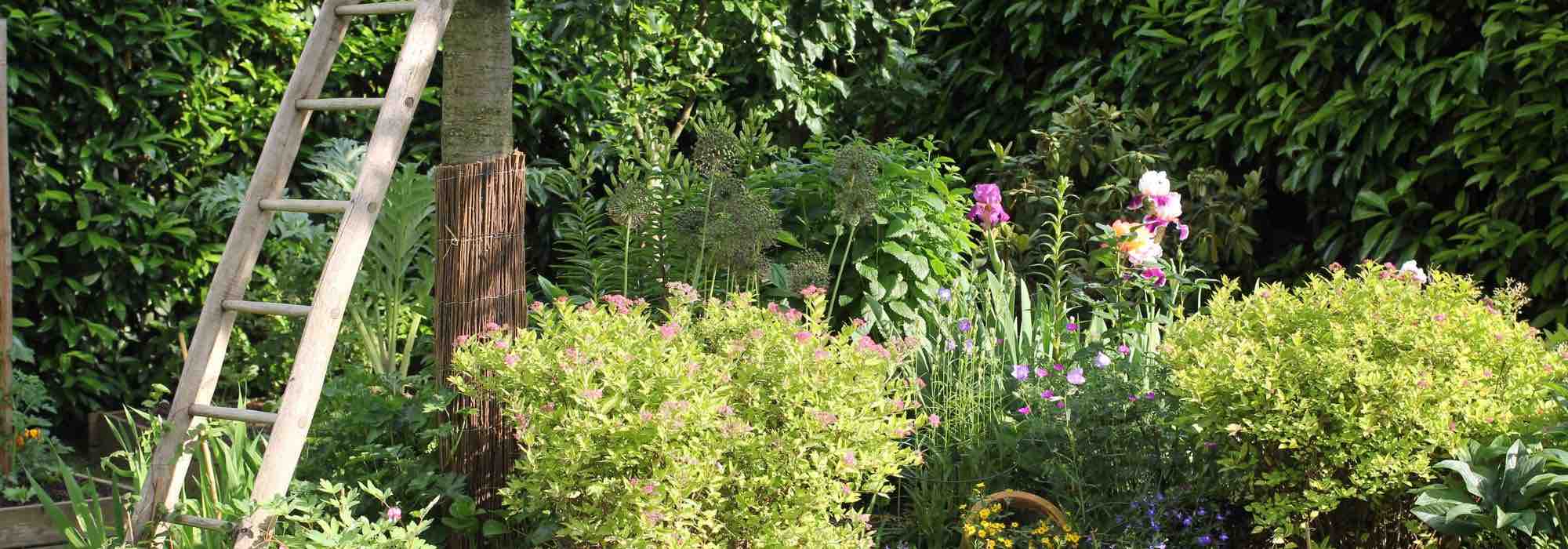
Shade sails, lanterns, garlands, a swing, a decorative ladder… All these finishing touches will help to make use of the vertical space in the garden and contribute to it looking larger. Of course, installing a pergola will also help to create height and to enhance the sense of space.
If you can, create landings or steps in the garden, which will again give an impression of volume and grandeur by adding an extra level.
Also think about playing with volumes by incorporating several plant strata: groundcovers and bulbs at the front, medium-sized and bushy plants in the middle, then larger plants such as shrubs at the back. Take inspiration from nature, where plants do not grow neatly side by side.
In terms of perspective, you can place a characterful feature at the end of a path (a statue, a fountain, a coloured container, a plant with graphic and/or coloured foliage), which will create a focal point and draw the eye into the distance, giving a sense of depth.
Remove garden boundaries
Another landscaping technique used by a gardener to enlarge a garden is to blur its boundaries and property lines. The eye no longer stops at walls or fences, creating rough screens and a greater sense of oppression, but wanders, for example, into the vegetation or the more airy materials.
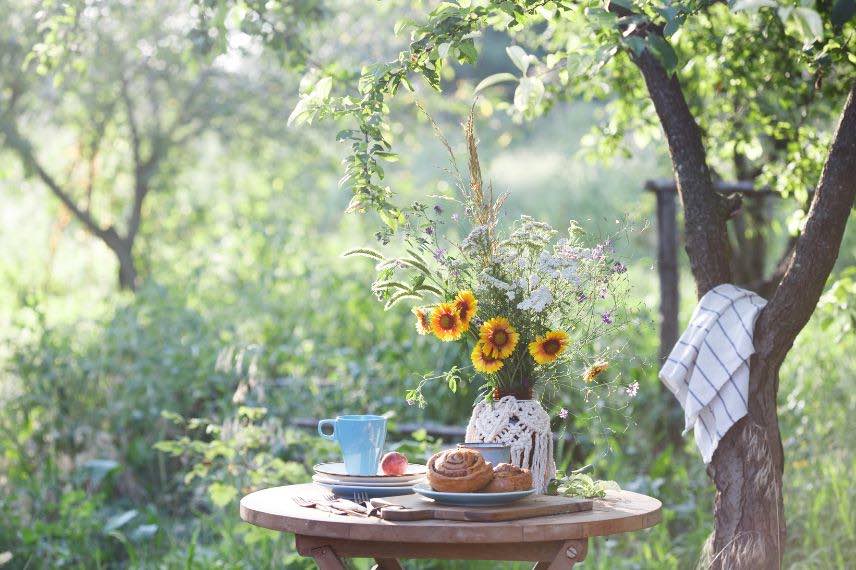
Letting the eye wander beyond the garden boundaries is always a good idea when possible
Read also
Designing a city gardenChoose the right furniture
In a small garden, space is at a premium, and a minimalist approach can readily take precedence. The ideal, therefore, is to opt for multifunctional arrangements, capable of performing several roles: a storage tub that doubles as a bench, a removable floor that reveals a sandbox or a small pool, etc.
Also consider wheeled, folding or stackable furniture, which can be moved easily to rearrange the whole setup and adapt, for example when you have guests. The aim is to enjoy all the comforts needed for a pleasant and comfortable garden, while enabling smooth circulation.
Note that light colours have the advantage of letting the eye breathe, and thus to give the impression of a larger space. Conversely, avoid dark colours, which tend instead to give a sense of narrowing.
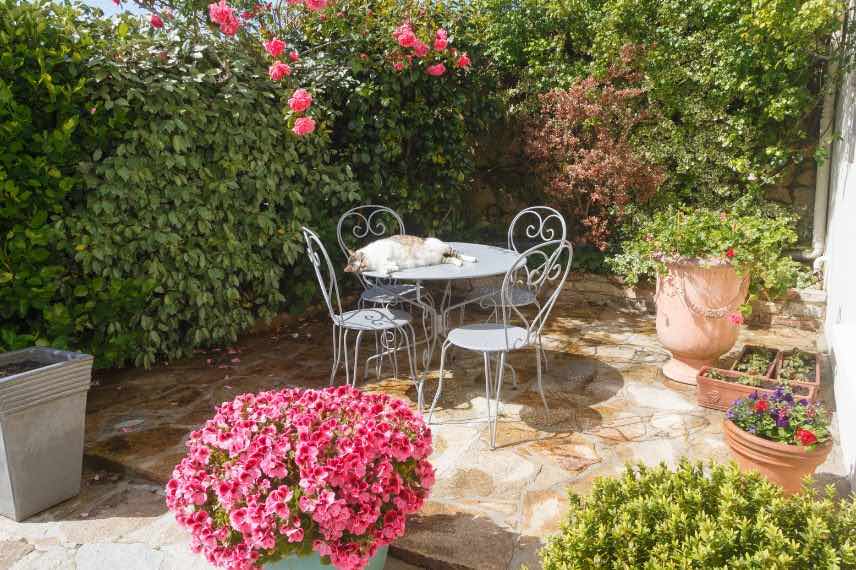
Choose light, visually lightweight furniture, or folding or multifunctional pieces
Play with reflections and lights to visually enlarge the space
By strategically placing one or two mirrors in your small garden, you will create a sense of depth that visually enlarges the space. They will indeed help reflect light and the surrounding elements more effectively. Install them at the end of a perspective or facing a window to create an optical illusion. Be sure to check which elements are reflected in the mirror for an aesthetically pleasing result.
You can also use water to create movement, reflections and plays of light: a small fountain or a shallow pond will be ideal for this purpose.
The care given to lighting also helps to enlarge the space. Avoid harsh spots and bright lights, which will create a reduced focal point. Prefer soft, diffused lighting, garlands that draw the eye far away, and gentle lighting that suggests the space continues beyond… Again, play with heights by pairing ground-level lamps with lampposts or lanterns hung in the foliage, for example.
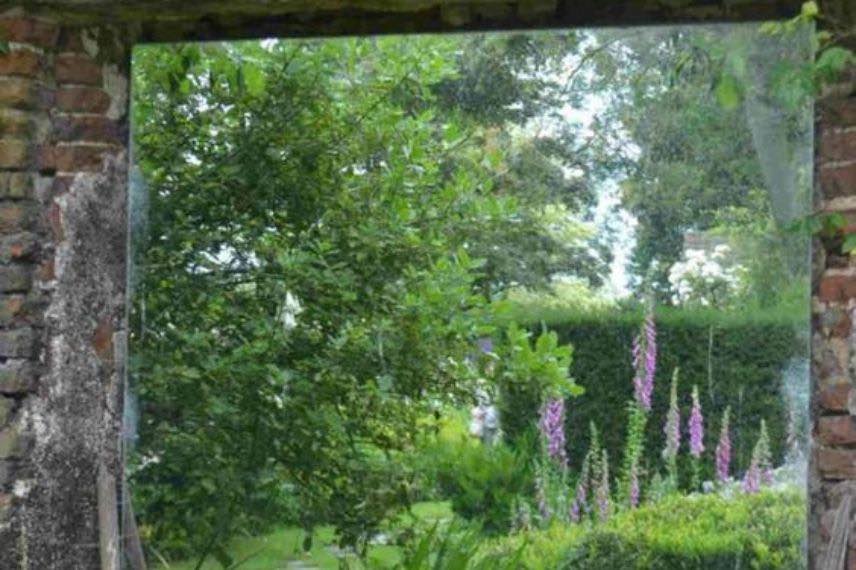
Installing a mirror is a very effective visual trick
- Subscribe!
- Contents
Comments