
























Standard tree, half-standard tree, coppice shoots: what are they?
Decoding plant jargon to choose the ideal tree for your garden
Contents
Choosing a fruit tree or ornamental for your garden can quickly become a complicated affair with all the horticultural terms along the way. Between the jargon of half-standard, standard and coppice shoots… You’d almost think you’re in a plant-themed quiz show! No need to panic, we’re here to translate this “botany” into something digestible, without leaving you baffled! In this article, we’ll clarify all this jargon to help you easily understand the different tree forms available in nurseries. This will help you choose the tree that’s right for you, whether your garden is small or large, and learn the conditions in which these trees thrive best.

Why is it important to know the different types of stems?
Each type of tree — coppiced, standard or half-standard — has a different form, with its own characteristics and advantages, whether in terms of shade, fruit harvesting or even resistance to the elements. It is therefore crucial to know these distinctions. Taking the time to understand these different forms can help you choose a tree according to the size of your garden and your needs. Whether you are looking to create a shaded area, a windbreak, establish an orchard or simply add an aesthetic touch to your garden, ignoring these classifications could lead to a less suitable choice, such as a tree that is too large for a confined space or one poorly adapted to your local climate.
What is a half-standard tree?
A half-standard tree has a trunk usually measuring between 1 metre and 1.40 metres in height before the first branches appear. This intermediate size makes it more accessible for fruit harvest and general maintenance, while allowing good exposure to light and air.
In the case of ornamental trees, the half-standard form highlights the flowering or the tree’s foliage while making maintenance easier.
Half-standard trees are often used in moderately sized gardens.
Advantages:
- Makes fruit picking easier without the need for a ladder.
- Maintenance is easier thanks to its dimensions.
- Provides a good amount of shade without taking up too much space.
- Suitable for creating rows or mid-height hedges.
Optimal conditions:
- Moderately sized gardens.
- Spaces that require both shade and sunlight for other plants.
- Areas with well-drained soil and sufficient sunlight.
With a half-standard tree, you can easily create a welcoming garden without having to sacrifice too much space. Its intermediate size makes it a preferred option for those looking to maximise the functionality of their green space.
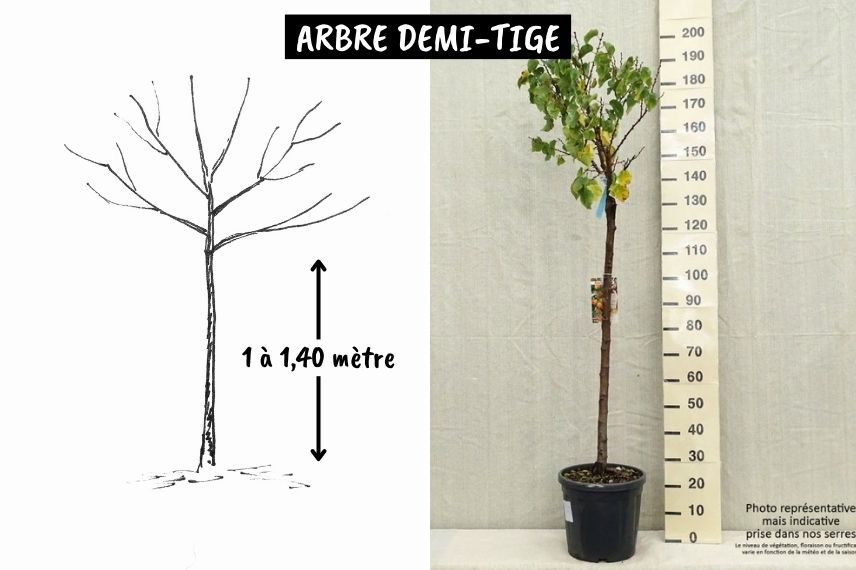
Half standard tree – Sketch © Gwenaëlle David
What is a standard tree?
A standard-trained tree has a trunk whose height generally ranges between 1.5 and 1.8 metres before the first branches or the branches begin to develop. This type of tree is very versatile, adapting to gardens of different sizes while offering some unique advantages.
Advantages:
- Versatile and suited to various garden sizes, from medium to large.
- Practical trunk height for picking fruit. A ladder or a fruit-picking pole may be necessary for harvesting at height.
- Space under the tree allowing other plantings or gardening activities.
Optimal conditions:
- Medium- to large-sized gardens, where a compromise is sought between height and soil space.
- Areas requiring some shade without monopolising soil space.
- Well-drained sites with moderate to full sun exposure.
The standard-trained tree offers an excellent option for those seeking a balance between visual impact and functionality. It is often chosen for landscaping projects that require both height and soil space for other plants or activities. It combines the advantages of several other tree types, making it a very sensible choice for various gardening needs.
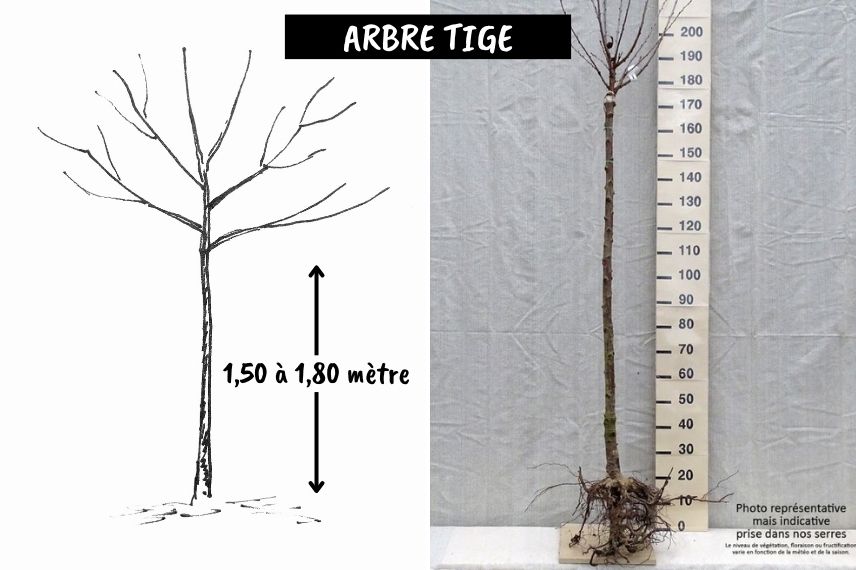
Standard tree – Sketch © Gwenaëlle David
Read also
10 good reasons to plant a treeWhat is a high-stem tree?
A high-stem tree is characterised by a longer trunk, generally from 2 metres, before the first branches appear. These trees are often used for specific purposes and in larger spaces.
Advantages:
- Ideal for creating effective windbreaks thanks to their height.
- Provides more extensive shade, perfect for large gardens.
- Adds a majestic, imposing element to landscape design.
Optimal conditions:
- Large gardens and open spaces.
- Areas where a windbreak is required.
- Well-drained ground with adequate sunlight exposure.
The high-stem tree is usually the preferred choice for larger-scale landscaping projects or for gardens that can accommodate more substantial specimens. It meets specific needs and provides a striking presence in any green space.
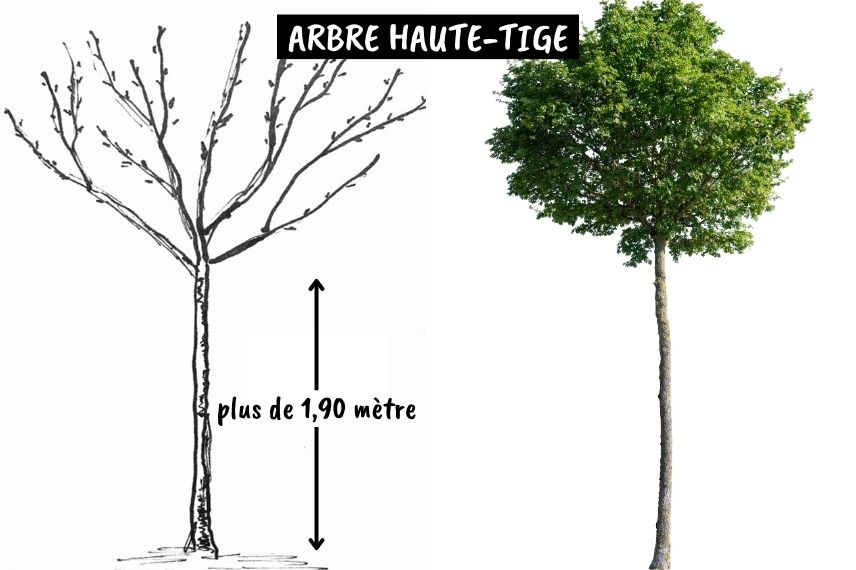
High stem tree – Sketch © Gwenaëlle David
What is a coppiced tree?
Unlike previous forms, a coppiced tree does not have a single trunk, but several trunks that emerge from the base. This characteristic gives it a bushier, less formal appearance.
Advantages:
- Offers a unique aesthetic effect, ideal for contemporary or rustic gardens.
- Can serve as an effective windbreak due to the density of the stems.
- Easy to maintain and often more disease-resistant.
Optimal conditions:
- Gardens of all sizes, particularly those seeking a more natural atmosphere.
- Areas requiring a screen of greenery or a degree of privacy.
- Well-drained soil, with moderate to full sun exposure.
The coppiced tree offers a more relaxed approach to landscaping and can be an excellent option if you are looking to create a natural, welcoming space.
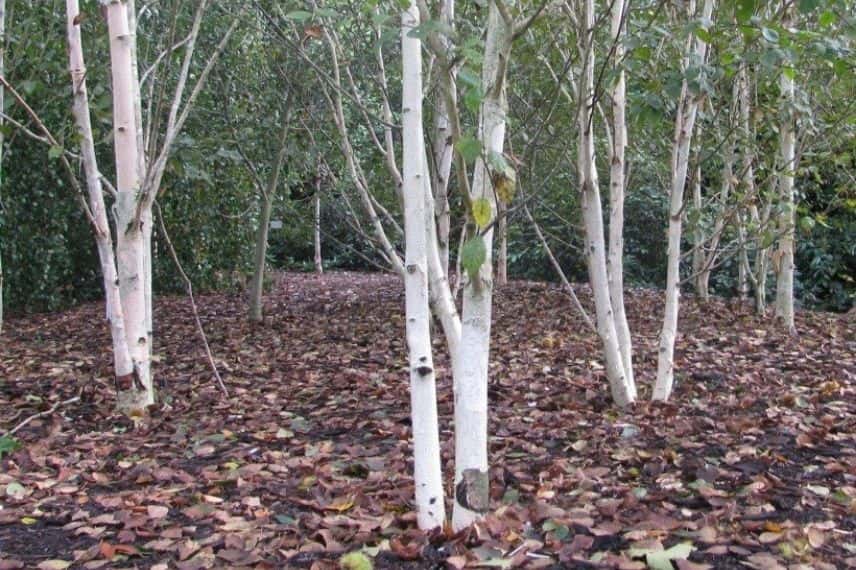
Coppiced trees
Other tree forms
In addition to the half-stem, stem, high-stem and coppice shoots forms, there are several other options that might better suit your garden or specific needs:
Low stem
A low-stem tree is pruned so that its trunk is shorter (between 70 cm and 1.10 m), with branches that start quite low. This form is particularly suitable for smaller gardens and for container growing. It is often chosen for fruit trees such as apple and pear trees. They are commonly referred to as ‘dwarf’ trees or fruit trees.
Scion
A scion tree is a young tree that has not yet been pruned to adopt a particular shape. It is often less expensive and offers more flexibility for future pruning. Choosing a scion tree can be ideal if you want to fully customise the shape of your future fruit trees.
Goblet
The goblet tree, also called “cup pruning” or “bushy form”, is commonly used for fruit trees. Its structure makes fruit picking easier and is ideal for more confined spaces. Choosing this form can be particularly wise if you have limited space or want to make fruit picking easier.
Palmette
The palmette is a form of fruit tree pruned so that the branches form horizontal palmettes, usually in a U shape. This type of pruning is used for living fences, trellises or against walls. It offers a very neat appearance and also facilitates the harvest.
Bush
A bush-shaped tree has a compact habit with branches starting from the base of the trunk. This form is often used for small fruit trees and bushes, and it is ideal for smaller gardens or for container planting.
Columnar
A columnar tree has a narrow, elongated shape. This form is perfect for small gardens or narrow spaces, and it can be used to create rows or hedges.
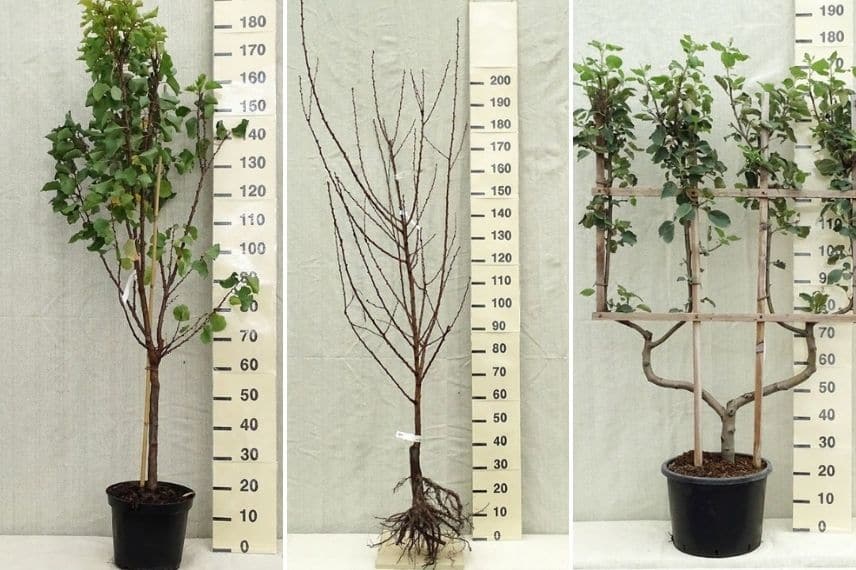
3 different forms (from left to right): goblet, scion and palmette
How to choose the type of tree best suited to your needs?
Now that you know this botanical jargon better, all that remains is to make your choice. But before you take up the spade and buy your tree, here are some questions to ask yourself:
1. Assess the available space
The size of your garden can greatly influence the type of tree you can plant. A high-stem tree will require more space and is better suited to large gardens, while a half-standard or coppiced tree may be more appropriate for medium or small gardens.
2. Consider sun exposure
The location of your future planting and its exposure to the sun can also be determining factors. Some trees, such as high-stem trees, require moderate to full sun to thrive.
3. Think about maintenance
The amount of time you want to devote to caring for your tree is another factor to consider. Coppiced trees, for example, are generally easier to maintain and can be more resistant to disease. High-stem trees will demand more care and suitable equipment.
4. Consider the desired functions
What are you hoping to get from your tree? Shade, a windbreak, easier fruit harvesting? Each type of tree has advantages of its own that can meet specific needs.
5. Consider the local climate
The climate in your area is also a factor not to be overlooked. Some types of trees are more resistant to extreme weather conditions, to diseases or to pests.
6. Consider your soil type
The soil type of your garden is also a crucial factor. Some trees prefer well-drained soils, while others can tolerate wetter conditions and clay soils. The same goes for acidic or calcareous soils. Don’t hesitate to have a soil analysis carried out if necessary to choose the most suitable tree.
In short, choosing the type of tree best suited to your needs is a decision that requires thought and knowledge. Take the time to assess each of the criteria listed above to make an informed choice and make the most of your new tree.
- Subscribe!
- Contents
Comments