





























Strawberry tree: how to choose the ideal variety?
Our tips
Contents
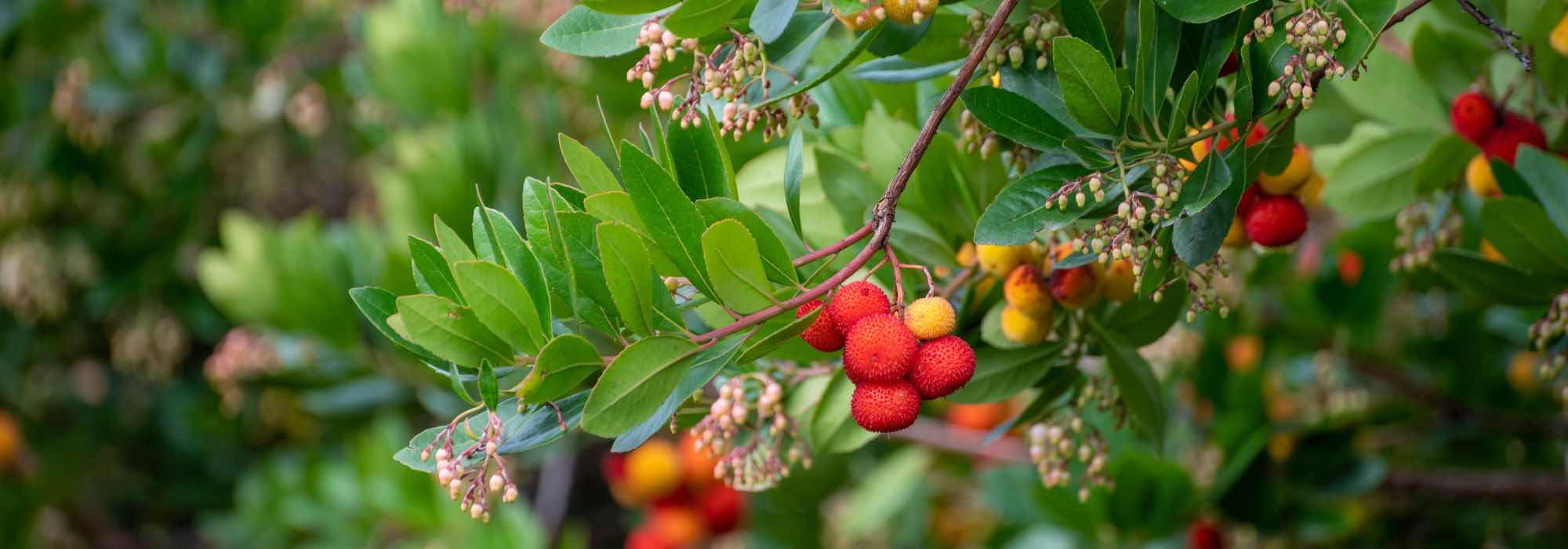
Arbutus unedo, also known as strawberry-tree, is a true treasure for Mediterranean gardens or areas with mild or temperate climates, but also in any region if grown in a pot. Its evergreen foliage is attractive all year round, and its delicate bell-shaped flowers resemble those of lily of the valley. They bear colourful edible berries. The strawberry tree brings colour and charm all year round. Before planting this charming tree, it is important to choose the variety best suited to your space and to the use you have in mind. Discover the keys to selecting the perfect strawberry tree for your garden or terrace.

According to its adult size
Arbutus unedo, the best-known and most cultivated species of strawberry tree in our gardens, forms a bush with an attractive, slightly contorted habit, a little winding, that reaches 5 m in height and 3 m in spread at maturity.
Several varieties of strawberry trees derived from Arbutus unedo are more compact shrubs, 2 to 2.5 m tall and about 1.5 m wide (see the Uses chapter).
The Cyprus strawberry tree, which Latin name Arbutus andrachne, forms a much larger shrub, more like a small tree, 8 to 9 m tall and about 4 m wide in adulthood.
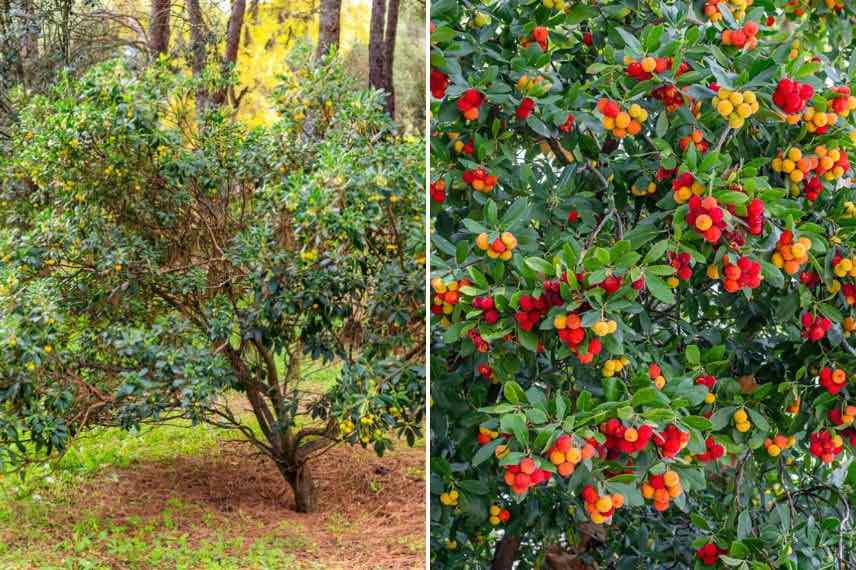
Arbutus unedo forms a medium-sized bush with an attractive, slightly contorted habit, and a very colourful fruiting display
According to the bark
Strawberry trees often have decorative bark. In Arbutus unedo, the brown bark becomes scaly and peels away with time.
The Arbutus andrachne, or Cyprus strawberry tree, features a remarkable bark: smooth, glossy and with changing hues, ranging from orange-red to pistachio green. Its appearance is continually evolving, peeling in broad plates that reveal even more vibrant nuances under ambient humidity.
In the Marina cultivar ‘Marina’, the bark is of a superb cinnamon colour; it peels in broad plates to reveal a new smooth surface, a bright mahogany. Later, this outer skin then peels away, revealing bark in shades of pistachio to olive green, gradually evolving toward a warm orange-brown. The Arbutus ‘Marina’, discovered accidentally in a garden in San Francisco, is said to have Arbutus andrachnoides as a parent, which has passed on its splendid bark. The Arbutus x andrachnoides is itself derived from crossing Arbutus andrachne and the Arbutus unedo species.
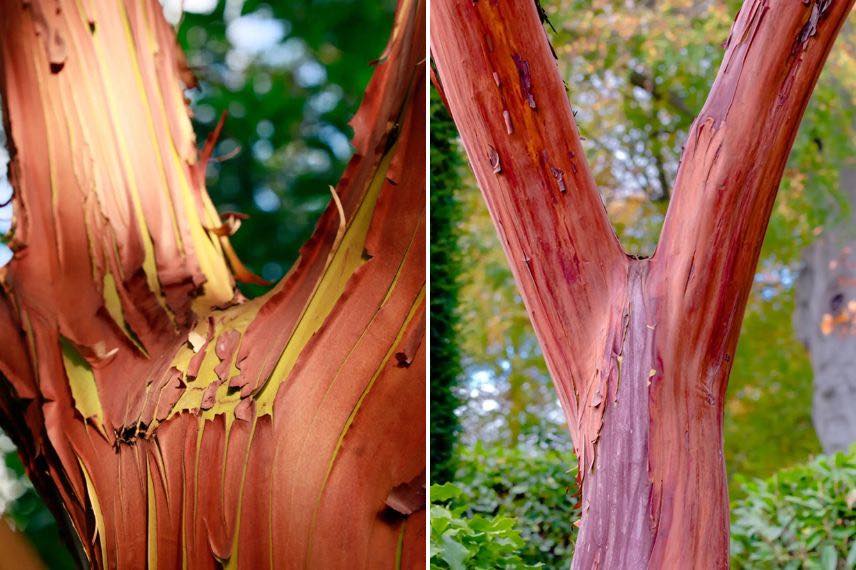
The bark of the Cyprus strawberry tree on the left and of the ‘Marina’ strawberry tree
According to flowering period
The Arbutus unedo and its cultivars bloom from early autumn and through most of winter, from September–October to December–January in a mild climate, concurrently with fruiting reaching ripeness at the same time, further increasing their ornamental appeal.
The Cyprus strawberry-tree, Arbutus andrachne, flowers in spring, from March to May.
Read also
Arbutus: diseases and treatmentsAccording to the flowering colour
The adorable little bell-shaped flowers of the strawberry trees, reminiscent of lily of the valley, are white to pale cream with a yellowish tinge, sometimes pink.
However, some cultivars stand out with more colourful flowering. The Award of Garden Merit-winner cultivar ‘Rubra‘ displays vivid to deep pink bell-shaped flowers, leaning towards red. ‘Roselily’ offers pale pink flowers. Pink Giant ‘Nevez’ develops a flowering of a similar colour, a nearly translucent pink. ‘Marina’ also features rather pink flowers.
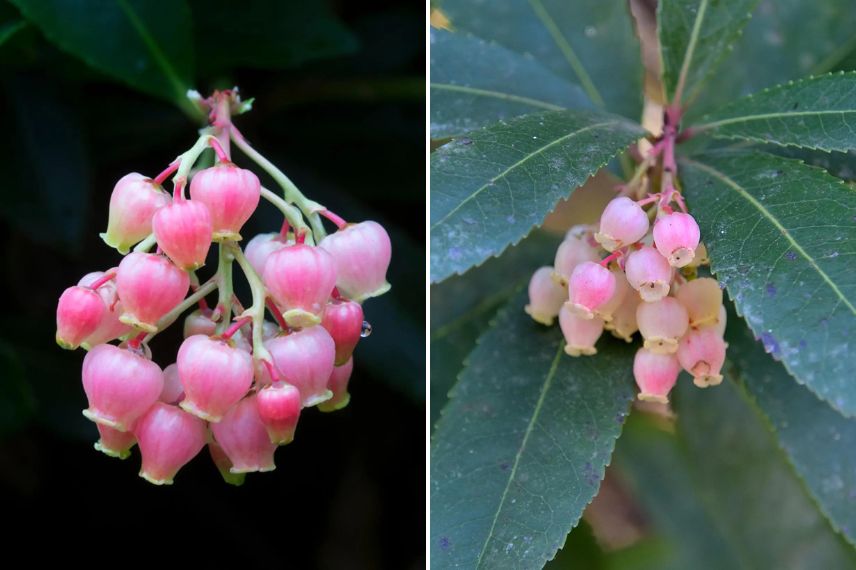
‘Rubra’ on the left and ‘Nevez’
According to growth rate and fruiting rate
Pink Giant ‘Nevez’ Strawberry Tree, also known as ‘Atlantic Rose’, distinguishes itself by faster growth than the strawberry tree in general, and earlier fruiting.
Arbutus ‘Marina’ also offers the same growth and rapid fruit-bearing characteristics. Moreover, its fruits are particularly large.
This gives these varieties normal growth, whereas other strawberry trees tend to have rather slow growth.
Fruit-bearing varies by species and variety: Arbutus unedo takes more than five years after sowing to bear fruit, while others, such as ‘Compacta’, are fruit-bearing from the early years.
According to soil
Strawberry trees grow in well-drained soil, even in poor soil, in sunny or semi-shaded positions, but sheltered from cold winds. The species Arbutus unedo grows in the wild in acidic soil, but tolerates neutral soil or slightly calcareous soil.
Arbutus andrachne is even more versatile: it grows well in calcareous soil, neutral soil or slightly acidic soil.
The strawberry trees’ roots are sensitive to poorly aerated, damp and compact soils. They prefer full sun in cool climate regions, but tolerate partial shade in warm climates. Their hardiness is limited to -12°C or slightly more in a well-protected position and very well-drained soil.
According to its hardiness
As mentioned in the previous paragraph, the hardiness of strawberry trees is limited to around -12°C. Under well-protected conditions and ideal growing conditions, they can tolerate frost down to -15°C.
The ‘Marina’ cultivar is somewhat less hardy. It is likely the result of the hybridization between Arbutus andrachnoides and A. canariensis.
The Arbutusx andrachnoides is generally regarded as hardy to frost down to -10°C maximum, in well-drained soil. Its young shoots can be scorched by frost from -6 to -7°C.
Depending on use
The strawberry tree is a bush grown in the ground which reaches about 5 m in height and 3 m across, but the most compact species and varieties grow well in pots. Choose for this the Arbutus unedo ‘Compacta’, ‘Roselily’ or ‘Rubra’, which reach 2.50 m in height, Atlantic, which grows up to 2 m in height.
In regions with cold winters, favour compact varieties for growing in pots.
The Arbutus andrachne is grown exclusively in the ground, as it attains dimensions larger than the other species, around 8–9 m in height with a 4 m spread. It should be grown as a solitary specimen.
All the other strawberry trees form handsome specimens when grown as solitary plants, but they are also good shrubs for a free-standing hedge. In a border with perennials and shrubs, it provides an interesting focal point.
- Subscribe!
- Contents

Comments