





























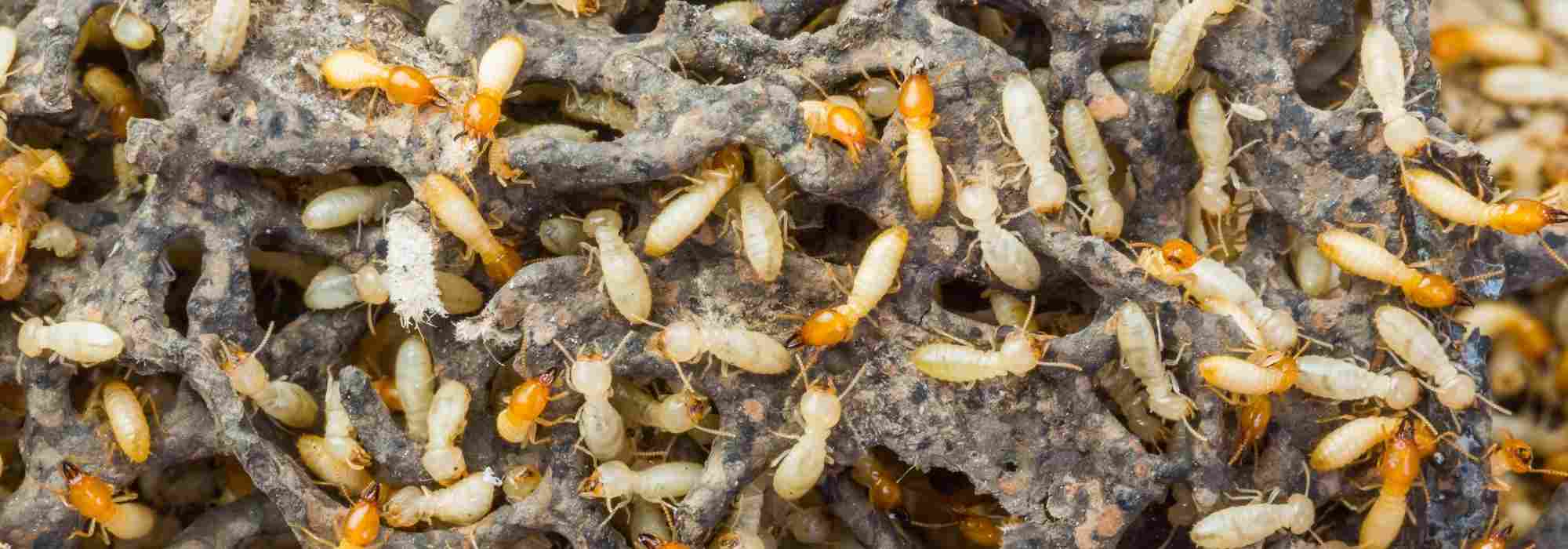
Termites: a hidden menace to your garden and home?
Discover how to detect them and prevent their establishment
Contents
Invisible to the naked eye, light-sensitive, silent and tenacious, termites can slyly invade our gardens and homes, in rural settings as in urban areas. Discreetly, they gnaw at the wood of trees, but also at window frames, roof timbers, or furniture in our homes. And the damage can be substantial… So, how can these wood-boring insects that build real underground cities be detected? Are there any measures to counter their establishment? And above all, what are the ways to eradicate them?
Dive into the fascinating yet secret world of these pests that nevertheless play an essential role in ecosystems. And discover how to protect your garden and your home and contents.

What should you know about termite biology?
Termites are wood-eating insects belonging to the suborder Dictyoptera, alongside cockroaches. They are grouped into eight distinct families, found across the globe. Among these eight families, Rhinotermitidae are certainly the most invasive, about 80% subterranean, and therefore difficult to detect. In France, only species of the genus Reticulitermes are present. There are six distinct subspecies, four native to Europe and two invasive species:
- The lucifuge termite (Reticulitermes lucifugus) lives mainly around the Mediterranean basin, in coastal forests
- The termite Reticulitermes lucifugus corsicus is a subspecies of lucifuge, which is present in Corsica
- The Landes termite (Reticulitermes grassei) naturally occurs in the forests of the Aquitaine Basin
- The Banyuls termite (Reticulitermes banyulensis) is native to the Roussillon, but is found as far as Marseille
- Reticulitermes urbis, native to the Balkans, was probably introduced accidentally. It was discovered and described in 2003 in towns in the Southwest
- The yellow-legged termite or Saintonge termite (Reticulitermes flavipes) is native to the United States, but has established itself in Charente-Maritime several centuries ago.
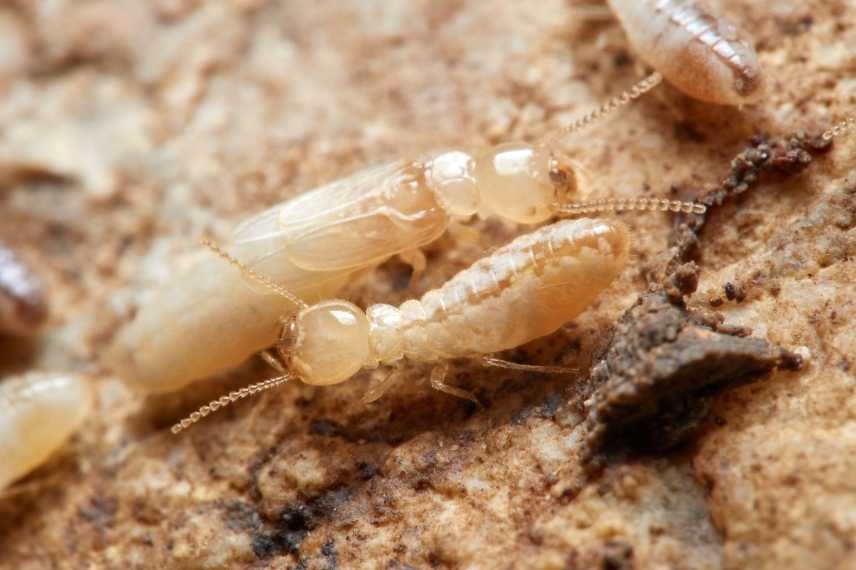 Lucifuge termites</caption]
To these six species, one can add Kalotermes flavicolis, the drywood termite, which poses no danger to homes.
Although slightly different from one species to another, termites are insects equipped with chewing mouthparts that allow them to feed on the cellulose in wood, but also on paper or cardboard. They live in forests, where they feed on dead wood and plant debris in a highly organised manner. This is why termites have an ecological role in forest regulation: they decompose the cellulose to incorporate it into the soil, structure the soil with their galleries, improve water infiltration, while contributing to the diversity of microbial activities.
For centuries, these termites have also occupied homes and gardens adjacent to forests. And that is where the problems begin…
How is termite life organised?
Termites live in perfectly organized colonies, in castes, much like ants or bees. Each has its place, and everything seems predestined, since the eggs laid possess a particular ontogenetic potential. Termite colonies present in France are lucifugous (light-averse): they never appear in daylight and live underground, in galleries. The colony is organised around a queen that lays eggs and a king who provides her with his sperm. The rest of the colony comprises thousands of individuals with specific roles:
-
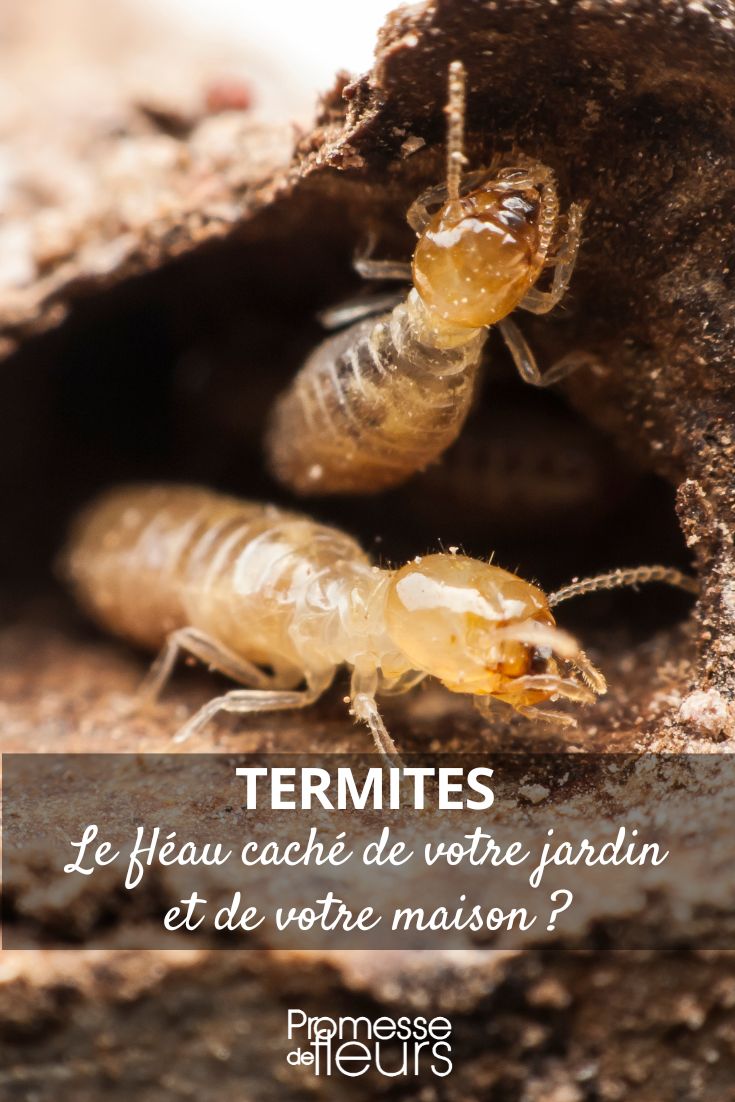
- The workers: they make up about 80% of the colony. They are sterile termites with elongated, soft bodies and a whitish colour. They have rounded heads, short, fine antennae, but no wings or eyes. They undertake construction and maintenance tasks for the colony, and feed the young and the other individuals.
- The soldiers: they account for 2% of the colony. They are distinguished by their brown heads bearing sharp mandibles. They are responsible for defending the colony.
- The nymphal line: the nymphs molt through various stages to reach the imago stage, i.e. the adult stage. Some winged imagos will found new colonies by swarming in spring, from April to June; others are secondary reproductives or workers in the making who can substitute for the death of the queen or king. These secondary nymphs also intervene in case of accidental dispersal of the colony, for example during a demolition site. They can also detach from the parent colony to reproduce in turn.
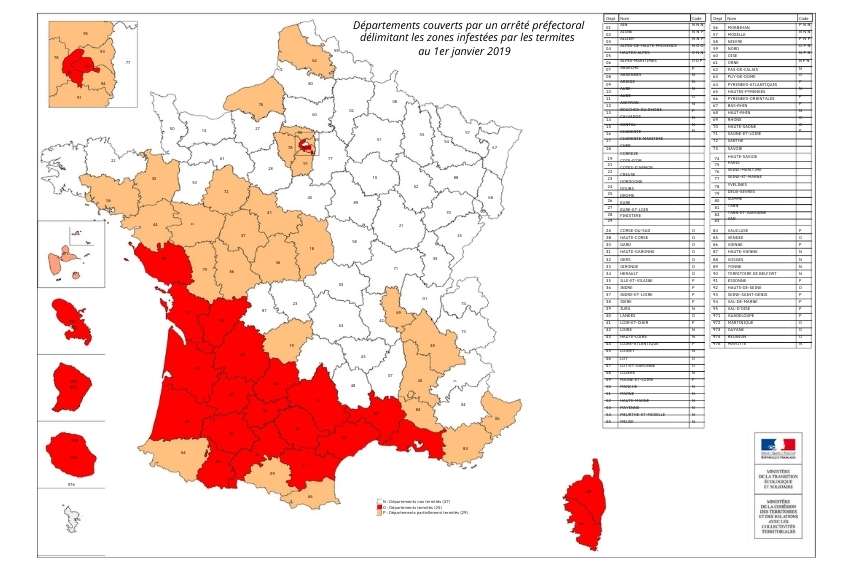 Termites are very present in the southwest, Corsica and the Paris region (source: https://www.ecologie.gouv.fr/)
How to detect a termite infestation and what to do about it?
To live happily and build a thriving colony, termites need three essential elements: darkness, warmth and humidity. And of course cellulose to sustain all members of the community. This is why they can perfectly settle in the garden soil, near a damp spot such as a swimming pool, a well, a pond, a water source like a tap, a pond… with wood nearby. And they will be very difficult to detect, as they are completely invisible. Indeed, unlike woodlice, they do not produce visible sawdust. The only clue that might tip you off to termites is the “cordons” left behind by worker termites. These cords, usually vertical, formed of saliva, wood residues, faeces and soil, are in fact exterior galleries to the colony which allow termites to invade a tree or a façade, while being hidden from light.
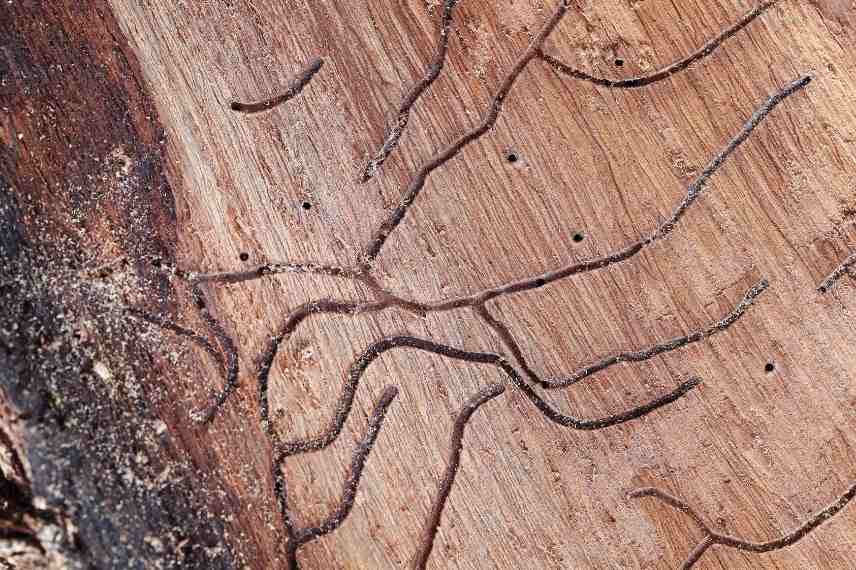
Cordons left by termites
If you have a large plot of land or woodland, don’t hesitate to inspect the trunks or large branches, dead or badly damaged. By probing with a pointed tool, check that your wood is not hollowed by galleries lined with a termite cement formed of saliva, faeces and soil. The wood has the appearance of a laminated, multi-layered structure. Some termites can even attack living trees, via their root system, notably in cities such as Paris. With a preference for softwood species, such as lime (linden). Even though they also attack other trees such as plane trees or ashes.
In spring, it is also possible to see alates (winged adults) taking to the air to mate and establish a new colony. But these adult termites closely resemble winged ants or mayflies.
What kinds of damage can termites cause?
As long as termites stay in the undergrowth, damage is very limited. However, once they establish themselves near homes, the danger is more pressing. Indeed, termites can invade all wood in a house: joinery (windows and doors), carpentry, the timber frame, stairs, parquet floors, floorboards and skirting boards, furniture… They also favour places where paper rules, such as archives departments or libraries. Without showing anything, since termites, which fear light, avoid digging into exterior walls. They also move through plaster partitions.
In general, they favour buildings where humidity and warmth prevail. From the soil, termites attack buildings from bottom to top, thanks to the famous mud tubes.
By gnawing galleries and feeding on cellulose, termites markedly weaken furniture or wooden structures. There are therefore high risks of collapse, making your home potentially dangerous, or even uninhabitable in the event of a large infestation.
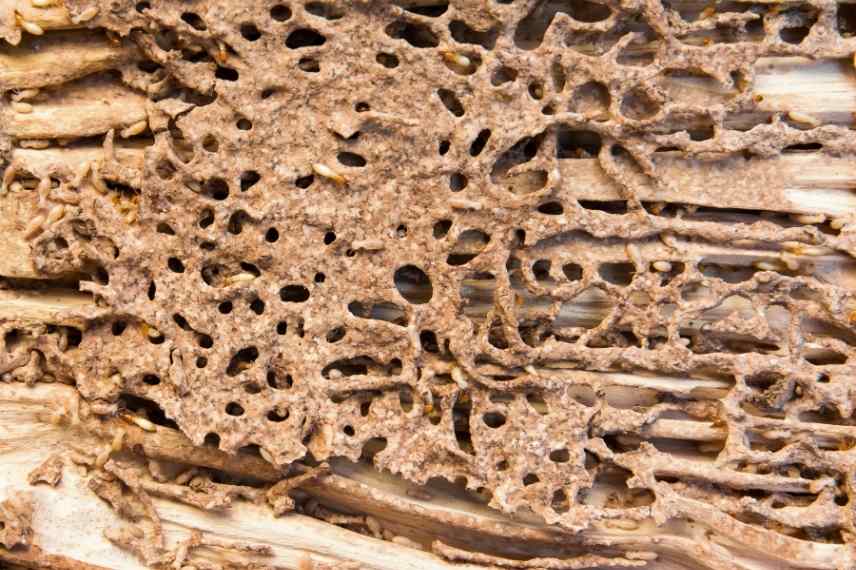
Termites-infested wood, with a laminated appearance
If termite presence is suspected, it is essential to consult a professional who will confirm their presence or not, thanks to acoustic solutions. Thereafter, they can implement a curative treatment, coupled with a preventive treatment.
Finally, under the French Law No. 99-471 of 8 June 1999, any occupant or owner of a building attacked by termites is obliged to report it to the town hall. Failure to comply with this obligation may result in sanctions.
How can you prevent them from getting established?
Several preventive measures can be put in place to prevent an infestation, especially in areas heavily infested by termites:
- Plant timber stakes in your garden and check them regularly for any sign of infestation
- Soak the roots of imported trees
- Remove dead trees in the garden
- Repair all leaks in the irrigation systems
- In and around the home, address all moisture points, such as damp, leaks, or rising damp in walls due to capillary action
- Raise firewood off the ground to insulate it from the soil using materials other than wood. There must be no contact between the firewood and the soil
- Avoid storing firewood, boards, pallets or cellulose-containing debris (paper, cardboard, old furniture…) along the exterior of a dwelling or in a cellar with a dirt floor.
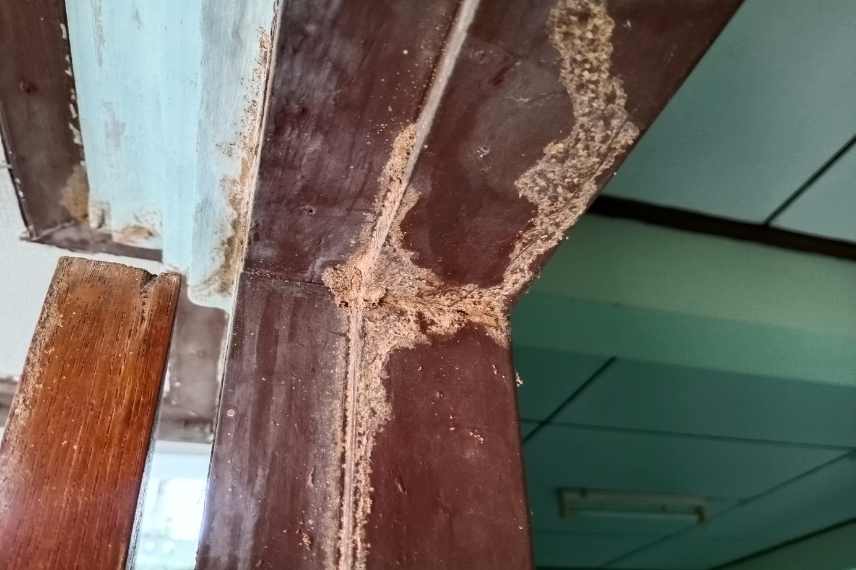
Dwelling infested by termites
- Subscribe!
- Contents
Comments