





























The Bur cucumber: how to grow this unusual fruit-vegetable?
All our tips on sowing, planting and caring for this exotic vegetable plant
Contents
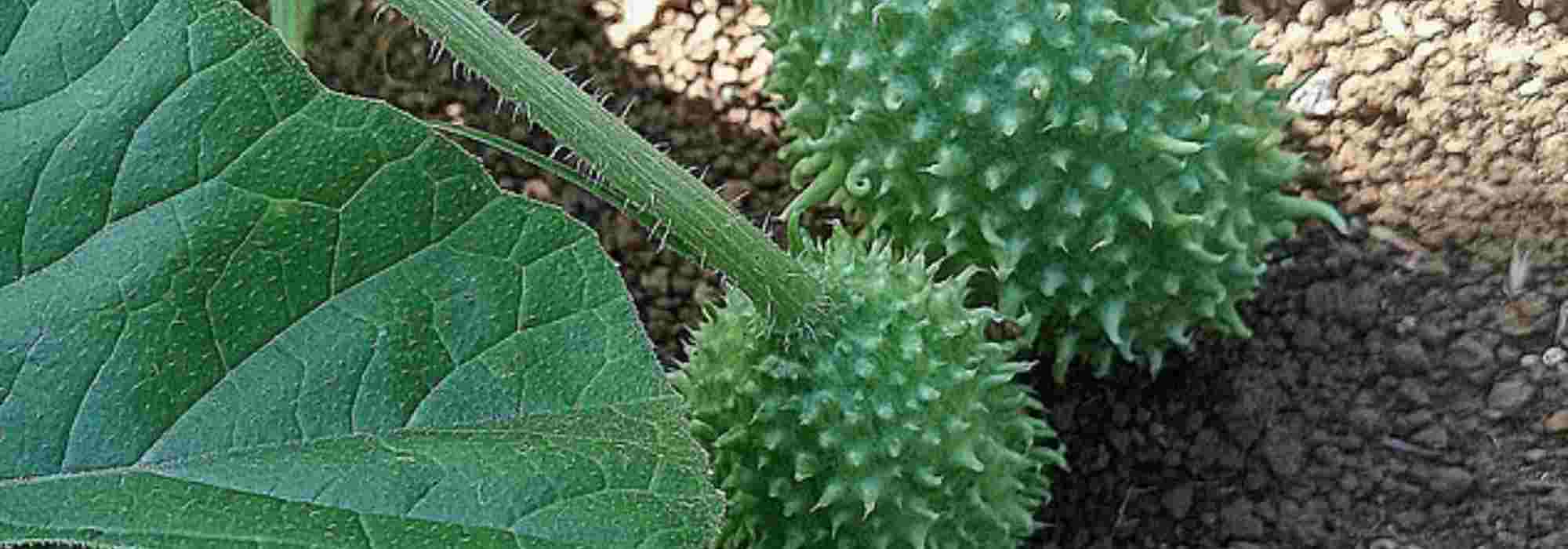
If you want to add a touch of originality to your garden and your plate, the Bur cucumber (Cucumis auguria) is the ideal candidate! Indeed, this small cucumber, also known as “West Indian gherkin” or “maroon cucumber”, has all the qualities to enter your garden and surprise your visitors! While the creeping vegetable plant from the Cucurbitaceae family may not seem particularly remarkable, the fruits it bears are eye-catching. Unlike cucumbers widely grown in our kitchen gardens, the Antilles cucumber adopts an oval shape, somewhat egg-shaped, and is covered in soft thorns. As for its flavour, it recalls that of our cucumbers, with no bitterness but with a hint of sweetness.
In the garden, the Antilles cucumber is grown just like its cucumber relatives. It will need warmth, fertile soil and regular watering. All in all, it isn’t particularly difficult to grow. And you’ll have the pleasure of placing on your table small garden curiosities.
Discover how to sow, plant and care for this extraordinary vegetable-fruit that is the bur cucumber.
For further reading: Cucumber and gherkin: sowing, planting, growing, pruning.

What exactly is the bur cucumber?
Like the other cucumber, the bur cucumber (Cucumis auguria) is a vegetable plant of exotic origin, native to East Africa. Introduced to the Americas, this plant with creeping stems has naturalised in Latin America and the southern United States, as well as in the Caribbean, where the seeds have been selected over the years.
A member of the Cucurbitaceae family, this plant, grown as an annual in our latitudes, produces small fruits about 4 cm long and 3 cm wide. In short, the size of a chicken egg! Small fruits that display a distinctive and unusual appearance, being oblong in shape and, above all, bristly with soft spines that cause no injury. These protuberances, more than spines, resemble the burrs of the horse chestnut, which has earned it the nickname “chestnut cucumber”. This skin, turning from green to yellow at maturity, hides a translucent flesh, packed with small crunchy seeds that crack under the bite.
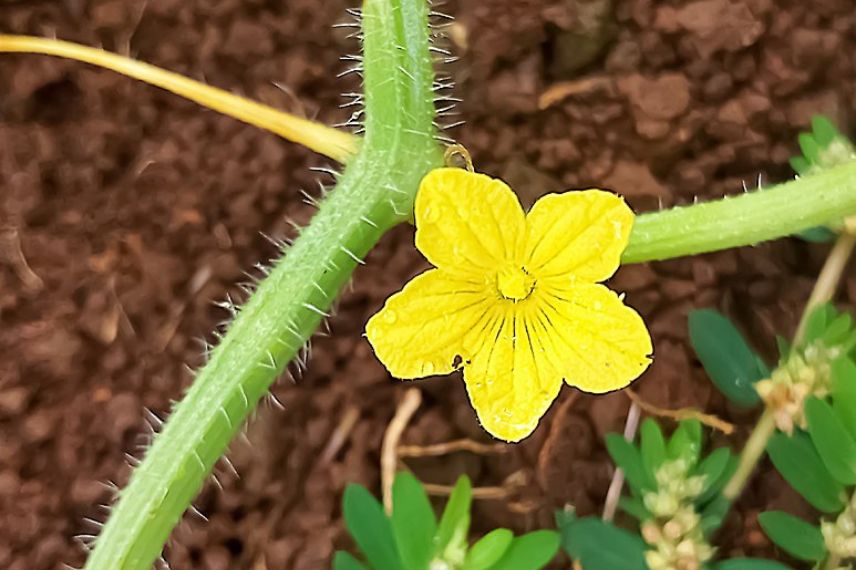
The flower of the bur cucumber (©Flo Gèn for Wikimedia Commons)
As for the plant, it grows rapidly. It produces long stems that can reach 3 m in length. These branched stems bear foliage that is trilobed, palmately lobed, and particularly hairy. These stems can creep along the ground or climb if given support. Bright yellow flowering occurs from June to September. The flowers are monoecious.
How to sow and plant the bur cucumber?
Due to its origins, the bur cucumber has an imperative need for warmth for both the germination of seeds and its cultivation. This is why this vegetable plant will undoubtedly be more productive in regions with hot summers. As with ordinary cucumbers, sowing is done in warmth and the seedling will only be transplanted into the ground once late-spring frosts have been definitively ruled out.
Sowing of Cucumis auguria
Sowing of bur cucumber seeds is carried out in April in pots kept warm, in a very bright room with a temperature of at least 22 to 25 °C. It is indeed the germination temperature of the seeds of Cucumis auguria. A conservatory is ideal.
The sowing is done in pots filled with seed compost, slightly dampened. Place 2 to 3 seeds per pot, about 1 cm deep, and water with a fine spray. To encourage germination, it is always possible to cover the pots with a pane of glass or plexiglass, remembering to ventilate regularly.
When the seedlings have three leaves (excluding cotyledons), they can be transplanted into garden soil. It is prudent to wait until mid-May to do so in regions where late-spring frosts are frequent.
Planting in open ground
The bur cucumber will thrive in any good garden soil, but a humus-bearing, fairly deep, loose and cool soil, and above all well-drained, will suit it. If the soil is rich, that’s even better, so a well-rotted compost addition is recommended in the autumn before planting. It also requires a sunny position sheltered from cold winds. In the less sunny regions or where summers are shorter, planting in a greenhouse is feasible.
As it is a trailing plant, it is important to give it enough space to develop at its own pace. Count at least 2 m² per plant and thus at least 1 to 1.5 m between each plant. In smaller gardens, trellising is advisable, for example against a fence, a trellis against a wall or even a playful teepee. Just be sure to guide the stems toward the support and then they will take care of themselves. Trellising has several advantages: the fruits are easier to harvest, cleaner as they do not touch soil, and above all better exposed to the sun. Additionally, the foliage is less prone to powdery mildew, sometimes caused by excessive humidity combined with heat.
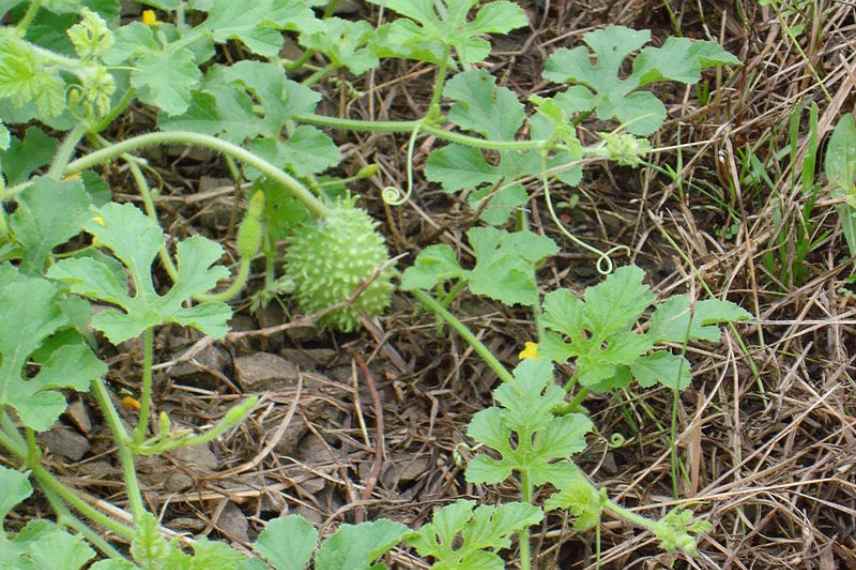
The bur cucumber needs heat to grow (©Eugenio Hansen OFS pour Wikimedia Commons)
Last, also avoid the pairing with Solanaceas (potatoes, tomatoes…) near the bur cucumber.
What care do West Indian cucumbers need?
Bur cucumbers are vegetable plants that require very little care. Pruning and fertilising are unnecessary. Only watering should be regular to keep the soil moist. To increase the effectiveness of watering, it is advised to hoe regularly around the cucumber plants to aerate the soil. This hoeing is also important for removing weeds.
To space out the watering, mulching is essential. This mulch will help retain moisture. You can use lawn clippings, dead leaves, straw…
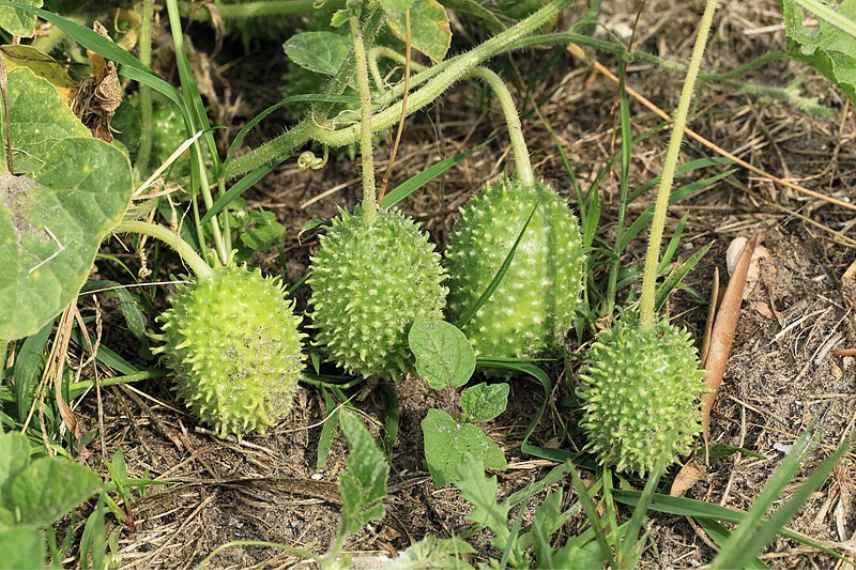
The bur cucumber requires very little care (©Frank Vincentz Wikimedia Commons)
This exotic-origin vegetable plant has no particular diseases or pests. Only slugs and snails may occasionally feast on the young plants. Discover our natural solutions to deter slugs and snails.
Harvest, conservation and consumption of Caribbean cucumbers
Harvest of cucumbers occurs 2 to 3 months after planting, from July to September depending on the region. They are harvested while immature, when they are green, at the moment they begin to turn yellow. The harvest can thus be spread over several weeks. They keep for 2 to 3 days in the fridge but no longer.
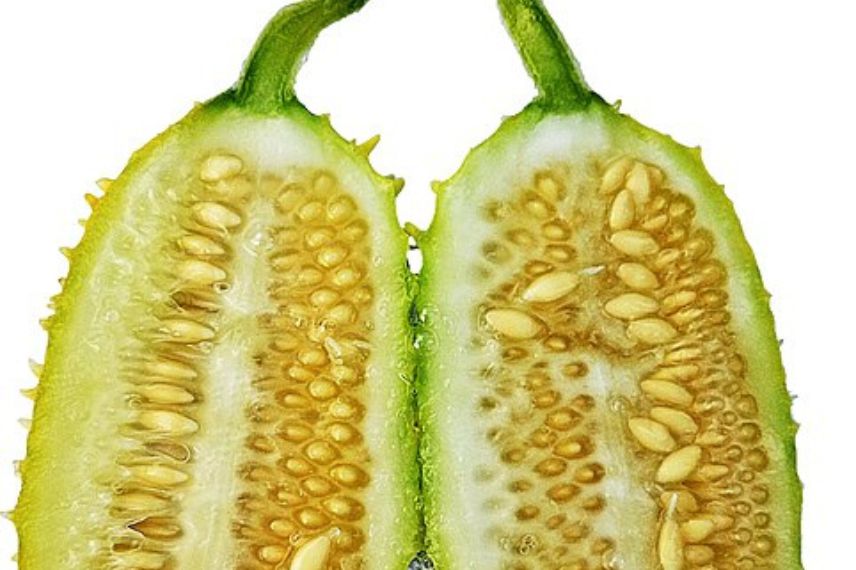
Flesh of the bur cucumber (©Flo Gèn Wikimedia Commons)
Bur cucumbers are eaten raw, cut into thin slices and served with a French dressing. These cucumbers can also be cooked by steaming or boiling, then sautéed in a pan. They can be incorporated into a sauce such as Colombo sauce. They are also traditionally prepared in a ragout, simply in meat juices, or as a fritter. Finally, they can be pickled in vinegar as a condiment.
- Subscribe!
- Contents
Comments