





























The common starling: friend or foe to the gardener?
Understanding the impact of the common starling on your garden
Contents
Whether you live in the city or the countryside, you have almost certainly seen swarms of thousands of common starlings (Sturnus vulgaris) weaving intricate patterns in the sky. Forming real black clouds, they can descend on vineyards in autumn to feast on just-ripe grape clusters. Cities are not spared from starling flocks. In the evening, these starlings gather in the trees of urban parks to roost for the night. They generate incessant chirping and droppings that are not only very messy but also potentially disease-carrying.
Nevertheless, the common starling is also a very useful bird in the garden. It proves to be an effective ally in biological pest control.
Let’s get to know the common starling, a passerine in the Sturnidae family, and learn to accept its presence.

The common starling, a gregarious bird with a talent for mimicry
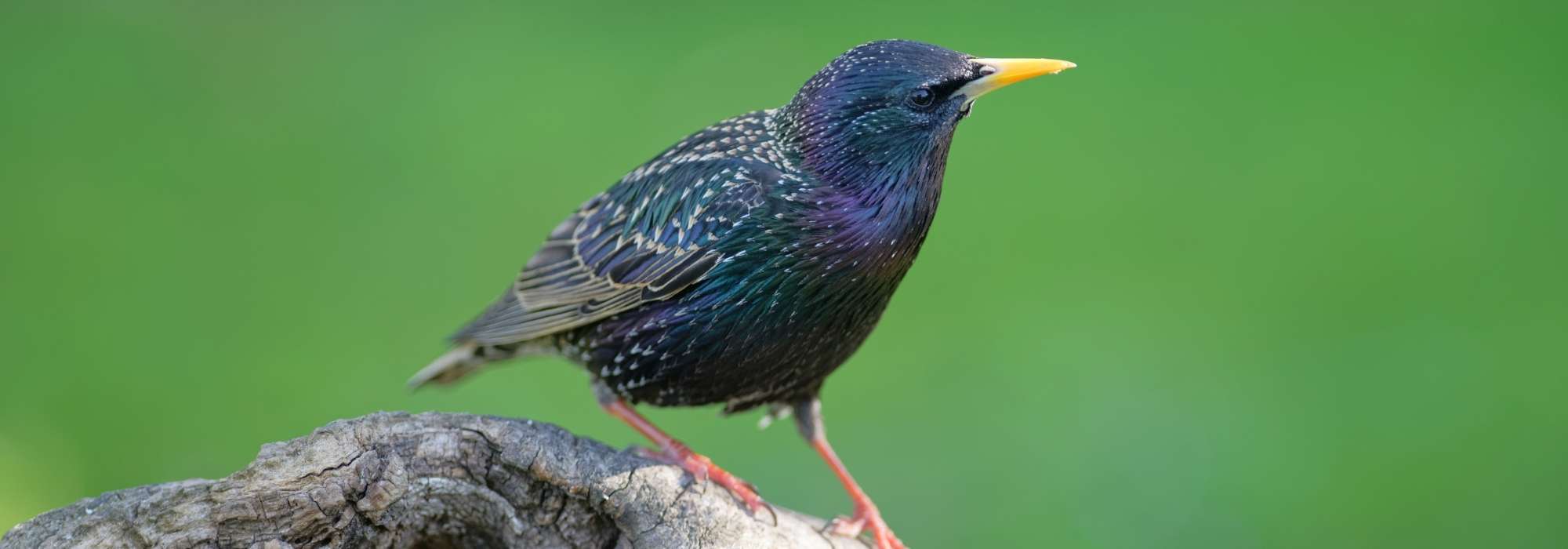
The common starling (Sturnus vulgaris) is a passerine bird in the Sturnidae family, typically stocky with a pointed beak and a short tail.
A bird often confused with the blackbird
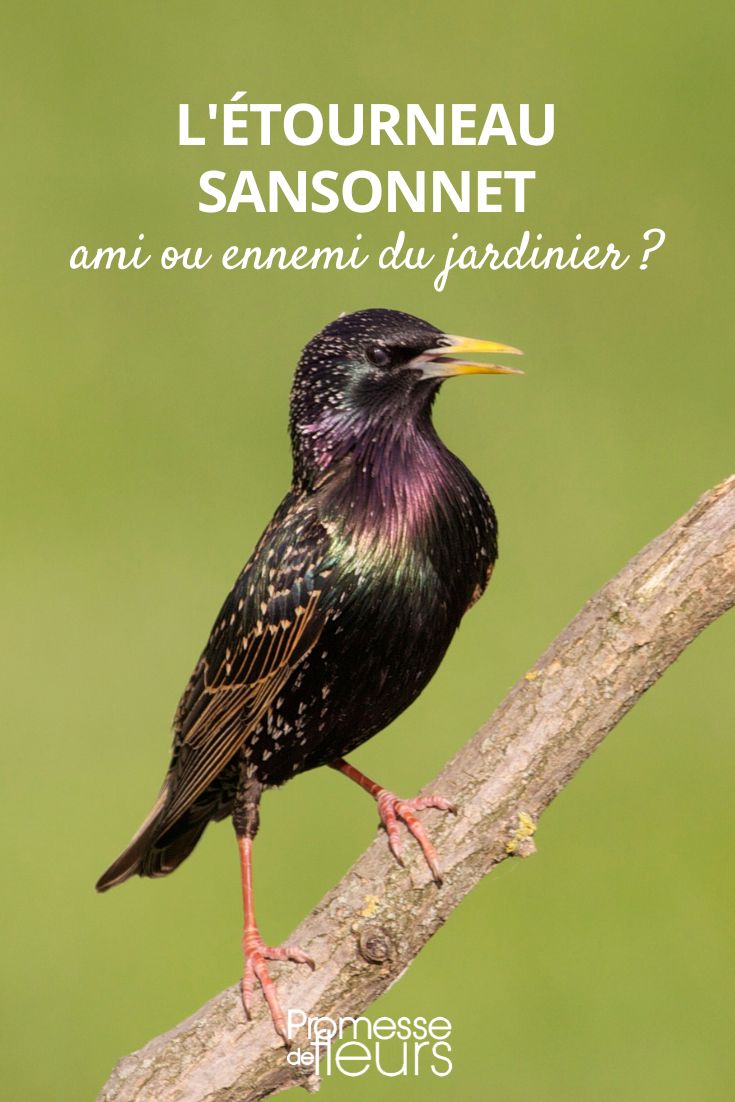
At about 20 cm long and weighing 60 to 90 g, it features black plumage with green iridescence and purplish reflections in summer, and is more beige and yellowish-white mottled in winter. This overall black plumage, and especially its yellow beak, means it is often confused with the blackbird. Its beak becomes grey in winter. There is no strongly marked sexual dimorphism between males and females.
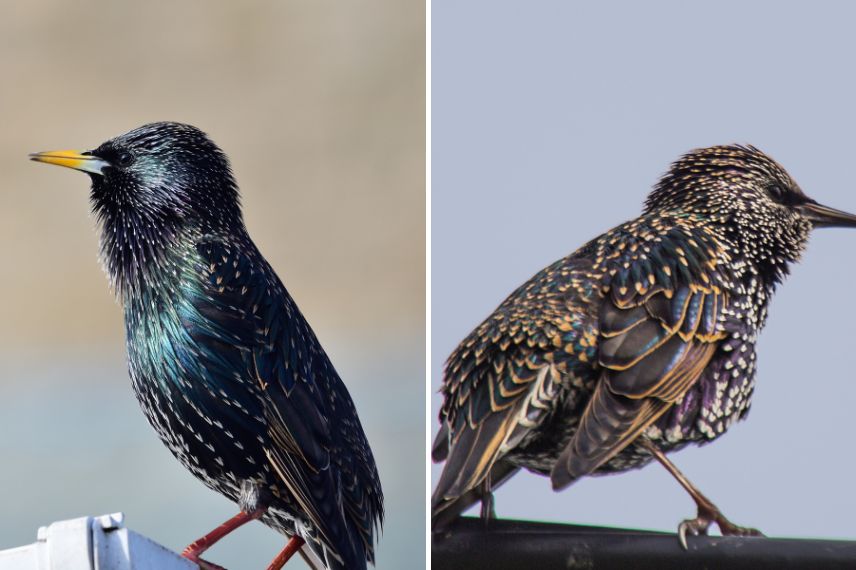 The starling’s plumage becomes beige-spotted in winter, and its beak shifts from yellow to grey
In terms of song, the starling uses several tones. Its song, described as a pot-pourri, is very varied, consisting of chirps, creaks, and clear whistles… It is among the birds that sing quite early in the year, from January to February, around the same time as blackbirds. It is especially renowned for its exceptional mimicking abilities. A true sponge, it absorbs and reproduces the surrounding sounds. It is thus capable of imitating the alarm cries of blackbirds, certain farmyard birds and the artificial sounds around it, such as a ringtone or objects that creak or click.
The starling is relatively sedentary or partially migratory for populations settled furthest north in Europe. Some populations move south to overwinter.
A prolific breeder
Very gregarious, the starling leaves the group to breed. The courtship starts early: the male tries to attract his mate (he is monogamous) with wing-beats and his long, flute-like song. Then, after mating, the male fashions and decorates a nest, perched 3 to 5 m high. Nesting in cavities, the starling often nests in holes in dead or old trees, or in cavities of old buildings. Nesting sites are becoming rarer and are sought after by other birds such as tits, woodpeckers or nuthatches. Needless to say, competition is fierce.
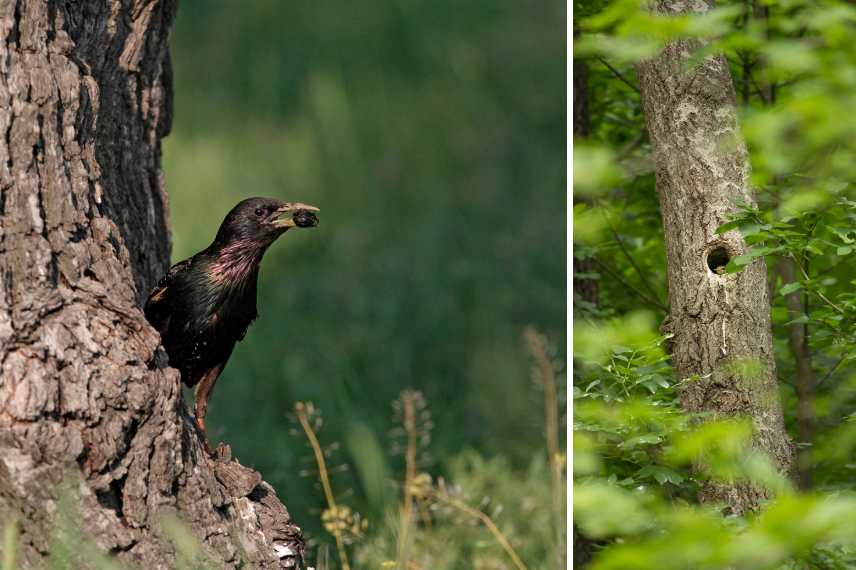 Nesting in cavities, the starling often nests in the hollow of a trunk
Once the nest is found, it is lined with various materials found nearby such as leaves, fresh or dry, small branches, moss, plant fibres, or even more artificial materials like string or paper. The female lays 4 to 6 eggs which she incubates alone for 12 to 14 days. When the chicks hatch, they are fed by both parents (only for the first brood of the year, the male being absent for the subsequent ones), mainly with animal food. After about twenty days, the youngsters leave the nest, still being fed by the parents. Then they form new groups with other juveniles.
The common starlings produce 2 to 3 broods per year.
Are starlings pests?
The common starling is a gregarious and omnivorous bird. Two characteristics that often lead it to be regarded as a nuisance.
Roost formation begins in autumn
Indeed, outside the nesting periods, and in particular from September to February–March, starlings group together in the evenings to establish proper roosts, usually located in major urban parks in towns and cities. It’s a way to withstand the cold, to gain a bit of daylight, but above all to escape predators such as the peregrine falcon or the Eurasian sparrowhawk. These nocturnal gatherings are therefore the cause of impressive and noisy flights, drawing undulating shapes across the sky before sunset. It is not uncommon for these ballets to number in the thousands of starlings, each year swelled by juveniles joining the group in autumn. It is indeed at this time that roosts reach their peak in terms of numbers of individuals. Indeed, small roosts, formed of a few individuals in spring and summer, join together in autumn.
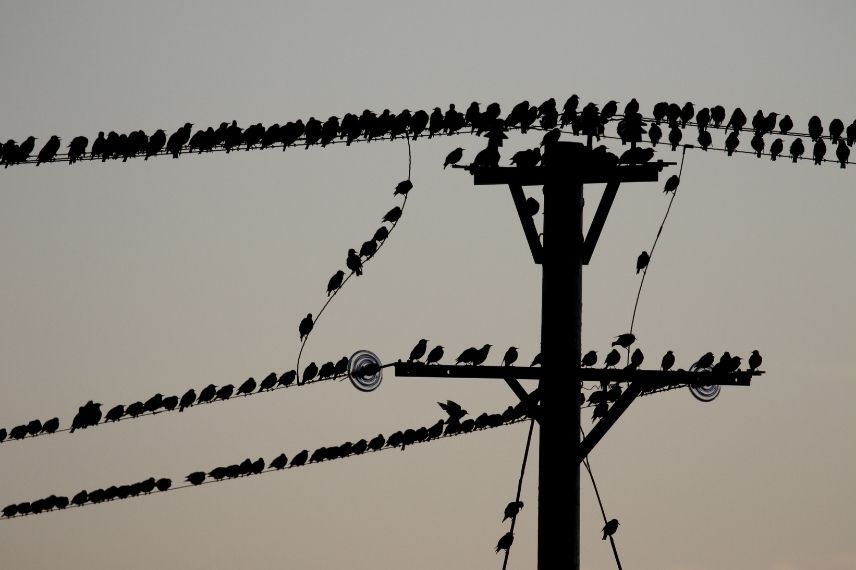
Grouping at the pre-roost site
Concretely, each evening, the birds group in pre-roosts, elevated sites such as power lines where they perch. Then, at nightfall, they move together towards the roost, which they leave at dawn to go and feed.
A bird that is a nuisance
Obviously, these swarms of birds that settle in the large trees of city parks cause numerous disturbances, both noisy and odorous. Because tens of thousands of birds chirp with energy and defecate in abundance, their droppings landing on vehicles or pavements. Beyond the purely aesthetic and hygienic aspects, these starling droppings can potentially carry pathogenic bacteria and diseases, such as salmonella.
In some large urban areas, the common starling crystallises the discontent of residents and elected officials who do not always know how to act.
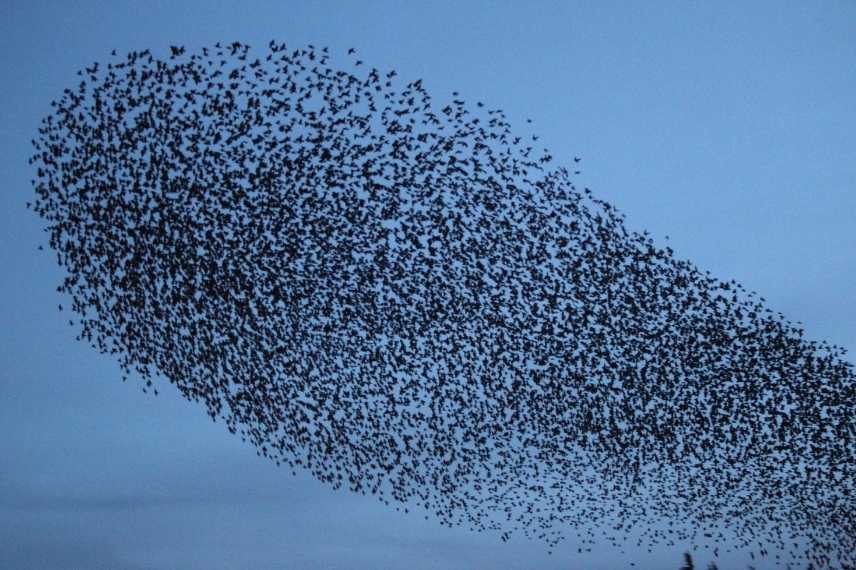
At nightfall, the starlings gather to join the roosts
But starlings are not content to merely irritate urbanites! By day, they leave the towns to feed. And it is common to see these flocks take over orchards, arable land, maize silage or vineyards. For the common starling is an omnivorous bird that feeds on insects as well as seeds, fruit and berries. And it is particularly fond of grapes and cherries. Another opportunity to make enemies among wine growers, farmers and orchardists…
How to deter starlings from towns, orchards and vineyards?
Classed as a “species likely to cause damage” in certain departments, the starling may be trapped and shot there (except in nests). Nevertheless, the Ligue de Protection des Oiseaux (LPO) recommends instead observing the birds’ movements in the evenings, from October to the end of February, to anticipate their establishment. Thus, they could be diverted to zones laid out to welcome them.
If the starlings have already found their roost, scaring them off remains the best way to drive them away. A scare-off, comprising acoustic, visual and biological (buzzard, falcon) elements, carried out according to a precise protocol over several days. Nevertheless, flocks of alarmed birds are simply moved and end up settling elsewhere. The objective is therefore to encourage them to settle in woodland copses away from the population, near pre-roosts.
In vineyards, orchards and cultivated lands, the method of visual deterrents and the bird nets can be easily adapted for a family garden to protect fruit trees and vineyard trellises from the starlings’ greed.
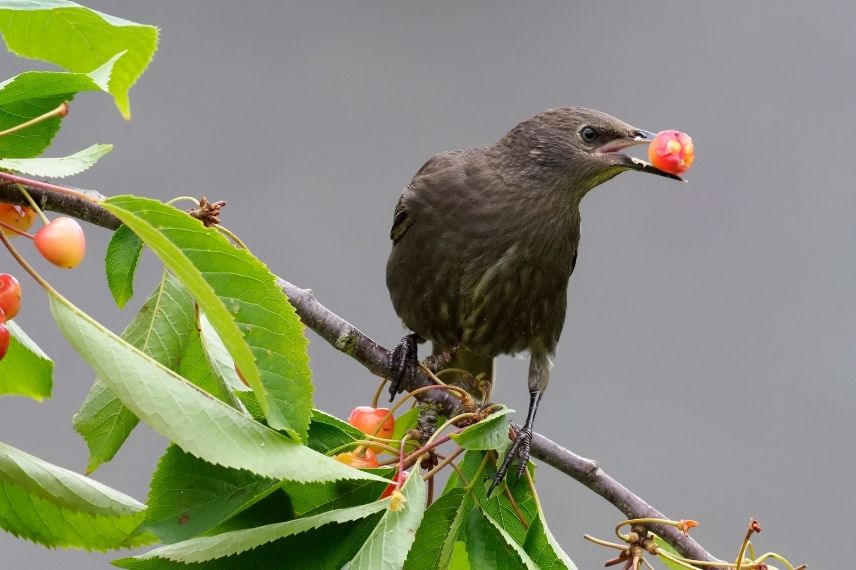
Starlings love cherries
Read also
DIY: Bird FeedersThe starling, a useful garden bird: how to attract it?
It is especially during nesting that the starling rises in the esteem of people, and in particular of gardeners, orchardists and winegrowers… Indeed, as it must feed its hungry offspring, the starling sets out in search of insects. And it is a mighty predator of all the insects that could be nuisances to vegetable crops and to fruit trees. Starling thus puts on the menu a whole range of larvae and caterpillars, worms, aphids, cockchafers, small invertebrates and spiders… They also feast on crane flies, these large mosquitoes commonly called “crane flies” whose larvae can damage market garden crops. All in all, it’s welcome in allotments or even in orchards where fruit trees are often vulnerable to pest attacks.
So, if you see the starling more as a friend, effective in terms of biological control of pests, than as an enemy, don’t hesitate to invite it into your garden by treating it to a few small attentions:
- Spread food on the ground, as the common starling does not feed at feeders, usually frequented by other garden birds. Seed mixes scattered on the ground or placed on a small, easy-to-clean tray
- Plant berry shrubs whose starlings love them. Perhaps they will be deterred from your cherries, figs, grapes, gooseberries or strawberries, which they also relish? You can thus form hedges of berry shrubs such as the dogwood (Cornus), the hawthorn (Crataegus), the viburnum (Viburnum), the amelanchier, the elder (Sambucus), the holly (Ilex), the rowan (Sorbus), the crab apple (Malus sylvestris), the black mulberry (Morus nigra), the bird cherry (Prunus avium), the prunier sauvage (Prunus insititia)…
- Install nest boxes. The starling is an opportunist capable of settling in an old great spotted woodpecker’s nest or in a coal‑tit’s nest. That is why you can install nest boxes fairly simple, but closed, on the fork of several branches, or better still in the hollow of an old tree.

Starlings particularly enjoy berries
- Subscribe!
- Contents
Comments