





























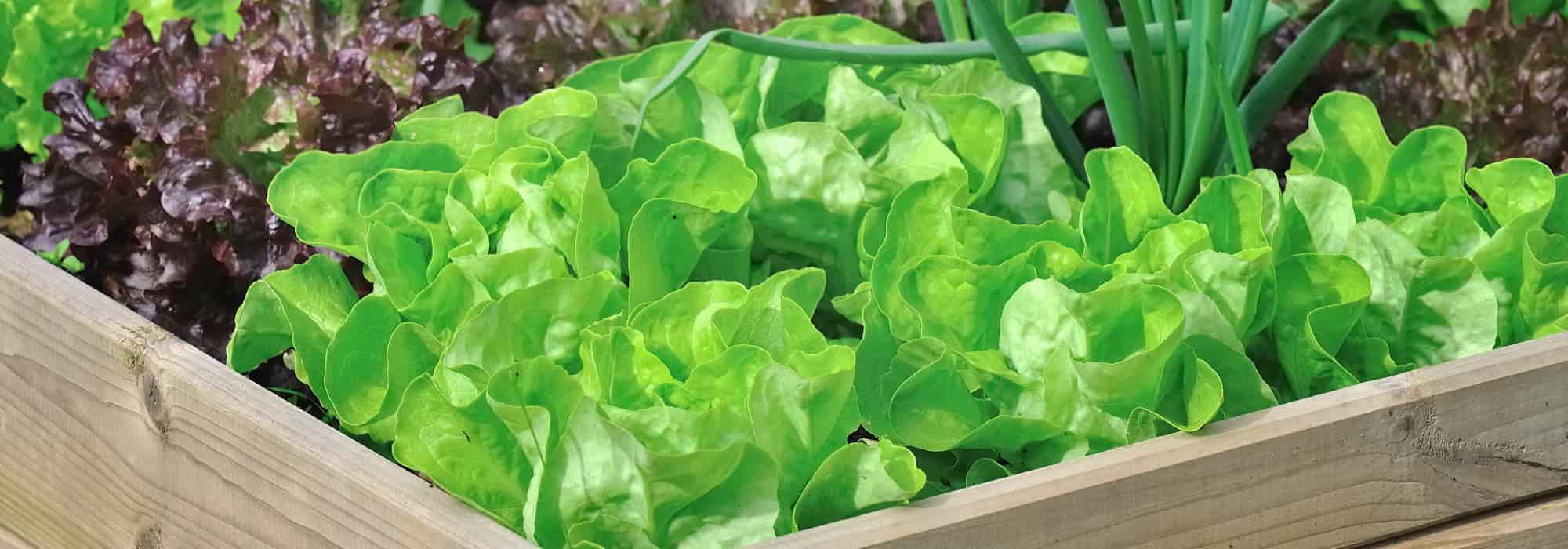
The 8 best companion plants for salads
to speed their growth and protect them from pests
Contents
A kitchen garden often yields salad leaves! Blonde, green or red, depending on the gardener’s preferences, we appreciate its cultivation and, above all, its harvest for its freshness and flavour. Even though these leafy greens are easy to grow, salad leaves benefit from companion planting to boost their growth and protect them from pests. Also known as companion planting, this method of cultivation, based on the complementarity between plants, promotes a balanced, productive and more resilient ecosystem. In this article, we will explore the eight best companion plants for salad leaves, highlighting their specific advantages.

Radishes: fast-growing protectors
With their compact size, radishes take up little space in the vegetable garden and easily fill the gaps between the lettuces. Their rapid growth allows them to be harvested well before the lettuces, thereby freeing up space. But that isn’t the only advantage! The leaves of radishes also attract certain pests, such as flea beetles, which prefer them to lettuce leaves. The lettuces’ tender leaves are then spared.
The radish roots penetrate deeply into the soil, aerating it and improve water infiltration, which benefits the lettuces that prefer well-drained soil. In addition, radishes and lettuces have slightly different water and nutrient needs, reducing competition between these two vegetables. What a good neighbour this is!
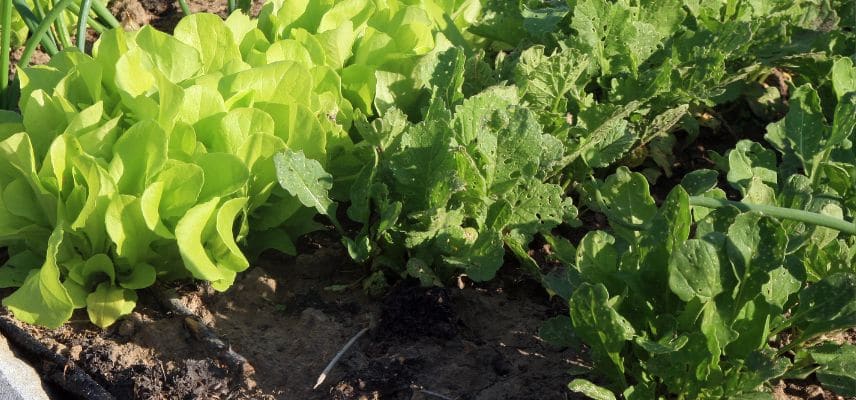
Lettuce and radishes
Strawberries: Beneficial neighbours
Strawberry plants, with their creeping habit, cover the soil around salad leaves, making the most of the available space. This leafy cover also helps retain moisture in the soil, something salad leaves love. Moreover, slugs and snails see it as additional obstacles to reaching the tender lettuces. Access is all the more difficult, and the strawberry leaves provide a natural shelter for certain beetle species that feed on these same gastropods.
The flowers of the strawberry plants also attract natural enemies of aphids, such as ladybirds, hoverflies and lacewings, which feed on them, thereby helping to protect our precious salads.
In addition, strawberries and salad leaves have different nutritional requirements, which limits competition.
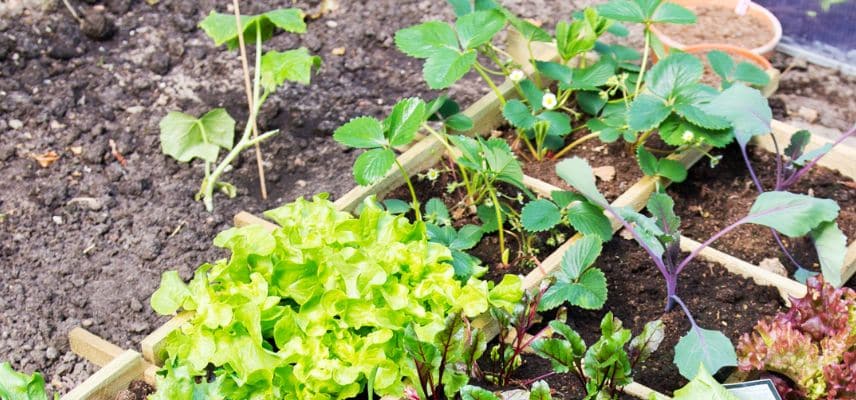
Salad and strawberry plants
Peas: nitrogen fixers
Peas have the ability to fix atmospheric nitrogen, through a symbiosis with bacteria present in their roots. This process enriches the soil with nitrogen, an essential nutrient for the growth of salads.
Climbing peas, when planted near salads on a trellis, provide beneficial shade during the warm months, limiting premature bolting of salads.
The combination of peas grown vertically and salads that spread horizontally allows more efficient use of space in the garden.
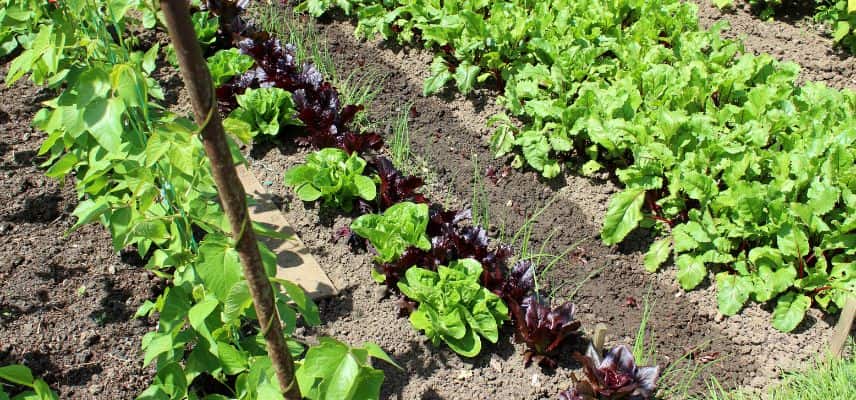
Salads and peas in the vegetable garden
Read also
Salads: buyer's guideCarrot: a beneficial coexistence
Carrots and lettuces have complementary growth profiles: carrots mainly develop their roots deep in the soil, while lettuces spread at the surface with their leaves. This difference allows efficient use of vertical and horizontal soil space. In addition, the roots of carrots aerate the soil and can help to break up compacted soils, thereby facilitating the penetration of water and nutrients for lettuces.
Carrots and lettuces, when sown together, can create an olfactory confusion for some pests. Carrot flies and aphids will detect these vegetables less easily if they are interspersed with one another, rather than in a dense block. Add to that some Dill, some Chives and some marigolds, and the pests won’t know where to look!
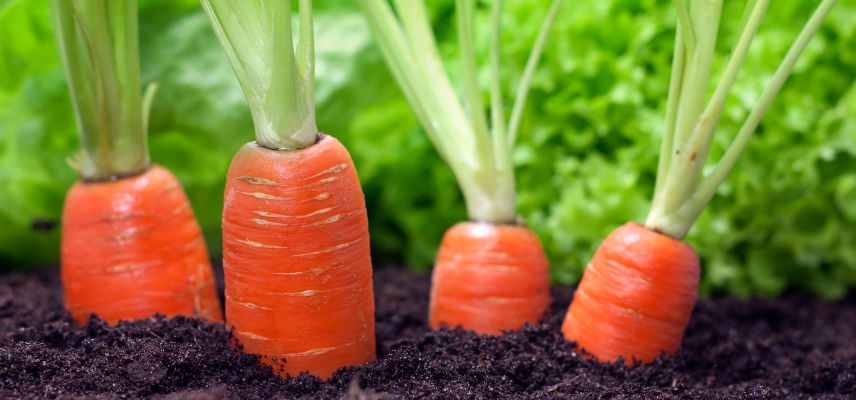
Lettuce and carrots
Chives: a repellent odour
Chives, with their strong aroma (due to their sulphur compounds), can help deter pests, notably aphids and whiteflies, from your lovely salads.
Chives have a delicate, slightly peppery flavour that pairs perfectly with the fresh taste of salads. Growing them beside each other makes harvesting easier.
Although no scientific study can confirm it, some gardeners claim that chives enhance the flavour of salads, thanks to interactions in the soil and through the air. Nothing stops you from trying it in your vegetable patch, does it?
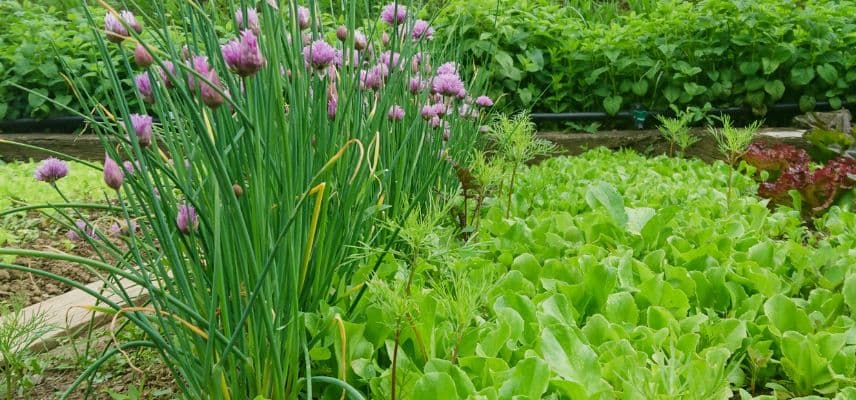
Salad and chives
Nasturtium: a colourful lure
Nasturtium is often used as a companion plant to attract aphids away from more vulnerable crops, such as lettuces. By serving as a sacrificial plant, it helps keep pests at bay while adding a splash of colour to the garden. Nasturtiums also attract ladybirds and hoverflies, predatory insects that feed on aphids.
Did you know? Nasturtium flowers are edible and add a slightly peppery flavour and colour to your salads. Another reason to grow them together!
Another advantage: nasturtiums are climbing plants that can cover the soil at the base of your lettuces. This helps to suppress weed growth and maintain soil moisture, especially in summer, reducing the lettuce’s running-to-seed.
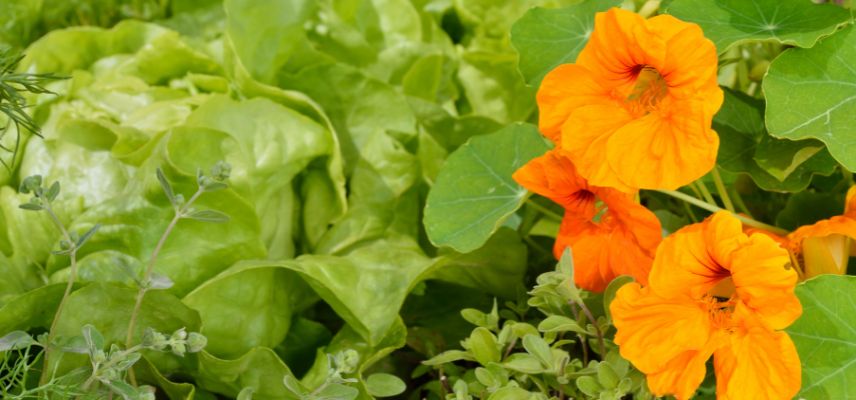
Salad and nasturtium
Dill: the friend of beneficial insects
With its strong odour, dill repels certain pests, including aphids and whiteflies. As a result, its presence limits their attacks on the tender leaves of lettuce. Dill also attracts beneficial insects such as ladybirds, which feed on aphids, a common foe of lettuce.
Its fresh, slightly lemony flavour makes dill, when finely chopped, a good match for salads.
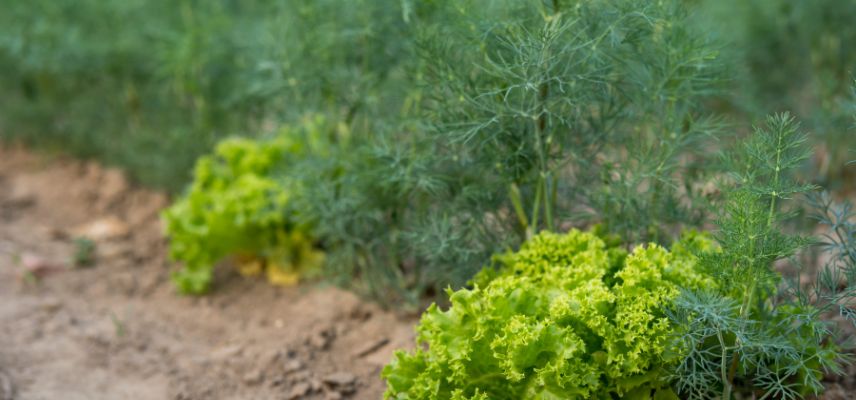
Salads and dill
Onions, garlic and shallots: the fragrant guardians
Onions, garlic and shallots have a strong scent that repels certain pests, such as whiteflies and leek moths. This helps protect salad leaves from attacks by these insects and improve the harvest quality.
Onions and shallots also possess natural antifungal properties that can reduce the incidence of certain diseases, such as downy mildew, which can affect salad leaves in damp conditions.
In cooking too, their combination is interesting : fresh onions and shallots, finely sliced or chopped, add a touch of flavour to your salads, while garlic enhances the flavour of meats.
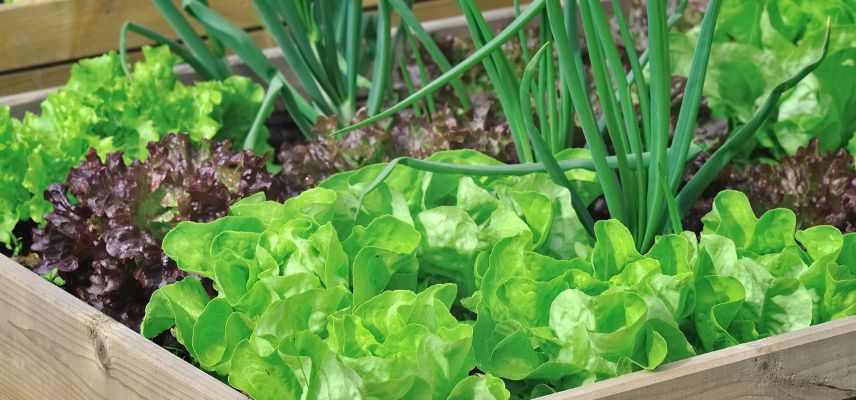
Salads and onions
And many more besides.
In the vegetable garden, Lettuce generally makes good neighbours. Lettuce can also be planted next to tomatoes, peppers, aubergines, celery and spinach.
- Subscribe!
- Contents

Comments