


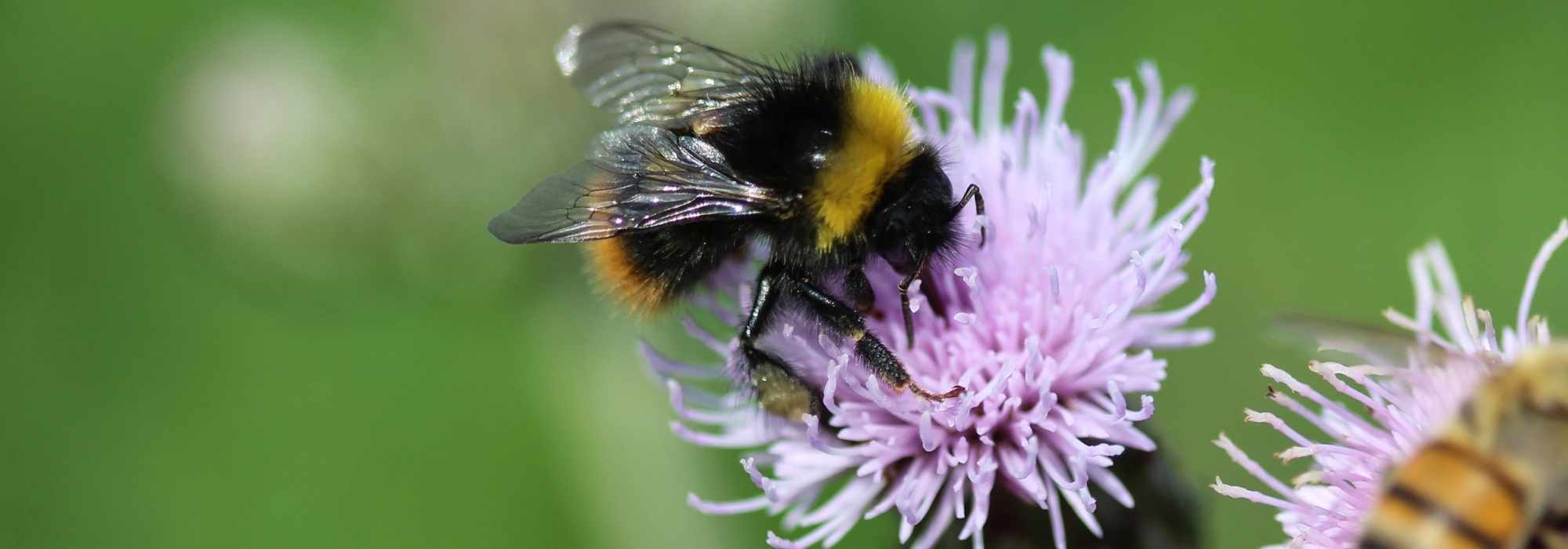
The favourite flowers of bumblebees
To help these effective pollinators
Contents
Bumblebees (Bombus sp.) are very important insects for the pollination of fruit and vegetables such as tomatoes, aubergines, peppers, chillies, courgettes, peas, beans… Unfortunately, like many insects, the various species of bumblebees are in decline across Europe. The causes are multiple: reduction in the number of natural habitats, climate change, and decades of insecticidal use. To help them, it is relatively simple. You need to leave space for nature in your garden and promote biodiversity: wildflowers, tall herbs, piles of wood, stone heaps… Additionally, you can also ensure to provide quality nectar and pollen for bumblebees by planting or sowing their favourite flowers: borage, lavender, willow, clover, nasturtium, rosemary… and many more.
→ What are the favourite flowers of bumblebees? Here are some suggestions to help you with a short list organised by flowering period.
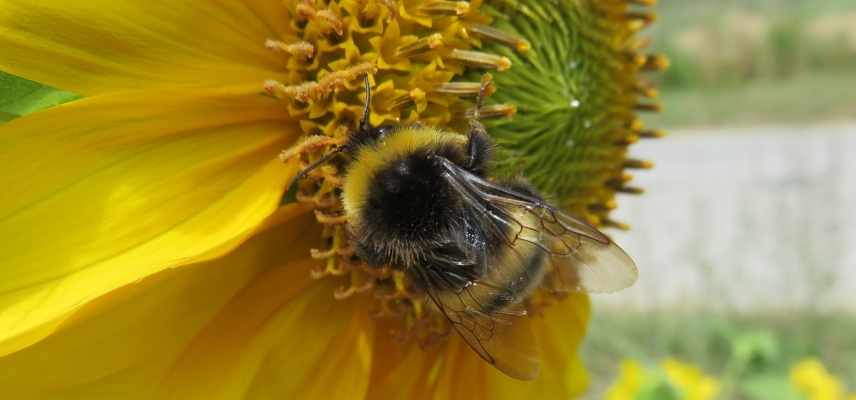

Focus on bumblebees
What is a bumblebee?
The common name “bumblebee” refers to insects of the genus Bombus (family Apidae and order Hymenoptera). There are over sixty species of Bombus in Europe, with the most common ones being the Buff-tailed Bumblebee (Bombus terrestris), the Red Mason Bumblebee (Bombus lapidarius), the Early Bumblebee (Bombus pratorum), and the Field Bumblebee (Bombus agrorum). Please note that the bumblebee is not the male of the bee.
Please note: some insects are colloquially referred to as “bumblebee something.” This is the case, for example, with the Violet Carpenter Bee (Xylocopa violaceae), sometimes nicknamed “black bumblebee.” It is also worth noting that the males of bee species are commonly called “drone” by beekeepers. In this advisory sheet, we will only discuss “true” bumblebees: the Bombus.
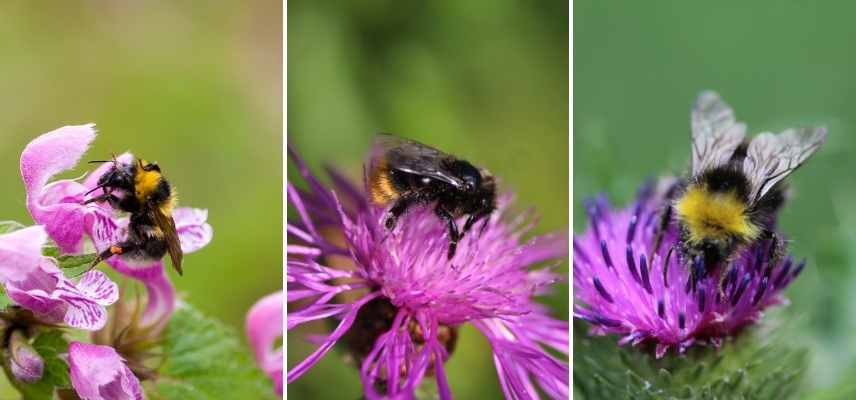
Bombus terrestris, Bombus lapidarius and Bombus pratorum
The bumblebee is a very effective pollinator
Bumblebees feed on the nectar of flowers and use pollen (and a bit of honey) to nourish their larvae. Bumblebees visit nearly all flowers, but some are more favoured than others (see below). They are effective pollinators, thanks in part to the presence of hairs on which pollen from flowers clings. Additionally, bumblebees start foraging at temperatures as low as 5 °C (compared to 15 °C for bees) and are active from March to November, at dawn and even on windy and rainy days.
If your garden is not inhabited by enough bumblebees, the production of fruits and vegetables will suffer significantly: this is true for tomatoes, aubergines, peppers, blueberries, strawberries, squashes and courgettes, raspberries, peas, beans…
Bumblebees are in danger
Unfortunately, bumblebee populations are declining mainly due to the loss of natural habitats caused by rampant urbanisation and intensive agriculture, the decades-long use of insecticidal products, as well as climate change. Agroecology and the restoration of flowering meadows are potential solutions for the conservation of bumblebees.
The life cycle of bumblebees
Bumblebees are social insects, living in colonies. The queen spends the winter alone, then seeks a hole (a rodent burrow, a birdhouse…) to build her nest with moss, hairs, grass, and leaves.
The female will lay the first eggs and take care of constructing the wax cells. The eggs will hatch, and the larvae will develop into pupae and then sterile workers. These workers will take care of the colony: foraging for food for the next larvae and protecting the nest.
At the end of summer, the queen will lay eggs again to give rise to new queens and male bumblebees. They will be fed by the sterile bumblebees. Once mature, the queens and males will mate. However, only the queens will survive the winter and start a new colony the following spring.
Only female bumblebees can sting, but only in self-defence, such as when stepped on or squeezed in a hand. The bumblebee is a peaceful insect.
The end of winter - the very beginning of spring: feeding the queen
The end of winter (February-March) is a critical period for queens who need to regain strength before building their nest and staying there for several days to lay eggs.
During this time, food (pollen and nectar) is scarce in nature and in the garden. However, willows are already starting to flower, and the aments are one of the main sources of nectar and pollen. Winter heathers (Erica carnea and Erica (x) darleyensis) are also widely visited. The first bulb flowers that bloom at the end of winter greatly assist bumblebees: snowdrops and the first crocuses.
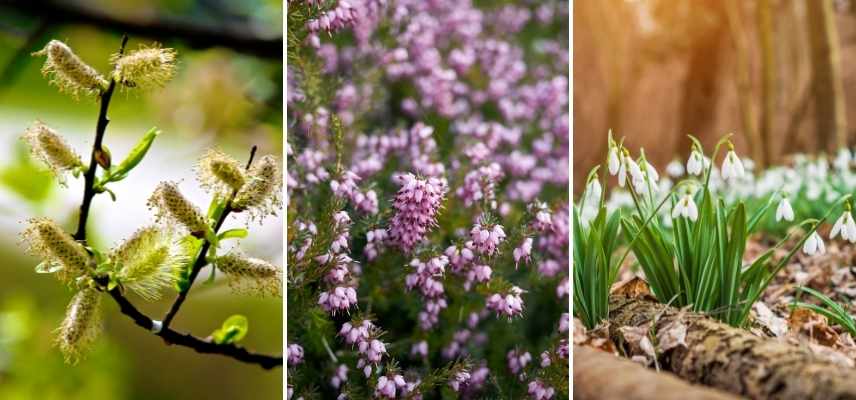
Among the winter blooms that attract bumblebees: willows, heathers, and snowdrops
Spring: the workers emerge and begin to stock up
Spring is synonymous with flowering. Nature finally awakens: spring bulbs, a large number of bushes, and many perennial or annual flowers reveal their nectar to insects.
Dandelion remains the favourite flower of bumblebees in spring (and not just them, by the way). Feel free to let some bloom in your lawn or flower beds. White clover and crimson clover, which bloom from April (for white clover) until autumn, also provide a good source of food.
Among other spring flowers, we can highlight lamiums, native or not, which often bloom as early as May, pulmonarias, comfreys, chives…
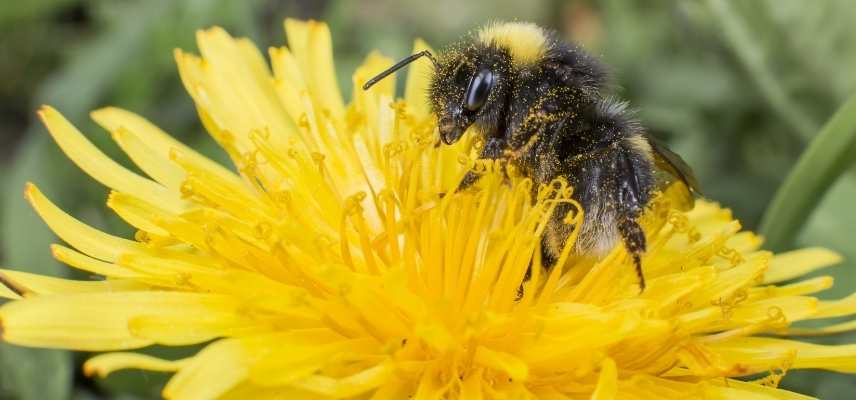
Dandelion, a flower adored by bumblebees
Read also
Flowers that attract beesSummer: it's time to think about the laying of future queens
Worker bees are very active in summer, provided it is not too dry. In that case, nectar is much less present in flowers, and bumblebees may simply starve.
Among the summer-flowering plants favoured by bumblebees are: scabious, globe thistle, lavender, hardy geraniums such as Geranium macrorrhizum and Geranium pratense, borage, viper’s bugloss, foxgloves, cornflowers, perennial poppies and corn poppies, hollyhocks, nasturtiums, perennial sweet peas… and let’s not forget roses with single flowers.
But also some aromatic plants: thyme, rosemary, common sage, oregano…
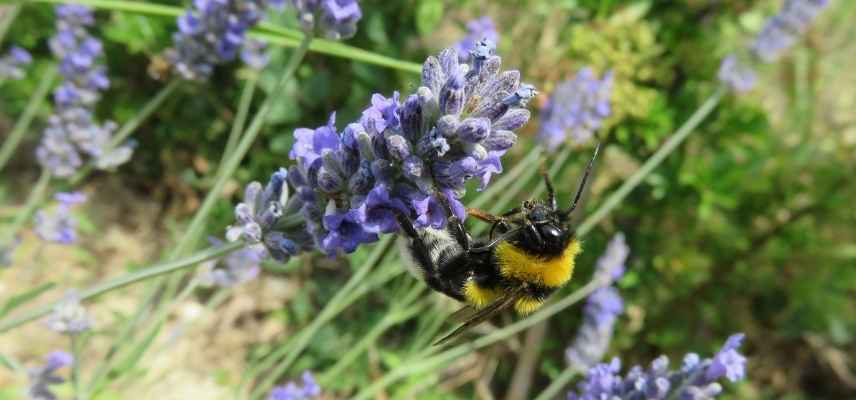
In summer, many flowers including lavender are favoured by bumblebees
Autumn: gathering strength before winter
In autumn, there are still some beautiful nectariferous flowerings in the garden. The summer flowerings are still holding on a bit, and the late-flowering perennials bring joy to the pollinators.
For bumblebees, there will be single-flowering dahlias, Japanese anemones, autumn-flowering asters, gauras, kalimeris, Hylotelephium spectabile (formerly Sedum spectabile)…
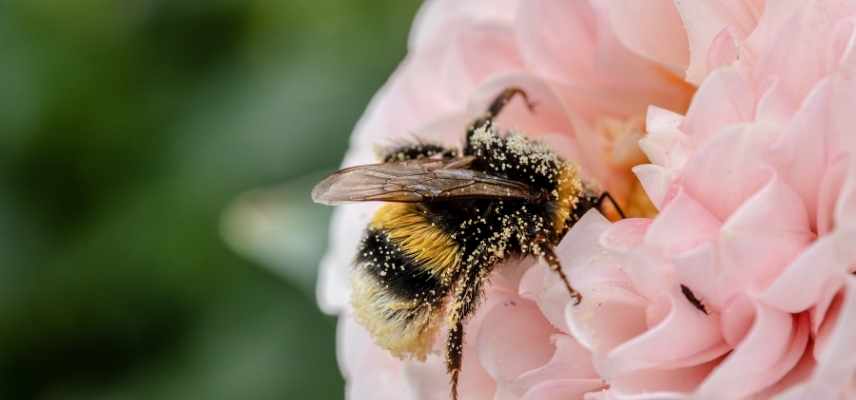
Bumblebee enjoying a Dahlia…
How to encourage bumblebees in the garden?
In addition to sowing, planting, and allowing as many flowers as possible to grow, we can encourage the presence of bumblebees in the garden through a few simple adjustments. Just keep in a forgotten corner of the garden: a pile of dead leaves, stones, or wood under which the queen can prepare her nest. A garden that hosts wild plants, as well as moss (for the nest), and slightly tall herbs… provides even more benefits for the conservation of bumblebees.
As a side note, bumblebee nests to be buried are now available for sale. However, let’s allow the bumblebee queens to create their own nests. After all, they have been managing perfectly well for millions of years; they certainly do not need a nest made by humans…
- Subscribe!
- Contents
Comments