





























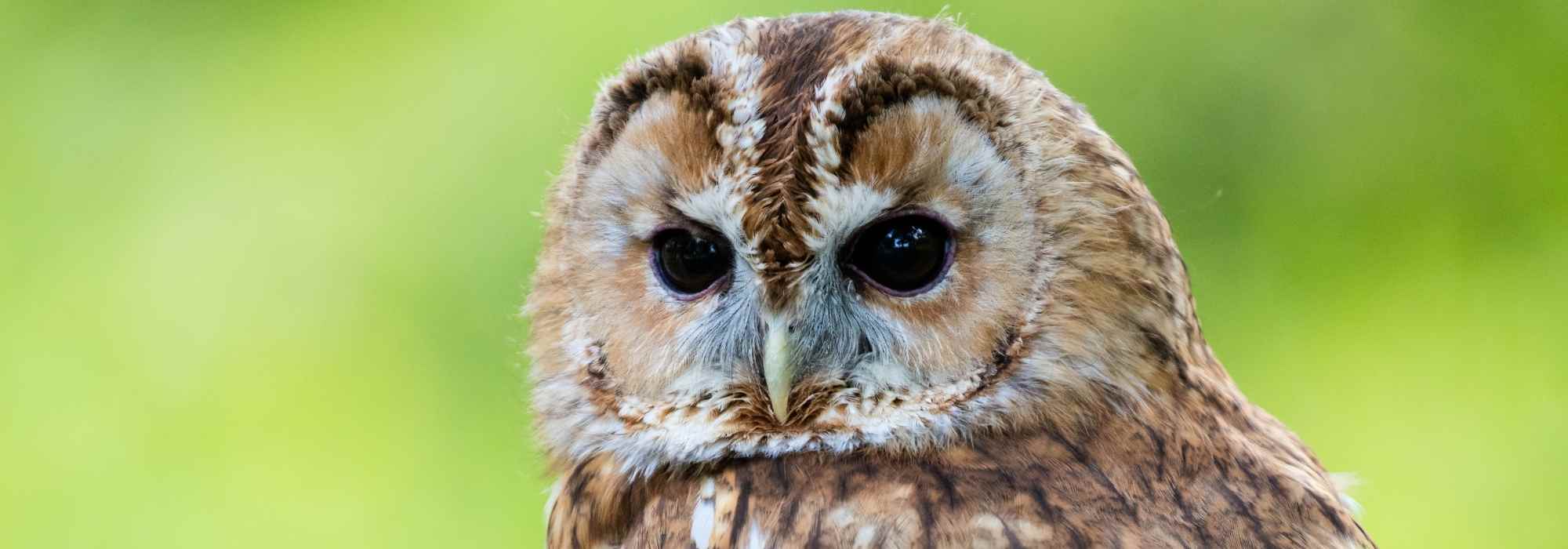
Tawny owl in the garden
All you need to know about this nocturnal bird of prey
Contents
The Tawny owl, formerly known as the Cat owl, is a very common nocturnal bird of prey in Europe. This bird prefers forests and wooded countryside, but does not shy away from parks and tree-filled gardens. The Tawny Owl is an exceptional predator that feeds on small mammals, rodents, birds, as well as insects, slugs, and earthworms. How can you tell if one or more Tawny Owls live near you? How can you best welcome them into your garden?
We’ll tell you everything in this article.

A bit of ornithology...
The Tawny Owl (Strix aluco) is part of the family Strigidae, which includes all owls, nightjars, and little owls. It is a widely distributed nocturnal raptor in Europe (except in Ireland and the northern part of Scandinavia). The Tawny Owl can be found in France (except in Corsica) and Belgium, both in summer and winter.
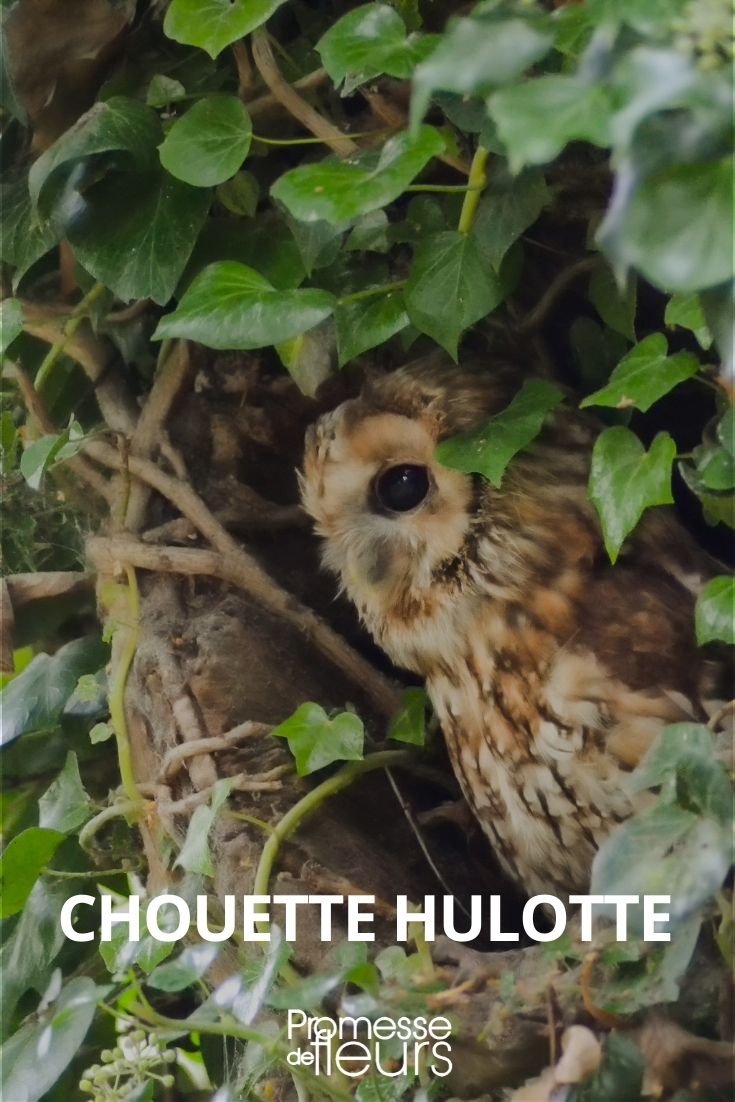
This owl is roughly the size of a large pigeon: 40 cm tall, with a wingspan of nearly 1 m and a weight of about 500 g. The female is slightly larger and heavier than the male. Some individuals have brown-grey plumage with light or dark brown spots, while others have plumage that leans more towards rufous. In both cases, the plumage aids in the bird’s camouflage among the branches of trees. The head is distinctive, with two round facial discs forming a sort of “heart.” The eyes are dark brown. Unlike other owls, the Tawny Owl does not have ear tufts, those feathers that stand upright on the head.
The Tawny Owl prefers woods and forests (except for boreal coniferous forests), but it can also be found in urban parks and well-treed gardens.
The flight of the Tawny Owl is swift and extremely silent, thanks to its silky feathers.
It nests from February to July in a spacious tree hole or in a specific nesting box, sometimes provided by nature conservation organisations. It can also, though less frequently, occupy a cavity in a rock face, “squat” in an unoccupied old building, or take over an old buzzard nest. The female lays between 3 and 5 eggs per clutch, but most of the young will not survive to one year of age due to predation or lack of food.
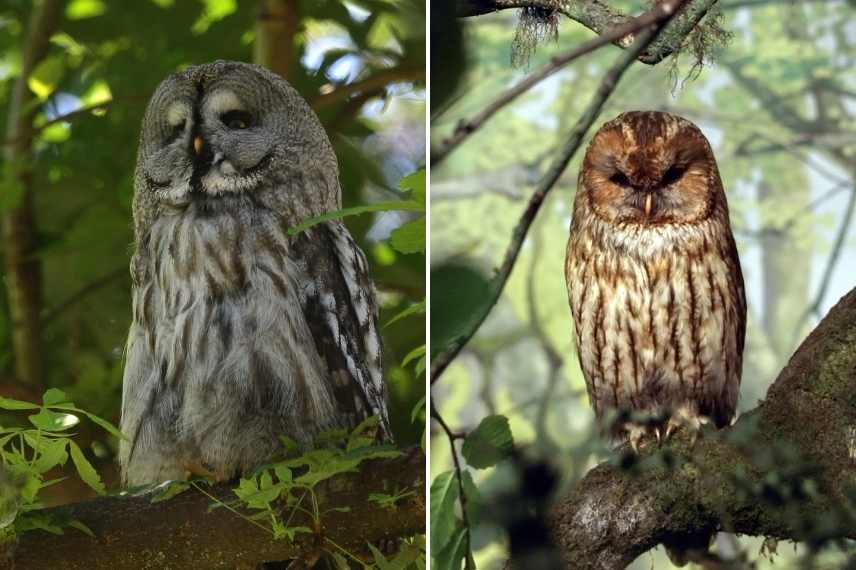
Tawny Owls can have grey or brown plumage
Read also
How to attract birds to your balcony?The tawny owl is an essential link in the food chain
The Tawny Owl assists farmers and gardeners. This bird is considered a beneficial species for crops. Indeed, it is fond of small rodents or small mammals (voles, shrews, and mice), birds and nestlings, but also, and less commonly known, insects, slugs, and earthworms.
One can even have fun dissecting the pellets to identify the diet of the owl that produced them. Inside, you will find small bones, recognisable with a bit of practice, elytra, insect wings, tufts of hair, down… In short, everything that is indigestible for the owl.
The male and female do not have the same hunting sites, nor sometimes the same diet. This is often the case with raptors: it helps them avoid food competition.
It hunts at night, but it does not rely solely on its eyes. Indeed, it is thanks to its ears (do not confuse them with egret feathers, as owls do not have those), arranged asymmetrically on the sides of its head, that it can be a formidable hunter in the dead of night. Our own ears, arranged on the same line, only give us a “left-right” perception of the source of a sound, as well as a sense of distance based on the sound’s intensity (to put it simply!). The owl, with its asymmetrical ears, also possesses excellent directional hearing. The owl can locate its prey with great precision. The prey stands no chance.
The Tawny Owl is not just a predator; it can also be preyed upon. The Goshawk (Accipiter gentilis) and the Eurasian Eagle-Owl (Bubo bubo) are capable of catching and killing Tawny Owls. The Red Fox, for its part, regulates owl populations by sometimes attacking nestlings in the nest or those that have fallen from it (which is easier for it).
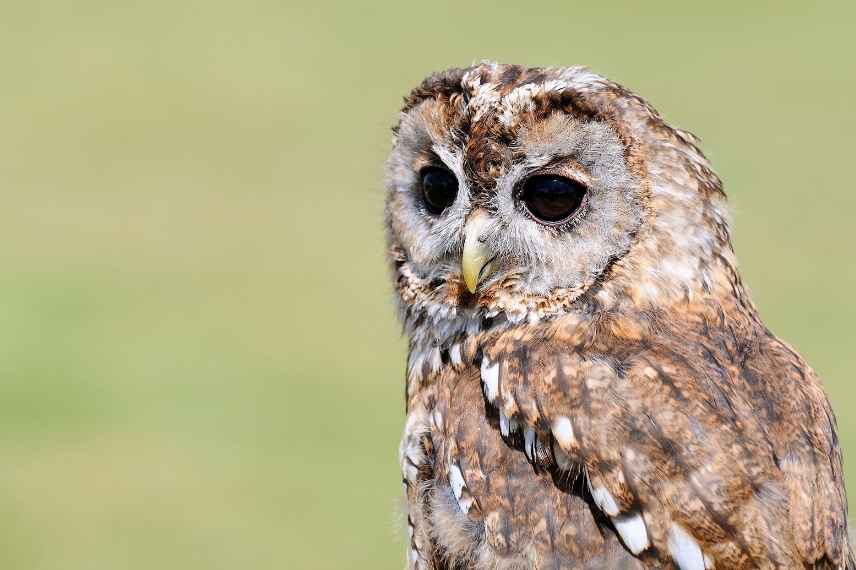 Tawny Owl
What can you do to have the chance to welcome the Tawny Owl into your home?
Welcoming one or more owls to your home or nearby is somewhat of a stroke of luck and largely depends on the owls themselves. However, there are several ways to ensure they feel comfortable in your garden:
- Create a garden that prioritises nature: with a wide biodiversity so they can find food;
- Maintain calm both day and night: in terms of noise, human activity, and light pollution;
- Keep large trees on which they can perch: mainly leafy trees;
- Leave some living or dead trees with cavities;
- If that’s not possible, installing specific nesting boxes is a plus: here’s an example plan for this type of nesting box.
 A garden promoting biodiversity with large trees or those with cavities will be ideal for supporting tawny owl habitats.
And what about light pollution?
Contrary to popular belief, light does not blind the tawny owl. In reality, its visual acuity is only slightly better than ours. Its eyes simply adapt to darkness better than ours. However, light pollution is indeed problematic for nocturnal raptors, as well as for moths and nocturnal insects, migratory birds, bats, nocturnal mammals, and even amphibians. In the case of owls, light during the night disrupts their hunting and prevents them from finding refuge sites. In other words, do not over-illuminate your garden and the surroundings of your home if you care at all about wildlife. The night must remain night.
Read also
Hedge for birds: which shrubs to choose?How to know if she is around?
Pellets of regurgitation
You can find pellets of regurgitation (or boluses) in certain areas of a Tawny Owl’s territory: often at the base of a tree used as a perch. Tawny Owl pellets are more or less cylindrical, about 5 cm long and 2 cm in diameter, and are relatively greyish. They contain everything the owl cannot digest after swallowing its prey whole: bones, hair, feathers, elytra…
Did You Know? Pellets of regurgitation are not exclusive to raptors. Other carnivorous, piscivorous, or omnivorous birds also produce them. This includes corvids (crows, magpies, ravens…), larids (gulls and terns), waders (sandpipers, godwits…) and the Kingfisher.
Tawny Owl’s call
You hear it more than you see it! Between January and March, which is the breeding season, the male’s territorial hooting is quite distinctive: a prolonged “ouuuuu” followed a few seconds later by “ou… ou ou ou ou”. The female then responds to the male with a very powerful “kiwit”. This “kiwit” can be heard all year round.
Please note: do not attempt to imitate the male’s call in hopes of receiving a response! This is a source of stress for him, and you risk disrupting any potential nesting.
⇒ Listen to the Tawny owl’s call.
Direct observation
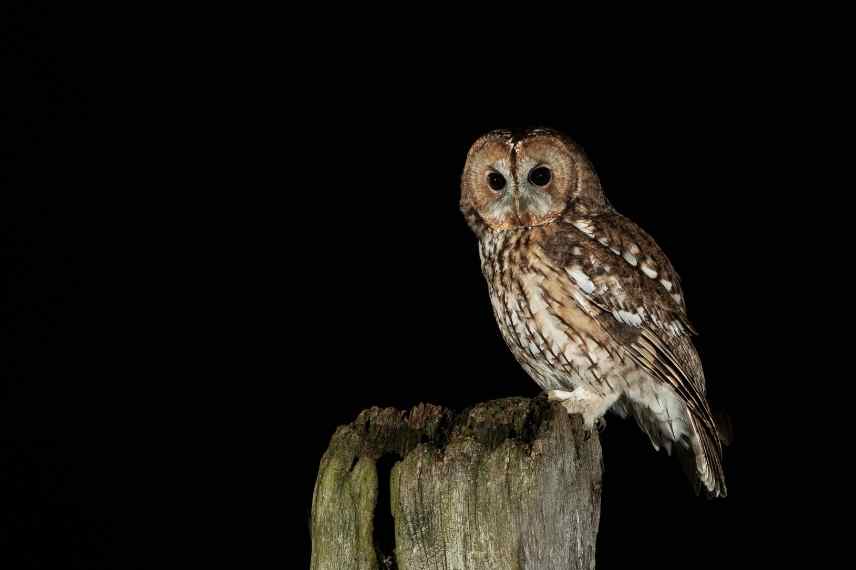
Although the Tawny Owl is quite discreet, it can sometimes be seen at dusk when it goes hunting or simply perched at the top of a tree. It is not particularly shy, and if you maintain a distance of about twenty metres and avoid sudden movements or noise, you can observe it for a few minutes while it prepares to take flight and resume hunting. Note that both diurnal and nocturnal raptors often return to the same spots if they are not disturbed.
Although primarily nocturnal, it can also be disturbed during the day. By humans, of course, but not only. Some birds, particularly among the corvids (Crows, Ravens…), may harass it with loud calls when they discover it. In this case, the Tawny Owl has no choice but to change its location for a nap.
However, be careful! Never disturb it at the nest! The Tawny Owl is very aggressive near its young, and a curious onlooker who comes too close may quickly lose an eye.
The night of the owl
Some ornithologists and nature guides organise nature walks, lectures, or activities focused on nocturnal raptors. This is the case, among others, with the LPO (League for the Protection of Birds) in France, as well as Natagora in Belgium during “The Night of the Owls”. Don’t hesitate to inquire about events near you!
- Subscribe!
- Contents
Comments