


They resist the cold: discover the hardiest Eucalyptus trees
The hardiest varieties
Contents
Eucalyptus trees possess a range of aesthetic qualities: blue-grey-green aromatic foliage, a majestic silhouette, a smooth and colourful trunk. They are often associated with the hot and dry landscapes of Australia, their main native region. Yet, some of these remarkable trees have proven their ability to thrive well beyond the borders of their natural habitat and adapt surprisingly well to colder climates. In this article, let’s explore the hardiest eucalyptus varieties, those that can withstand the rigours of winter.
→ Read our full guide on Eucalyptus.

Eucalyptus parvula
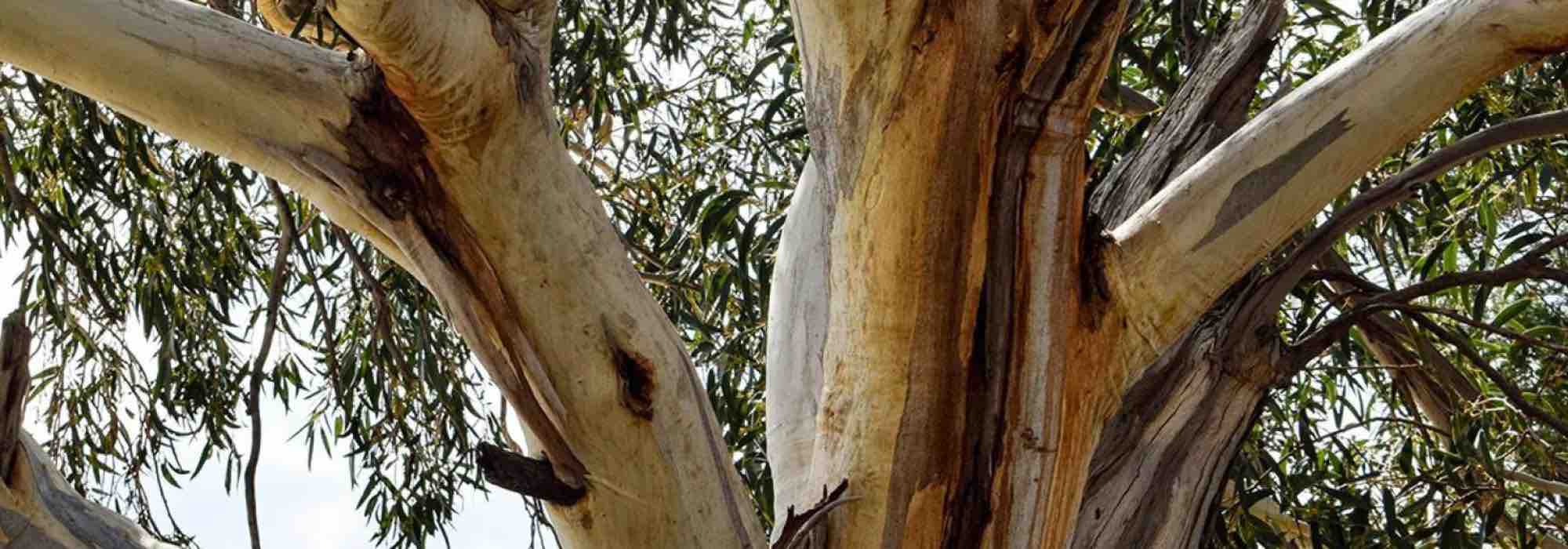
The Eucalyptus parvula, known as the small-leaved gum, is a small evergreen tree with a slightly contorted habit and trailing branches. Its grey bark peels in ribbons, revealing fresh bark in changing colours. Its sickle-shaped leaves, a vivid olive-green, stay on the tree all year round.
Originating from Australia, specifically the plateaus of New South Wales and the state of Victoria, the small-leaved gum is characterised by rapid growth and a spreading habit. Although modest in size for a eucalyptus, it develops a twisted trunk and a dense, bushy crown, reaching 8 to 12 metres in height and 7 metres in width at maturity. However, proper pruning can help limit its growth.
Adapted to semi-montane and semi-arid climates, the small-leaved gum tolerates temperatures down to -20°C. While eucalypts are generally water-hungry, this species tolerates summer drought, particularly in Mediterranean climates. Eucalyptus parvula, with its distinctive appearance, twisted trunk, notable bark and elegant foliage, makes a standout feature in the garden when grown as a specimen.
Eucalyptus pauciflora subsp. pauciflora 'Buffalo'
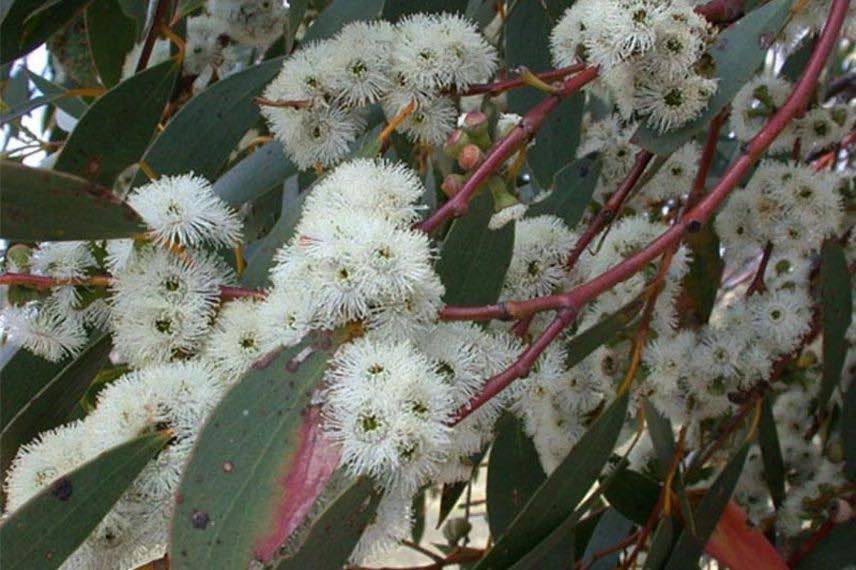
L’Eucalyptus pauciflora subsp. pauciflora ‘Buffalo’, also known as Buffalo Mountain Snow Gum, is a shrub or small evergreen tree with a spreading habit and a rounded crown, distinguished by its highly decorative bark in grey, white and cream tones. Juvenile foliage is of a distinctive ovate shape and bluish-green in colour.
Native to a restricted area around Mount Buffalo in Australia, the Eucalyptus pauciflora subsp. pauciflora ‘Buffalo’ is exposed to a broad range of climatic conditions. Its growth, though relatively slow, allows it to form a small tree or a mallee, a ramified shrub with a low-growing habit typical of some Australian regions, measuring less than 10 m. The arborescent form, in our latitudes, rather measures 6 to 10 m, with an equivalent spread.
This species demonstrates great adaptability, both to soil and climatic conditions. It grows happily in neutral to acidic soils, and also tolerates calcareous soils fairly well. It is also tolerant of heat and even drought, all of which aid its hardening in most of our regions. Its only requirement is well-drained soil.
Capable of withstanding temperatures down to -15°C, the Eucalyptus pauciflora ‘Buffalo’ brings to our cooler region gardens a touch of the exotic. For a strikingly exotic composition, pair it with a Asimina triloba for its exotic fruits and with the Diospyros kaki for its lush foliage and tasty fruits.
→ Note that this Eucalyptus has the ability to regenerate via a lignotuber. This is an underground swelling rich in starch, capable of emitting numerous shoots if the aerial part of the plant is destroyed (typically by fire). The regrowth is thus denser than the original plant after this coppicing. This characteristic allows for severe pruning to limit its development, encourage branching and stimulate the growth of juvenile foliage, often more decorative.
Eucalyptus pauciflora subsp. niphophila 'Mt Bogong'
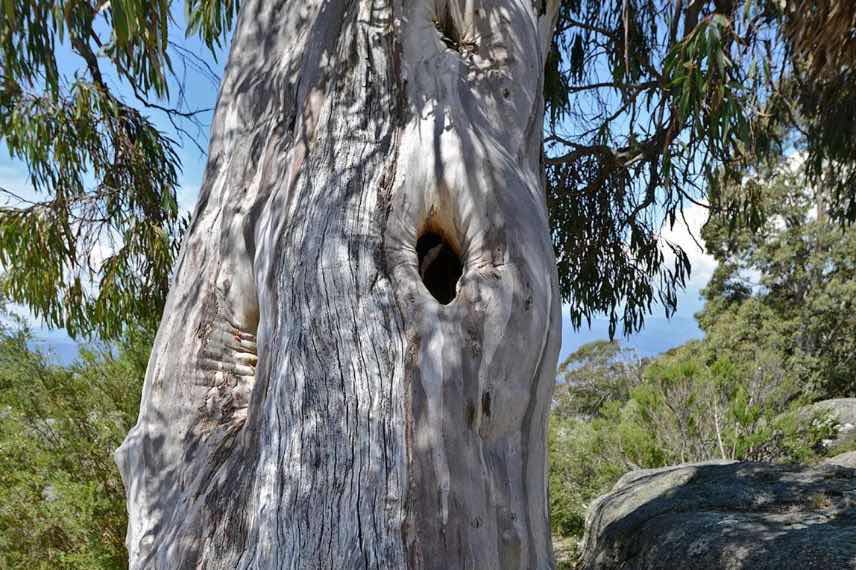
The Eucalyptus pauciflora subsp. niphophila ‘Mt Bogong’, also known as Mt Bogong Snow Gum, is a bush or a small multi-stem tree that attracts attention with its decorative bark, blending shades of grey, white and cream. Its compact habit and its rather sparse crown make it an ideal choice for restricted spaces. Juvenile foliage is an attractive blue. Its high hardiness and its ability to adapt to most well-drained soils, including calcareous and dry soils once established, allow it to harden across almost all regions of France.
The Mt Bogong Eucalyptus originates from the mountainous zones of Australia, notably around Mount Bogong. This cultivar, suited to a mountain climate with mild summers and cold, snowy winters, has demonstrated exceptional frost resistance, able to withstand temperatures down to -23°C in its natural habitat, though its hardiness is generally limited to -18°C outside its native range for well-established mature plants.
This Eucalyptus typically forms a mallee 7 to 8 m tall and 3.5 to 4 m wide, with a significant regenerative capacity thanks to its lignotuber. It can also assume a relatively low tree habit, but with a single trunk. The foliage, both juvenile and adult, is decorative and moderately aromatic, with bluish oval leaves on young shoots and longer leaves, lanceolate to falcate, in adults.
Compact and well suited to pruning, it is suitable for small gardens and can be paired with the Cyprus strawberry tree or Arbutus andrachne in climates not too cold for its beautiful red-orange bark, or with Prunus maackii ‘Amber Beauty’ in colder regions for the same aesthetic contrast.
Read also
Growing an Eucalyptus in a potEucalyptus archeri
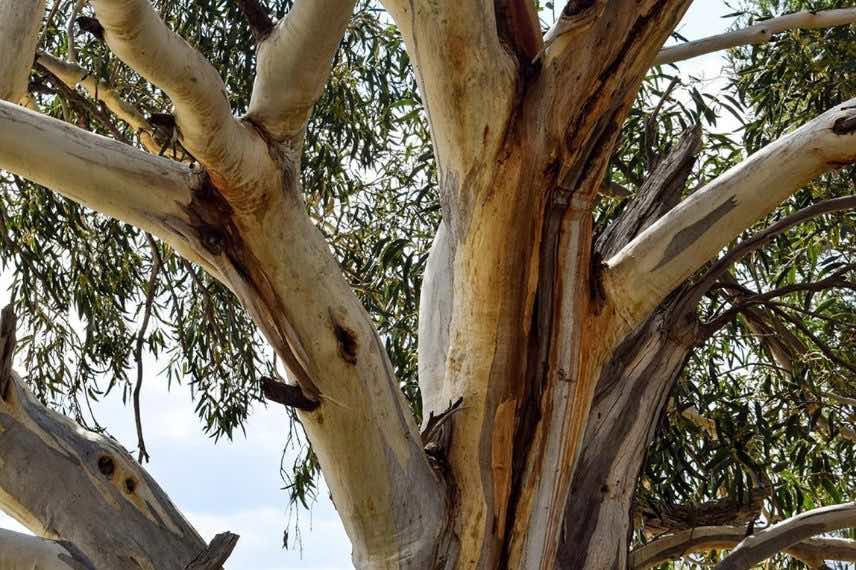
Originating from the Tasmanian Alps, Eucalyptus archeri is close to Eucalyptus gunii but with greener foliage and a more compact habit; it also offers superior resistance to harsh climatic conditions. In its youth, it adopts a shrubby appearance before maturing into a small, graceful tree, whose light crown and fragrant foliage are decorative all year round. Its bark bears soft pink, grey-green and white highlights.
The rapid growth of Eucalyptus archeri allows it to form a small, elegant tree, reaching about 8 to 9 metres in height with a 4.5-metre spread. Its bark is adorned with transverse scars. The foliage, which remains juvenile for several years, evolves from small rounded leaves in a pale blue-grey to adult leaves that are pendulous, elliptical or lanceolate, ranging from grey-green to bright silvery-green.
With a lignotuber beneath the soil surface, Eucalyptus archeri can resprout from the stump after severe frost, fire or drastic pruning. It tolerates snow, wind and salt spray well, and its root system is not extensive, minimising risk to structures. Its light shade does not hinder neighbouring plants’ growth.
Eucalyptus archeri harmonises with silvery shrubs such as coyote willow or the pendulous willow-leaved pear, or with a purple hazelnut for a striking contrast. Easy to maintain and hardy to -18°C once mature, it adapts to a range of soils, including clay and slightly calcareous soils.
Eucalyptus niphophila
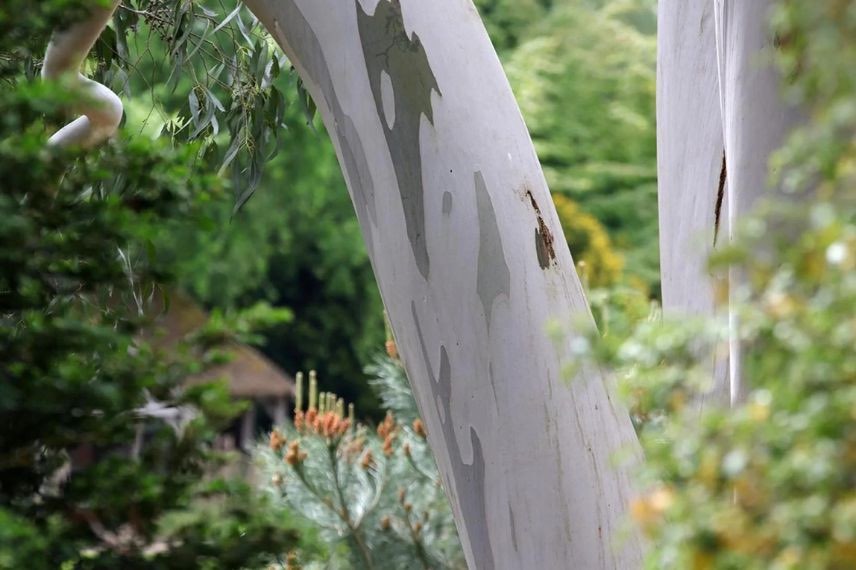
The Eucalyptus niphophila, a compact, twisted form of the Eucalyptus pauciflora, is a large evergreen bush that draws the eye with its twisted habit and spiralled branches. Its bark peels in broad ribbons to reveal, over time, a patchwork of creamy-white, grey and brick-red. Its long sickle-shaped leaves, a greyish, leathery hue, provide an effective vegetative screen in a hedge or border. Renowned as one of the hardiest eucalypts for cold weather, it readily adapts to many regions, including mid-montane areas, requiring only a sunny site and well-drained soil.
Native to south-eastern Australia, more precisely from around Mount Kosciuszko in the Australian Alps, Eucalyptus pauciflora ssp. niphophila thrives in high-altitude valleys that are often snow-covered in winter. This plant, which was awarded an Award of Garden Merit in 1993, is characterised by moderate growth, forming a twisted trunk and a bushy crown with a slightly spreading habit, reaching at maturity six to eight metres with a similar spread.
Adapted to semi-montane climates as well as semi-arid summer conditions, this eucalyptus can withstand temperatures down to -20°C, provided it is planted in well-drained soil. Curiously, eucalypts are generally heavy water users, even in winter, contributing to the drying of soils. By contrast, their drought tolerance in summer is proven in Mediterranean climates. When planted as a specimen, Eucalyptus niphophila is particularly notable for its distinctive habit, its spectacular bark and its elegant foliage, although it can also be integrated harmoniously into hedges with other hardy bushes such as the Buddleias.
Eucalyptus vernicosa 'Mt Hartz'
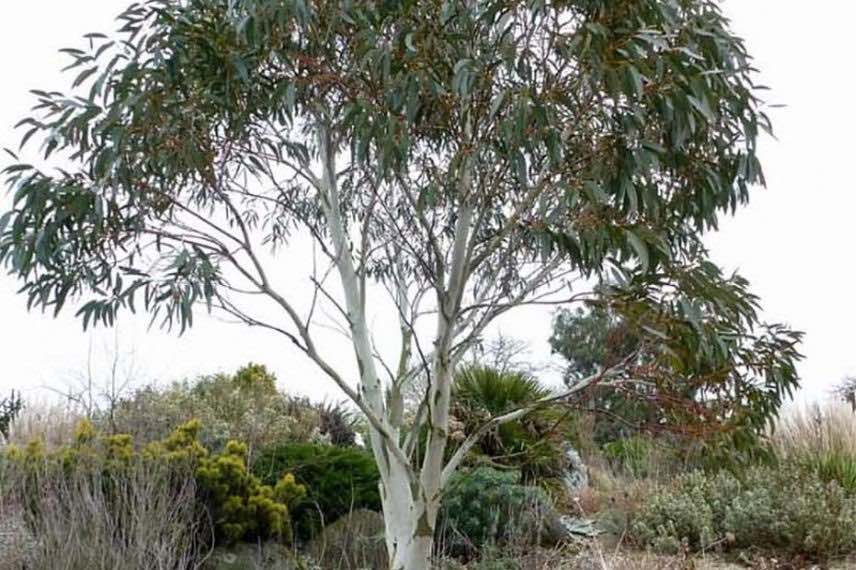
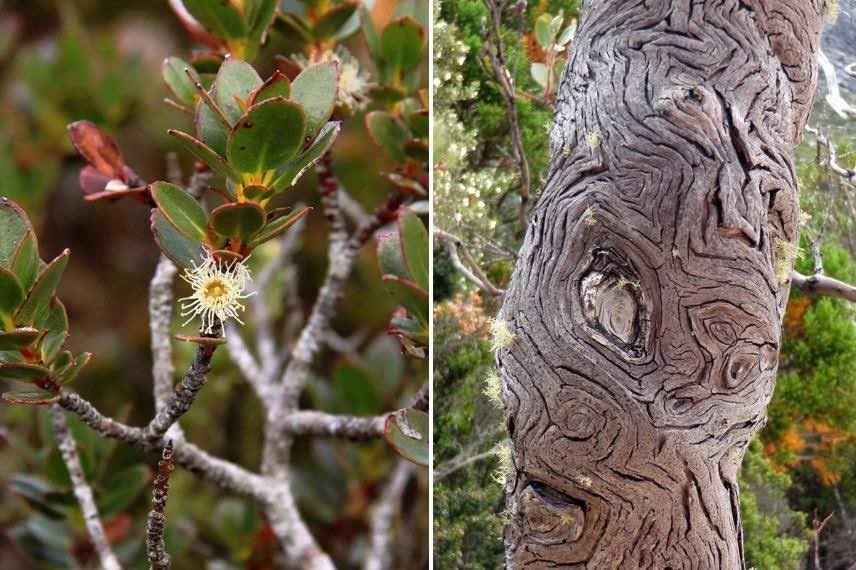
Eucalyptus vernicosa ‘Mt Hartz’, nicknamed varnished gum or varnished gum tree, is a dwarf bush with a charming compact habit and glossy foliage. Originating from the cold, mountainous regions of Tasmania, it is distinguished by its ability to withstand temperatures down to -15°C, snow and strong winds. Its very slow growth and its preference for moist conditions require a well-chosen spot in the garden, in full sun and in moist soil.
Endemic to south-west Tasmania, Eucalyptus vernicosa grows naturally on the high plateaus and in alpine regions, such as Hartz Mountains National Park, where it is subjected to extreme climatic conditions. It thrives in poor, acidic and peaty soils, often above the treeline, at elevations between 700 and 1,400 metres. This shrub, which can reach 1 metre high and wide, has dense foliage of small obovate leaves, green and glossy, which remain juvenile throughout its life. Young shoots, a vivid dark green with bronze-brown highlights, and knobbly branches bearing smooth, brown-silvery bark, add to its aesthetic appeal.
It is equipped with a lignotuber. It is perfectly suited to alpine gardens or planted as a solitary specimen in an open space to showcase its unique architecture. Pot culture is also feasible, provided the substrate remains moist and light feeding is given during the growth period.
- Subscribe!
- Contents
Comments