


Growing wasabi
To enjoy this Japanese culinary plant
Contents
Do you love the strong, spicy flavour and the beautiful green colour of wasabi? Can you not imagine enjoying your sushi without this flashy condiment? However, you have some doubts about the origin and production methods of the industrial wasabi sold in supermarkets… What if you grew your own wasabi in your vegetable garden or in a pot in a greenhouse? It’s perfectly possible, provided you offer it the right growing conditions. Because Japanese wasabi (Eutrema japonicum) is a somewhat demanding and delicate plant that requires constant temperature and humidity. Likewise, you will need to be patient and wait 2 to 3 years before harvesting the roots.
So, if the experience of growing wasabi appeals to you, discover how to plant, grow, and care for this perennial with a kick.

What exactly is wasabi?
Wasabi (Eutrema japonica syn. wasabia japonica syn. Cochlearia wasabi) is a perennial condiment plant from the Brassicaceae family. It is therefore a close cousin of mustard and horseradish, as well as cabbages, turnips, rapeseed, and rocket… Native to Asia, this herbaceous plant naturally grows in Japan, typically near water sources such as streams and rivers in mountainous areas that benefit from a temperate climate. It is also widely cultivated in this country, a major consumer of wasabi.
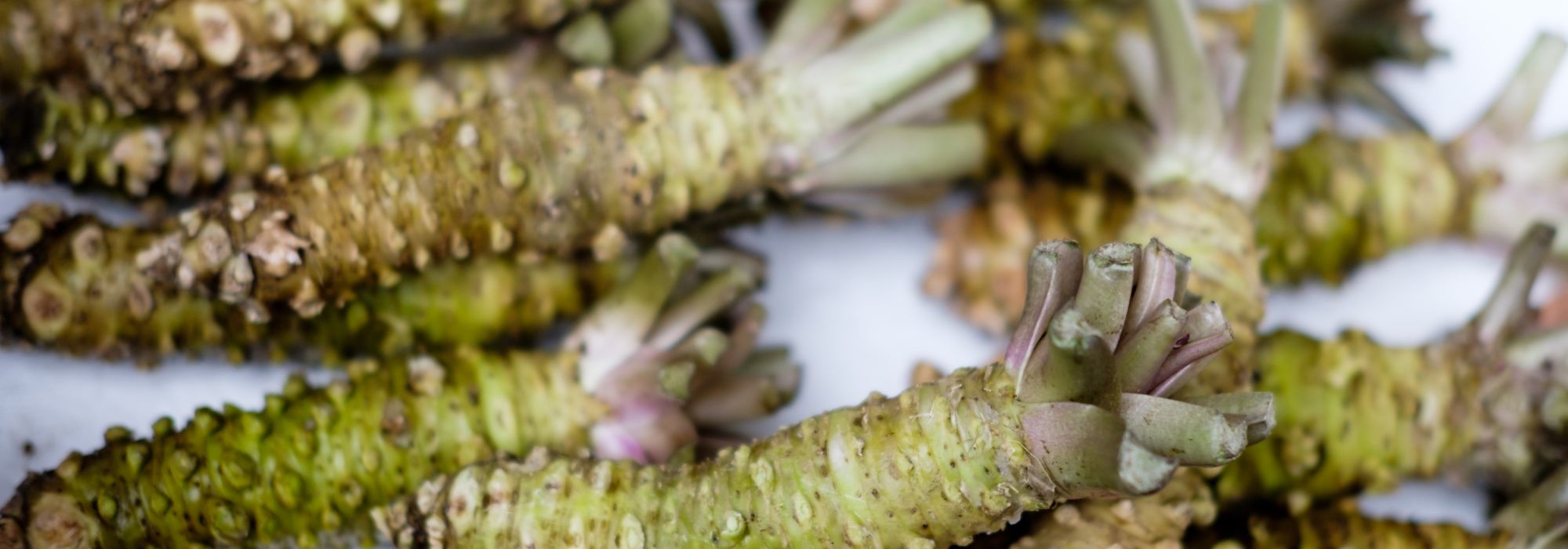
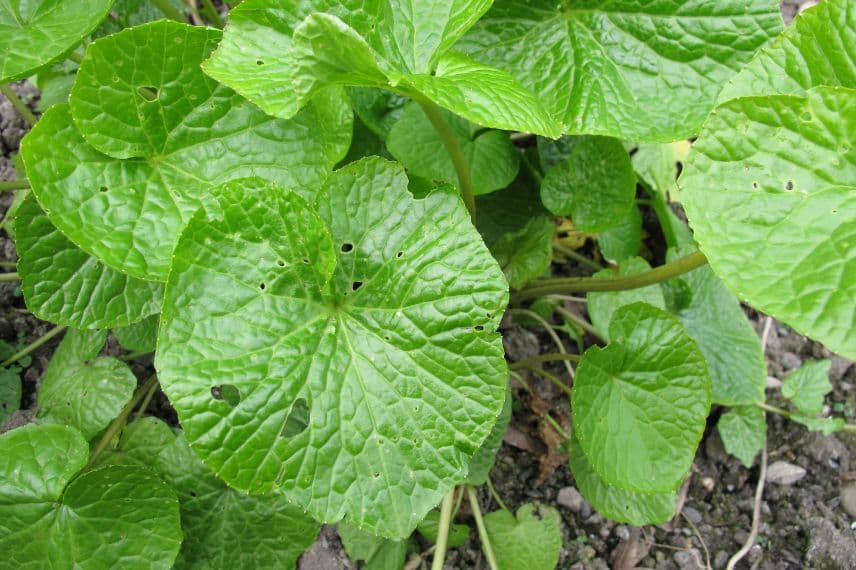
Eutrema japonica is a rhizomatous plant that produces a basal rosette of large, heart-shaped, crinkled, thick evergreen leaves with very prominent veins. The leaves, which can reach 20 cm in diameter, are borne on brownish stems. The young shoots emerge in bronze-green to purplish hues, then turn a more vibrant green as they grow. Each young leaf is characterised by protrusions resembling beads at the tips of the veins. As for the rhizome, it measures 10 to 18 cm long and 2 to 4 cm wide, and it is this part that is consumed with sushi!
Between April and May, small flowers with 4 petals, white to pink, grouped in panicles, bloom above the foliage. Afterwards, the plant goes dormant in summer.
In terms of size, wasabi reaches approximately 60 cm in height with a spread of 30 cm.
Planting Wasabi: hewre, when, and how?
Japanese wasabi is a plant with demanding cultivation requirements, somewhat complicated to maintain due to its cultural preferences. Similarly, if you wish to harvest its root, you will need to wait 18 months to 3 years. However, be aware that the leaves are edible! To facilitate the cultivation of this perennial plant, pot planting is entirely feasible.
Where to plant wasabi?
Wasabi is a shade or partial shade plant that cannot tolerate direct sunlight at all. Understory areas and wooded environments suit it perfectly. It is sensitive to frost and must benefit from a constant temperature of around 12 to 15 °C, both summer and winter. This is the first challenge for planting in open ground.
Likewise, this semi-aquatic plant thrives in constantly cool and moist, yet well-drained soil. Indeed, waterlogged soil would cause the rootstock to rot. It prefers neutral to acidic soils.
In our latitudes, wasabi is primarily grown in pots with excellent quality potting soil. It is obligatory to place a good layer of clay pebbles at the bottom of the pot. For better drainage, it is also possible to alternate layers of potting soil and layers of clay pebbles. The pot must absolutely have drainage holes, but avoid using a saucer where water can easily stagnate. This would be very detrimental to wasabi.
Ideally, here, wasabi is grown in pots and in a greenhouse, in a shaded corner. Otherwise, the climate of the Atlantic coast suits it quite well, as frosts are minimal and temperatures remain relatively constant throughout the year.
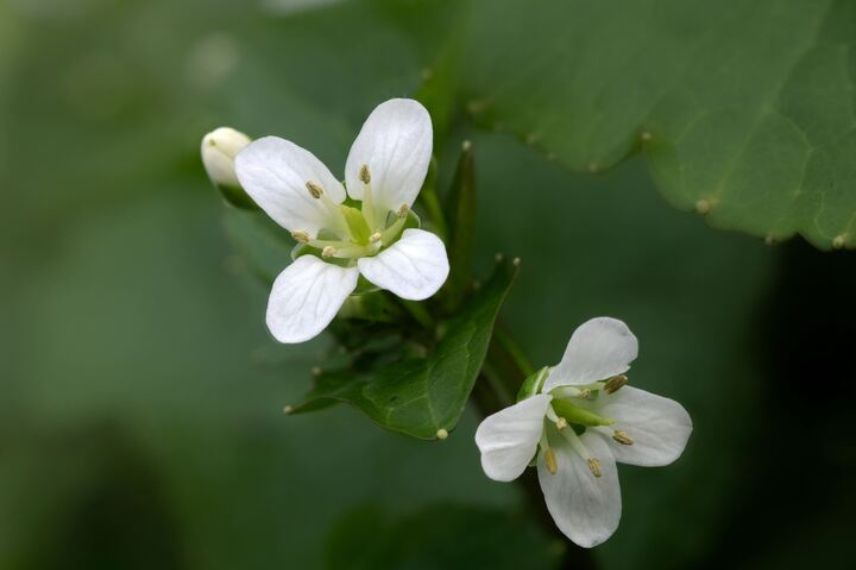
Flower of wasabi
When to plant wasabi?
Wasabi should be planted in spring, ideally in April or May, outside of frost periods.
How to plant wasabi in a pot?
- Choose a pot with drainage holes
- Place a good layer of clay pebbles
- Add a layer of very good potting soil
- Gently plant the wasabi rootstock
- Cover with potting soil
- Firm down and water
What care does wasabi require?
The essential care for wasabi consists of watering. The substrate should remain continuously moist, never drying out. Ideally, watering should be done using a drip system to ensure the substrate never dries. However, it should be monitored deeply.
Wasabi enters dormancy quite early, in summer. Nevertheless, watering will continue.
When the rootstock is ready to be harvested, small shoots appear at the base of the plant. These small rhizome shoots can be taken and replanted. However, sowing is difficult, as the seeds take a long time to germinate.
Harvesting and storing wasabi
Leaves can be harvested as needed. They have a milder and less pungent flavour than the root. They can be added raw to a salad and enjoyed cooked.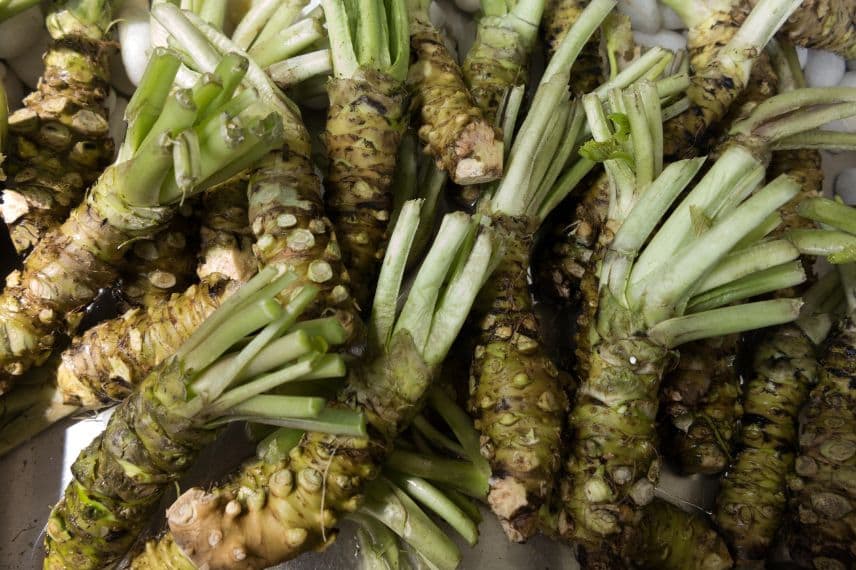
After 18 months to 2 years of patience, the plant can be unearthed to retrieve the rootstock. Remember to keep the small offsets to replant immediately. This rootstock can be stored for several weeks in the refrigerator, like ginger roots. It should be wrapped in a damp cloth or in a damp paper towel, placed in an open plastic bag or an airtight container. The cloth should be re-moistened every two days.
Wasabi: from the kitchen garden to the kitchen
The root of wasabi is used grated or crushed, added at the last minute, just before serving, as its flavour is very volatile. The brown skin should be scraped or cut off beforehand. It can easily be incorporated to flavour a meat or fish dish, a soup, Asian noodles… It can also be added to a spreadable cheese on toast. 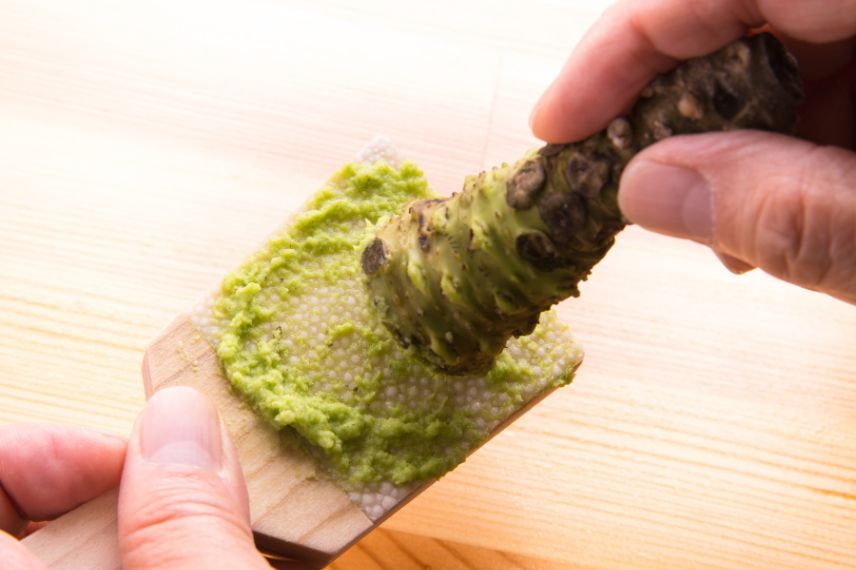
- Subscribe!
- Contents

Comments