





























Kitchen garden in French Eastern regions: which vegetables to grow?
Selection of vegetables suited to the Eastern kitchen garden
Contents
Growing your own small kitchen garden and enjoying fresh vegetables all year round is a dream for many people, whether rural or urban. However, not everyone is on an equal footing depending on the region in which they live and garden. France is blessed with a diversity of climates, often extreme from north to south. That is why it is essential to select species and varieties of vegetables adapted to a climate, terroir, and soil. Nothing is more disheartening or discouraging than failed sowings or meagre harvests.
If you are fortunate enough to live in the Grand Est region of France, discover the main vegetables that can be grown there with great success.

What climate is typical in the French eastern region?
If we had to simplify, eastern France could, climatically speaking, encompass the 10 departments of the Grand Est region (Ardennes, Aube, Marne, Haute-Marne, Meurthe-et-Moselle, Meuse, Moselle, Bas-Rhin, Haut-Rhin and Vosges), to which Haute-Saône, Doubs and Jura could be added. This vast area benefits from a semi-continental climate across most of the territory, with pockets of montane climate in the Vosges and Jura.
That’s why this eastern region is subject to a fairly harsh climate, characterised by hot summers and relatively cold, severe winters. Snowfall is, moreover, regular there, varying in amount from year to year. Clearly, the temperature range between summer and winter is substantial. As for precipitation, it is highly irregular and unpredictable due to the presence of relief. By contrast, storms begin in spring and are frequent in summer.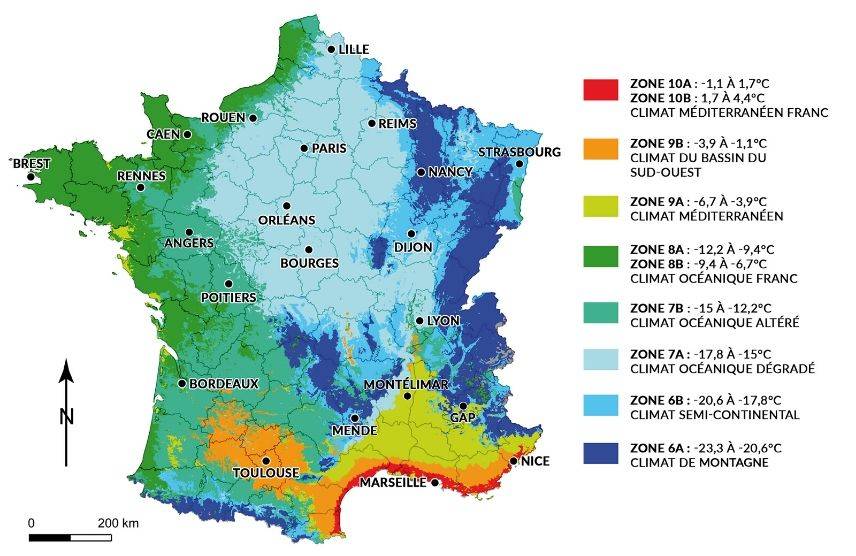
Over the last twenty years, north-eastern France, like the rest of the country, has borne the consequences of climate change, with episodes of drought and heatwaves. Winters tend to be milder, but spring frosts have become more pronounced. Moreover, snow is no longer rare from November or early spring, sometimes in substantial quantities.
Various vegetables to grow in a kitchen garden in the Eastern region
Continuing in a spirit of simplification and clarification, I will endeavour to compile, as exhaustively as possible, a list of vegetables easy to grow in the East region. Of course, this list isn’t set in stone, in the sense that crop success depends on many other factors beyond climate. Soil type and exposure are essential, as are cultivation methods (mulching, soil amendments, digging or simply aerating the soil…). Likewise, the time you can devote to your veg plot factors into the profitability of your harvests. That said, in principle almost all traditional vegetables can be grown in France, but some will be more suited to the East’s climate, others a little less so.
The root vegetables
These are undoubtedly the region’s flagship vegetables for the East, as, on the whole, they tolerate the cold more easily. However, due to late spring frosts, sowings in open ground will be a little later, often not before mid- or late March. Planting will only take place after mid-May. This is why it is always best to select late-maturing varieties. Unless you grow under some shelter (greenhouse, tunnel, frame…) which will allow you to bring forward your sowings a little.
Among the root vegetables, the carrots top the list. You can stagger your sowings: in March in sunny conditions for a harvest in June–July, and from March to July for a later harvest. However, carrots prefer cool, deeply worked soils and above all not stony. Among the varieties recommended for the East region, one may cite the Colmar à cœur rouge, a late-maturing and hardy variety, valued for its red, juicy flesh. The carrot ‘Géante de Tilques’ is also an old, traditional variety from the north of France to favour in your veg plots. It combines all the qualities: yield, long keeping quality, flavour and root size. Finally, the ‘Jaune du Doubs’, originating from Franche-Comté, is today prized for its flavourful qualities.
In the East region, it is also possible to grow turnips. Sown in open ground in April, or July–August for an autumn and winter harvest. It will be necessary once again to choose hardy, robust varieties such as the ‘Navet rave d’Auvergne tardif’ which offers excellent yields, or the ‘Blanc dur d’hiver’ with long white roots, or the Navet de Nancy à feuille entière, a productive variety that resists the cold.
Beetroot will also find a place in your veg plot. Sown from April to July. Thus, the very old French variety ‘Crapaudine’ should allow you to enjoy beetroots with very subtle flavour.
Also consider black winter radish, which is sown from June to July. But to obtain a good harvest, they will need to be watered generously through the summer. Naturally, all other varieties of radish grow without difficulty in the East region.
Not forgetting these heritage vegetables, less common but incredibly tasty. Namely rutabagas, Jerusalem artichokes, scorzonera (black salsify) and salsify, or parsnips.
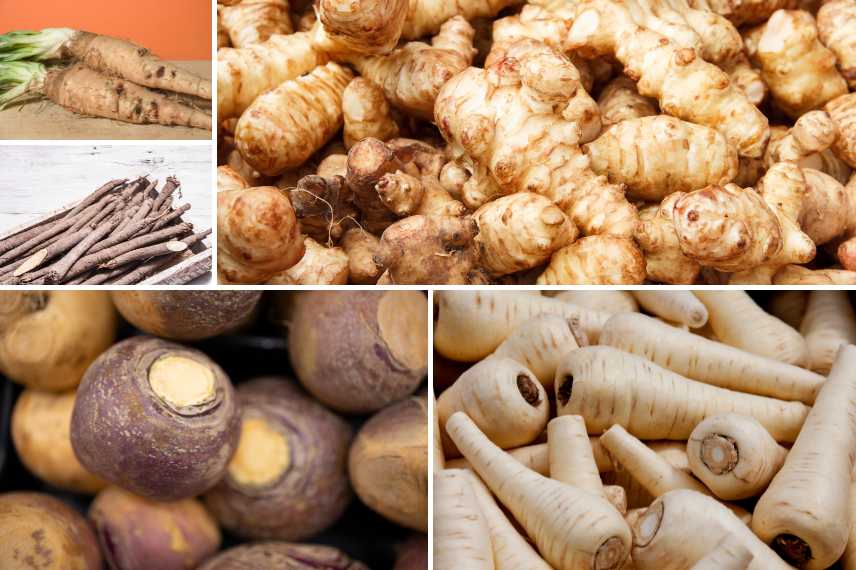
In addition to traditional root vegetables, heritage vegetables are very well suited to the East region’s vegetable garden
The leafy vegetables
In a veg plot in the East region, it is quite possible to grow a multitude of leafy vegetables. Starting with cabbages, fairly well suited to the climate conditions of this area. All cabbages can be grown: white cabbage (such as the ‘Quintal d’Alsace’ or the Cabus de Brunswick’), Milan cabbage (notably the ‘Gros des Vertus’), curly kale (D’automne tardif’), kohl rabi, kale…
Spinach also adapts very well to the East France’s veg plot. They are sown from March to April, and in August–September. For autumn cultivation, the Giant winter is certainly a safe bet.
Leeks are also to be prioritised in your garden. Again, you’ll want to choose hardy varieties such as ‘Bleu de Solaize’, the Bleu d’hiver or the Winter leek of Saint-Victor. To maximise your success, favour buying crowns rather than sowing.
Of course, all salads (lettuce, lactuca, endives, lamb’s lettuce, rocket…) can be sown and pricked out. It is essential to consider sowing times and growing seasons to choose the best varieties. For more: Lettuces to harvest in autumn and winter
As with leeks or chard, whose sowing will be later than elsewhere. Choose varieties such as the Verte à cardes blanches or the ‘Verte à couper’.
The seed vegetables
The East region’s climate is also very well suited to growing seed vegetables, such as green beans, peas, sugar snap peas, broad beans… generally a sure-fire success. For peas, you should opt for round-seeded varieties rather than wrinkled-seeded ones.
Fruit vegetables
As in the rest of France, the tomatoes, courgettes and squashes, cucumbers and gherkins are grown in summer in the Northeast departments’ veg plots. Nevertheless, planting cannot be considered before mid-May due to late spring frosts. Given that hot summers sometimes extend into October, there is plenty of time for everything to ripen.
Flower vegetables
This category includes cauliflower, broccoli, Brussels sprouts, artichokes and cardoons. Among cauliflowers, choose varieties suited to all climatic conditions such as the ‘Merveille de toutes saisons’ or ‘Géant d’automne Primus’. Broccoli will require plenty of moisture and fertile soil. In contrast, Brussels sprouts are recommended for their hardiness. The variety ‘Sanda’ is hardy and late. Artichokes can be planted in the garden provided they are protected from cold in winter with a wintering veil together with a straw cover. The same goes for cardoons.
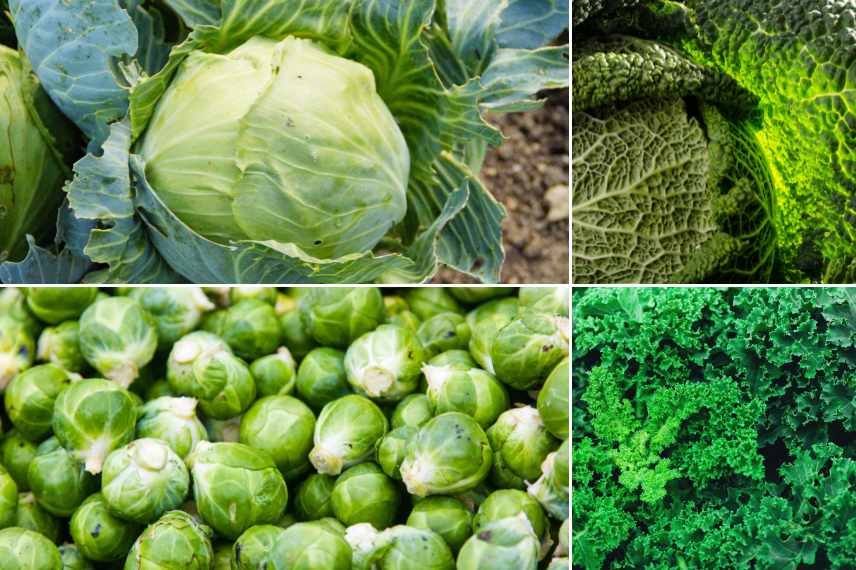
Many cabbage varieties find a place in East region’s vegetable gardens
Tubers
All potatoes can be grown, either as early varieties for a quick harvest or for storage.
Bulbs
Treat yourself to garlic, onions and shallots. It is nevertheless best to plant bulblets rather than sow.
Vegetables you can (almost) forget about!
In vegetable gardens located in semi-continental climates, with pockets of montane climate, some vegetables will be difficult to grow in open ground, without shelter. And in particular all Mediterranean-origin vegetables that require hot, long summers. Thus, it is quite challenging to obtain good harvests of peppers and chillies, of melons or watermelons or of aubergines. However, under glass, you can always give it a go…
Similarly, the cultivation of lentils and of chickpeas is out of the question. Or that of sweet potatoes whose cultivation is long and whose harvest is late in autumn.
- Subscribe!
- Contents

Comments