





























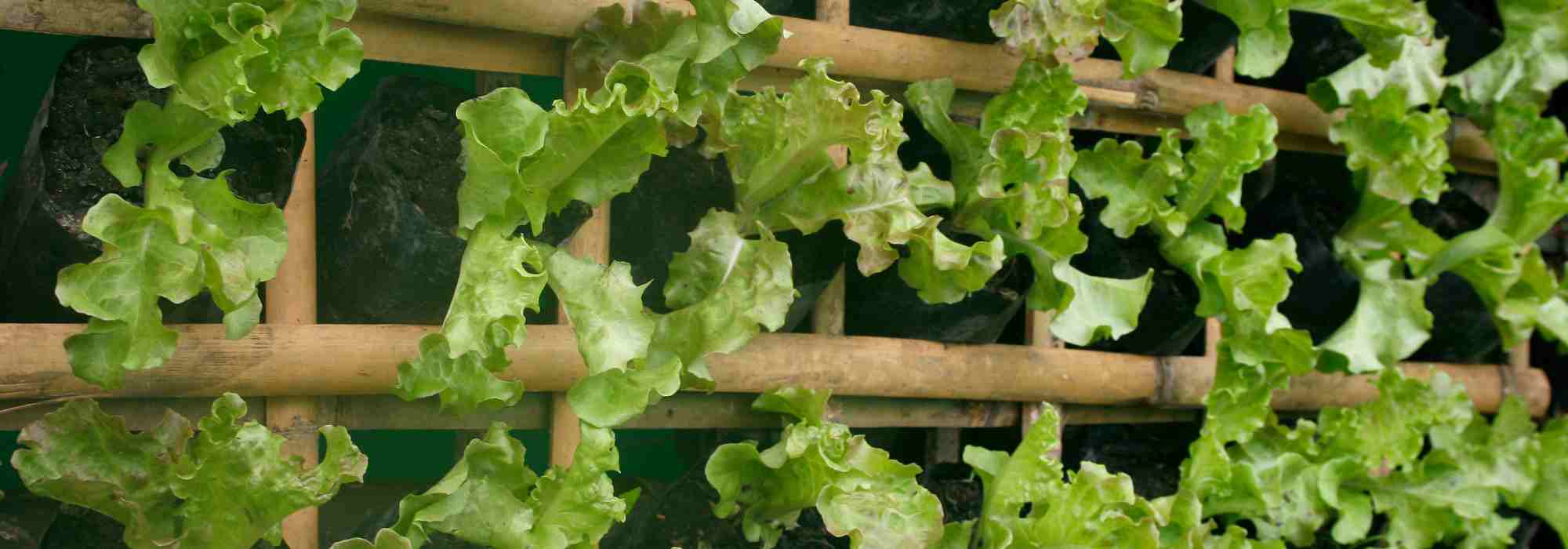
Vertical vegetable garden: our ideas for getting your crops climbing
Tips and advice for creating a vertical vegetable garden in the ground or on a city balcony
Contents
Traditionally, a vegetable garden is laid out horizontally. The vegetables grow in beds, neatly arranged in rows, spaced at sensible distances. Aisles make it easier to move around, but also to hoe, weed, water, and harvest. Obviously, this traditional vegetable garden requires a lot of space. Space that some gardeners simply do not have — either because the plot is too small, they live in town, or they only have a terrace or balcony.
Hence, the only solution to obtain a more nourishing vegetable garden is to go vertical. Indeed, the simple act of growing vertically can free up square metres, and, incidentally, reduce the effort involved. When it comes to vertical gardening, anything is possible and there is no shortage of upcycling tips. Discover all our ideas, good or bad, for creating a vertical garden that is productive and aesthetically pleasing.
Benefits of growing your vegetable garden vertically
Developing or creating a vertical vegetable garden presents many advantages. Starting with the most obvious: space-saving. Indeed, by increasing the surface area available for planting and cultivation, you gain in productivity and profitability. And the smallest vertical space can be exploited: the front of a house, a garage or a garden shed, the fence of your vegetable garden, whether mesh or wood… On a terrace, you can use a pergola or an arbour; on a balcony, railings or side panels. In short, it’s all opportunities to squeeze in a few extra square metres. And logically, that means more vegetables or small fruits to grow to boost your yield.
The second argument in favour of vertical gardening also seems obvious: it helps limit effort and reduce back pain. Indeed, with these vertical installations, the only effort is to sow or plant! Afterwards, the harvest is carried out at standing height (or at waist height) so it is considerably less exhausting.
Then, the vegetables and small fruits grown vertically are noticeably healthier and cleaner since they have no contact with soil. They are soil-free and washing is easier. Beyond this cleanliness, vegetable crops grow more healthily. Indeed, the foliage is not dampened by watering and does not touch the soil, which helps limit the development of cryptogamic diseases. Moreover, some fungal spores often lie hidden in the soil.
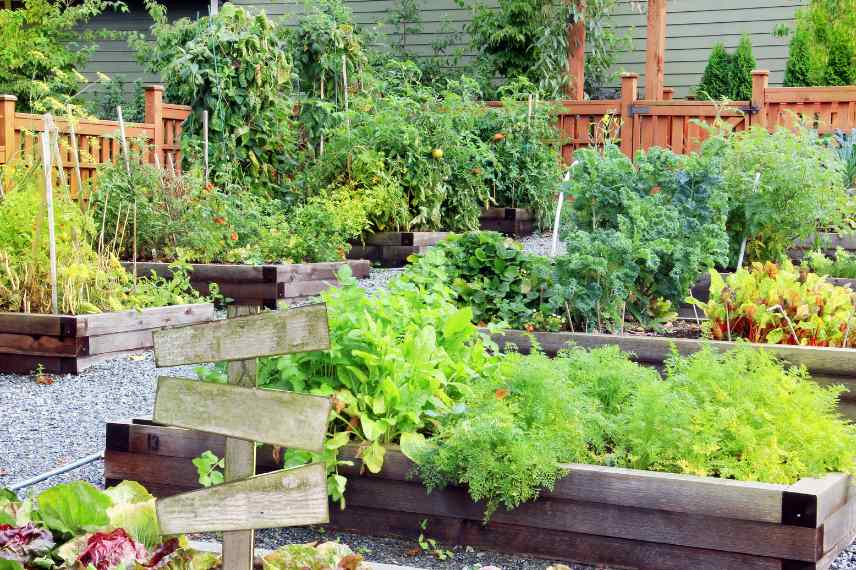
To garden vertically, you can take advantage of the garden’s fences
The final argument is purely aesthetic. Creating a small vertical vegetable garden on a balcony or terrace in the city allows nature to enter. And by gardening vertically, you bring opulence, lushness and abundance… a bit like a jungle. You also contribute to environmental preservation and to the restoration of biodiversity in cities.
How do you garden vertically in an in-ground vegetable garden?
Vertical growing is a clever way to optimise a vegetable garden. The space saved at ground level is substantial, particularly for common vegetables. Moreover, these vertical crops can prove very useful for shading other vegetables at ground level, such as radishes or lettuce, once the foliage has covered the structure. That’s the crux of the matter! For a plant to grow vertically, it needs an appropriate structure. You can, of course, run these climbing plants along the mesh fencing or the wooden edging surrounding the vegetable garden. Or on the house’s vertical walls, or on a garden shed. First, install an off-the-shelf trellis. To keep costs down, you can also use sheep or chicken wire, masonry mesh, or tiler’s mesh… Just ensure about a 10 cm gap between the façade and the structure to allow voluble stems to thread through.
Within the vegetable garden, you can also rely on a DIY approach. Handymen are at the forefront of devising ingenious systems. A few battens and sheep netting are enough to create arches, tunnels and pergolas to allow plants to grow upwards. More playfully, it’s easy to collect bamboo canes or Provence reeds (Arundo donax) to build a tipi. Just tie them together at their ends to secure them.
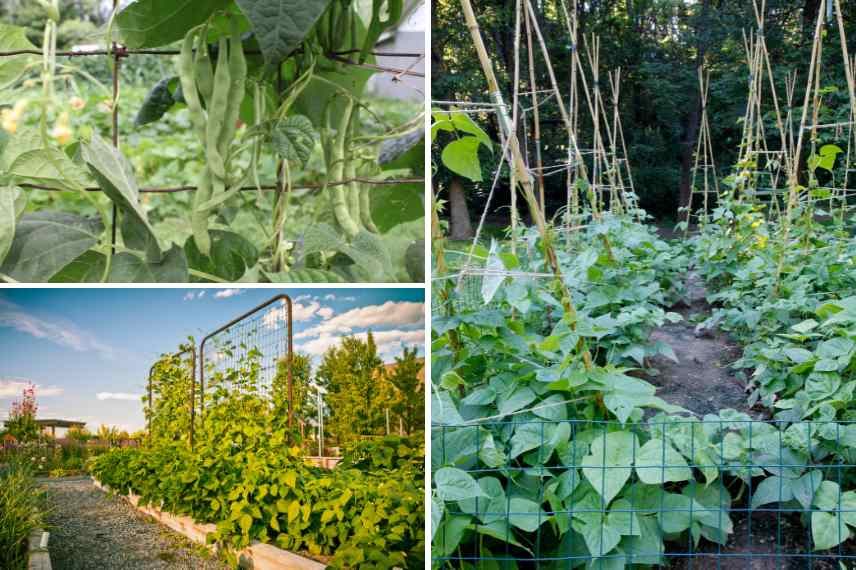
To make vegetable plants climb, it’s easy to create structures with bamboo canes and stakes…
For tomatoes, also consider cages, which Virginie D. details the construction for abundant harvests, without pruning. Alexandra explains how to weave living osier, or willow.
As growing vegetable plants can also take place beyond the walls of the vegetable garden, don’t hesitate to bring out the drill, nails and hammer to build raised square-foot vegetable beds that will be installed in your ornamental garden. To do this, pallets rescued from a haulier or a major retailer are ideal.
Finally, without turning it into a garden forest, you can take inspiration by letting edible climbing plants climb up a living or dead tree.
Create a vertical vegetable garden on a balcony or terrace
In urban settings, it’s hard to find a patch of soil to grow a garden. Apart from shared gardens or community and family gardens, which remain very common in some cities such as Saint-Étienne. Nevertheless, even the smallest balcony or terrace can be used to create a vegetable garden. To start, the urban gardener can install pots, planters, containers and square vegetable beds, raised or not, to accommodate a wide variety of vegetable crops. But space quickly becomes limited. The aim, therefore, is to make use of vertical surfaces.
The simplest option is to install shelves along the sides of the balcony or terrace, where you can easily fit pots of different sizes and formats. An old, refurbished piece of furniture can lend your balcony a touch of bohemian, chic and country charm. Just like the old ladder, propped against a wall, on which you can place or hang pots. In approaching this topic, why not consider hanging pots where strawberries can be planted that will trail down (for the delight of children and adults alike!).
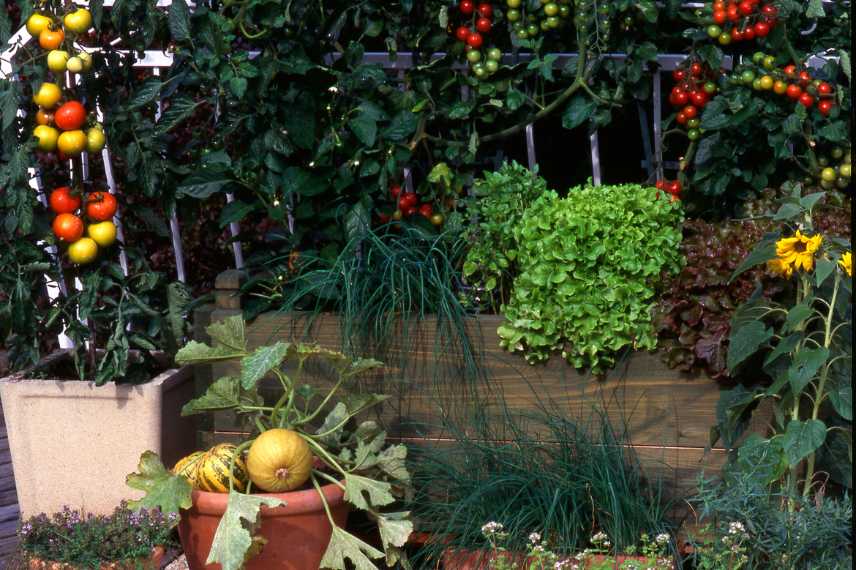
Balustrades or balcony side walls can be used
On a balcony, you can also fit any trellis, or even braided cords running from floor to ceiling. Also use the balcony’s balustrades and guard rails to train climbing vines. A recycled pallet is also an option. Simply line one side with garden felt, then cover it with a sheet of plywood. Then fill it with potting soil and install it vertically against a wall. Ordinary stakes can also serve as supports for a climbing vegetable plant.
On the internet, other budding gardeners have cobbled together vertical vegetable gardens using gutters nailed to battens. Quite ingenious, but the available potting soil is in very short supply to provide ideal growing conditions. In shops, it’s also easy to find pocket gardens or grow bags, relatively practical and effective, but pricey.
Read also
Growing strawberries on the balconyWhich vegetable plants and small-fruit plants can be grown vertically?
In a vertical vegetable garden, climbing vegetables will be grown as a priority. Starting with all species in the Cucurbitaceae family: squashes, butternuts, patty-pan squashes, pumpkins, climbing courgettes…but also cucumbers, the melons, the gherkins.
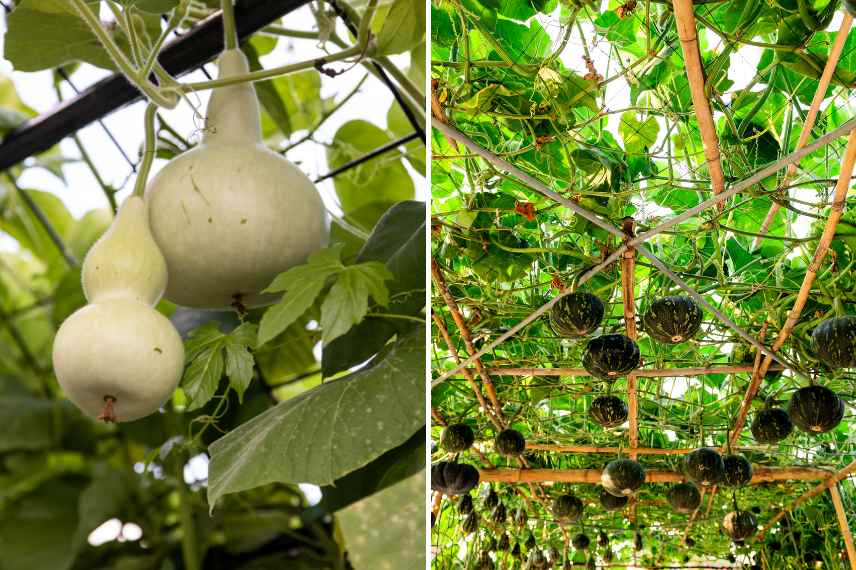
Squashes adapt very well to vertical cultivation on sturdy structures
Less well known but highly productive, chayotes or christophines (Sechium edule) also need support for their climbing stems. Just like the remarkable Malabar spinach (Basella alba), which is well suited to pot culture. Or yam (Dioscorca batatas) which produces climbing vines.
Among the more common vegetables, perfect for integrating into a vertical vegetable garden, we include climbing beans, garden peas, mange-tout or sugar snap peas, broad beans which need trellises, supports or canes to climb. Don’t forget also the magnificent Spanish beans (Phasoleus coccineus) which allow you to combine utility and beauty with their orange flowers.
Tomatoes, aubergines, peppers and chillies can also be grown vertically, in “towers”.
In vertical structures such as pallets or pocket gardens, one can sow or plant salad leaves, leeks, spinach…Not forgetting all the aromatic herbs.
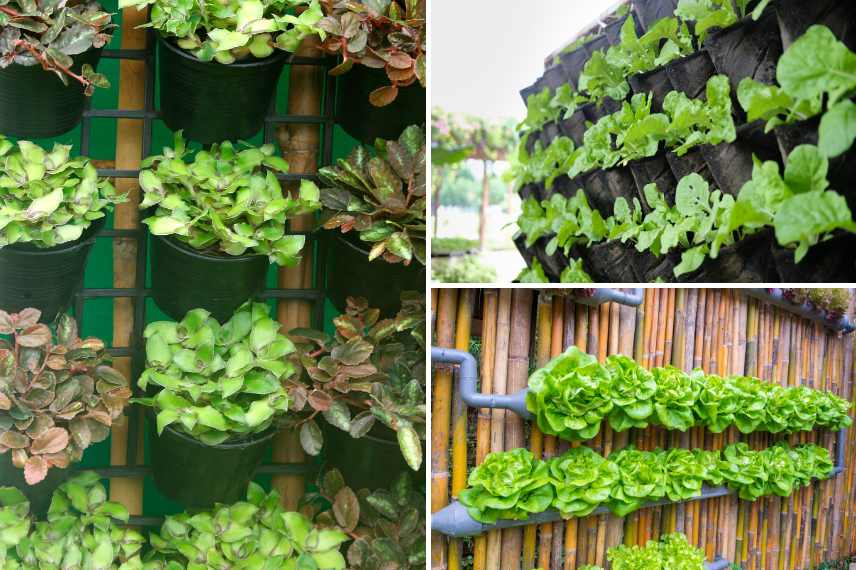
Salad leaves adapt well to vertical cultivation
Root vegetables, however, are not well suited to this type of cultivation, as they require deep soil.
A kitchen garden also includes small fruits. And in this regard, many of them grow vertically. Thus, strawberries bear fruit as do fruiting brambles which yield our delicious blackberries or raspberries. Also consider kiwifruit (Actinidia) trained on the vine, grapevines, the Schisandra which bears Chinese berries, and passionflower and its passion fruits.
- Subscribe!
- Contents
Comments