


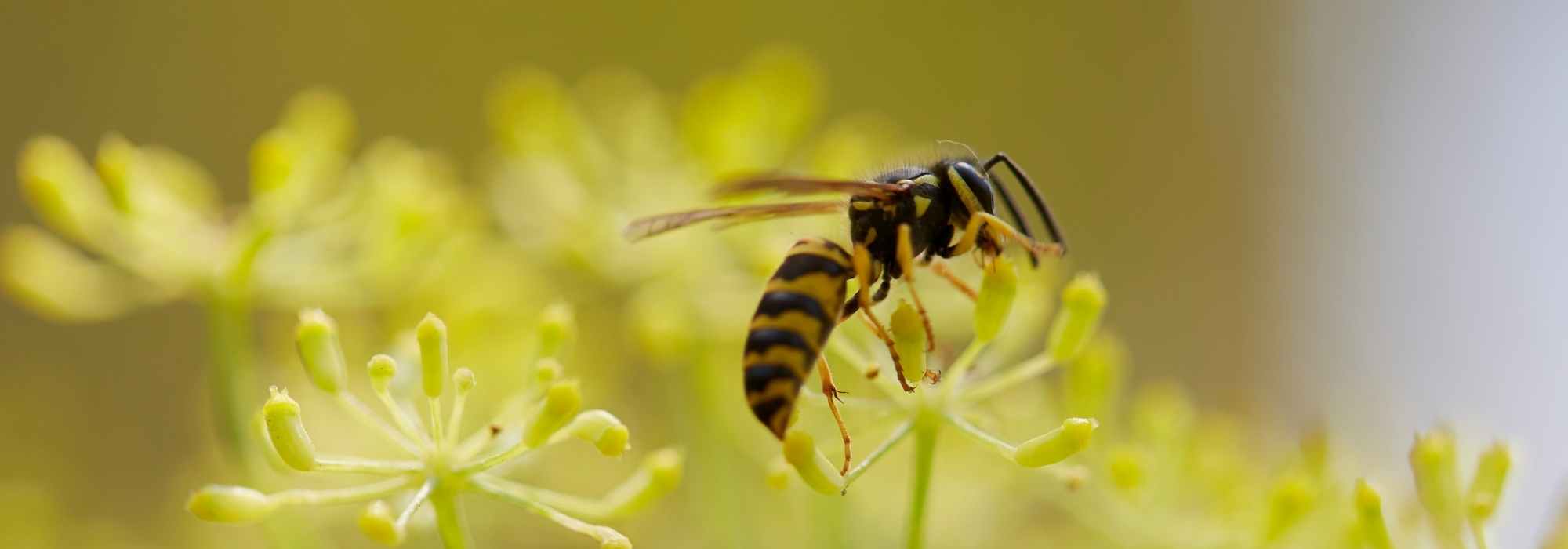
Wasps in the garden: friends or foes?
an insect as unloved as it is unknown
Contents
Wasps are hymenopteran insects that are often feared, even hated, and are almost considered pests. People worry when they see a few wasps, particularly the Common Wasp or the German Wasp, buzzing around us while we enjoy a meal outdoors in the warm season. It’s even worse when we discover a wasp nest too close to our homes. It is true that the sting is painful and can even lead to serious complications in case of an allergy.
However, the species of wasps are as numerous as they are diverse: they come in all sizes and colours, and they differ in their lifestyles. Wasps can also be beneficial in the garden and in nature. They prove to be good pollinators and help regulate insect populations, sometimes those that are harmful. In short, let’s allow a place for wasps in the garden if they do not pose immediate problems.
Discover more about wasps in our advice sheet.

What are wasps?
The vernacular name “wasp” is ambiguous. This term refers to many species of hymenopterans (an order that also includes bees, bumblebees, and ants) that are aculeate, meaning their abdomen is distinctly separated from the thorax (the waist of a wasp!). In common language, the term wasp typically refers to two very common species: the Common Wasp (Vespula vulgaris) and the German Wasp (Vespula germanica).
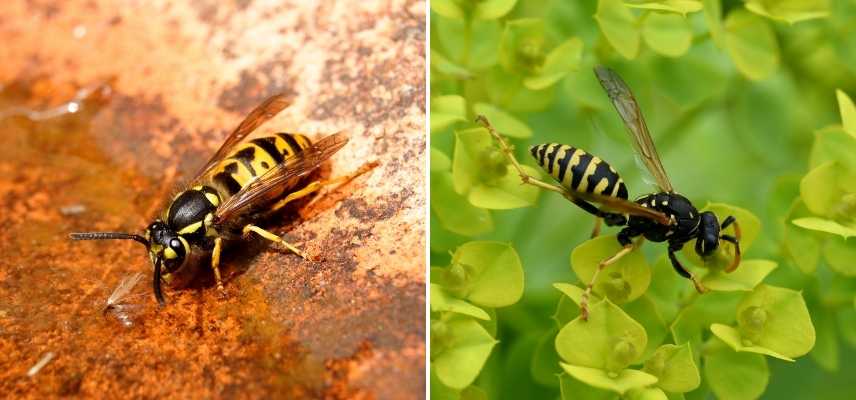
Vespula vulgaris and Vespula germanica
Wasps can be classified as follows:
- social wasps: these wasps form annual colonies founded in spring by a queen. The nest is made up of cells constructed from a kind of paper-like paste made by the wasps chewing wood and mixing it with their saliva. Among these wasps are the Common Wasp and the German Wasp, but hornets (genus Vespa) are also considered social wasps;
- solitary wasps: they enjoy warmth and sunlight. They come in various shapes, sizes, and colours depending on the species. They inhabit many different environments but are particularly prevalent in sandy areas;
- mason wasps: these solitary wasps build small nests from clay or mud or particles of sand and clay agglomerated with saliva. The nests are specific to the species, so if a nest is found, the species can be identified;
- digging wasps: these are solitary wasps that dig nests underground. These nests are often filled with the remains of insects or spiders in which the female directly lays an egg;
- pompilid wasps: pompiliids are solitary wasps. The female feeds the larvae with spiders. She may either use a spider’s nest, take over a cavity, or dig a burrow before or after capturing her prey.
Given the number of species, hundreds just in Europe, it goes without saying that “wasps” exhibit great diversity in shape (large or very slender), size (from a few millimetres to several centimetres), and colour (black, brown, yellow and black, black and white…). Furthermore, their habits (feeding and nesting) vary significantly.
Life Cycle of Social Wasps
- In spring, the queen of a social wasp (for example, from the genus Vespula) will begin to construct a nest in a suitable location. This nest will be made from plant fibres mixed with her saliva, creating a sort of paper pulp. The nest is formed of hexagonal chambers (the cells), within which she will lay an egg;
- The larvae will develop in the cells while the queen feeds them with hunted insects;
- Once mature, these larvae will form the caste of sterile workers (although some may be fertile and help increase the number of wasps). These workers will enlarge the nest and continue to hunt to feed the larvae from the queen’s second brood. The queen now dedicates herself solely to reproduction and no longer leaves the nest;
- The larvae fed by the workers become fertile adult females and males. They will emerge for their nuptial flight around the end of summer or the beginning of autumn. Females and males mate with individuals from the same nest and with individuals from different “wasp nests”. Males die after mating;
- The fertilised females will return to the nest to continue being fed by the workers. As the outside temperature drops, the future queen females leave the nest and seek a place to spend the winter in diapause (winter rest, slowed metabolism): a hole, a gallery in wood, beneath a bark…;
- In spring, the young queens that have survived will be able to create their own colony. And so on.
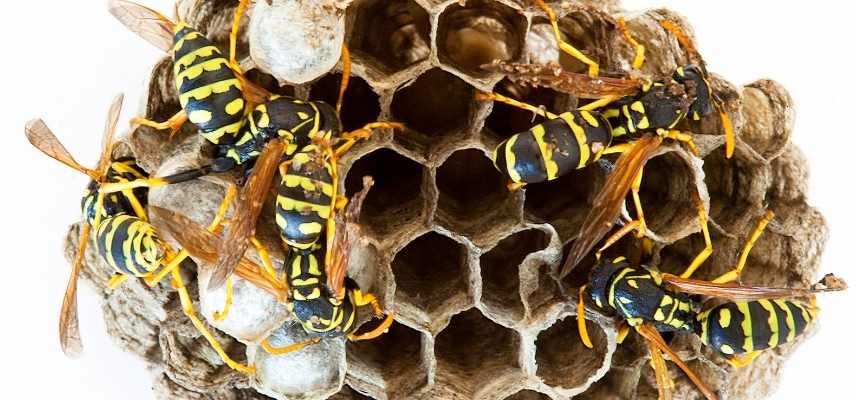
Wasp nest
Wasps are useful.
It is not widely known, but wasps are very useful insects in the garden and in nature. For this reason, they can be considered as auxiliary insects for cultivation for various reasons:
- Wasps are pollinating insects: adult wasps enjoy the sugar found in aphid honeydew, flower nectar, and fruits (and the large cakes enjoyed during Sunday afternoon family gatherings…);
- Wasps are excellent regulators of other insects: wasps can attack the larvae of beetles and dipterans, as well as butterfly caterpillars to feed their own larvae;
- Wasps represent an essential link in the food chain: some birds have specialised in preying on wasps (and other hymenopterans), such as the Honey Buzzard or even the European Bee-eater, a stunning bird that lives up to its name. Wasp nests are sometimes parasitised by insect larvae such as dipterans of the genus Volucella. Please note that badgers may occasionally enjoy a little snack of wasps.
Please note: a recent study has shown that the yeast Saccharomyces cerevisiae, used in alcoholic fermentation (notably in beers and wines), can develop in the digestive system of hibernating queens, thus being subsequently disseminated. Wasps therefore play an important role in the life cycle of this yeast.
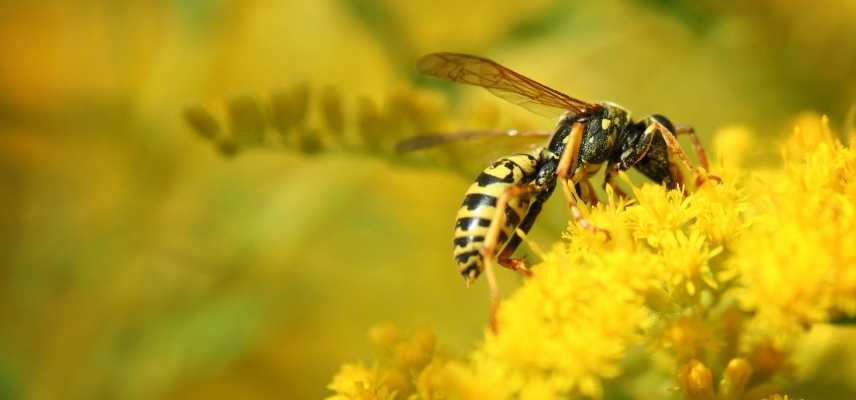 Wasps are also part of the pollinating insects</caption]
Read also
Planting a hedge for insectsHow to encourage wasps in the garden?
- Abolish all use of products ending in -cide (insecticidal, fungicidal, acaricidal, weedkiller…), even those supposedly organic or natural;
- keep dead wood on the ground or standing (if it does not pose a danger);
- leave some fruit to rot on the ground under the fruit trees;
- maintain grassy areas (banks, grassy strips, ditches, meadows…);
- diversify plant life in the garden as much as possible: trees and bushes, flowering perennials and annuals, as well as conifers;
- dig a pond or, if not possible, leave out some saucers of water in summer;
- do not destroy nests, unless they pose an immediate danger.
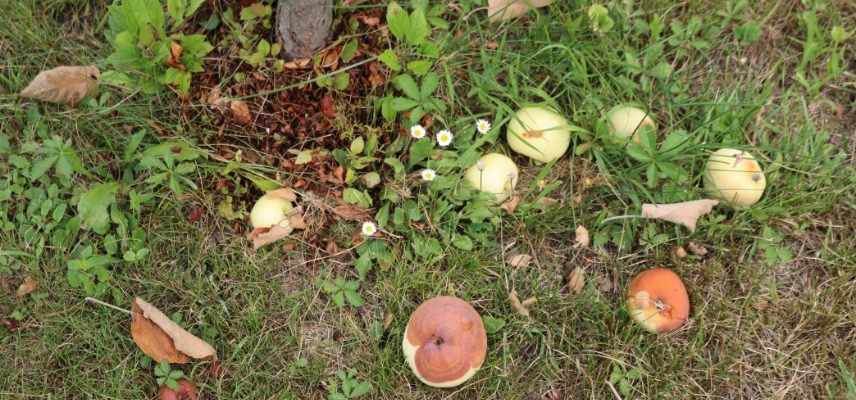
Leave some fruit to rot on the ground
Caution near wasps!
The females and workers of common wasps and German wasps, those found near homes, can sting. The sting is unpleasant but subsides quickly. However, in case of an allergy, the stung individual may experience anaphylactic shock or develop Quincke’s oedema, which can be very serious. So let’s remain cautious around wasps and avoid provoking them. As a reminder, unlike bees, a wasp can sting multiple times.
You can set up wasp traps near high-traffic areas: terrace, dining area, children’s play zone… However, these traps are rarely selective, and you are likely to kill a significant number of insects present in the garden.
If you find a wasp nest in a very busy area or very close to your home, it is advisable to have it removed by a specialised company. Do not attempt to do it yourself or rely on “a friend who happened to be passing by”!
Otherwise, if the social wasp nest is far from the home and all pathways, leave it alone! For solitary wasp nests, which can sometimes be difficult to spot, there is no risk; you can leave them be.
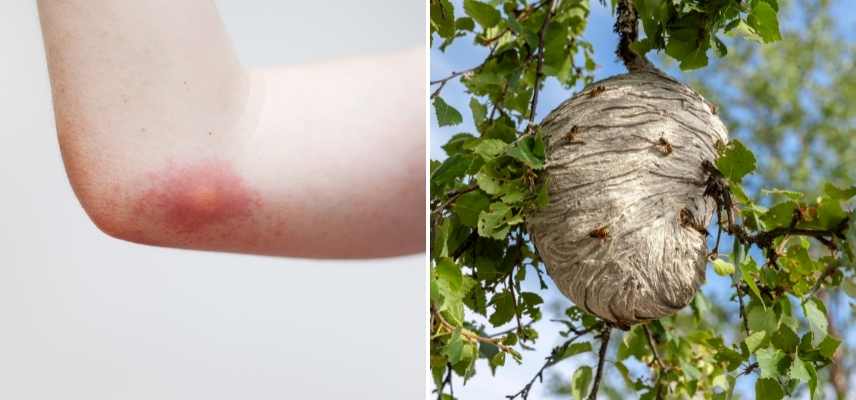
Wasp sting and nest
- Subscribe!
- Contents
Comments