


Which fertilisers to choose for ericaceous plants?
Tips for meeting the nutritional needs of acidophilous plants
Contents
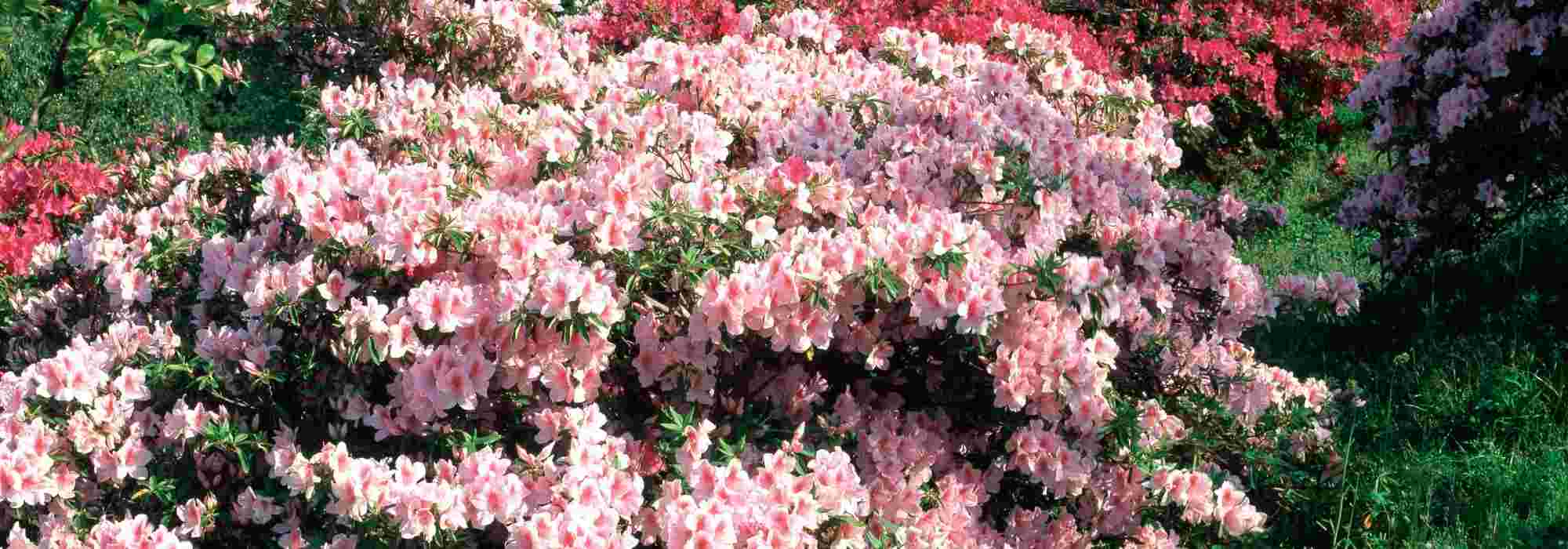
Rhododendrons and azaleas, camellias, hydrangeas, magnolias… these shrubs all enjoy spectacular flowering, and have a real cult following among some keen gardeners. But to obtain these sumptuous flowers, you must meet the specific needs of these ericaceous plants and shrubs, in terms of planting, soil and exposure. However, over time these ericaceous bushes may slow down; growth becomes less vigorous, foliage dull and flowering less abundant. An application of fertiliser is required. But not just any fertiliser!
Discover our tips for giving your cherished ericaceous plants the most suitable fertiliser.

The specific needs of ericaceous plants
Before concentrating on the best fertilisers for ericaceous plants, perhaps it’s worth recalling the plants’ specific needs, at least in terms of soil? Because this soil is not only their growing medium, but above all the earth where they will find the nutrients and water they need to thrive and give you their prettiest flowering.
And what if I start by whetting your appetite with a non-exhaustive list of splendid ericaceous plants and shrubs: rhododendrons and azaleas, camellias, hydrangeas, magnolias, Japanese maples, ferns, heathers, Pieris, Nandina domestica, Skimmia… not forgetting Leucothoe, Loropetalum, Daphne, Sarcococca… or the less well known Stewartia. Most have evergreen foliage and flowering displays, all more generous and more aesthetically pleasing than the others. All are also acidophilous plants that require acidic soil to grow well. By “acid”, we mean a pH below 7, generally between 5 and 6.5. It is a light soil, rich in humus formed from the decomposition of organic matter such as fallen leaves and dead wood. In short, it is often woodland soil, quite rare in our gardens. And logically, ericaceous shrubs thrive best where there is no lime.
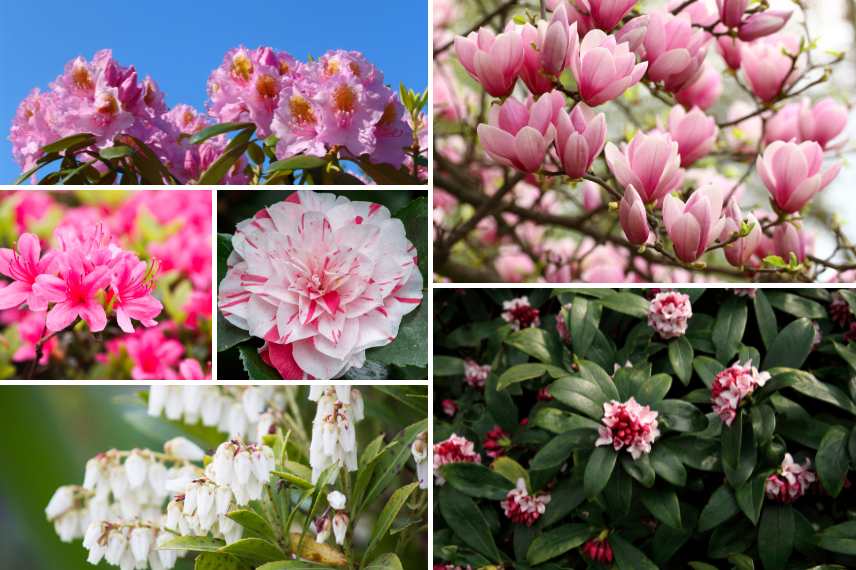
Ericaceous shrubs have specific soil needs, but also fertilisers
That is why, when planting in the ground or in pots, it is essential to add ericaceous soil, but also leaf mould, pouzzolane, pine bark… for a quarter to a third, mixed into the garden’s loam.
But behind the term “ericaceous soil” lie the true ericaceous soil and the so-called ericaceous soil. A small difference that can matter. The true ericaceous soil, harvested from woodland, is very acidic, very well-drained, rich in humus, but very poor in nutrients. By contrast, the so-called ericaceous soil is a substrate composed of peat, both blond and/or brown, crushed pine bark, compost, plant fibres… It is more affordable, less well-drained, and above all richer in nutrients. Not to mention that manufacturers sometimes add fertilisers.
Which fertilisers are most suitable for ericaceous plants?
Be that as it may, the soil of these ericaceous shrubs is becoming depleted. And, in particular, the substrate of plants grown in pots or tubs. Hence the importance of regularly feeding them with a fertiliser specifically tailored to their particular needs.
What exactly is a fertiliser?
A fertiliser is an organic substance whose role is to supply the nutrients that plants need to develop, flower and, eventually, fruit. Unlike amendments which feed, improve and structure the soil, fertilisers feed the plants directly. Indeed, they provide them with basic nutrients such as nitrogen (N), phosphorus (P) and potassium (K), but also secondary elements like calcium, magnesium, sulphur, or trace elements (iron, boron, zinc, sodium, manganese…). Each of these nutrients has a particular role.
Thus, nitrogen contributes to the development of the above-ground part of the plant, phosphorus promotes the growth of the root system and strengthens the plants’ resistance. As for potassium, it is essential for flowering and fruiting. Among the secondary elements, magnesium is primordial for photosynthesis, and in particular the production of chlorophyll, the beautiful green colour of plants. The contents of nitrogen, phosphorus and potassium are indicated by the numbers that accompany the label. For example, a NPK 12-2-1 fertiliser contains 12% nitrogen, 2% phosphorus and 1% potassium.
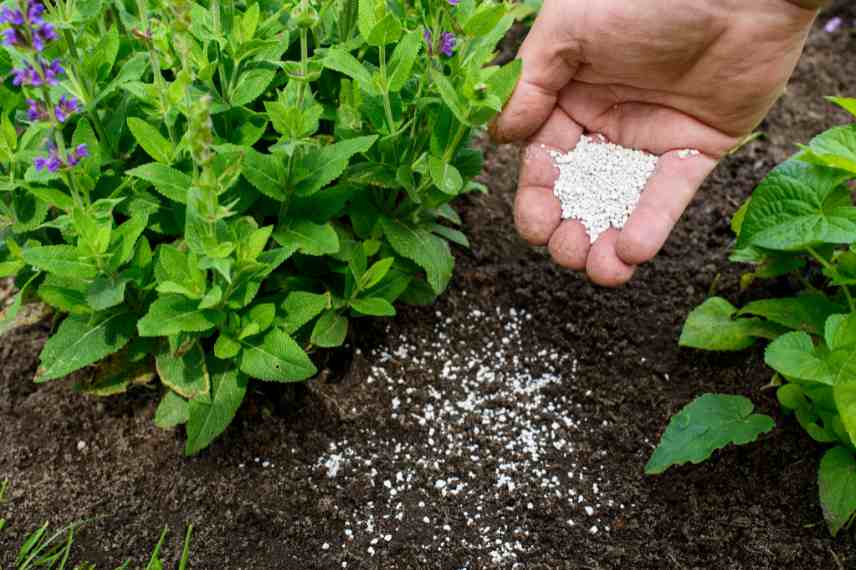
A fertiliser provides the right doses of nitrogen, phosphorus and potassium, plus secondary elements and trace elements
And finally, fertilisers, solid or liquid, come in three types:
- organic when derived from animal sources (horn meal, dried blood, guano, fish or feather meal, manures…) or plant-based (green waste, green manures, manures, seaweed, castor cake…)
- minerals when derived from natural deposits
- organo-mineral when derived from a blend of organic and mineral fertilisers.
Characteristics of fertilisers suitable for ericaceous shrubs
What do we expect from our ericaceous shrubs and plants? The question may seem blunt, but it is essential to understand which fertilisers to offer them. Indeed, rhododendrons, azaleas, camellias, magnolias… in good health are shrubs with healthy, green and glossy foliage, growing steadily, and bearing flowers in profusion, generous and adorned with their brightest colours. That is why ericaceous plants need fertilisers rich in nitrogen and potassium, two elements that promote the vigour of the foliage and the production of beautiful flowers with intense colours. They are therefore fertilisers with formulations such as NPK 7-3-10, NPK 7-5-8, NPK 4-3-6 or NPK 5-2-5 with added magnesium for the beauty of the foliage.
Whether organic or organo-mineral, in granules or liquid form, this fertiliser specifically meets the needs of ericaceous plants. Discover our selection of the best fertilisers for your ericaceous shrubs:
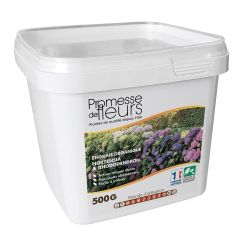
UAB Promesse de Fleurs fertiliser for hydrangeas and ericaceous plants, 500g box
Other fertilisers, more elaborated, have formulations enriched with trace elements, including iron, to improve resistance to chlorosis in ericaceous plants. For reference, chlorosis is a condition caused by iron deficiency, identifiable by pale green, sometimes yellowing foliage. It tends to develop especially in soils that are too calcareous. Here is a fertiliser selected to nourish your ericaceous shrubs, while limiting the effects of chlorosis:
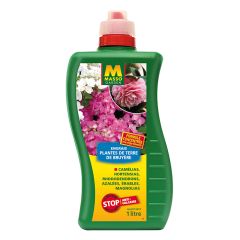
Masso Liquid Fertiliser for ericaceous plants
The special case of blue hydrangeas
‘Blauer Zwer gg’, ‘Endless Summer® The Original’ or ‘Bodensee’… these three Hydrangea macrophylla are striking for their abundant flowering in a range of blue tones. But sometimes the blue shifts to pink! Indeed, in neutral to alkaline soil, the flowers change colour. That is why it is recommended to add Heather soil, but also aluminium sulphate which will restore the flowers’ blue hue. Some fertilisers, designed for hydrangeas, are precisely balanced in nitrogen and potassium, with a hint of magnesium. But they go further by being supplemented with aluminium sulphate, for an abundant and long-lasting flowering of an intense blue.
Our selection of a blue hydrangea fertiliser :
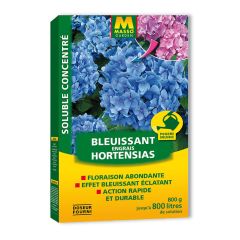
Blueing Hydrangea Soluble Fertilizer Masso Garden
Read also
Plant young ericaceous plantsWhen and how should these fertilisers be added?
Overall, special fertilisers for ericaceous plants can be added at planting or during the growth period, generally from March to September–October. And this at a rate of three applications, whether for ericaceous plants grown in pots or in the ground.
The start of spring is the ideal time to use granular fertilisers, just before growth resumes. In summer, adding a fertiliser will help support the summer flowering of certain bushes such as hydrangeas, or the autumn flowering of some camellias. And the final application, between the end of summer and the start of autumn, is essential for ericaceous plants that flower in spring such as rhododendrons.
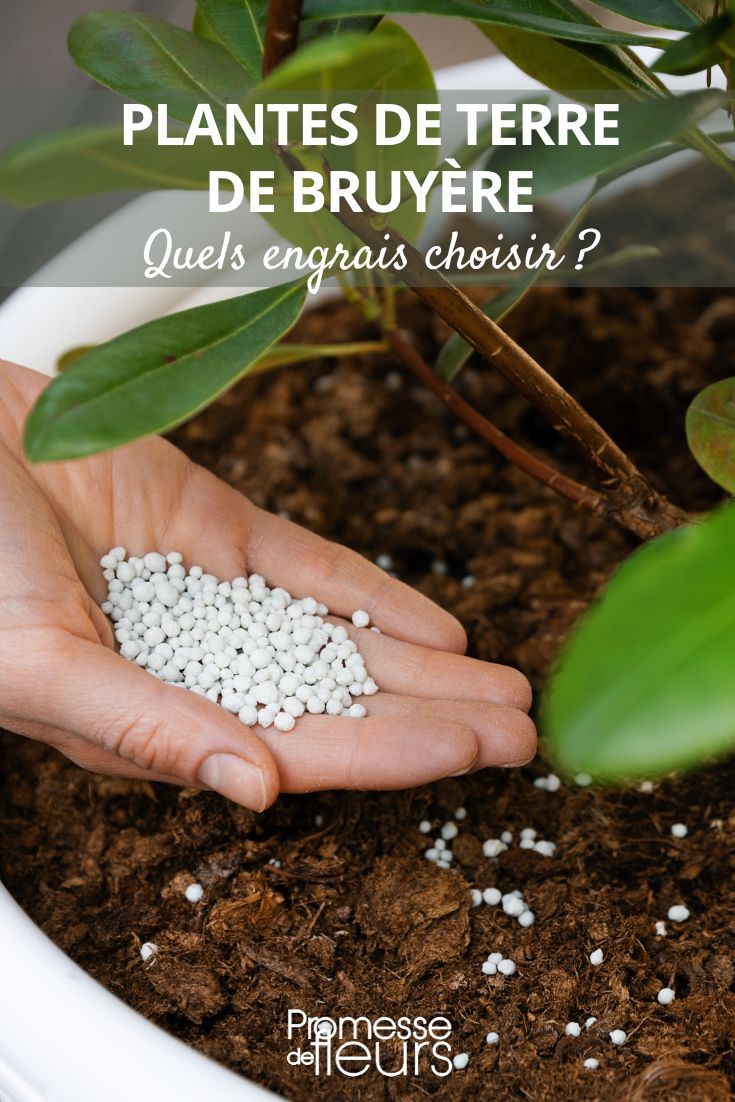
Whether granular or liquid, fertiliser is fairly easy to use. Granules are spread on soil, around the plant base, lightly worked into the soil to incorporate them, then water thoroughly to release the nutrients. Liquid fertilisers are simply added to non-calcareous water for ericaceous plants. Rainwater is perfect.
Fertiliser amounts vary by brand. It is essential to refer to the labels. And remember that when it comes to fertilisers, it’s better to under-dose than over-dose.
- Subscribe!
- Contents
Comments